TL;DR
- A human resources officer hires, develops and looks after employees in a company, in the National Careers Service's words. Prospects describes the role as managing employee relations, using administrative and people skills to hire, develop and look after staff. It is the generalist rung of the HR ladder: above the assistant who processes the paperwork, below the manager who runs the function, and the first call for a line manager with a people question.
- The duties run across the employee lifecycle: recruitment and job descriptions, induction and training, pay and benefits administration, absence and performance issues, grievances and disciplinary procedures, policies and the staff handbook, and advice on employment law. Records, confidentiality and sound judgement sit under all of them.
- Routes in are a degree or HND, a CIPD qualification, an HR apprenticeship at Level 3 or Level 5, or promotion from HR assistant. The job description should say which parts of the lifecycle the officer owns, how many employees and managers they support, whether they run payroll, and the route to HR adviser, specialist or manager.
Every organisation of any size has someone whom managers ring when a new starter needs a contract, an employee has been off sick for three weeks, or a complaint has landed. In many organisations that person is the HR officer. What is a human resources officer? The generalist who covers the whole employee lifecycle for a company or a site, doing the administration and giving the advice, and the rung on the HR ladder from which most HR careers grow.
This article explains the role using two UK primary sources, the graduate careers service Prospects and the National Careers Service, sets out seven duties, where the officer sits between the HR assistant and the HR manager, the skills, hours and routes in, and gives a job description template.
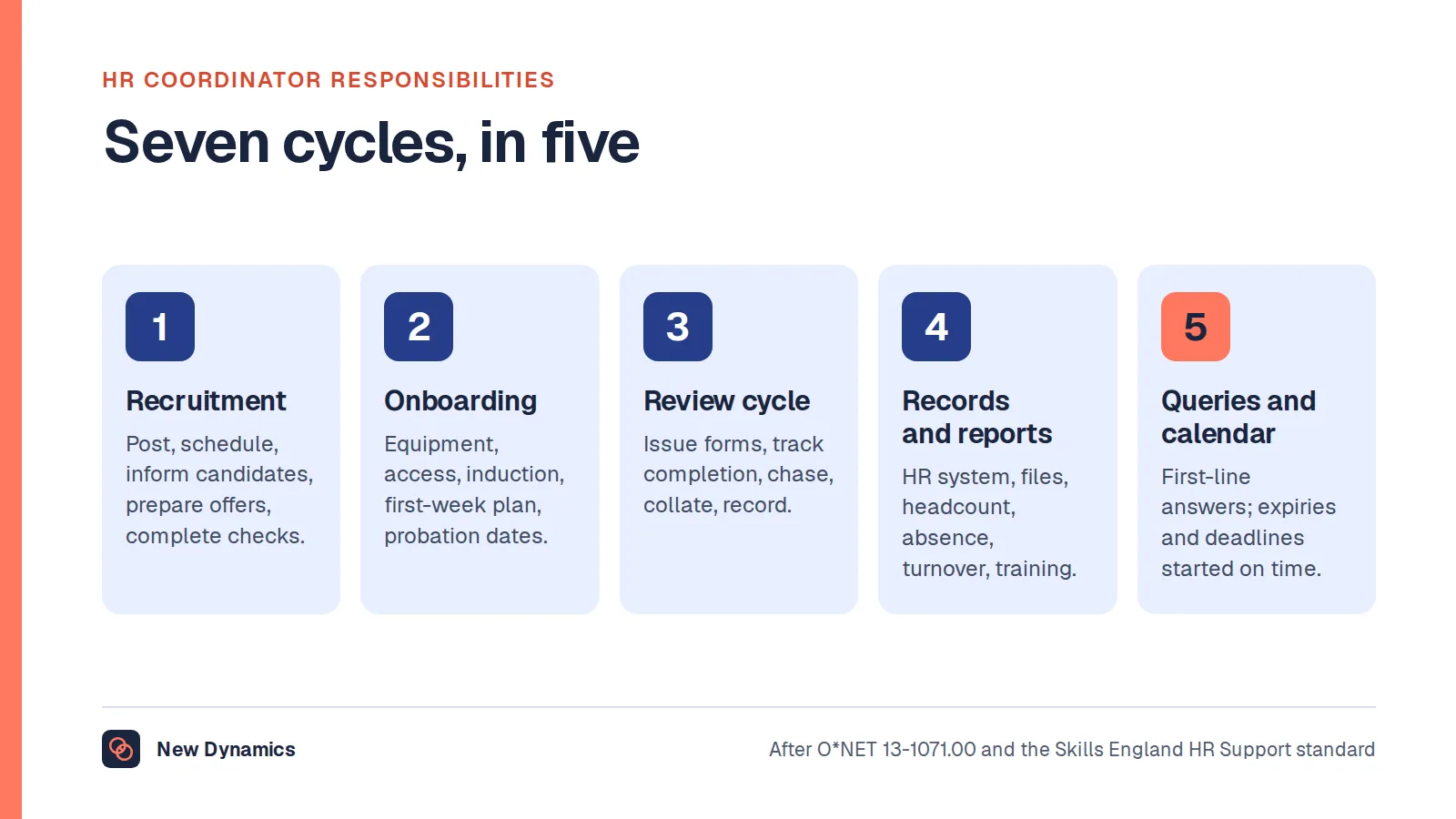
Much of an HR officer's year is the review cycle: chasing forms, tracking completion and answering managers' questions. See how New Dynamics workflows run your own review forms and stages with reminders and a completion view, so the officer advises instead of chasing.
For the capabilities behind the role, our post on HR skills covers which ones can be tested against a published standard.
What is an HR officer?
The National Careers Service puts it in a sentence: “Human resources (HR) officers hire, develop and look after employees in a company.” It gives personnel officer as an older title for the same job. Prospects describes the role as managing employee relations, “using administrative and people skills to hire, develop, and look after company staff”.
Two things define the job. It is generalist: the officer touches recruitment, training, pay, absence, discipline, policy and records rather than specialising in one. And it is advisory as well as administrative: the officer does the paperwork and also tells managers what they can and cannot do. Which of the two dominates depends on the size of the organisation.
Where the officer sits on the HR ladder
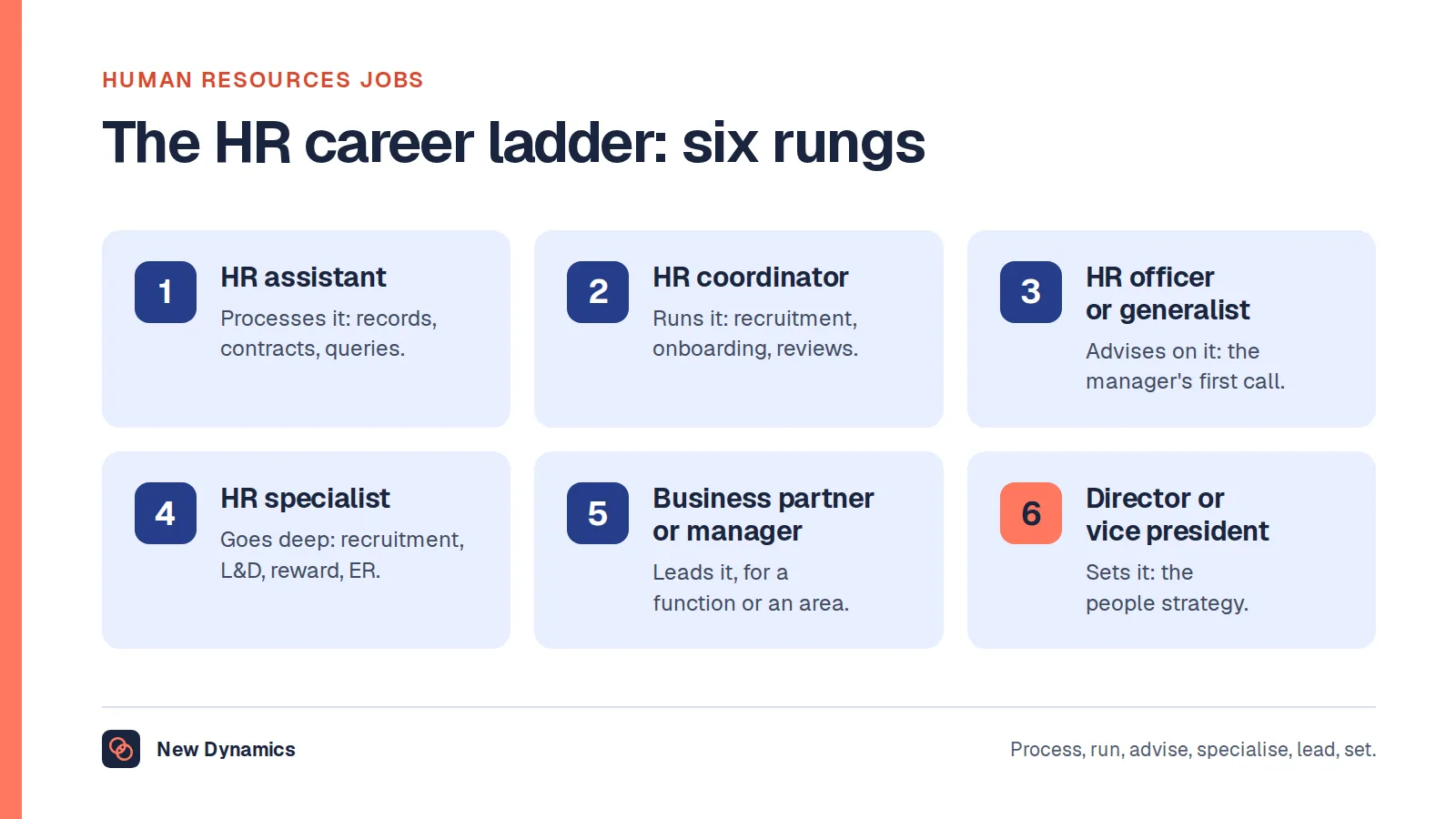
| Rung | Title | What they do with the HR work |
|---|---|---|
| Below | HR assistant, HR administrator | Process it: records, contracts, letters, first queries |
| This role | HR officer, HR adviser, HR generalist | Advise on it: managers' first call across the lifecycle |
| Above | HR business partner, HR manager | Lead it: the function, the strategy, the budget |
In a small organisation the HR officer may be the whole HR function, reporting to a finance director or the managing director. In a larger one they support a site or a division under an HR manager and pass complex cases upwards. The full ladder is in our guide to HR jobs, and the rung above in the HR manager job description.

HR officer duties: seven responsibilities
Grouped from the Prospects responsibilities and the National Careers Service tasks, the work follows the employee lifecycle.
- Recruitment. Prospects: “write and develop job descriptions, person specifications, and job adverts”; “appoint, develop, and retain the right staff”. The National Careers Service: “help to recruit new employees”. The officer drafts the advert, sits on panels, checks the right to work and issues the offer and contract.
- Induction and training. Prospects: “plan and sometimes deliver training, including new staff inductions”; the National Careers Service: “plan staff training and development activities”. The officer runs the first week and keeps the training record.
- Pay and benefits. The National Careers Service: “make sure employees have the right pay and benefits”; Prospects lists administering payroll and maintaining employee records. In many organisations the officer prepares the payroll changes rather than running payroll itself; the job description should say which.
- Absence and performance. The National Careers Service: “deal with work absence and staff performance issues”. Return-to-work meetings, absence triggers, capability processes and support for managers running them.
- Grievances and discipline. Prospects: “deal with staff welfare and administration-centred activities, as well as deal with grievances”; the National Careers Service: “handle complaints and disciplinary procedures”. The officer advises the manager, arranges the hearing, takes the notes and keeps the process fair and on time.
- Policies and the handbook. Prospects: “develop and implement policies on issues such as working conditions, performance management”; “prepare staff handbooks”.
- Employment law advice. Prospects: “interpret and advise on employment law”; the National Careers Service: “advise on pay negotiations, redundancy and employment law”. The officer knows when a case needs a manager, a specialist or a lawyer.
Under all seven sit confidential records, which the National Careers Service lists as a task in its own right, and the judgement to know what to escalate.

Skills employers ask for
Prospects lists business awareness and management skills, strong interpersonal skills, written and spoken communication, IT and numeracy, the ability to analyse and interpret employment data, integrity and cultural awareness for sensitive discussions, negotiating and influencing, and the ability to multitask and prioritise a workload. The National Careers Service asks for administration skills, knowledge of human resources and employment law, thoroughness and attention to detail, the ability to work well with others, excellent written communication, business management skills, and “sensitivity and understanding”.
For the job description, the skills that separate a good officer from a good administrator are:
- Judgement under pressure. Knowing which absence, complaint or request is routine and which needs escalating today.
- Explaining the law to managers in a sentence they can act on.
- Confidentiality as a habit, not a policy.
- Running a fair process on time: hearings arranged, notes taken, letters sent, deadlines met.
- Data discipline: accurate records, because the case file is the organisation's defence.
Hours, environment and employers
The National Careers Service gives 38 to 40 hours a week, typically between 8am and 6pm, in an office, from home or remotely. Prospects describes a standard 37-hour week, Monday to Friday, mainly office-based with occasional travel to other sites, and notes that shift or weekend work is possible in some sectors. Prospects lists employers across private companies, the public sector including the Civil Service, local government, the NHS and the armed forces, charities and consultancies.
Routes in and qualifications
The National Careers Service sets out four routes: university, with a foundation degree, HND or degree ideally in an HR-related subject, leading to a graduate HR training scheme; college, with a qualification such as the CIPD Foundation Certificate in People Practice; an apprenticeship, the HR Support Level 3 Advanced Apprenticeship or the People Professional Level 5 Higher Apprenticeship; or starting work as an HR assistant or business administrator and training on the job.
Prospects says CIPD accreditation is valued but not mandatory, that the CIPD offers qualifications at several levels with the Advanced Diploma leading to Associate membership, and that chartered membership follows with experience. Industrial placements, internships and part-time or voluntary HR work strengthen an application.
Progression. The National Careers Service describes moving to a larger HR department, training to become an HR manager, or specialising in policy or training. Prospects lists specialist routes in talent management, employee relations and learning and development, and progression to HR manager, HR director or independent consultancy.
HR officer job description template
Job title: HR Officer (or HR Adviser, HR Generalist)
Reports to: HR Manager, or in a smaller organisation the Finance Director or Managing Director
Scope: State the number of employees and managers supported, the sites, and whether the role owns payroll, recruitment administration or both.
Purpose: Provide generalist HR administration and advice across the employee lifecycle, so that managers act fairly and lawfully and employees are hired, paid, developed and supported well.
Responsibilities:
- Draft job descriptions, person specifications and adverts; support recruitment from shortlisting to offer and contract; complete pre-employment checks.
- Run inductions; plan and record training and development.
- Prepare pay and benefits changes; maintain accurate, confidential employee records.
- Support managers with absence, performance and capability processes.
- Advise on and administer grievance and disciplinary procedures: hearings, notes, letters, timescales.
- Maintain the staff handbook and HR policies; brief managers on changes.
- Advise managers on employment law and escalate complex cases.
- Run the performance review cycle: launch, reminders, completion and reporting.
Skills and experience:
- Experience in an HR administration or assistant role, or a CIPD qualification or HR apprenticeship.
- Working knowledge of employment law and HR practice.
- Accuracy, confidentiality and attention to detail.
- Clear written and spoken communication; the ability to advise managers.
- Confident with HR systems and spreadsheets.
Working pattern: State the hours and any hybrid arrangement.
Progression: State the route to HR adviser, specialist or HR manager and the support for CIPD study.

Frequently asked questions
What does a human resources officer do?
They hire, develop and look after employees, in the National Careers Service's words: recruitment, induction and training, pay and benefits administration, absence and performance issues, grievances and disciplinary procedures, policies and the handbook, and advice on employment law, with confidential records under all of it.
What is the difference between an HR officer and an HR manager?
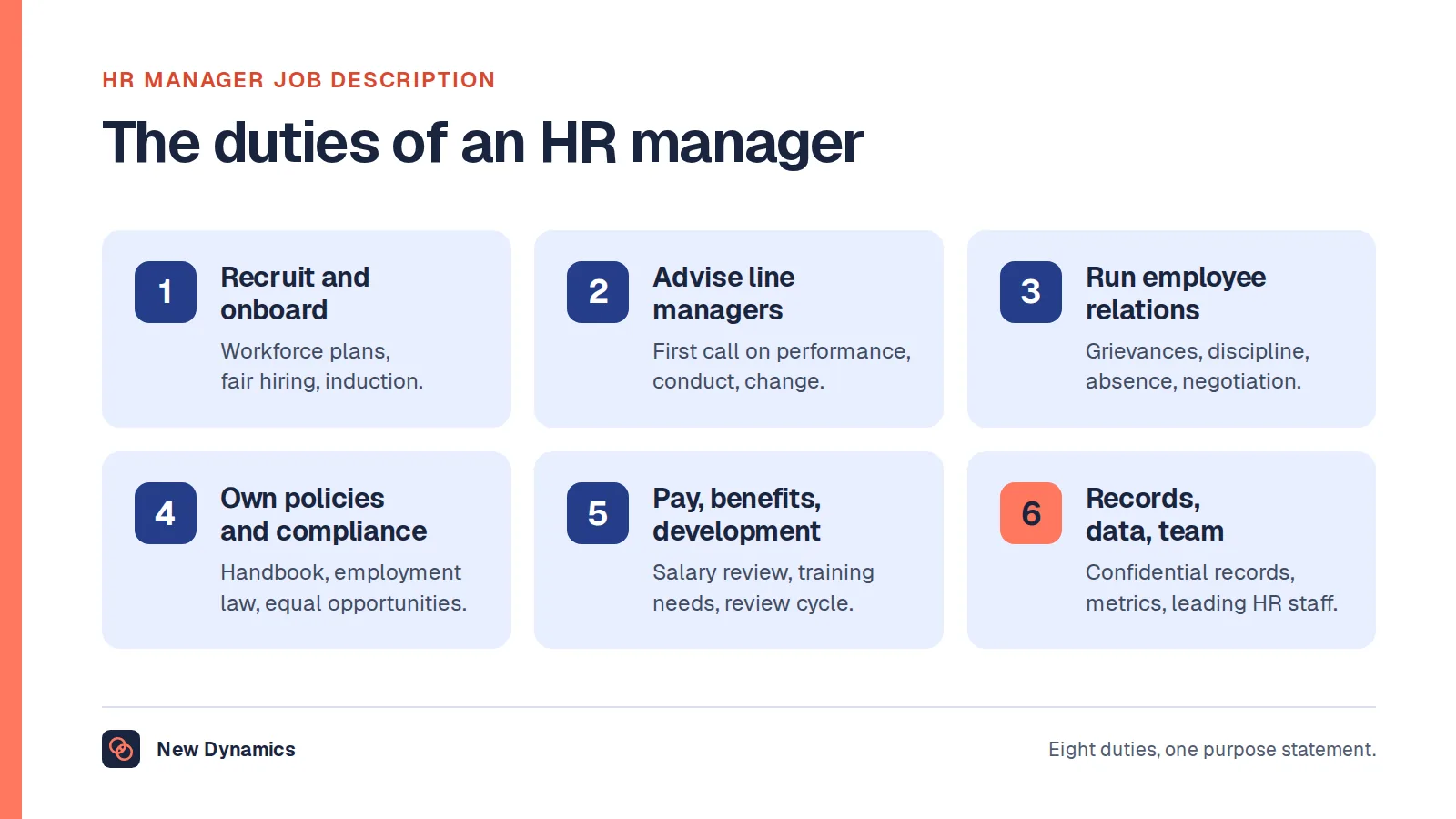
The officer is the generalist who does the administration and gives first-line advice across the lifecycle. The manager leads the HR function, sets policy and strategy, owns the budget and handles the complex cases the officer escalates. In a small organisation the officer may be the whole HR function.
What is the difference between an HR officer and an HR assistant?
The assistant processes the paperwork: records, contracts, letters and first queries. The officer advises managers as well as administering, and takes decisions within policy. Many officers began as assistants.
What qualifications do you need to be an HR officer?
The National Careers Service lists a degree, foundation degree or HND, a CIPD qualification such as the Foundation Certificate in People Practice, an HR apprenticeship at Level 3 or Level 5, or progression from an HR assistant role. Prospects says CIPD accreditation is valued but not mandatory.
Is an HR officer the same as a personnel officer?
Yes. Personnel officer is the older title for the same job, which the National Careers Service lists as an alternative name.
Your next step: say which lifecycle the officer owns
- State the number of employees and managers supported and whether the role owns payroll.
- List the seven duties in your own words and mark which are advisory and which administrative.
- Name the reporting line and the escalation route for complex cases.
- Describe the route to adviser, specialist or manager and the support for study.
For the practice the role is built on, read and download our human resources management guide. The guide is free to read, and the PDF uses our short download form.
Want the review cycle the officer runs to complete itself, with reminders and a completion view instead of a spreadsheet? Book a New Dynamics demo and bring your current forms. You can also email contact@new-dynamics.com.