TL;DR
- An HR manager leads the human resources function for an organisation or site: recruitment, employee relations, policies, pay and benefits, learning, records and the advice that line managers rely on.
- A job specification has two halves. The job description sets out the purpose and eight duties. The person specification lists the essential and desirable knowledge, skills, experience and qualifications, and how each will be assessed.
- Write both from the job rather than the last post-holder, keep essentials to what the role cannot be done without, and say how each criterion is tested, so that selection is fair and defensible.
The people who write every other job specification in the organisation rarely get a good one themselves. An HR manager job description is often either a list of everything the function does, or three lines and a salary. Neither helps a candidate decide, and neither helps a panel choose.
This article gives the job specification of a human resource manager in its two parts: a job description with the role's purpose and eight duties, and a person specification with essential and desirable criteria and how each is assessed. It adds the qualifications and routes into the role in the UK, a template to adapt and the mistakes that weaken HR adverts.
The HR manager usually owns the review cycle. See how New Dynamics performance reviews bring goals, feedback and development into one fair discussion.
Job description and person specification: what each does
A job description describes the job: its purpose, where it sits, what it is responsible for and what it must deliver. A person specification describes the person who could do it: the knowledge, skills, experience, qualifications and behaviours needed, split into essential and desirable, with the method used to assess each. Together they are often called the job specification.
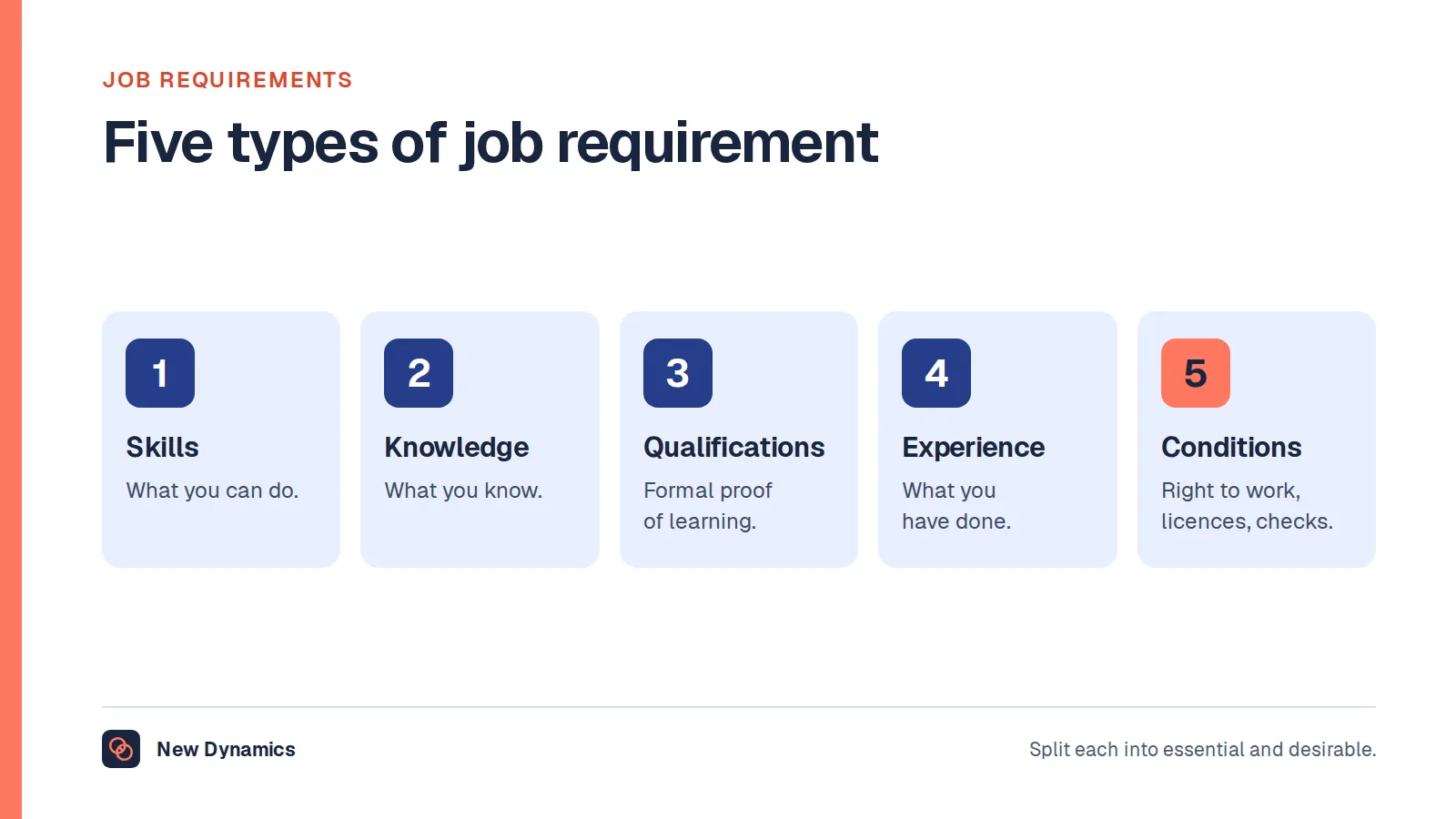
The split matters for fairness. Candidates are shortlisted against the person specification, not against a manager's picture of the ideal applicant. Prospects, the UK graduate careers service, lists writing “job descriptions, person specifications, and job adverts” among the tasks of an HR professional in its human resources officer profile, which is a reminder that the HR manager will be judged partly on how well they write these for everyone else. Our guide to job requirements covers the essential and desirable split in more depth.
What an HR manager does
The UK National Careers Service describes the HR officer role, one rung below manager, in one line: HR officers “hire, develop and look after employees in a company”. Its human resources officer profile lists the day-to-day tasks: helping to recruit new employees, planning training and development, making sure employees have the right pay and benefits, arranging support services, handling complaints and disciplinary procedures, dealing with absence and performance issues, advising on pay negotiations, redundancy and employment law, developing HR policies and maintaining confidential records.
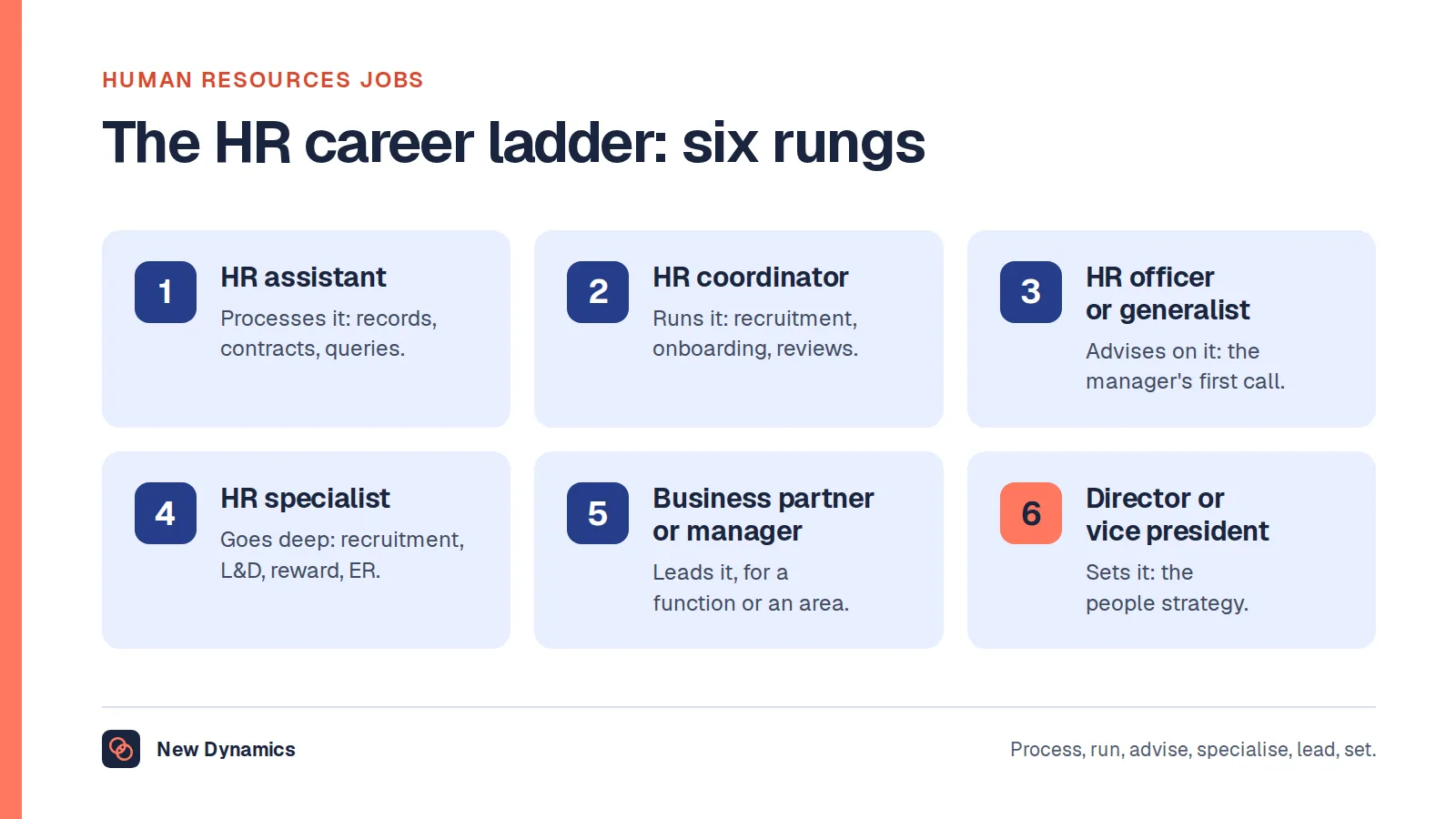
The HR manager does the same work at a higher level and adds leadership. In a small or medium organisation, the HR manager leads the whole function: the team, the budget, the policies and the relationship with the leadership team. In a larger one, an HR manager may lead HR for a site, a region or a business area. Our guide to HR jobs and the career ladder places the role among the others.
HR manager duties: eight responsibilities
- Recruit and onboard. Plan workforce needs with managers, run fair recruitment from job specification to offer, and make sure new starters are inducted. Prospects lists appointing, developing and retaining the right staff and ensuring prospective employees have the right to work.
- Advise line managers. Be the first call on people questions. Prospects lists advising line managers on how to implement policies and procedures and liaising with managers on staff performance, organisational structure and health and safety.
- Run employee relations. Handle grievances, disciplinary cases, absence and performance issues, and, where there is a recognised union, negotiate with staff representatives on pay, conditions, contracts and redundancy. Our guide to employee relations covers the ground.
- Own policies and compliance. Develop and implement policies on working conditions, performance management, equal opportunities, disciplinary procedures and absence, interpret employment law and keep the handbook current.
- Manage pay and benefits. Advise on pay and benefits, run salary reviews and, when needed, redundancy programmes, within budget.
- Develop people. Analyse training needs with department managers, plan and sometimes deliver training and inductions, and run the performance and development cycle.
- Keep records and data. Maintain confidential employee records, administer or oversee payroll inputs, and report the people metrics leaders need: headcount, turnover, absence, time to hire.
- Lead the HR team and the agenda. Manage HR officers, advisers and assistants, set priorities, and, as Prospects puts it, understand the employer's business objectives and “devise and implement policies that support them”.

HR manager person specification
The table below is a person specification for a generalist HR manager in a small or medium organisation. Adjust the essentials to your context; every criterion you mark essential is one that will exclude candidates, so keep the list to what the job cannot be done without.
| Criterion | Essential or desirable | Assessed by |
|---|---|---|
| Working knowledge of UK employment law and its application | Essential | Application, interview |
| Experience of handling grievance, disciplinary and absence cases to conclusion | Essential | Application, interview |
| Experience of running recruitment from specification to offer | Essential | Application |
| Experience of managing or supervising HR staff | Essential | Application, interview |
| Ability to advise and influence managers at all levels | Essential | Interview, exercise |
| Clear written communication: policies, letters, reports | Essential | Written exercise |
| Discretion with confidential and sensitive information | Essential | Interview, references |
| Analysis of people data and presentation of findings | Essential | Exercise |
| CIPD qualification at level 5 or above, or equivalent experience | Desirable | Application |
| Experience of pay and benefits review | Desirable | Application, interview |
| Experience of working with a recognised trade union | Desirable | Application |
| Experience of an HR information system and payroll interface | Desirable | Application |
Prospects lists the skills behind these criteria: business awareness and management skills, written and verbal communication with IT and numeracy, analytical skills for interpreting employment-related data, integrity and approachability so that people can raise sensitive issues, curiosity and a willingness to challenge organisational culture, teamworking, influencing and negotiating, and the ability to juggle multiple tasks. The NCS adds administration skills, knowledge of HR and employment law, attention to detail, sensitivity and understanding and business management skills.

Qualifications and routes into the role
Degree. The NCS says you could do a foundation degree, HND or degree in any subject and then apply for a graduate HR training scheme, with an advantage for HR-related subjects such as human resources management, business management and HR, or psychology. A postgraduate qualification in human resource management is possible but not essential.
CIPD. The NCS points to the Chartered Institute of Personnel and Development for professional qualifications at each level, from the Foundation Certificate in People Practice upwards, and to its Profession Map for the values, knowledge and behaviours the profession expects. Many HR manager adverts ask for CIPD level 5 or 7, or equivalent experience.
Apprenticeships. The NCS lists the HR support level 3 apprenticeship and the people professional level 5 higher apprenticeship. Skills England's apprenticeship listing carries the current standards.
Experience. Most HR managers have come up through HR assistant, officer or adviser roles. Prospects says competition for jobs is strong and that experience in HR teams, placements, internships and general administrative work all help.
Requirements differ in other countries, and employment law does too. Check the rules where you work.
HR manager job description template
Adapt the template to your organisation. Keep every line true.
Job title: HR manager
Reports to: Managing director or head of operations
Direct reports: HR officer and HR assistant
Location and hours: [Site], with [hybrid working]; [37.5] hours a week
Purpose of the role: To lead the HR function so that the organisation recruits, develops, pays and treats its people fairly and lawfully, and so that managers get sound, timely advice.
Main duties:
- Plan and run recruitment and onboarding with hiring managers
- Advise managers on performance, conduct, absence and change
- Handle grievance, disciplinary and absence cases, and support formal hearings
- Maintain and develop HR policies and the employee handbook in line with employment law
- Run the annual pay review and benefits administration within budget
- Lead the performance and development cycle, and coordinate training
- Keep accurate, confidential records and report monthly people metrics
- Manage and develop the HR team
Person specification: see the essential and desirable criteria above, with the assessment method for each.
We provide: Support for CIPD study, a seat at the leadership team meeting, [hybrid working] and a clear route to head of people.
Say what size the organisation is, how many people the function supports and whether there is a recognised union. Those three facts change the job more than the title does. Our job description template explains the structure, and our guide to strategic human resource management covers the planning side of the role.

Common mistakes in HR manager job specifications
Everything the function does. A list of forty tasks reads as a job for three people. Eight duties and a purpose statement are enough.
Essentials that are really preferences. A CIPD level 7 and ten years' experience for a first HR manager post excludes good candidates and invites indirect discrimination.
No assessment method. A person specification without a column for how each criterion is tested leaves the panel to improvise, and the shortlist to bias.
Silence on the hard parts. Restructures, redundancies and difficult cases are part of the job. Say so.
Copied from the last post-holder. Write from what the organisation needs now, not from the CV of the person who is leaving.
Frequently asked questions
What is the job specification of a human resource manager?
It is the job description and person specification together. The job description states the purpose of the role and its duties: recruitment, advice to managers, employee relations, policies and compliance, pay and benefits, development, records and leading the HR team. The person specification lists the essential and desirable knowledge, skills, experience and qualifications and how each is assessed.
What are the duties of an HR manager?
Eight core duties: recruit and onboard, advise line managers, run employee relations, own policies and compliance, manage pay and benefits, develop people, keep records and data, and lead the HR team and agenda. In a small organisation the HR manager does much of this personally; in a larger one they lead others who do.
What is the difference between a job description and a person specification?
The job description describes the job: purpose, duties and reporting line. The person specification describes the person needed: the criteria a candidate must or should meet, split into essential and desirable, with the assessment method for each. Shortlisting uses the person specification.
What qualifications does an HR manager need?
In the UK there is no legal requirement. Most HR managers hold a CIPD qualification at level 5 or 7 or equivalent experience, and have come up through HR officer or adviser roles. Degrees in any subject, HR apprenticeships at levels 3 and 5 and graduate schemes are the usual entry routes.
What skills does an HR manager need?
Working knowledge of employment law, experience of handling cases, the ability to advise and influence managers, clear writing, discretion, analysis of people data and leadership of a small team. Prospects adds business awareness, negotiating skills and the curiosity to challenge organisational culture where necessary.
How long should an HR manager job description be?
One to two pages: a purpose statement, six to eight duties, the reporting line and team, and a person specification table with assessment methods. Anything longer is usually a list of tasks rather than a description of a job.
Your next step
- Write the purpose statement in one sentence and test it against each duty.
- Draft the person specification, then challenge every essential: could the job be done without it?
- Add an assessment method to each criterion before the advert goes out.
- Decide what a good first year looks like, and write it down as objectives.
For the policies the new HR manager will inherit, read and download our employee handbook guide. The guide is free to read, and the PDF uses our short download form.
Want the review cycle, goals and feedback that the HR manager will run in one place? Book a New Dynamics demo and bring your current job specification. You can also email contact@new-dynamics.com.