TL;DR
- An interior designer plans the inside of buildings so that they work for the people who use them. The job runs from the client's brief, through drawings and sourcing, to coordinating trades on site.
- The scope covers six stages: brief, survey and feasibility, concept, detailed design, sourcing and costs, and site coordination and handover. It is wider than decoration and narrower than architecture.
- The main skills are technical design including CAD, drawing and spatial awareness, communication, project management, and knowledge of regulations and business. In Great Britain, interior designers have safety duties as designers under CDM 2015.
Television has taught us that an interior designer chooses cushions and paint, and reveals the result to a tearful homeowner. The real job has far more spreadsheets, site visits and building regulations in it, and the cushions come last.
This article answers the question what does an interior designer do. It sets out the job scope in six project stages, separates the role from the decorator and the architect, lists the skills that matter, explains a UK safety duty that surprises many designers and gives a job description template for employers.
A new designer has software, suppliers, standards and clients to learn. See how New Dynamics onboarding brings tasks, early goals and manager conversations into a clear path for a new starter.
What is an interior designer?
The Cambridge Dictionary defines an interior designer as “a person who plans the decoration of the inside of a building such as a house or office”.
The professional picture is wider. Prospects, the UK graduate careers service, describes the work in its interior and spatial designer job profile: “Interior and spatial designers use their creative skills and technical knowledge to design internal spaces”. They often manage a project “from conception through to completion”, which includes “creating the initial designs, sourcing the necessary products and materials, and coordinating the various trades needed to complete the work”.
The purpose matters as much as the look. Prospects says that a designer needs to understand the intended purpose of the space and how it will affect the people using it, “taking into account factors such as efficiency, functionality, safety, accessibility, wellbeing, sustainability and visual appeal”.
Designers specialise. Prospects lists areas that include residential, workplace, retail, hospitality, healthcare, education, public spaces, transport, and even marine and aeronautical interiors.
The job scope of an interior designer: six stages
These six stages group the responsibilities that Prospects lists.
- The brief. Discuss the project in detail with the client, taking into account the client's needs and the needs of the people who will use the space.
- Survey and feasibility. Take part in site surveys, conduct feasibility studies, and gather information and photographs.
- Concept. Develop initial ideas and present them to the client as sample or mood boards. Agree the final brief.
- Detailed design. Prepare 2D or 3D plans, drawings and models of the layout, which Prospects calls spatial planning, together with the design scheme.
- Sourcing and costs. Set timelines, work to the budget, negotiate fees and source fittings, furniture, lighting and finishes, with samples for the client. On larger projects this means working with quantity surveyors, architects and structural engineers.
- Site coordination and handover. Coordinate the trades on site, act as the point of contact for contractors, keep the client informed, solve problems that threaten the schedule and “carry out a walk-through with the client on completion of the project, noting any outstanding issues”.
Around the projects sits the business: finding new clients, selling services and keeping up with products, standards and regulations. Prospects notes that many designers work freelance or are self-employed, usually after gaining substantial experience.

Interior designer, interior decorator and architect
- Interior decorator. Works on the surface of a finished space: colour, furniture, fabrics and styling. No structural or technical design.
- Interior designer. Plans how the interior works as well as how it looks: layout, lighting, joinery, materials and fittings, with technical drawings, and coordinates the people who build it.
- Architect. Designs the building itself, including structure and exterior. The interior designer often works beside one on larger projects.
The boundaries overlap, and titles are used loosely. In a job advert, describe the work and not only the title. Prospects treats interior designer and spatial designer as one profile, and interior architect is another common label.

Five skills of a good interior designer
Prospects gives a long list of skills. They fall into five groups.
- Technical design. Prospects asks for “a high level of technical knowledge, including CAD and model-making skills”. It mentions software such as AutoCAD, SketchUp, Photoshop and InDesign, and advises job seekers to check which packages employers use.
- Drawing and spatial awareness. Good drawing skills, including perspective drawing, with creativity and imagination.
- Communication. Strong written, verbal and presentation skills “to write briefs, promote and explain ideas, and build relationships with clients”, plus negotiation.
- Project management. Organising time, working under pressure and to deadlines, attention to detail and working in a team with other professionals.
- Regulations and business. An awareness of building and safety regulations, knowledge of the wider construction industry, and business, finance and marketing skills.
Qualifications. Prospects says that you will usually need a relevant degree, foundation degree or HND, in a subject such as interior design, interior architecture or spatial design, and that entry without one “is possible if you have significant experience and creative flair”. Selection is often based on a portfolio. UK professional bodies include the British Institute of Interior Design (BIID), the Society of British & International Interior Design (SBID) and the Chartered Society of Designers.
A UK safety duty that designers often miss
In Great Britain, the Construction (Design and Management) Regulations 2015 give legal duties to anyone who designs for construction work. The Health and Safety Executive's page on designers' roles and responsibilities names the profession directly: “Designers can be architects, consulting engineers, quantity surveyors and interior designers, or anyone who specifies and alters designs as part of their work.”
HSE explains why: “A designer's decisions can affect the health and safety of all those involved in constructing a building, those who use it as a workplace, and those who maintain, refurbish and eventually demolish it.” Among other things, designers must make sure that the client is aware of the client's own duties before design work starts, and must eliminate foreseeable health and safety risks where possible, or take steps to reduce or control them.
For an employer, this belongs in the job description and in training. This is general information, not legal advice, and other countries have their own rules.
Interior designer job description template
Adapt the wording to your practice. Replace the text in square brackets.
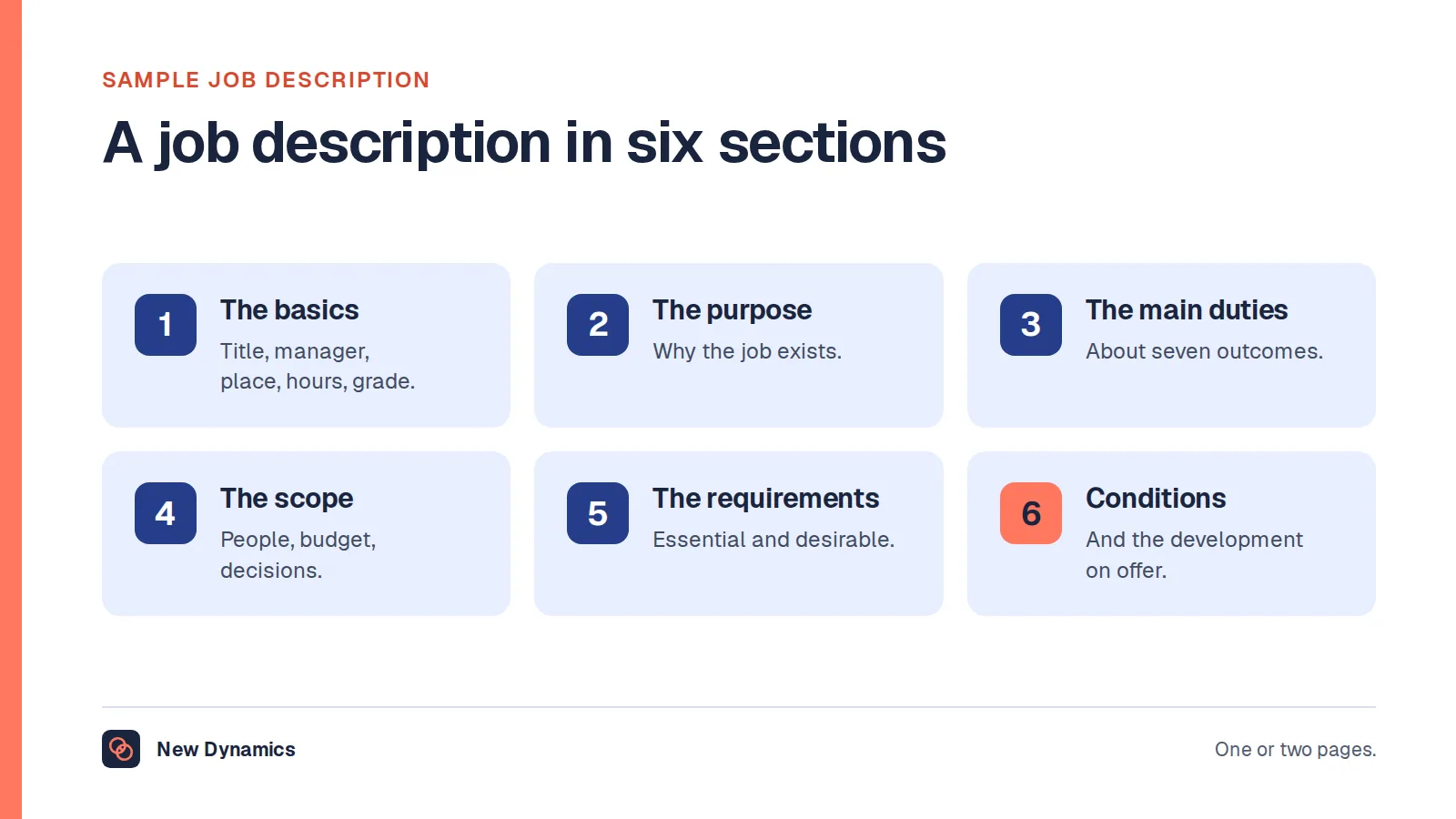
Job title: Interior designer [junior, midweight or senior]
Reports to: [Design director or studio lead]
Location and hours: [Studio, with site visits in the region]. [Hours]. Some evening and weekend work around project deadlines.
Purpose of the job: To design interiors that meet the client's brief, budget and programme, and to see them through from concept to handover.
Main duties
- Take and develop client briefs, and carry out site surveys.
- Produce concepts, mood boards and presentations, and present them to clients.
- Prepare space plans, detailed drawings and specifications in [software].
- Source and specify furniture, fittings, lighting and finishes within budget, and manage samples and orders.
- Work with architects, engineers, quantity surveyors and contractors, and coordinate trades on site.
- Keep projects to programme and budget, and keep the client informed.
- Comply with building, fire, accessibility and health and safety regulations, including designers' duties under CDM 2015.
- Carry out snagging and the final walk-through, and contribute to the studio's portfolio and new business.
Essential requirements
- A degree or equivalent experience in interior design, interior architecture or spatial design.
- A portfolio that shows [sector] projects from concept to completion.
- Fluent use of [CAD and visualisation software].
- Clear communication with clients, suppliers and site teams.
- [Number] years' experience, for midweight and senior roles.
Desirable
- Membership of, or progress towards, a professional body such as the BIID or SBID.
- A driving licence, for site visits.
- Experience of [specialism].
Conditions: [Pay range], [holiday], [benefits].
For the general format, see our sample job description, and for help with separating essential from desirable, our guide to job requirements.
Common mistakes in hiring an interior designer
Advertising for a designer when you need a decorator, or the reverse. Decide whether the role includes technical drawings and site coordination.
Judging the portfolio by looks alone. Ask what the brief and budget were, what went wrong and what the candidate personally did.
Ignoring the software. A designer who must retrain on your CAD system is slower for months.
Leaving out regulations. Safety and accessibility are part of the job, not an optional extra.
Hiding the hours. Deadlines and site visits mean some evenings and travel. Say so.
No route to grow. Prospects notes that designers typically spend five to ten years building skills before moving into a senior role. Show candidates what that path looks like in your studio.
Frequently asked questions
What does an interior designer do?
An interior designer plans the inside of buildings so that they work well and look good. The job runs from taking the client's brief, through surveys, concepts, detailed drawings and sourcing, to coordinating trades on site and handing over the finished space.
What is the job scope of an interior designer?
The scope covers six stages: the brief, survey and feasibility, concept design, detailed design and drawings, sourcing and cost control, and site coordination and handover. Many designers also find clients, negotiate fees and run their own business.
What is the difference between an interior designer and an interior decorator?
A decorator works on the surface of a finished space: colour, furniture and styling. An interior designer also plans how the space works, with layouts, lighting, materials and technical drawings, and coordinates the people who build it.
What skills does an interior designer need?
The main skills are technical design including CAD, drawing and spatial awareness, communication and presentation, project management, and knowledge of building and safety regulations, with some business and marketing ability.
Do you need a degree to be an interior designer?
Usually. Prospects says that a relevant degree, foundation degree or HND is normally needed, in a subject such as interior design, interior architecture or spatial design. Entry without one is possible with significant experience and creative flair, and a strong portfolio is essential.
Where do interior designers work?
Prospects says that they usually work for architects or design consultancies, or for commercial organisations with in-house design departments. Many work freelance or are self-employed. Clients may include commercial and construction companies, hotel and leisure companies, local government bodies, retailers, and theatre, TV and film companies.
Your next step
If you are hiring, decide which of the six stages the post holder will own, copy the template and name your software. If you are considering the career, build a portfolio that shows a brief, a budget and a finished result, not only pictures.
For the whole hiring process, from the job description to the offer, read and download our recruitment and selection guide. The guide is free to read, and the PDF uses our short download form.
Want every new starter to have clear tasks and goals from the first day? Book a New Dynamics demo and bring your current approach. You can also email contact@new-dynamics.com.