TL;DR
- Interviewing someone who already works for you is harder than interviewing a stranger. You have years of information, most of it unstructured; you have a relationship to protect; and the person will still be in the building whatever you decide.
- Fairness is the constraint that makes the rest work. Acas is clear that where an organisation has a recruitment policy, “you must apply it in the same way to everyone”, that questions “must not discriminate”, that you should “ask each applicant the same questions where possible”, and that decisions should rest on “how each applicant met each point in the job description and person specification”.
- Two things make or break an internal process: using what you already know as evidence for specific criteria rather than as a general impression, and handling an unsuccessful internal candidate properly, a real conversation, specific feedback, and something concrete to work on.
An internal interview looks like the easy one. Everyone knows everyone, half the assessment is already done, and the paperwork is shorter. In practice it is the hardest interview a manager runs, because the two things that make it feel easy (the existing knowledge and the existing relationship) are exactly what make it go wrong.
This article covers interview questions for an internal position: fifteen questions written for a candidate you already know, how to use what you know without contaminating the decision, how to run it fairly beside external candidates, and what to do afterwards. It is general information about hiring, not legal advice.
An internal candidate arrives with a review history, which is useful evidence and a tempting shortcut. See how New Dynamics performance reviews let you run the review cycle on your own form, with completion visible instead of chased.
Why it is harder

- You know too much, unstructured. Years of impressions, most of them formed from a different job than the one being filled.
- Everyone has already decided. The team has an expectation, often loudly. A process that overturns it needs to be visibly fair, and a process that confirms it needs to be genuinely fair.
- There is no clean ending. An external candidate who is unsuccessful goes away. An internal one comes to the same meeting on Monday.
What you already know, and how to use it
The evidence is real and you should use it. The discipline is to attach it to criteria rather than to a general sense of the person.
- Convert impressions into evidence. "Good with customers" is an impression. "Handled the three complaints in March and each one closed without escalation" is evidence for a criterion.
- Separate the current job from the new one. Most internal disappointments come from promoting the best performer in the old role into a job needing different things. Evidence from the current role counts only where the criterion overlaps.
- Write down what you know before the interview, against the person specification, so you can see what is evidenced and what is assumption. Our job specification post covers writing criteria that can be assessed.
- Do not let knowledge replace the question. If a criterion matters, ask about it even if you think you know the answer. Sometimes you are wrong, and always the candidate deserves the chance to show it.
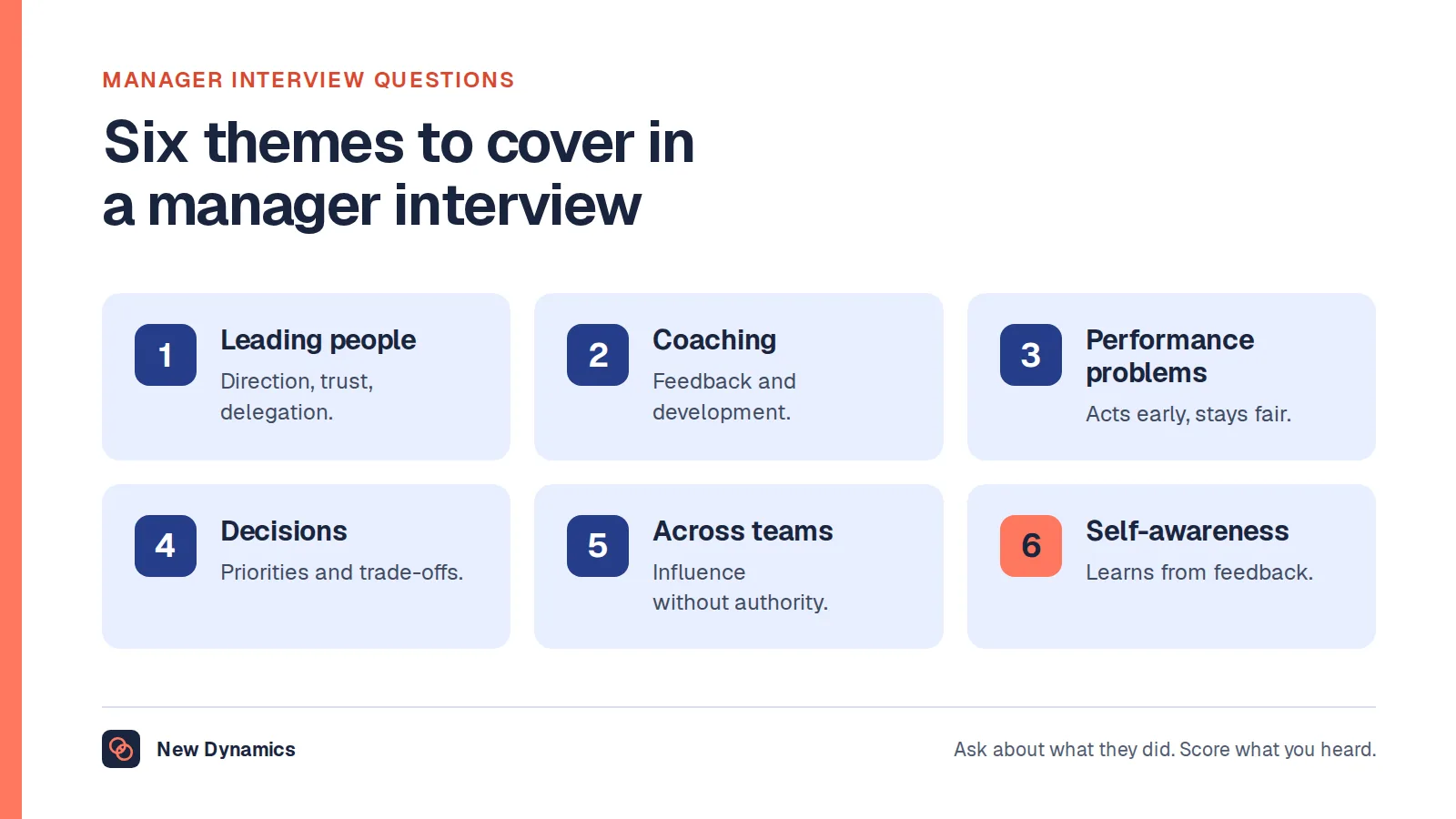
Fifteen questions for an internal candidate

These are ours; use or adapt them freely.
The change
- "What is different about this job compared with the one you do now?" Listen for: a real understanding of the step, not a bigger version of today.
- "What will you have to stop doing?" The most revealing question in the set.
- "Which part of this role are you least prepared for?" Listen for: honesty and a plan, rather than a disguised strength.
- "What would you do in the first month that you cannot do now?"
The evidence
- "Tell me about something you have done that is closest to the hardest part of this job."
- "What have you changed in your current role that outlasted you doing it?"
- "Where have you worked outside your own team, and what did you learn about how the rest of the organisation works?"
- "What have you learned in the last year, and how?"
The relationships
- "Some of the people you would manage are your peers today. How will you handle the first time you have to say no to one of them?"
- "What will your current manager have to do differently if you get this?"
- "How would you handle a colleague who applied for this job and did not get it?" Ask this of every internal candidate, including the one you expect to appoint.
- "Who outside your team would you need on side, and how would you approach them?"
The gap, and the aftermath
- "What do you think we are worried about, and what would you say to it?" A better question than "what are your weaknesses", and internal candidates usually know the answer.
- "If you are not appointed, what would you want from us?" Listen for: something specific and developmental, which tells you how they will take the news.
- "What would make you leave in the next year?" Uncomfortable, honest, and better asked now than at an exit interview.
Questions to avoid
- "Why should we give this to you rather than an external candidate?" It frames the process as a favour.
- Anything that trades on the relationship ("you know how we work here, so…") which invites an answer nobody can score.
- Questions about their future family plans, health, age or anything else unrelated to the job. Acas lists the protected characteristics as age, disability, gender reassignment, marriage and civil partnership, pregnancy and maternity, race, religion or belief, sex and sexual orientation, and the rules apply exactly as they do to external candidates.
- "How would you feel if a colleague got the job?" asked only of some candidates. Ask everyone or nobody.
Running it fairly alongside external candidates
Acas's guidance on advertising a job notes that a recruitment policy "might say whether you have to advertise a job, where you should advertise, who you must advertise to – for example, internal or external applicants", and is unambiguous about consistency: "if you have a recruitment policy, you must apply it in the same way to everyone."
Its guidance on following discrimination law adds that in recruitment, discrimination can happen through "the arrangements you make for deciding who to offer the job", "the terms under which you offer the job" and "not offering someone the job", so an internal shortcut is exactly the kind of arrangement that needs to be defensible.
In practice:
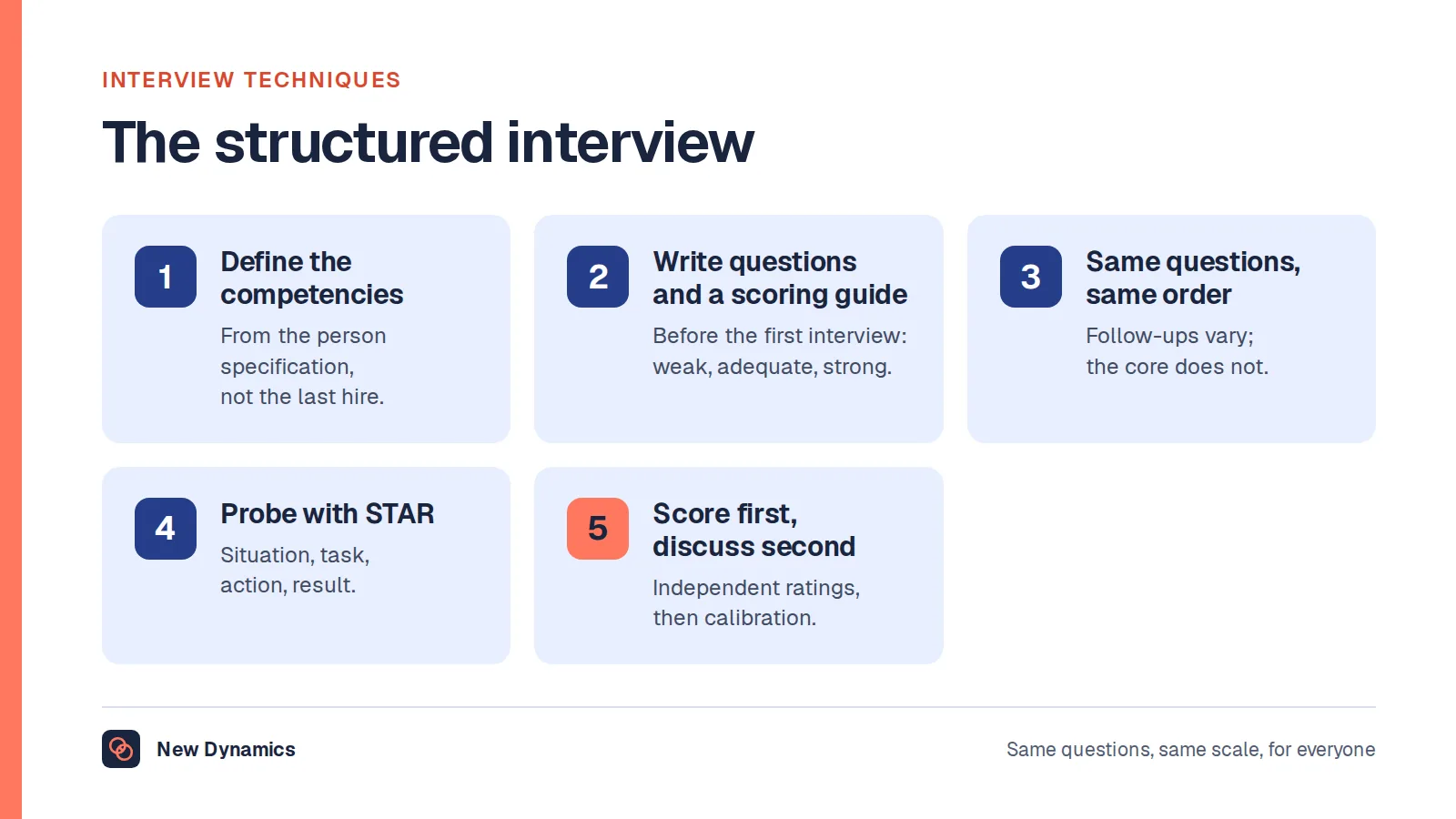
- Same questions, same order, for internal and external candidates alike. Acas advises asking "each applicant the same questions where possible. This is to ensure you're treating applicants in the same way."
- More than one interviewer where possible, "to reduce the risk of discriminating".
- Ask everyone about reasonable adjustments, which is a legal requirement for anyone attending an interview and applies to a colleague as much as to a stranger.
- Score against the person specification, and be able to show the scoring afterwards, because you may need to explain it to someone you see every day.
- Say what weight, if any, prior performance evidence carries, and apply it consistently.
The Monday afterwards

Whatever you decide, this part determines whether the process cost you a colleague.
- Tell them first, in person. Before the announcement, before the successful candidate is congratulated in a meeting they are sitting in.
- Give specific feedback against the criteria. Not "it was very close", which criterion, what evidence was missing, and what would change it.
- Offer something concrete. A piece of work that builds the missing evidence, a secondment, a project, a named person to learn from. Acas advises telling candidates at the end of an interview what sort of feedback to expect; for an internal candidate, that promise has to be met properly.
- Follow up in a month. The conversation on the day is not the one that matters; the one four weeks later is.
Our career development guide covers turning that into a path rather than a consolation.
If you are the internal candidate
- Prepare as if they know nothing. Familiarity is not evidence, and an interviewer scoring properly cannot credit what you did not say.
- Talk about the new job, not a longer version of your current one.
- Bring specifics: what you did, what changed, what you would do differently.
- Ask what the gap is, and ask it in the interview rather than afterwards.
- Decide in advance how you will respond if the answer is no, because that reaction is remembered longer than the interview.
Frequently asked questions
What questions are asked in an internal interview?
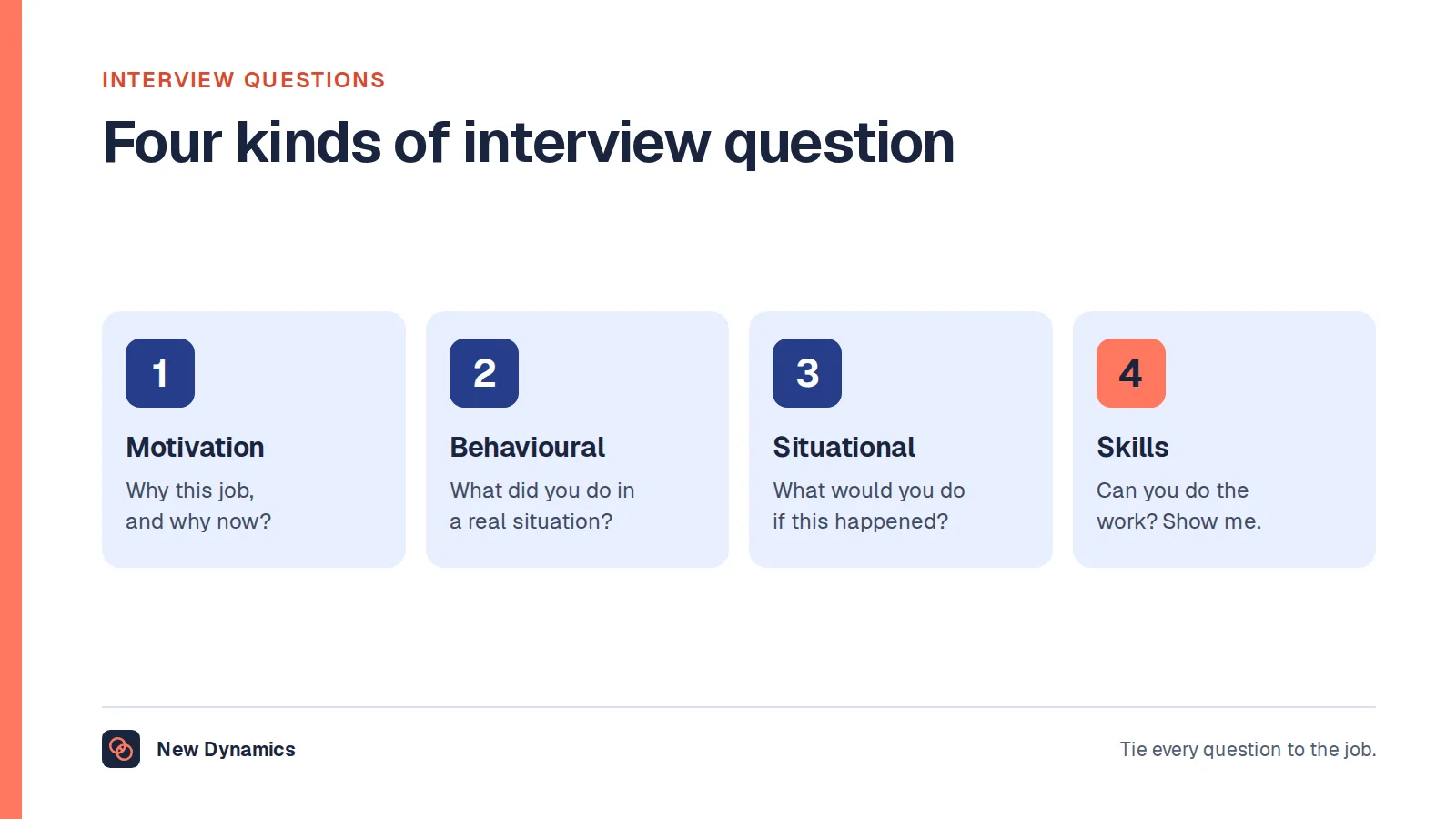
The same core questions as any interview, plus ones that only make sense internally: what is different about this job compared with your current one, what you would have to stop doing, which part you are least prepared for, how you would handle managing people who are peers today, what you think our concerns are, and what you would want from us if you were not appointed.
How should an internal candidate prepare?
Prepare as though the panel knows nothing about you. Familiarity is not evidence, and an interviewer scoring against criteria can only credit what you actually said. Bring specific examples with outcomes, talk about the new role rather than your current one, and ask directly what the gap is.
Should internal candidates be interviewed the same way as external ones?
Yes. Acas states that where an organisation has a recruitment policy, it "must apply it in the same way to everyone", and advises asking each applicant the same questions where possible so that applicants are treated in the same way. Discrimination in recruitment can arise from the arrangements made for deciding who to offer the job, so shortcuts for internal candidates need to be defensible.
Can you use what you already know about an internal candidate?
Yes, if you use it as evidence against specific criteria rather than as a general impression, apply the same approach to every internal candidate, and still ask the question. Evidence from the current role only counts where the criterion genuinely overlaps with the new job.
How do you tell an internal candidate they did not get the job?
In person, before any announcement, with specific feedback against the criteria rather than "it was close". Offer something concrete that builds the missing evidence, and follow up a month later. How this is handled decides whether you keep the person.
What should you not ask an internal candidate?
Anything unrelated to the job that touches a protected characteristic, age, disability, gender reassignment, marriage and civil partnership, pregnancy and maternity, race, religion or belief, sex, sexual orientation. Also avoid questions that trade on the relationship, or questions about colleagues' reactions asked of some candidates and not others.
Your next step: write down what you already know
- Before the interview, list what you know about the candidate against each criterion, and mark what is evidence and what is assumption.
- Use the same questions and the same scoring for internal and external candidates.
- Ask every attendee about reasonable adjustments.
- Plan the unsuccessful conversation before you run the interview, including what you will offer.
For turning that conversation into a development path rather than a consolation, read and download our career development guide. The guide is free to read, and the PDF uses our short download form.
Want the evidence from reviews and check-ins in one place, so an internal decision can be explained? Book a New Dynamics demo and bring your current interview pack. You can also email contact@new-dynamics.com.