TL;DR
- A stocking associate, also called a stocker, stock associate, shelf filler or replenishment assistant, receives deliveries, moves stock from the back to the shop floor, fills and faces shelves, rotates dates and keeps the stockroom in order.
- The job has six duties: receive and check deliveries, move and store stock, fill and face shelves, rotate and remove out-of-date stock, count and report, and keep the floor safe and tidy. Much of it is done before opening or overnight.
- Employers should train for manual handling, which UK law requires them to assess and reduce, state the shift pattern honestly and show the route to stock control, supervision or the sales floor.
Customers see full shelves and assume they filled themselves. Retailers know that a store which opens with gaps has already lost the morning. The stocking job description covers the people who make sure that does not happen: the stocking associates, stockers, shelf fillers and replenishment teams who turn a delivery into a saleable shop floor, often before anyone else arrives.
This article explains what a stocking associate is, sets out six duties, lists the skills employers ask for, covers the safety training the job needs, gives a template you can adapt and wording for a CV.
Stocking teams are often the newest people in the building, and their first shifts decide whether they stay. See how New Dynamics onboarding brings tasks, early goals and manager conversations into a clear path for a new starter.
What is a stocking associate?
The Cambridge Dictionary's entry for the verb stock gives the sense the job is named after: “to fill something such as a cupboard or shelves with food or goods”, with the example “He has a part-time job stocking shelves in the local supermarket.” A stocking associate is the person who does that as their job.
Titles vary. In the United States the role is a stocker, stocking associate, stock associate or overnight stocker. In the UK it is a shelf filler, replenishment assistant, stock assistant or, in a stockroom, a stores assistant. The UK National Careers Service profiles the related role of stock control assistant, which it says keeps “track of product levels and make sure there are enough supplies to meet customer demand”, and whose day-to-day tasks include receiving deliveries, checking labelling and paperwork, moving stock into storage and replacing out-of-date items on shelves and racks. The stocking associate is the hands-on end of that work.
Typical hours in the NCS profile are 37 to 42 a week on day, night or weekend shifts. In retail, much stocking is done overnight or in the early morning, and the job description should say so.
Stocking associate duties: six responsibilities
- Receive and check deliveries. Unload, count, check items against the delivery note and report damage or shortages.
- Move and store stock. Take goods from the loading bay to the stockroom or the floor, using cages, trolleys or, where trained, pallet trucks. Keep the stockroom organised so that stock can be found.
- Fill and face shelves. Put products in the right place at the right quantity, with labels visible and fronts pulled forward, following the planogram or layout.
- Rotate and remove. Put new stock behind old, check dates, take out-of-date or damaged items off sale and record them.
- Count and report. Count stock, report gaps and low lines, help with stock takes and update the system, as the NCS lists for stock control assistants.
- Keep the floor safe and tidy. Break down cardboard, clear packaging and cages from aisles, and leave the floor safe for customers and colleagues.
In a supermarket the first three dominate. In a fashion or electricals store, the stockroom and the counts matter more. Say which yours is.

Skills and qualities employers look for
The NCS lists the skills for a stock control assistant: being thorough and paying attention to detail, customer service skills, the ability to work well with others, verbal communication, “the ability to accept criticism and work well under pressure”, active listening, concentration, the ability to use your initiative and competence with computers and software.
For a stocking advert, six things.
- Pace. A delivery has to be on the shelf before the doors open.
- Accuracy. Right product, right place, right quantity, right date rotation.
- Stamina. Lifting, bending, pushing cages and standing for a full shift.
- Reliability. A missing stocker at 5am is felt by the whole store.
- Safe habits. Lifting correctly, clearing aisles, using equipment only when trained.
- Helpfulness. When customers arrive, a stocker is often the first person they ask.
No qualifications are needed to start. Training is given on the job.

Safety: manual handling and equipment
Stocking is a manual handling job, and in Great Britain the employer has legal duties. The UK Health and Safety Executive's guidance on manual handling at work defines manual handling as “transporting or supporting a load by hand or bodily force”, including lifting, putting down, pushing, pulling, carrying or moving loads. It sets out what the law requires: employers must “avoid hazardous manual handling, so far as reasonably practicable”, assess the risk from any hazardous manual handling that cannot be avoided, and reduce that risk “to as low as reasonably practicable”. HSE notes that the weight of a load matters but “the law does not set specific weight limits”.
For a stocking team that means:
- Training in good handling technique before the first delivery, and refreshers.
- Equipment such as cages, trolleys and pallet trucks, with training before use.
- Assessment of the heavy or awkward lines and a plan for them, such as two-person lifts or split cases.
- Clear aisles and stockrooms, because slips and trips on packaging are the other common injury.
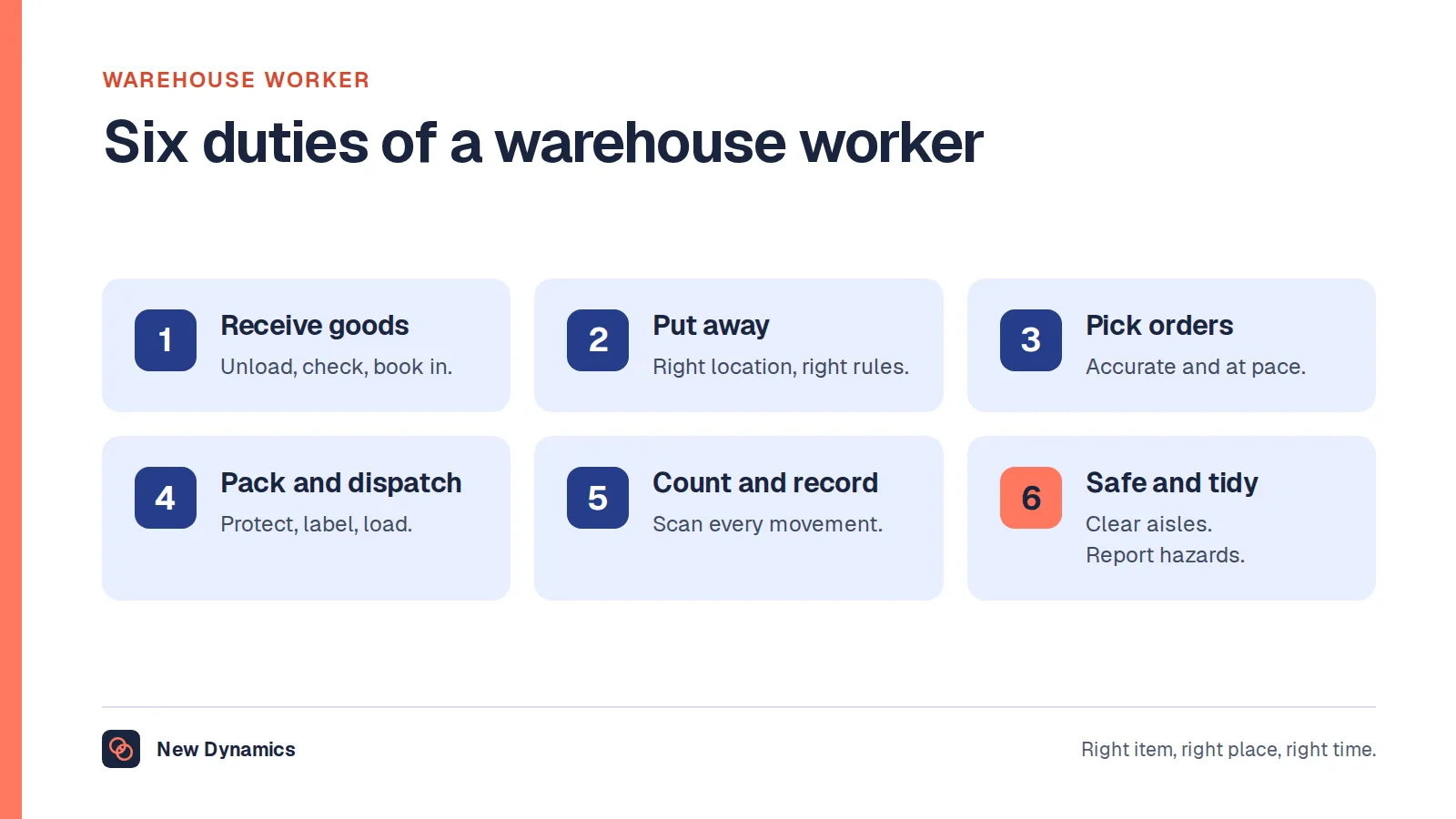
HSE guidance applies in Great Britain; employers elsewhere have their own rules, and this is general information rather than legal advice. Our warehouse worker job description covers the same duties in a distribution setting, and our workplace safety tips the basics.
Stocking associate job description template
Adapt the template to your store. Keep every line true.
Job title: Stocking associate (replenishment assistant)
Reports to: Stock or replenishment team leader; store manager
Hours: [Part-time or full-time] on [overnight / early morning / day] shifts, including weekends
Purpose of the role: To receive deliveries and keep the shop floor and stockroom fully stocked, correctly faced and in date, so that the store opens ready to trade every day.
Main duties:
- Unload and check deliveries against paperwork and report discrepancies
- Move stock to the floor and stockroom using cages, trolleys and [pallet trucks, once trained]
- Fill and face shelves to the planogram, with correct labels and prices
- Rotate stock, remove out-of-date and damaged items and record them
- Count stock, flag gaps and low lines, and support stock takes
- Break down packaging and keep aisles and stockroom clear and safe
- Help customers with product locations when the store is open
Skills and experience:
- Able to work at pace and lift and move stock safely for a full shift
- Accurate and thorough
- Reliable, especially for early starts and nights
- Works well in a team; experience welcome but not required
We provide: Manual handling and equipment training, [shift premium for nights], staff discount, and a route to stock control, team leader or the sales floor.
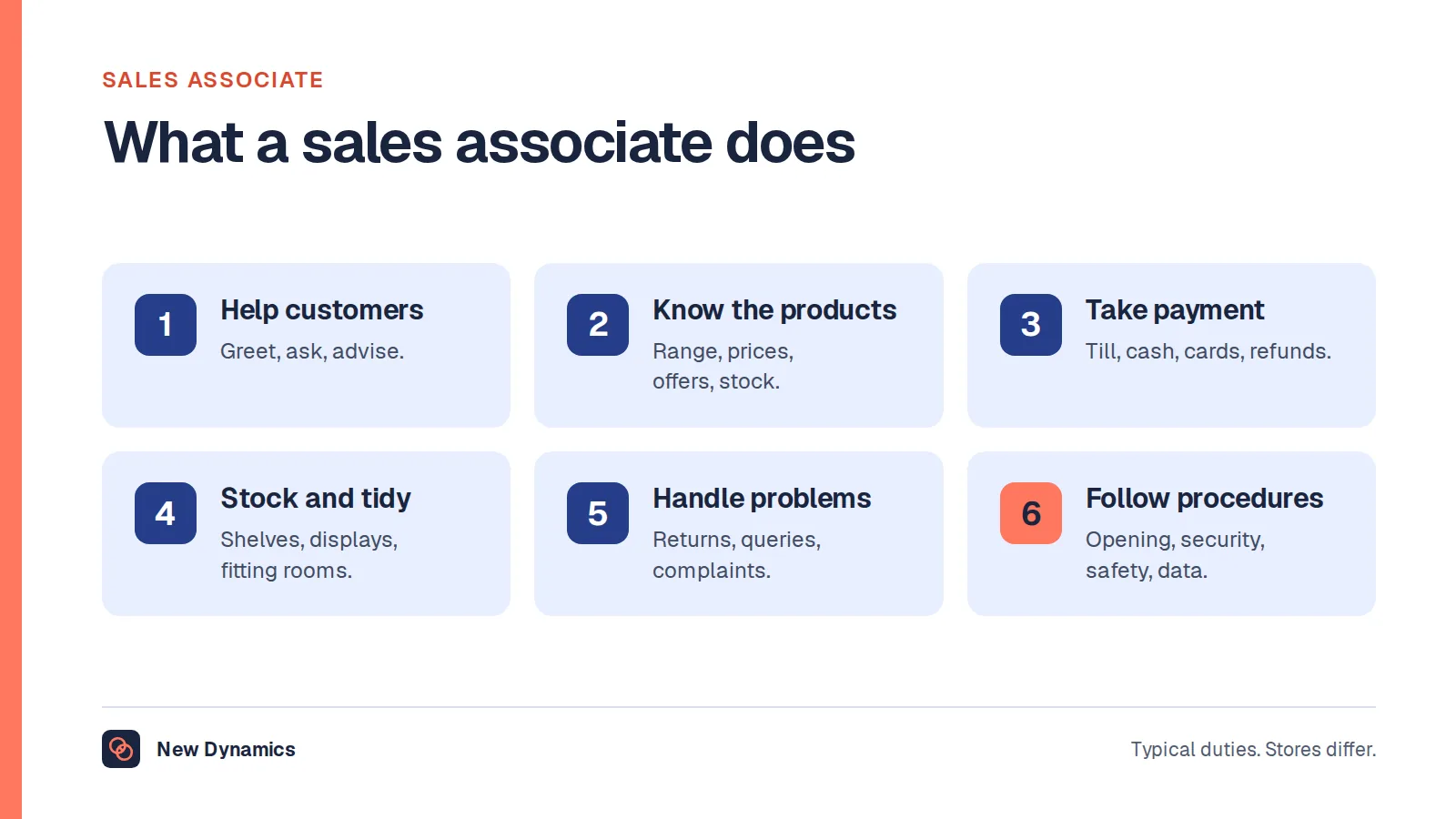
State the real shift pattern, including start times, and whether nights carry a premium. Our job description template explains the structure, and our sales associate job description covers the front-of-store role many stockers move into.

Career path
The NCS says a stock control assistant could become a stock supervisor or shift manager, leading a team, forecasting stock levels and working with suppliers, could move into retail buying or, with further training, into supply chain management. For a stocking associate the usual first steps are replenishment team leader, stock controller or a move to the sales floor and from there to supervisor. Good employers say so in the advert.
How to describe stocking work on a CV
Write what you did and the scale. The lines below are our own examples.
- “Overnight replenishment associate in a large supermarket, filling and facing around [n] cages a shift to planogram before opening.”
- “Checked deliveries against paperwork and reported shortages and damage; trained on pallet truck use.”
- “Rotated chilled and fresh lines to date and recorded waste, with zero out-of-date items found in audits.”
- “Supported quarterly stock takes and flagged low lines to the stock controller.”
- “Trained three new starters on handling technique and the layout.”
Common mistakes in stocking job adverts
Hiding the hours. Overnight and 5am starts are the job. Say so, with the pattern.
No training promise. Manual handling training is a legal expectation in Great Britain and a practical one everywhere.
Physical demands understated. People who know what they are signing up for stay longer.
No route onward. The candidate who wants to move to the floor or into stock control will go to the store that names the path.
Missing pay and premiums. Entry-level candidates compare quickly.
Frequently asked questions
What is a stocking associate?
A stocking associate is a retail employee who receives deliveries, moves stock to the shop floor and stockroom, fills and faces shelves, rotates dates, removes out-of-date items, counts stock and keeps aisles and stockrooms tidy. The role is also called stocker, stock associate, shelf filler or replenishment assistant.
What does a stocking job involve?
Six main duties: receiving and checking deliveries, moving and storing stock, filling and facing shelves to the planogram, rotating and removing out-of-date stock, counting and reporting, and keeping the floor safe and tidy. Much of the work is done overnight or before opening.
What skills does a stocking associate need?
Pace, accuracy, stamina, reliability, safe handling habits and helpfulness with customers. The National Careers Service lists attention to detail, teamwork, working under pressure, concentration and initiative among the skills for the related stock control assistant role.
Do you need qualifications to be a stocker?
No. Employers train on the job. Manual handling and equipment training should be given before the first delivery, and pallet truck use requires training first.
Is stocking a physically demanding job?
Yes. It involves lifting, bending, pushing cages and standing for a full shift, often at night. In Great Britain employers must assess and reduce the risk from hazardous manual handling; HSE guidance sets out the duties.
What is the career path from stocking?
Replenishment team leader, stock controller or stock supervisor, a move to the sales floor and supervision, and, with training, retail buying or supply chain management, as the National Careers Service describes for stock control assistants.
Your next step
- Use the template above with your real shift pattern, start times and any night premium.
- Say what handling and equipment training you provide, and when.
- Name the route onward, and someone who has taken it.
- Plan the first shift as an induction with a buddy, not a cage and a planogram.
Then plan the first month. Read and download our employee onboarding guide. The guide is free to read, and the PDF uses our short download form.
Want onboarding tasks, early goals and check-ins for every new starter on every shift in one place? Book a New Dynamics demo and bring your current induction. You can also email contact@new-dynamics.com.