TL;DR
- Every HR function covers four jobs (records and administration, cases and advice, hiring, and change) whatever it is called and however many people hold them.
- The Civil Service publishes a framework built on “11 HR job families (split by levels and grades)”, which is a better starting list than any diagram copied from a larger organisation.
- Below about fifty employees the structure question is really a workload question: which of the four jobs is the one person drowning in, and what gets bought in.
Search for an HR structure and you get an organisation chart designed for a company with two thousand employees. Copying it into a company with sixty produces titles rather than capability.
This article sets out the four jobs every HR function covers, the published list of specialisms, the shapes an HR team can take and what each trades away, and the order in which roles usually get added.
A structure is only useful if people can see it. See how New Dynamics org charts keep roles and reporting lines current.
The four jobs

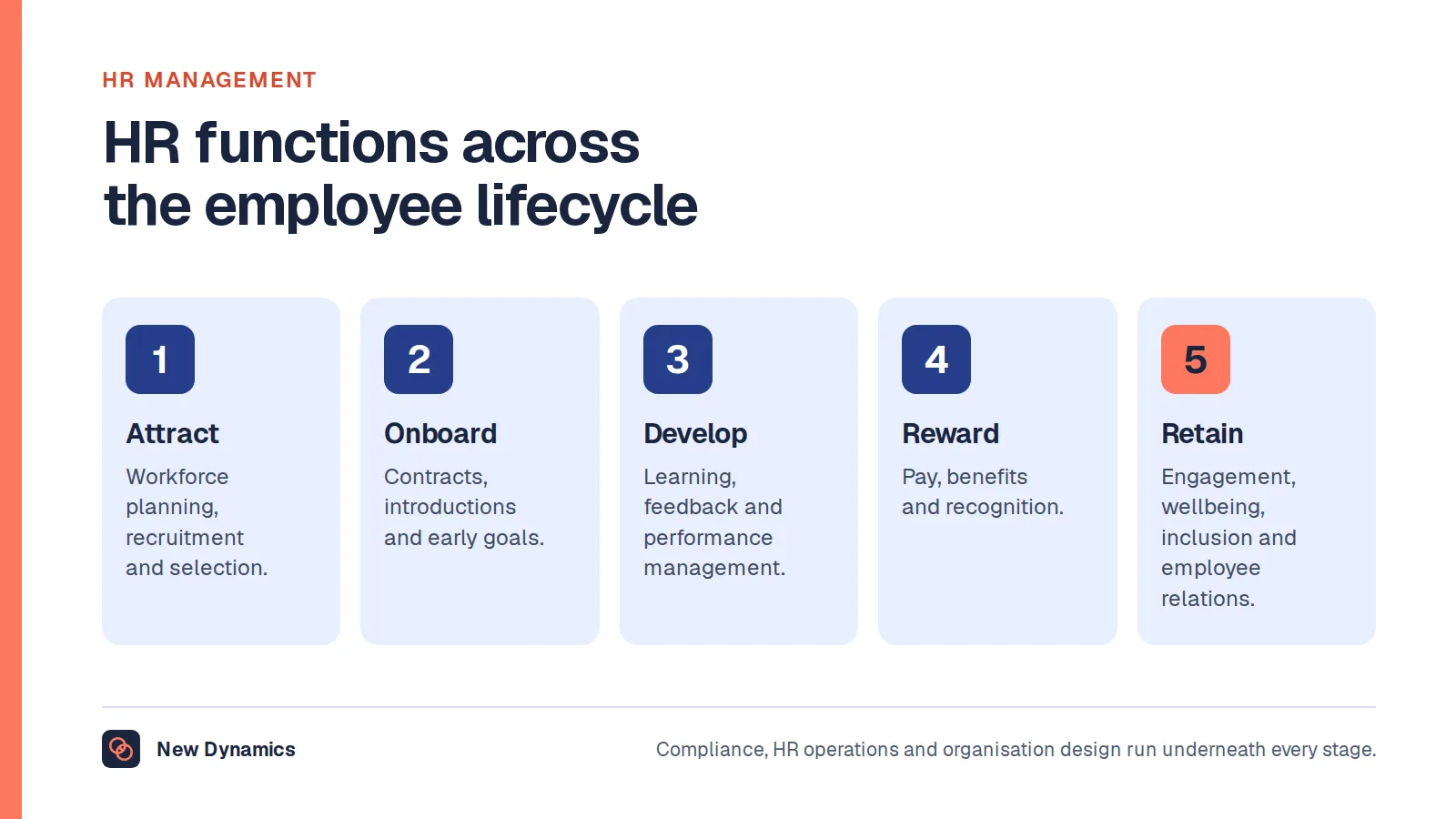
Whatever the size, an HR function covers four kinds of work:
- Records and administration. Contracts, payroll input, right to work checks, absence records, the written statement on day one. Unglamorous, and the layer where legal exposure accumulates.
- Cases and advice. Disciplinary and grievance, performance, sickness, the conversations managers would rather avoid. Low volume, high consequence.
- Hiring. Adverts, selection, offers, onboarding.
- Change and development. Structure, capability, pay design, whatever the organisation is trying to become.
In a small organisation one person holds all four. That is not a structure problem; it is a workload and priority problem wearing a structure costume.
The published list
The UK Civil Service publishes an HR career framework built around "11 HR job families (split by levels and grades)", alongside "HR professional standards (Success Profiles and CIPD)" and career pathways. It defines a pathway as "a series of defined and connected job roles which often feature at different levels", which "enables people to identify what is expected for roles at each level".
Its families and specialisms include HR business partnering, resourcing, reward, employee relations, casework, HR operations, learning and development, strategic workforce planning, and organisational design and development, the last described as practitioners who "help organisations understand their current states and work towards a desired future".
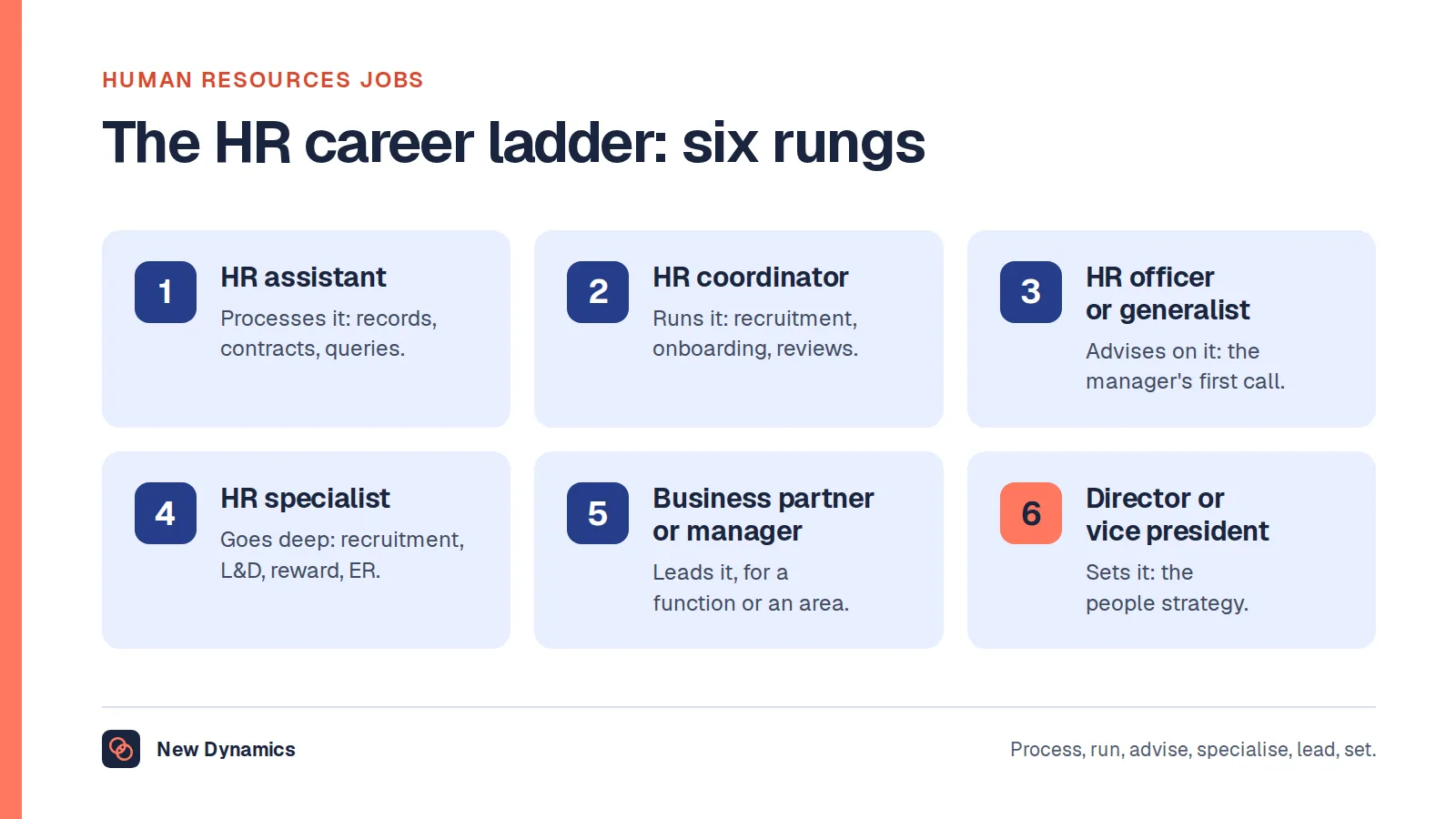
You are unlikely to have eleven people, let alone eleven families. The value of the list is as a checklist of work that exists in your organisation whether or not anyone is named against it. Our HR jobs post covers how those roles ladder.
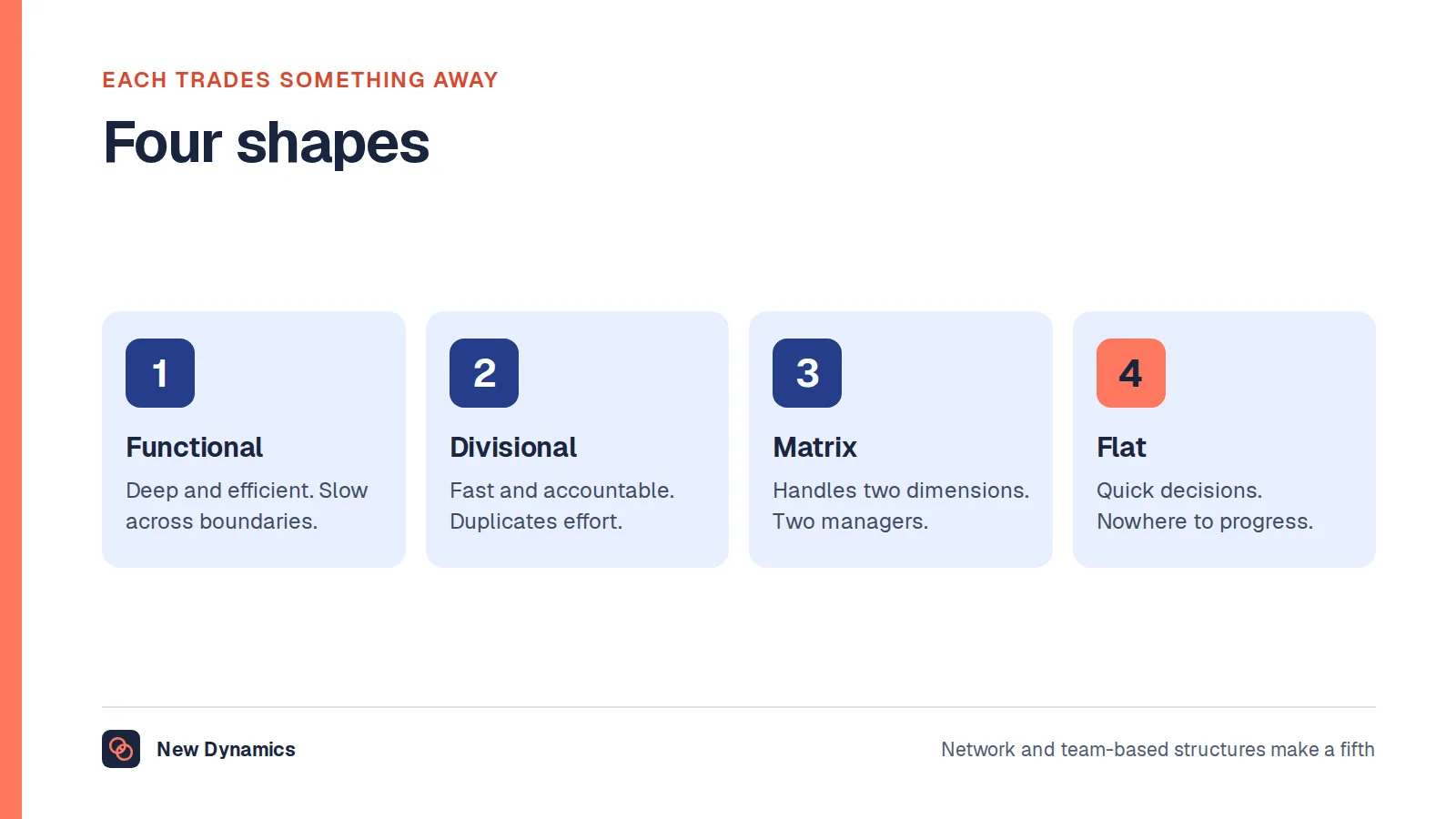
Four shapes

Single generalist. One person, everything. Fast and personal; the risk is that cases crowd out everything else, and that the organisation has a single point of failure with no cover for leave.
Small generalist team. Two to five people, each doing a bit of everything, perhaps with one specialising in administration. Resilient, and usually the right answer for a long stretch of growth. The weakness is depth: nobody is expert in reward or employment law.
Business partner model with centres of expertise. Partners aligned to business areas, specialists behind them in reward, resourcing and development. Powerful at scale and commonly adopted far too early, where it produces partners with nobody behind them and specialists with no volume.
Shared services plus partners. Transactional work centralised or automated, advice devolved. Efficient at large scale, and dependent on the service layer actually working, when it does not, the partners end up doing administration and resenting it.
Our organizational structure post covers the same trade-offs for the wider organisation.
What the structure has to deliver
Shape matters less than whether the function makes certain things true. HSE's Support standard is a fair test: the organisation should have "policies and procedures to adequately support employees", systems "to enable and encourage managers to support their staff", employees who "know what support is available and how and when to access it", and employees who "receive regular and constructive feedback".
Underneath that sits the floor. GOV.UK's guide to employing staff lists employment status, a safe and accessible workplace, keeping "employee information and data safe", PAYE, pensions and employers' liability insurance. Our HR compliance post sets out the sequence. If any of those is uncovered, no diagram helps.
The order roles get added

Growth tends to add roles in a predictable sequence, and the common mistake is skipping the first.
- Administration first. The earliest hire that pays for itself is usually someone who takes records, contracts and payroll input off the generalist, freeing them for cases.
- Then hiring, when recruitment volume becomes its own job rather than a seasonal burst.
- Then depth in cases, as headcount and complexity raise the volume of employee relations work.
- Then specialists in reward, development or organisation design, last, because they are the easiest to buy in occasionally.
Organisations that hire a senior strategic person first, with no administrative support, produce an expensive employee doing data entry.
What to buy in instead
Specialist advice is the natural thing to buy rather than employ: employment law, reward benchmarking, occupational health, and one-off design work. Our HR outsourcing post covers what moves and what does not, the duties stay with you whoever does the work.
The thing not to outsource is the case judgement about your own people, because an external adviser can tell you what a fair procedure looks like without knowing anything about the manager involved.
How to tell the structure is wrong
- Cases are always late, which usually means one person holds both administration and advice.
- Managers ask HR to make their decisions, which suggests the function is doing management rather than supporting it.
- Nobody owns the floor. If you cannot name who is accountable for right to work checks, that is a structure fault rather than an oversight.
- The expensive people do the routine work, which is the commonest and least visible failure.
Frequently asked questions
How should an HR department be structured?
Around the work rather than a diagram: records and administration, cases and advice, hiring, and change. Decide who covers each, then choose a shape (single generalist, small generalist team, business partner model, or shared services) that fits your size.
What are the main HR job families?
The Civil Service framework is built on 11, including HR business partnering, resourcing, reward, employee relations, casework, HR operations, learning and development, strategic workforce planning, and organisational design and development. Smaller organisations cover the same work with far fewer people.
When should a company hire its first HR person?
When the four jobs stop fitting around somebody else's role, usually when case work or hiring volume starts displacing their actual job. The first hire is often a generalist, with administrative support added soon after.
What is the HR business partner model?
Partners aligned to business areas, with specialist centres of expertise behind them. It works at scale and is frequently adopted too early, producing partners with no specialists to draw on and specialists with too little volume to stay sharp.
How many HR staff do you need?
There is no reliable published ratio, and the answer depends on how much case work, hiring and change you have rather than headcount alone. A better question is which of the four jobs is currently being done badly or not at all.
Should HR report to finance or to the chief executive?
Whichever gives the function access to the decisions it needs to influence. Reporting into a function whose priorities conflict with people decisions tends to show up as HR being consulted after decisions rather than during them.
What should a small HR team outsource?
Specialist advice bought occasionally: employment law, reward benchmarking, occupational health, one-off design work. Keep decisions about your own people, because outside advisers do not know the context that makes a decision fair or unfair.
Your next step: name who holds each job
- Write the four jobs down and put a name against each.
- Check the compliance floor and confirm somebody owns every item.
- Ask whether your most expensive person is doing routine work.
- Decide what you would buy in rather than hire next.
For the wider function this describes, read and download our human resources management guide. The guide is free to read, and the PDF uses our short download form.
Want roles and reporting lines visible as the function grows? Book a New Dynamics demo and bring your current chart. You can also email contact@new-dynamics.com.