TL;DR
- A real estate agent, called an estate agent in the UK, arranges the sale, renting or management of homes, land and buildings on behalf of clients: valuing, marketing, showing, negotiating and seeing each deal through to completion.
- The six duties are winning instructions and valuing, marketing, arranging and carrying out viewings, negotiating, progressing the sale with solicitors, lenders and surveyors, and keeping up with the market and the rules. Lettings agents add tenant vetting, tenancy agreements, rent and property management.
- An agent works with clients; a broker, in the US sense, holds the senior licence and runs the business; an assistant supports one or more agents with administration and marketing. Employers ask for negotiation, confidence, commercial awareness, communication, customer service and perseverance.
Most people meet an estate agent three or four times in their lives, on the most expensive days of it. The job looks like showing houses. It is mostly valuing, persuading, chasing and holding a chain of nervous strangers together until the keys change hands.
This real estate agent job description explains what the job involves on both sides of the Atlantic, sets out six duties, adds what changes in lettings, separates the agent from the broker and the assistant, lists the skills employers ask for, gives a template that you can adapt and suggests how to describe the work on a CV.
Agents live on targets: instructions, viewings, offers, exchanges. See how New Dynamics Goals & OKRs keep targets and progress in one place, so that a branch's pipeline is the same on the board and in every agent's diary.
What is a real estate agent?
The Cambridge Dictionary defines a real estate agent, the US term, as “someone who arranges the selling, renting or management of homes, land and buildings”, and an estate agent, the UK term, as “a person whose job is to arrange the sale, renting or management of homes, land and buildings”. Same job, two names. Realtor is a term used in the United States for members of a particular trade association, not a separate job.
Prospects, the UK graduate careers service, describes the work in its estate agent job profile: “As an estate agent, you'll specialise in the sale and/or letting of homes, commercial properties, businesses, or land, on behalf of your clients. You'll value, market, and lead viewings on properties, with the aim of negotiating the best price for the buyer or buyers.”
Three things define the job.
- The client is the seller or landlord. The agent's duty runs to the person who instructed them, while dealing fairly with the buyer or tenant.
- Pay often follows completion. In many agencies, commission or fees are earned when the deal completes, not when the offer is accepted.
- The rules are specific. Identity and money laundering checks, fair descriptions and, in lettings, tenant and safety law. They differ by country and change.
Real estate agent duties: six responsibilities
Prospects lists what an estate agent will need to do. Grouped, the tasks come to six.
- Win instructions and value. Visit and talk to sellers about their property, estimate its value and persuade them to instruct you.
- Market the property. Collect the information, arrange photographs, write the listing and promote it, to the buyers on your books and the public.
- Arrange and carry out viewings. Match buyers to properties, show them round and follow up.
- Negotiate. Represent the seller in negotiation with buyers and make sure the price agreed is acceptable to both.
- Progress the sale. Monitor sales as they proceed and liaise with all interested parties. Prospects lists “mortgage brokers, solicitors, conveyancers, surveyors, and other estate agents”. This is where deals are saved or lost.
- Keep up with the market and the rules. Prices, competition, legislation and regulation in the relevant market.

If the role includes lettings
Prospects adds the lettings tasks: vet prospective tenants by collecting references and performing credit checks; ensure properties meet legal and health and safety requirements, such as gas safety certificates; draw up tenancy agreement contracts; collect or organise rent payments; and act as a property manager and resolve issues. Prospects also notes that in Scotland property sales are usually handled by a solicitor estate agent.

Agent, broker and assistant
The three titles that appear together in adverts do different jobs.
- Agent. Works with sellers, buyers, landlords and tenants: the six duties above. In the UK, an estate agent or negotiator; in the US, a licensed real estate agent or salesperson.
- Broker. In the United States, the senior licence. A broker can run a brokerage and is responsible for the agents who work under their licence, in addition to their own clients. A real estate broker job description therefore adds supervising agents, compliance, trust accounts and the business. In the UK the word is rarely used for property agents; the equivalent is the branch manager or the business owner.
- Assistant. A real estate assistant, agent assistant or broker assistant supports one or more agents: listings and photographs, marketing, diary and viewings, paperwork, compliance files, client updates and, in some roles, showing properties. It is the usual first step into the industry. Our guide to the administrative assistant job description covers the general version of the role.
Licensing is where the countries differ most. In the United States, agents and brokers are licensed state by state, and the requirements differ between states. Prospects says that in the UK “Formal qualifications are not essential to becoming an estate agent”, and points to Propertymark, the professional body, for training and qualifications. Check the rules where you work; this is general information, not legal advice.

Skills employers ask for
Prospects lists what an estate agent will need to show, and it is a fair summary of every advert in the trade.
- Negotiation and persuasion “to win clients and close deals”.
- A confident and outgoing manner to gain trust.
- Commercial awareness and the ability to achieve sales targets.
- Communication, verbal and written, for liaising with professional contacts and checking complex documents.
- Customer service to support clients and keep them happy.
- Determination, perseverance and patience to complete timely and complicated deals.
- Professionalism and time management.
- IT skills, including office tools and, in practice, the agency's listing and client systems.
Prospects adds that a full driving licence is likely to be a job requirement, because agents travel through the day.
Real estate agent job description template
Adapt the template to your agency and country. Keep every line true, and state how pay works.
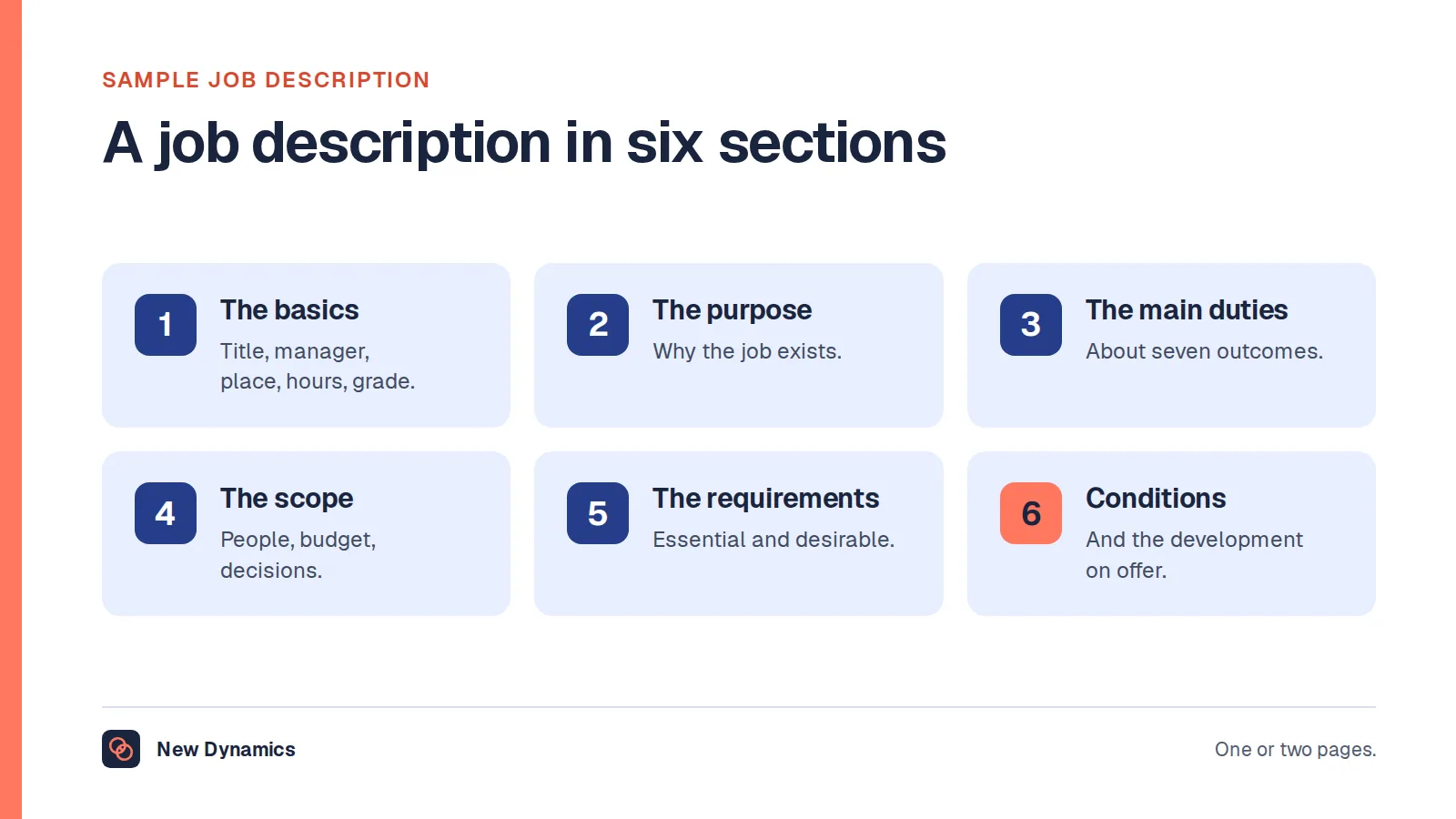
Job title: Real estate agent (estate agent, sales negotiator)
Reports to: Branch manager or broker
Location and travel: [Branch], with daily travel to properties; full driving licence required
Purpose of the role: To win instructions, market and sell [homes, commercial property or land] for our clients at the best achievable price, and to see every sale through to completion.
Main duties:
- Carry out valuations and win instructions from sellers
- Prepare listings, photographs and marketing for each property
- Match buyers to properties and carry out viewings
- Negotiate offers between sellers and buyers
- Progress sales with solicitors, lenders, surveyors and other agents to completion
- Carry out identity and money laundering checks and keep accurate records
- Keep up to date with the local market and the rules that apply
Targets and pay: [Basic salary] plus [commission structure], with targets for instructions, viewings and exchanges agreed each quarter
Skills and experience:
- Negotiation, persuasion and a confident manner
- Commercial awareness and a record of meeting targets
- Clear written and spoken communication
- Perseverance and organisation across many deals at once
- [Licence or qualification required in your country or state]
We provide: Training and professional qualifications, a pipeline and targets reviewed together each quarter, and a route to senior negotiator and branch manager roles.
Say whether the role covers sales, lettings or both, and exactly how commission works. Our job description template explains the structure.
How to describe the work on a CV
Employers want numbers. The lines below are invented examples, to show the form.
- Instructions and sales. “Won 60 instructions and completed 45 sales in a year across a suburban branch.”
- Conversion. “Converted viewings to offers at a rate above the branch average.”
- Progression. “Progressed a chain of six linked sales to simultaneous exchange.”
- Lettings. “Managed a portfolio of 120 tenancies, including referencing, agreements and safety certificates.”
- Compliance. Name the checks and training: money laundering, property descriptions, tenancy law.
Common mistakes in real estate agent adverts
Vague pay. "OTE" without the basic salary and the commission rules attracts the wrong people and loses the right ones.
No mention of progression. Sales progression is half the job and the half most adverts forget.
Advertising for a personality. "Hungry" and "driven" describe a type. Describe the targets, the support and the market.
Silence on compliance. Identity checks, fair descriptions and lettings law are daily work. Say you train for them.
One title for three jobs. If the role is really an assistant's, or really a broker's, say so.
Frequently asked questions
What does a real estate agent do?
A real estate agent, or estate agent, arranges the sale, renting or management of property for clients: valuing and winning instructions, marketing, arranging and carrying out viewings, negotiating offers, progressing the sale with solicitors, lenders and surveyors, and keeping up with the market and the rules.
What is the difference between a real estate agent and a broker?
In the United States a broker holds the senior licence, can run a brokerage and is responsible for the agents working under that licence, as well as for their own clients. An agent works with clients under a broker. In the UK the term broker is rarely used for property; the branch manager or owner plays the equivalent role.
What does a real estate assistant do?
A real estate assistant supports one or more agents with listings, photographs, marketing, diaries, viewings, paperwork, compliance files and client updates. It is a common first job in the industry and often leads to an agent role.
What skills does a real estate agent need?
Negotiation and persuasion, a confident manner, commercial awareness and target focus, clear communication, customer service, perseverance and patience, professionalism and time management, and IT skills. A driving licence is usually required.
Do you need qualifications to be an estate agent?
In the UK, Prospects says formal qualifications are not essential, and professional bodies offer training and qualifications once you are in the role. In the United States, agents and brokers are licensed state by state, with requirements that differ between states.
What does a lettings agent do differently?
A lettings agent vets prospective tenants through references and credit checks, makes sure properties meet legal and safety requirements such as gas safety certificates, draws up tenancy agreements, collects or organises rent and acts as property manager for issues that arise.
Your next step
If you are hiring, write the targets and pay line of the template first, with the real numbers, and say whether the role is sales, lettings or both. If you are applying, rewrite one line of your CV with instructions won, sales completed or tenancies managed.
For a method that turns branch targets into quarterly goals each agent can see, read and download our SMART goals guide. The guide is free to read, and the PDF uses our short download form.
Want pipeline targets, feedback and development in one place for every agent? Book a New Dynamics demo and bring your current approach. You can also email contact@new-dynamics.com.