TL;DR
- A social media manager leads an organisation's social media strategy and runs its channels: planning and producing content, managing the community that responds to it, running campaigns and paid activity, working with influencers and creators, and analysing and reporting what works.
- The job has six duties: set the strategy, plan and produce content, manage the channels and the community, run campaigns and paid activity, analyse and report, and lead the team and the budget. A content creator makes the content; a community manager runs the conversation; the social media manager is accountable for all of it.
- In the UK, marketing on social media must be obviously identifiable as advertising, and both brands and influencers are responsible for making it so. Employers look for writing and visual judgement, data literacy, calm under public pressure and knowledge of the rules.
Every organisation now publishes several times a day, to an audience that can answer back in front of everyone. The social media manager is the person who decides what to say, says it, handles the replies and reports whether any of it worked.
This social media manager job description explains what the job involves, sets out six duties, separates the social media manager from the content creator and the community manager, summarises the UK advertising rule that governs the work, lists the skills and measures employers should use, gives a template that you can adapt and suggests how to describe the work on a CV.
Social media runs on targets for reach, engagement and response, and the targets should be visible and fair. See how New Dynamics Goals & OKRs keep targets and progress in one place.
What is a social media manager?
The Cambridge Dictionary defines social media as “websites and computer programs that allow people to communicate and share information, opinions, pictures, videos, etc. on the internet, especially social networking websites”. A social media manager manages an organisation's presence on them.
Prospects, the UK graduate careers service, describes the job in its social media manager job profile: social media managers “lead an organisation's social media strategy in order to boost visibility and customer and client engagement”, and “manage an organisation's online presence by developing and implementing their social media strategy”, leading “campaigns and projects across a range of social media channels, producing engaging content, analysing usage data, building client relationships and facilitating customer service”. Prospects notes that strategies usually combine organic content with paid advertising, that in larger organisations the role is distinct and sometimes called social media coordination, that in small and medium companies it is often combined with other marketing and communications work, and that in agencies the title is often social media account manager.
Social media manager duties: six responsibilities
- Set the strategy. Design a social media strategy that serves the organisation's marketing objectives: which audiences, which channels, what the organisation will say and how it will sound, and what success looks like. Prospects lists designing and delivering creative and engaging strategies and setting targets for awareness, engagement and loyalty.
- Plan and produce content. Plan the content calendar, create or commission posts, images, video and other multimedia, and adapt the content to suit each channel and audience.
- Manage the channels and the community. Run the day-to-day handling of every channel, respond to posts and messages, develop discussions, handle complaints and hand customer service issues to the right people, and manage the moments when something goes wrong in public.
- Run campaigns and paid activity. Develop, launch and manage campaigns and competitions, manage paid advertising and work with influencers and creators, within the advertising rules. Our brand ambassador job description covers the people on the other side of that brief.
- Analyse and report. Monitor, track and report on performance, research the audience, analyse competitors, identify trends and recommend improvements. Prospects lists all of these, and adds evaluating new tools and techniques for measuring social activity.
- Lead the team and the budget. Manage and coach social media executives and assistants, manage and track the budget, educate colleagues on the use of social media and, in agencies, liaise with clients.

Social media manager, content creator and community manager
The three titles overlap and employers use them loosely.
| Title | What they do |
|---|---|
| Social media manager | Accountable for the strategy, the channels, the content, the community, the campaigns and the results |
| Content creator | Makes the content: writes, films, photographs, designs and edits posts and video, for an employer, for clients or for their own audience |
| Community manager | Runs the conversation: responds, moderates, builds and looks after the community around the brand |
What does a content creator do? A content creator produces the material that channels run on: short video, photography, written posts, graphics and audio, planned to a calendar and made to a brand's voice. In-house, the content creator works to the social media manager's plan; freelance creators and influencers produce content for their own audiences and are paid by brands to feature them, which is where the advertising rules below bite hardest. For the person who designs the visual side, see our graphic designer job description.
In a small organisation one person does all three jobs. In a large one they are separate posts, and the job description should say which it is.

The UK rule: ads must be obviously identifiable
Social media marketing in the UK is regulated advertising. The Advertising Standards Authority's guidance on recognising ads on social media explains that “Section 2 of the CAP Code requires that marketing communications are obviously identifiable as such.” Content on a brand's own page is usually recognisable as advertising from its context, but when an influencer or creator talks about a brand “it isn't self-evident whether they are expressing an independent opinion or whether they have been incentivised to do so by the brand”, so influencer ads must be “clearly and obviously distinguished from other content”. The ASA says that “Both brands and influencers are responsible for ensuring that ads are obviously identifiable”, that labels such as “Ad” are acceptable when prominent, and that the rules apply equally to advertorial, affiliate marketing and own-brand promotion.
For a social media manager, that means the campaign process must include the labelling of every paid and incentivised post, the briefing of every influencer and the checking of what they publish. This is general information about the UK, not legal advice; other countries have their own advertising and consumer rules, and sector rules apply to some products.
Skills employers ask for
- Writing and visual judgement. Words and images that suit the brand and the platform, produced quickly and often.
- Platform fluency. How each channel works, what its audience expects and how its formats change.
- Community handling. Calm, courteous and quick in public, including when the public is angry.
- Data literacy. Reading the metrics, attributing results honestly and reporting what happened rather than what was hoped.
- Campaign and budget management. Paid activity, competitions, influencers, timelines and money.
- Knowledge of the rules. Advertising labelling, competitions, data protection and the platform's own policies.
- Leadership and education. Coaching executives and teaching colleagues what social media can and cannot do.
Qualifications and measures
No qualification is required. Employers hire on a portfolio of channels run, content made and results achieved, and many social media managers come from marketing, journalism, PR or design. The measures that matter are reach and engagement against target, response times, the growth of the community, the outcomes campaigns were meant to produce, such as enquiries or sales, and the absence of avoidable incidents. Our OKR guide shows how to set targets that reward outcomes rather than activity.
Social media manager job description template
Adapt the channels, the setting and the team.
Job title: Social media manager
Reports to: Marketing manager or head of marketing [or, in an agency, account director]
Direct reports: [Social media executive, content creator]
Purpose of the role: To lead [the organisation's / clients'] social media strategy and run its channels, producing content and managing the community so that [awareness, engagement, enquiries] grow to target, within the advertising rules and the brand.
Main duties:
- Design and deliver the social media strategy and set targets for awareness, engagement and loyalty
- Plan the content calendar and create or commission content adapted to each channel
- Run the channels day to day, respond to the community and hand customer service issues to the right teams
- Develop and manage campaigns, competitions, paid activity and influencer and creator relationships, with every ad correctly labelled
- Monitor, analyse and report on performance, audiences, trends and competitors, and recommend improvements
- Manage and coach the team, manage the budget and educate colleagues on the use of social media
Skills and experience:
- Experience of running social media channels for an organisation or clients, with results to show
- Strong writing and visual judgement, and fluency across the major platforms
- Confident with analytics and reporting
- Calm and courteous in public, including in complaints and crises
- Working knowledge of the UK advertising rules and data protection as they apply to social media
- Experience of paid social and influencer campaigns [desirable]
Measures: Reach, engagement and community growth against target, response times, campaign outcomes, budget and compliance.
We provide: Tools and training, a written escalation process for incidents, a budget for paid activity and a route to head of social media or marketing manager roles.
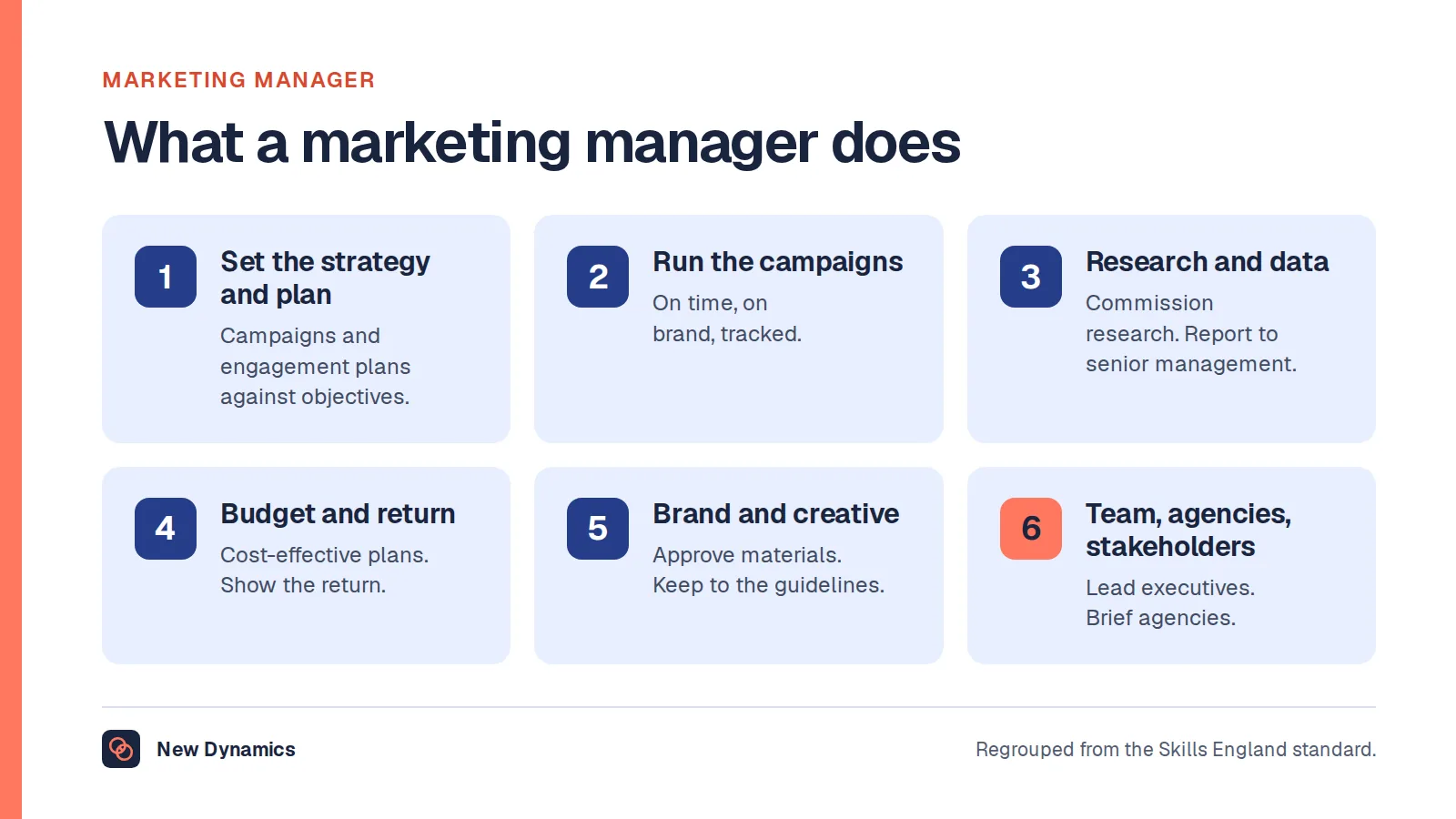
For the layout of the whole document, use our job description template. For the manager the role usually reports to, see our marketing manager job description.
How to describe social media work on a CV
Employers want the channels, the audience, the results and the content. The lines below are invented examples, to show the form.
- Show the scope. “Ran five channels for a national charity with a combined audience of 300,000.”
- Show results. “Grew engagement by 60% in a year and doubled enquiries from social.”
- Show content. “Planned and produced 20 posts a week, including a video series that reached 2 million views.”
- Show the community. “Cut median response time to under two hours and handled a product recall on social without escalation.”
- Show compliance. “Briefed 30 influencers a year with labelling requirements; no complaints upheld.”
Common mistakes in social media manager adverts
One job for three people. Strategy, content creation and community management, plus design and video, on one salary. Say what the job is and what the team provides.
Metrics unstated. Say what success looks like, or candidates will assume vanity metrics.
No escalation process. The advert should say what happens when something goes wrong in public, and who decides.
Silence on the rules. Labelling, competitions and data protection are duties. Name them.

Frequently asked questions
What does a social media manager do?
A social media manager leads an organisation's social media strategy and runs its channels: setting the strategy, planning and producing content, managing the channels and the community, running campaigns and paid activity, analysing and reporting performance, and leading the team and the budget.
What is the difference between a social media manager and a content creator?
The social media manager is accountable for the strategy, the channels, the community and the results. The content creator makes the content: video, photography, posts and graphics, to the manager's plan or for their own audience. In small organisations one person does both.
What does a content creator do?
A content creator produces the material channels run on: short video, photography, written posts, graphics and audio, made to a brand's voice and a content calendar. In-house creators work to the social media manager's plan; freelance creators and influencers make content for their own audiences and are paid by brands to feature them.
What are the UK rules for social media marketing?
The ASA's guidance says marketing communications must be obviously identifiable as such under the CAP Code, that influencer ads must be clearly and obviously distinguished from other content with a prominent label such as “Ad”, and that both brands and influencers are responsible. The rules apply equally to advertorial, affiliate and own-brand content. This is general information, not legal advice.
What skills does a social media manager need?
Writing and visual judgement, platform fluency, community handling, data literacy, campaign and budget management, knowledge of the advertising and data rules, and the ability to coach a team and educate colleagues.
What should a social media manager job description include?
The channels and the setting, the six duties from strategy to reporting, the team and the budget, the measures of success, the compliance responsibilities, the escalation process for incidents and the route to head of social or marketing manager roles.
Your next step: decide what the job is before you post it
- Say whether the post is strategy, content, community or all three, and what the team provides.
- Name the channels and the audience.
- Set the measures on outcomes, and write the labelling and escalation rules into the duties.
- Ask candidates to talk through one campaign from brief to results.
To set social media targets that reward outcomes, read and download our OKR guide. The guide is free to read, and the PDF uses our short download form.
Want channel targets, campaign goals and team check-ins in one place? Book a New Dynamics demo and bring your current targets. You can also email contact@new-dynamics.com.