TL;DR
- Goal setting is the process of deciding what you want to achieve, or what you want someone else to achieve, over a particular period. At work it means agreeing specific targets, the measures that show whether they have been met and the time frame, between an employee and a manager.
- Decades of research summarised by Edwin Locke and Gary Latham show that specific, difficult goals that people accept raise performance more than vague goals or simply trying your best. Goals work through three mechanisms: direction, effort and persistence.
- Good goal setting follows seven steps: specify the tasks, set targets, develop clear measures, outline a time frame, prioritise, decide how performance will be rated, and coordinate with others. Feedback on progress is what turns a goal into a result.
Every organisation sets goals and most people have opinions about them. Fewer can say what goal setting is, why it changes what people do, and what separates a goal that works from one that sits in a document until the next review.
This article gives the definition of goal setting, from the dictionary and from the research, explains the three mechanisms that make goals work, sets out seven steps for setting goals at work, lists the benefits and the mistakes, and links to the frameworks, such as SMART goals and OKRs, that put the definition into practice.
Goals only change behaviour when they stay visible and get feedback. See how New Dynamics Goals & OKRs keep targets and progress in one place, so that goals are reviewed rather than filed.
What is goal setting?
The Cambridge Business English Dictionary defines goal setting as “the process of deciding what you want to achieve or what you want someone else to achieve over a particular period”. Its example sentence carries the most important condition: “Goal setting will only be successful if there is a collaborative approach between employee and manager.” A goal itself, in the general dictionary's sense, is simply “an aim or purpose”.
At work, goal setting is the part of performance management in which an employee and a manager agree what the employee will achieve in a period, how achievement will be measured and by when. The US Office of Personnel Management, in its guidance on performance planning, puts it this way: “Planning means setting performance expectations and goals for groups and individuals to channel their efforts toward achieving organizational objectives.” It adds that involving employees in the planning “will help them understand the goals of the organization, what needs to be done, why it needs to be done, and how well it should be done”.
So a working definition has four parts: a result to achieve, a measure that shows whether it has been achieved, a time frame, and agreement between the person who will do the work and the person who will judge it.
Goal setting theory: why goals work
The research on goal setting is unusually consistent. Edwin Locke and Gary Latham studied it for decades, and OPM's article Improved Performance Starts with Planning I summarises four of their findings:
- People who kept daily records of everything they ate but set no goal to eat less did not change their habits. Only those who also set specific goals lost weight.
- People given feedback in performance appraisals performed no better than those given none. When goal setting followed the feedback, performance improved significantly.
- People given specific, hard goals outperformed people who were told to do their best.
- People given feedback on five aspects of their performance but a goal on only one improved significantly only on that one.
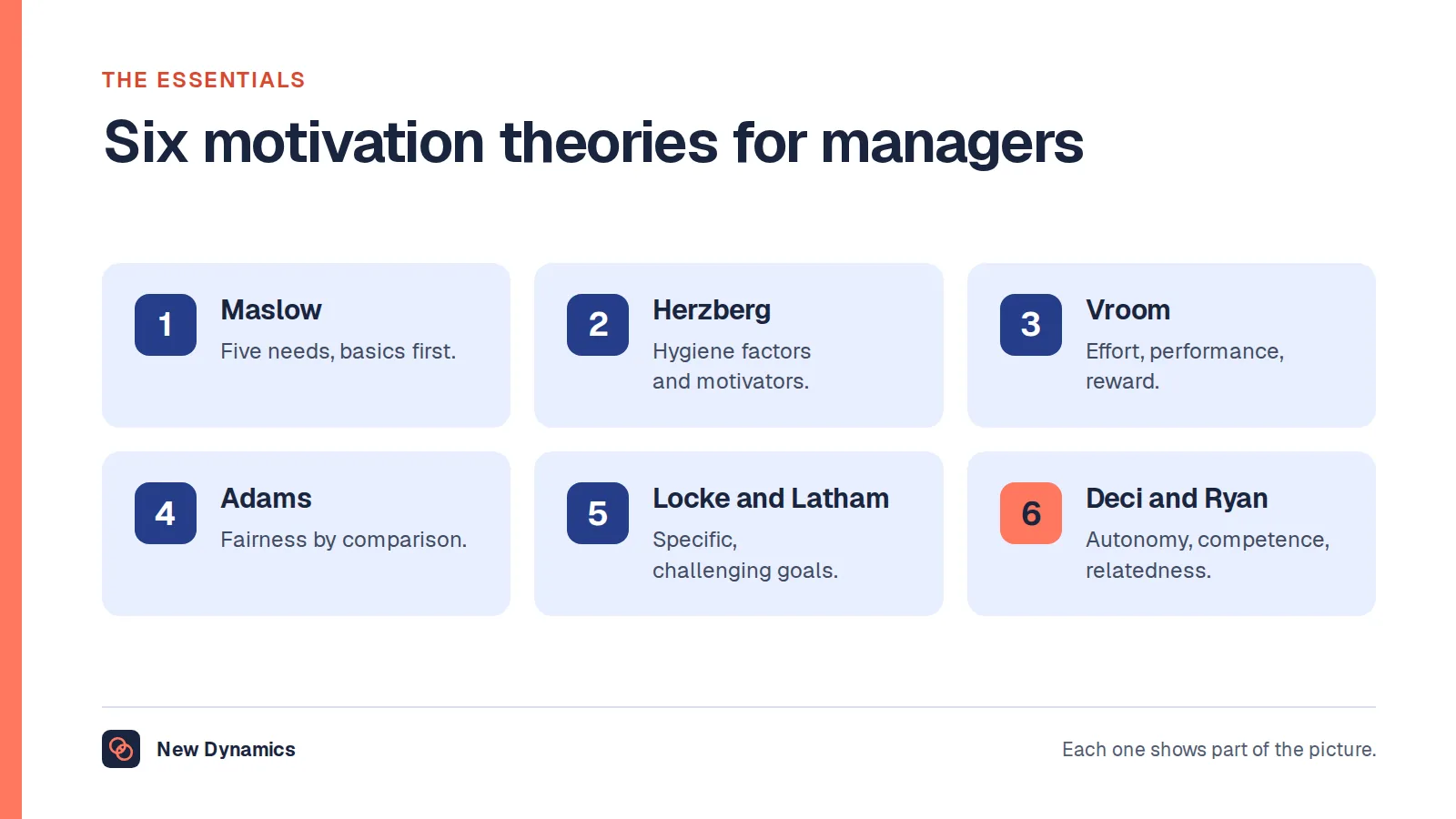
OPM's conclusion: “Study after study reveals that setting goals, measuring performance against those goals, providing feedback on goal achievement, and rewarding goal achievement improves performance significantly.” Our guide to motivation theories places goal-setting theory alongside the other five theories managers should know.

The three mechanisms
OPM's summary of the theory names three ways in which goals improve performance:
- Direction. “Goals give people direction and focus their thoughts and actions.”
- Effort. Goals let people “regulate their efforts in proportion to the difficulty level of the goal they have accepted”.
- Persistence. “Hard goals that employees accept increase employee persistence at achieving the goals.”
Notice the word accepted, twice. A goal that is imposed and rejected does none of this. That is why the Cambridge example sentence insists on collaboration, and why the seven steps below involve the employee throughout.

How to set goals at work: seven steps
OPM's second article, Improved Performance Starts with Planning II, sets out the seven key steps that Locke and Latham describe in their book Goal Setting: A Motivational Technique That Works!. Translated out of federal language:
- Specify the tasks. Write down the work that must be done, so that the goal is about something concrete.
- Set targets. Decide the level of performance to aim for. OPM notes that “setting goals that are difficult but possible to achieve produces higher levels of performance than if no goal or a vague goal had been set”, and warns that if only the acceptable level is described, improvement “can be happenstance rather than a planned objective”.
- Develop clear measures. Employees must know how their performance will be measured. If a measure cannot be quantitative or qualitative, it should at least verify whether the goal was achieved.
- Outline a time frame. Say when the goal is to be reached.
- Prioritise. If there are several goals, rank them, and make sure the employee knows and agrees with the ranking.
- Decide how performance will be rated. Employees must know how goal achievement will be judged and what, if anything, depends on it.
- Coordinate. Where tasks depend on other people, work out how each person's contribution will be measured.
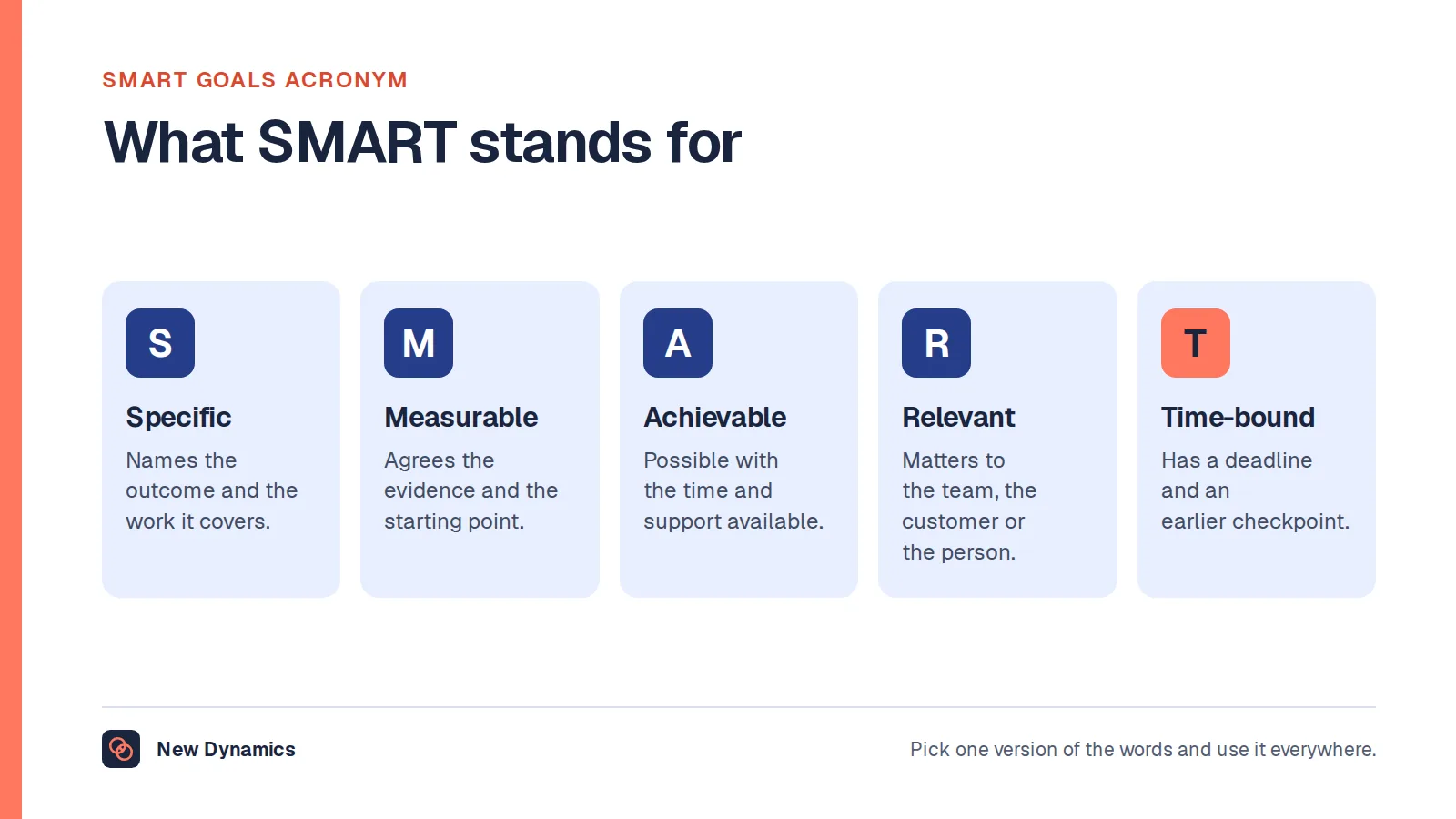
Those seven steps are the definition made operational. The SMART acronym is a memorable compression of the first four; our guide to what SMART goals stand for explains each letter, and our SMART goals guide works through examples. Objectives and key results add the prioritising and coordinating steps at team and company level; see our OKR guide.
The benefits of goal setting
Beyond performance, OPM's summary of the research lists what goals do for the people who hold them.
- They clarify expectations. People find it helpful to know what their managers expect.
- They make work more interesting. Goals can increase the challenge of a job and make a monotonous one more engaging.
- They give purpose. Goals that are difficult but attainable provide a sense of purpose.
- They raise satisfaction. Feedback that a goal has been reached increases liking for the job and satisfaction with performance.
- They build confidence. Setting and achieving goals creates self-confidence, pride and a willingness to take on the next challenge.
OPM adds that goals for teams are not optional: a team is two or more people coordinating to reach a common goal, so by definition a team must have one. Our team goals examples show what that looks like.

Common mistakes in goal setting
Vague goals. “Improve customer service” is a wish. “Raise first-contact resolution from 78% to 85% by March” is a goal.
Goals without feedback. The research is clear that goals and feedback work together. A goal reviewed once a year is barely a goal.
Imposed goals. Effort and persistence depend on acceptance. Set goals with people, not for them.
Too many goals. Attention is finite. Five goals with priorities beat fifteen without.
Goals on one dimension only. People improve on what is measured. If quality matters as well as volume, set goals for both.
Easy goals. A target everyone will hit changes nothing. Difficult but achievable is the standard.
Measuring what is easy rather than what matters. If the real result is hard to count, verify it rather than substituting a number that misleads.
Frequently asked questions
What is the definition of goal setting?
Goal setting is the process of deciding what you want to achieve, or what you want someone else to achieve, over a particular period. At work it means agreeing a result, a measure, a time frame and priorities between an employee and a manager.
What is goal setting theory?
Goal-setting theory, developed by Edwin Locke and Gary Latham, holds that specific, difficult goals that people accept lead to higher performance than vague goals or being told to do your best, provided people get feedback on their progress. Goals work by giving direction, regulating effort and increasing persistence.
Why is goal setting important?
Because it changes behaviour. Studies summarised by OPM show that setting goals, measuring performance against them, giving feedback and rewarding achievement improves performance significantly. Goals also clarify expectations, make work more engaging, give purpose and build confidence.
What are the steps in goal setting?
Locke and Latham's seven steps, as summarised by OPM: specify the tasks, set targets, develop clear measures, outline a time frame, prioritise the goals, decide how performance will be rated, and coordinate where tasks depend on others.
What is the difference between goal setting and SMART goals?
Goal setting is the process; SMART is one way of writing the goals it produces. Specific, measurable, achievable, relevant and time-bound cover the first four of the seven steps. Prioritising, rating and coordinating still need to be done.
What makes a goal effective?
It is specific, difficult but achievable, measured, time-bound, accepted by the person who holds it, prioritised against other goals, and followed by regular feedback on progress.
Your next step: set one goal properly
- Pick one result that matters this quarter and write it as a specific target with a measure and a date.
- Agree it with the person who will deliver it, including where it sits among their other goals.
- Decide when and how progress will be reviewed, and put the reviews in the diary.
- Give feedback at each review, and adjust the goal if the situation changes.
To write goals that pass every step, read and download our SMART goals guide. The guide is free to read, and the PDF uses our short download form.
Want goals, priorities and progress visible to everyone who holds them? Book a New Dynamics demo and bring your current goals. You can also email contact@new-dynamics.com.