TL;DR
- Strategic human resource management, or people strategy, is the coherent framework through which an organisation hires, manages and develops its people to support its long-term goals. It links every HR activity to the business strategy, and lets the workforce's capabilities shape that strategy in return.
- It differs from HR management in horizon and integration. HR management runs the functions: hiring, pay, training, employee relations. Strategic HRM decides what those functions are for, matches people to future needs and deals with structure, culture, capability and commitment across years rather than weeks.
- The US Office of Personnel Management's human capital framework organises the work into four systems: strategic planning and alignment, talent management, performance culture and evaluation. A workable method has five steps, from the business strategy to the measures that show whether the people strategy is delivering.
Every organisation manages its people. Fewer manage them strategically, which means deciding, before the vacancies and the grievances arrive, what kind of workforce the strategy needs and building the policies, structures and culture that will produce it. The difference shows up years later, in who is still there and what they can do.
This article explains what strategic human resource management is, where the term came from, how it differs from day-to-day HR management, the four systems that a public framework uses to organise it, a five-step method for doing it and the measures that show whether it is working.
Strategy only reaches people through goals they can see. See how New Dynamics Goals & OKRs keep targets and progress in one place.
What is strategic human resource management?
The Cambridge Dictionary defines strategic as “helping to achieve a plan, for example in business or politics”. Strategic human resource management is HR that helps to achieve the organisation's plan.
The CIPD, the UK professional body for HR, gives a fuller definition in its strategic HRM factsheet: “Strategic HRM, or 'people strategy', is about creating a coherent framework for employees to be hired, managed and developed to support an organisation's long-term goals.” It adds that strategic HRM “focuses on longer-term people issues, matching resources to future needs, and large-scale concerns about structure, quality, culture, values and commitment”.
The CIPD traces the idea to the early 1990s and quotes two academic definitions from that time: Schuler's, “The undertaking of all those activities affecting the behaviour of individuals in their efforts to formulate and implement the strategic needs of business”, and Wright and McMahan's, “The pattern of planned human resource deployments and activities intended to enable the organisation to achieve its goals”. The common thread is the word pattern. Strategic HRM is not one initiative; it is the way all the people decisions fit together.
The US government's term for the same idea is strategic human capital management. The Office of Personnel Management's human capital framework describes it as guidance that “provides talent management strategies that support and shape an organization's current workforce, while preparing for the future”, and defines human capital management as “a complex set of interrelated strategies and practices that are aligned with an organization's mission and guide the processes for selecting, developing, training, and managing a high-quality productive workforce”.
Strategic HRM and HR management
The two are not rivals. One decides, the other delivers.
| Question | HR management | Strategic HRM |
|---|---|---|
| Horizon | This week, this quarter | Two to five years |
| Unit of work | The function: hiring, pay, training, employee relations | The pattern: how the functions combine to produce the workforce the plan needs |
| Starting point | A vacancy, a policy, a case | The business strategy and the capabilities it requires |
| Typical questions | Who do we hire? What do we pay? How do we handle this case? | What capabilities will we need? Where will they come from? What culture delivers them? |
| Owner | HR officers, advisers, managers | The executive team, with the HR director |
The CIPD makes a further distinction that matters in practice. Individual HR strategies, such as a fair reward strategy or a plan to improve performance, are not strategic HRM by themselves. Strategic HRM, in its words, “is the framework that determines the delivery of individual strategies, systematically linking people with organisations by integrating HRM strategies into organisational strategies to deliver organisational success”. Our guide to HR management covers the functions that the framework directs.

Strategy shapes people, and people shape strategy
It is tempting to draw strategic HRM as a one-way arrow from the business plan to the people plan. The CIPD warns against it: individual HR strategies may be shaped by the business strategy, “but it's too simplistic to suggest that strategic HRM simply follows on from business strategy – the two must inform one another”. What the workforce can do, and what skills the organisation can obtain, should shape what the business decides to attempt. A strategy that assumes capabilities the organisation cannot build or buy is a wish.
The four systems of strategic human capital management
OPM's framework organises the work into four systems, each with focus areas that it describes as key elements to consider rather than requirements.
- Strategic planning and alignment. Linking the people plan to the mission and its critical objectives, and keeping them linked as both change. OPM says agency leadership “establishes an organization's vision and goals that become the center of strategic human capital management”.
- Talent management. The strategies and practices for selecting, developing, training and managing the workforce: recruitment, succession, learning and career development.
- Performance culture. The environment that gets results: performance management, recognition, engagement and accountability.
- Evaluation. Measuring progress and outcomes, and using the evidence to adjust the other three.
OPM presents each system from three perspectives: the strategic view of senior leaders and managers, the operational view of HR practitioners and supervisors, and the view of employees. That is a useful check for any organisation. A people strategy that exists only in the HR director's slides has one perspective; a working one is recognisable at all three levels.

How to do strategic HRM: five steps
- Start from the business strategy, and question it. Write down what the organisation intends to achieve over the planning horizon and the capabilities it assumes. Then ask whether those capabilities exist, can be built or can be bought. Feed the answer back before the strategy is fixed.
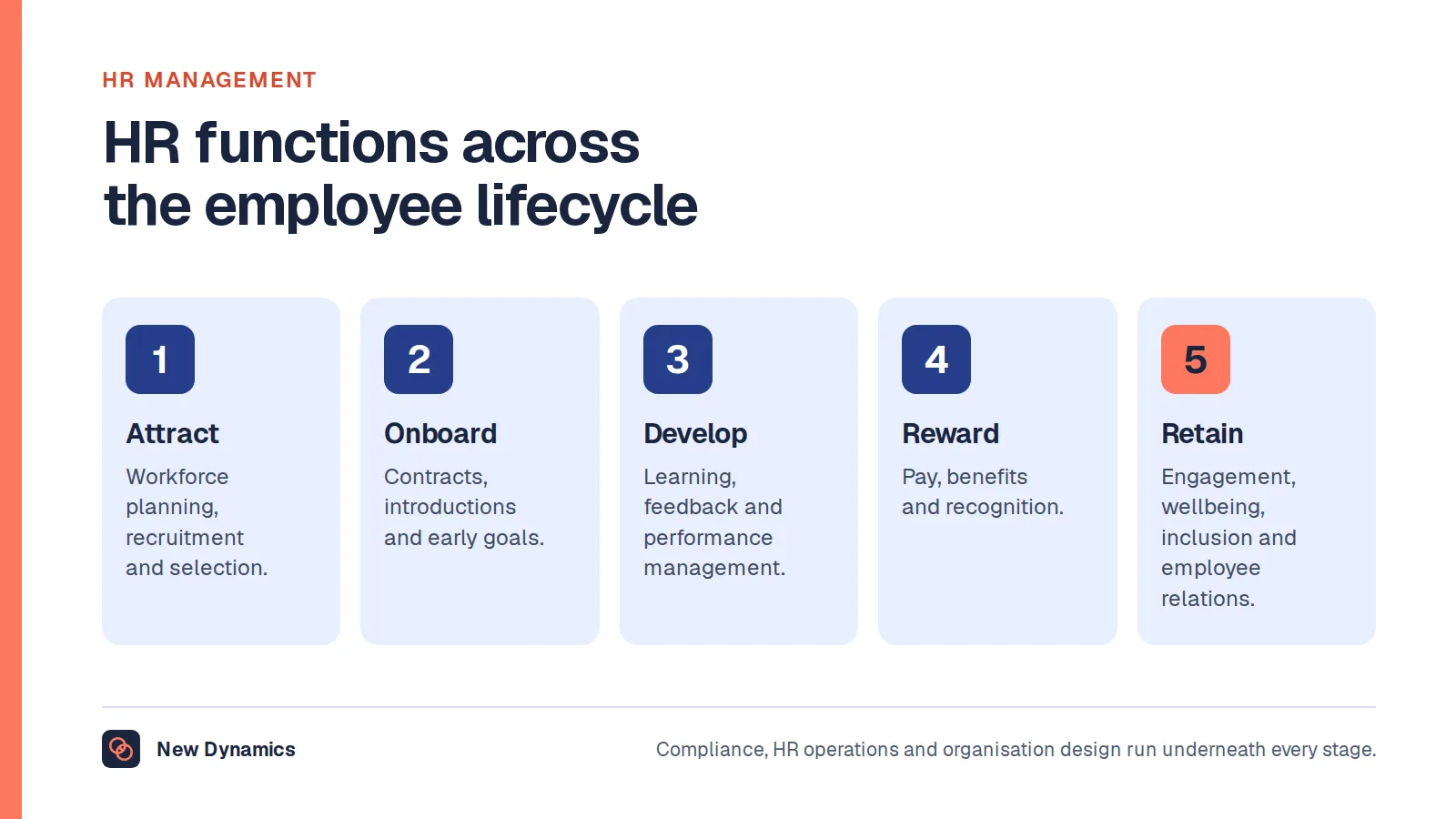
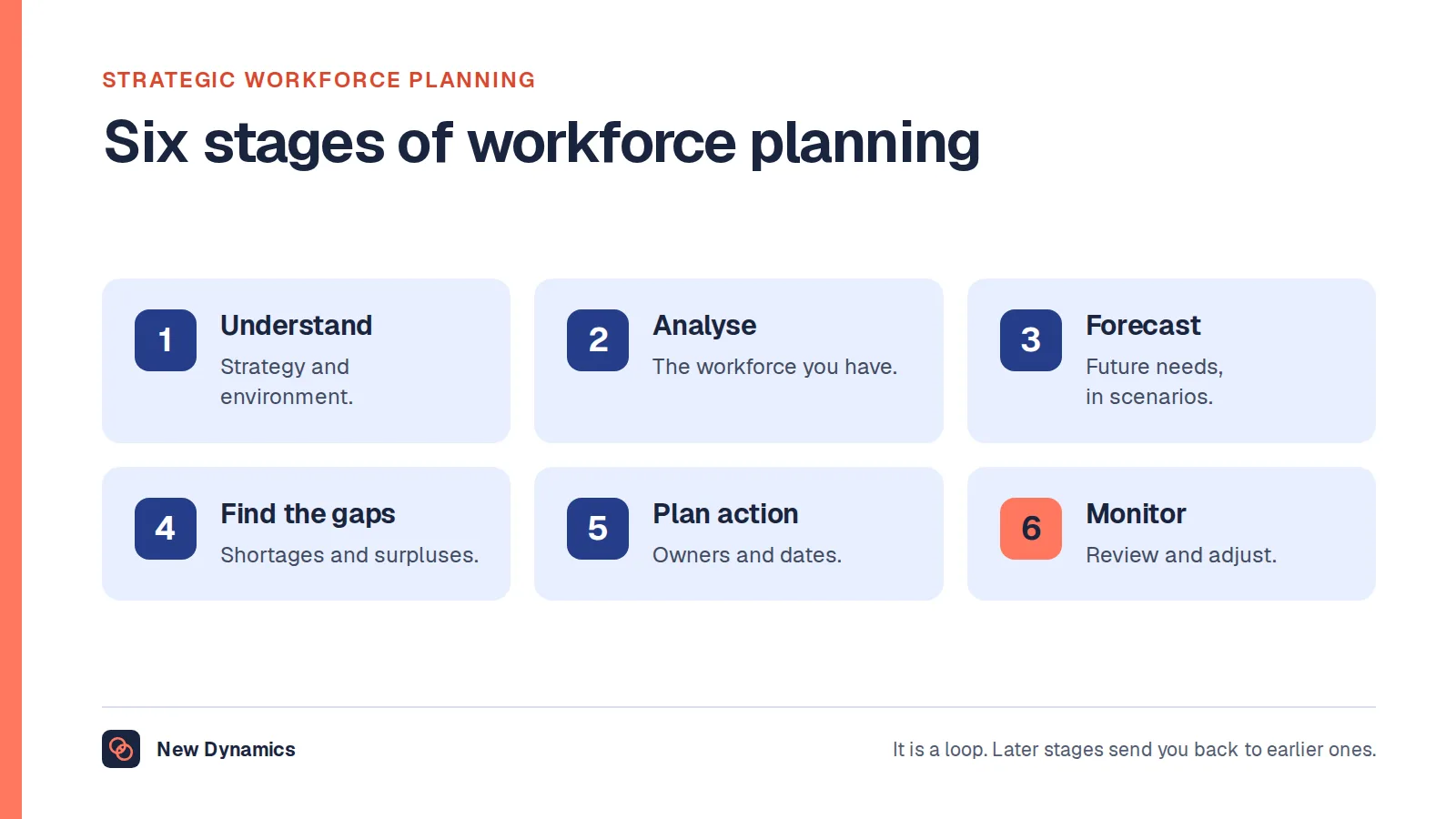
- Plan the workforce. Compare the people, skills and structure you have with what the strategy needs, and decide how to close the gaps: hire, develop, redeploy, contract or automate. The CIPD calls workforce planning the part of people strategy that puts business strategy into action, and our guide to strategic workforce planning sets out the method.
- Align the HR strategies. Recruitment, reward, learning, performance management, succession and employee relations should each be redesigned to serve the plan, and checked against each other so that they do not pull in different directions. Rewarding individual output while asking for teamwork is the classic contradiction.
- Build the culture that delivers. Structure, values, management behaviour and the performance system are what make the strategy real day to day. Our succession planning guide covers the leadership pipeline that carries it.
- Measure, evaluate and adjust. Set a small number of people measures tied to the strategy, review them with the executive team as seriously as the financial ones, and change the plan when the evidence says so.

How to tell whether it is working
The CIPD notes that people analytics is now part of strategic HRM, and that there is no single HRM strategy that delivers success in every case. The measures should therefore be chosen for your strategy, not copied. Useful candidates:
- Capability: the share of critical roles filled with people at the required level, and the time it takes to fill them.
- Succession: the share of critical roles with a ready successor.
- Retention: turnover among the people the strategy depends on, not the average.
- Performance: the share of employees with goals linked to the strategy and reviewed in the year.
- Engagement: survey questions about understanding the strategy and having the tools to deliver it.
- Cost and productivity: people cost against the output the strategy expects.
Treat the numbers as questions for the executive team, not as HR's report card.
Common mistakes
A people strategy written by HR alone. If the executive team did not write it, they will not deliver it.
A strategy without workforce numbers. Aspirations about culture with no plan for who will be in which roles by when.
Functions that contradict each other. Reward, performance management and learning designed separately, each sensible, jointly incoherent.
No evaluation. A strategy launched and never measured is a document.
Confusing planning with strategy. The CIPD, citing Boxall and Purcell, notes that strategic planning is a formal process while strategy exists in every organisation whether or not it is written down. The unwritten strategy is the one that is actually running.
Frequently asked questions
What is strategic human resource management?
Strategic human resource management is the coherent framework through which an organisation hires, manages and develops its people to support its long-term goals. It links every HR activity to the business strategy, matches people to future needs and addresses structure, culture, capability and commitment over years rather than weeks.
What is the difference between HRM and strategic HRM?
HR management runs the functions: hiring, pay, training, employee relations and cases, over weeks and quarters. Strategic HRM decides what those functions are for, links them to the business strategy and to each other, and plans the workforce over two to five years. The first delivers; the second directs.
What does SHRM stand for?
SHRM is the usual abbreviation for strategic human resource management. In the United States the same letters are also the name of a professional body for HR, so check which is meant.
What is human capital management?
Human capital management is the term the US government uses for strategic HRM. The Office of Personnel Management defines it as a set of interrelated strategies and practices aligned with an organisation's mission that guide selecting, developing, training and managing a productive workforce.
What are the main components of strategic HRM?
Using OPM's framework: strategic planning and alignment, talent management, performance culture and evaluation. In practice that means linking the people plan to the strategy, planning the workforce, aligning recruitment, reward, learning, performance and succession, building the culture and measuring the results.
Who is responsible for strategic HRM?
The executive team, led by the chief executive, with the HR director or chief people officer designing and facilitating it. The CIPD describes people professionals as instrumental in applying their expertise to organisational circumstances and designing workforce pipelines; the ownership sits with leadership.
Your next step: check the strategy for people assumptions
- List the capabilities the current business strategy assumes, and mark each as have, build or buy.
- For the critical roles, note who is in them, who could succeed them and by when.
- Check whether reward, performance management and learning point the same way.
- Pick five measures and put them on the executive agenda.
For the leadership pipeline that carries a people strategy, read and download our succession planning guide. The guide is free to read, and the PDF uses our short download form.
Want strategy-linked goals, reviews and development in one place across the whole organisation? Book a New Dynamics demo and bring your current people plan. You can also email contact@new-dynamics.com.