TL;DR
- Manufacturing experience means knowledge or skill gained from working in the business of producing goods in large numbers: on a production line, in a plant or workshop, in engineering, quality, maintenance, planning or supervision within a manufacturing operation.
- It covers six kinds of experience: operating processes and machines, working to standard operating procedures and quality standards, health and safety in a production environment, continuous improvement, working in shifts and teams, and the technical or supervisory roles around the line.
- Candidates should describe it by sector, process, volume, standard and result. Employers should say which kind they need and why, because 'manufacturing experience essential' without detail excludes good candidates and attracts the wrong ones.
“Manufacturing experience essential.” The phrase appears in adverts for operators, engineers, planners, quality inspectors, HR advisers and finance managers, and it means something different in each. A candidate who spent three years assembling gearboxes has it. So does an accountant who did the month-end for a food plant. Whether either has the experience the employer actually wants depends on what the advert did not say.
This article explains the meaning of manufacturing experience, the six kinds of experience the phrase can cover, what counts and what does not, how candidates should describe it on a CV and how employers should specify it in a job advert.
Experience on the line is developed by feedback on the line. See how New Dynamics continuous feedback supports check-ins between managers and their teams.
What does manufacturing experience mean?
Take the two words separately. The Cambridge Dictionary defines manufacturing as “the business of producing goods in large numbers”, and experience as “(the process of getting) knowledge or skill from doing, seeing, or feeling things”. Manufacturing experience, then, is knowledge or skill gained from doing work in the business of producing goods in large numbers.
Three parts of that matter for hiring.
- Producing goods. Physical products, made by processes, in a plant, factory or workshop. Software, services and retail are not manufacturing, however industrial their language.
- In large numbers. Repeatable production to a specification, with volume, cost and quality controlled. A craftsperson making one-off pieces has making experience; whether it is manufacturing experience depends on the volume and the system around it.
- Knowledge or skill from doing. Time spent inside a manufacturing operation, in whatever role, that taught the person how such operations work.
The phrase does not say which role. That is the source of most of the confusion.
Six kinds of manufacturing experience
Skills England's occupational standard for the lean manufacturing operative, a level 2 apprenticeship, describes what the core of the experience looks like at operator level. The operative is expected “to carry out their work safely and meet the exacting quality standards demanded in a fast paced and efficient processing environment”, will be required “to prepare, control, contribute to and complete manufacturing operations, and follow manufacturing processes and standard operating procedures (SOPs)”, and will contribute to improvement “using continuous improvement methods, kaizen tools, process visualisation using lean principles and problem solving tools and techniques”. It also describes responsibility for “carrying out quality checks throughout the manufacturing operations to ensure quality is built in”.
From that description and the roles around the line, manufacturing experience breaks into six kinds.
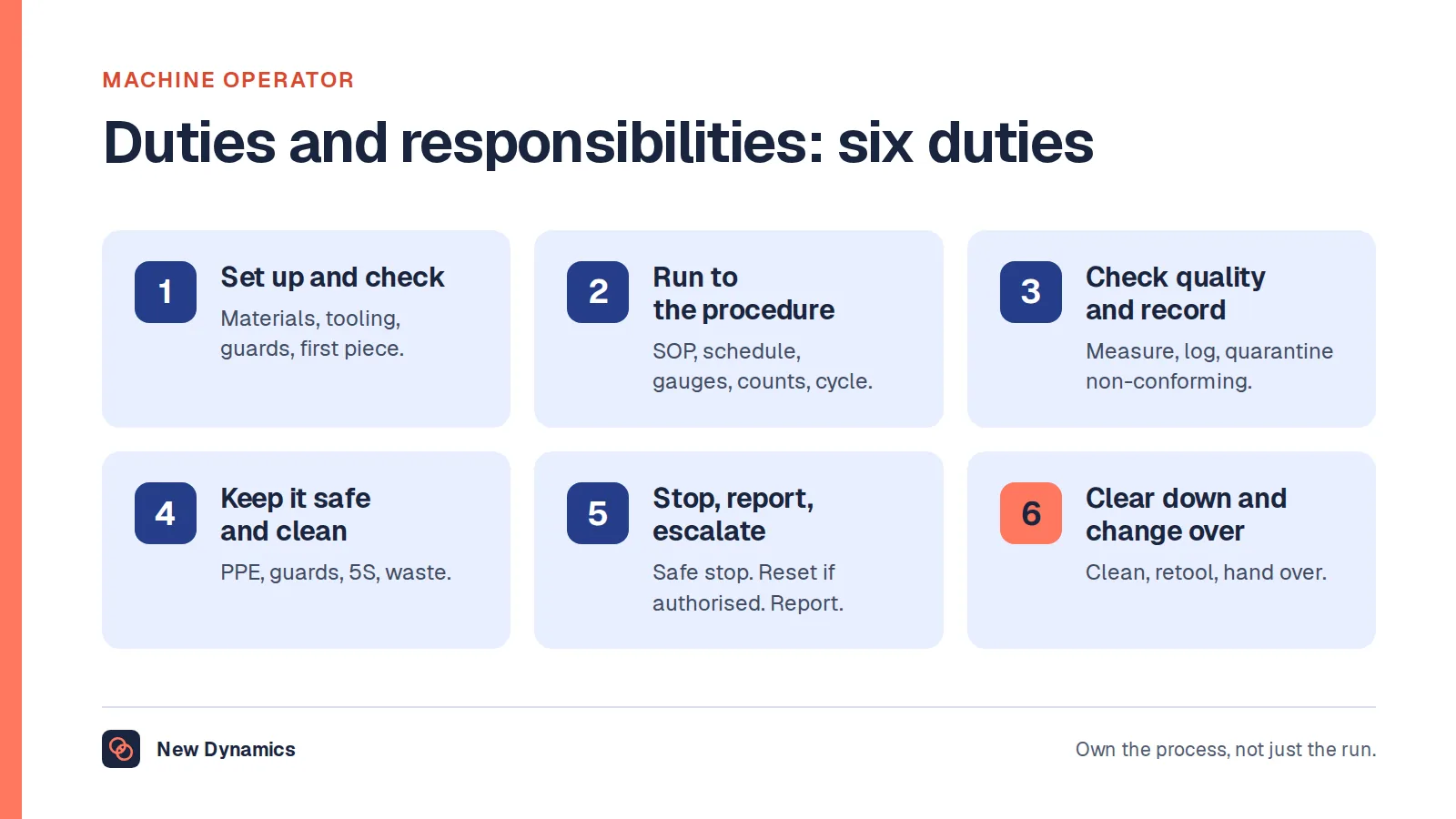
- Process and machine operation. Running, setting, changing over and monitoring production equipment. Our machine operator job description describes the role.
- Working to procedures and standards. Following standard operating procedures, work instructions, specifications and quality systems, and recording what was done. Our assembly worker job description shows this at the station level.
- Health and safety on the line. The standard's list is representative: personal protective equipment, safe use of equipment and tooling, safe stopping and resetting of machinery, an organised work area and safe disposal of waste.
- Continuous improvement. Lean principles, kaizen, problem-solving tools and the habit of suggesting and testing changes.
- Shifts and teams. Working a shift pattern, handing over, and working as one link in a line where your output is the next person's input.
- The roles around the line. Engineering, maintenance, quality, planning, supply chain, supervision and management within a manufacturing operation, each with its own version of the experience. Our welder job description and mechanical engineer job description cover two of them.

What counts, and what does not
| Usually counts | Usually does not, unless the advert says otherwise |
|---|---|
| Operator, technician, engineer, quality, maintenance or planning roles in a plant | Warehouse, distribution or retail roles for a manufacturer's products |
| Supervisory or management roles on a production site | Head office roles for a manufacturer with no plant contact |
| Apprenticeships and placements in production | Studying manufacturing without working in it |
| Support roles based on site and working with production: HR, finance, IT, EHS | Selling to manufacturers |
| Small-batch or job-shop production run to procedures and standards | One-off craft making outside a production system |
The middle column is where adverts go wrong. A production plant's HR adviser has manufacturing experience of a kind that matters to a plant hiring an HR adviser, and none that matters to a plant hiring a setter. The employer has to say which kind it wants. Our guide to job requirements covers separating essential from desirable.
How to describe manufacturing experience on a CV
Employers reading for manufacturing experience want five facts for each role. The lines below are our own examples.
- Sector. Automotive, food and drink, pharmaceuticals, aerospace, electronics, packaging, chemicals: each has its own standards and pace.
- Process. What was made and how: “CNC machining of aluminium housings”, “high-speed bottling line”, “sterile filling”.
- Volume and shift. “Two-shift operation, around [n] units a day.”
- Standard. The quality system and the procedures you worked to: “ISO 9001 site; worked to SOPs and completed batch records.”
- Result. What you improved or kept running: “Cut changeover time on line 3 from [40] to [25] minutes through a kaizen event.”
A CV line that carries all five reads like this: “Production operative, food and drink, [three] years on a high-speed packing line running [n] units an hour across two shifts; worked to SOPs and hygiene standards; led a 5S project that reduced line stoppages.” Our guide to soft skills on a CV covers how to add teamwork and reliability without the clichés.

How employers should specify it in a job advert
“Manufacturing experience essential” fails in both directions: it excludes candidates from adjacent industries who could do the job, and it invites applications from people whose manufacturing experience is the wrong kind. Four fixes.
- Name the kind. “Experience operating automated packaging lines” or “experience in a quality role on a regulated production site”, not “manufacturing experience”.
- Say why. If the reason is safety culture, say so; a candidate from construction may have it. If it is a specific process, say that; nothing else substitutes.
- Decide essential or desirable. Essential excludes. For most roles around the line, sector experience is desirable and the underlying skill is essential.
- Test it. A site tour with questions, a practical task or a case discussion shows manufacturing experience better than a CV does.
Our recruitment and selection guide sets out a fair process for assessing it.

Frequently asked questions
What does manufacturing experience mean?
Manufacturing experience means knowledge or skill gained from working in the business of producing goods in large numbers: in a plant, factory or workshop, on the line or in the engineering, quality, maintenance, planning, supervisory or support roles around it.
What counts as manufacturing experience?
Roles on a production site that involve making, controlling, improving or directly supporting the making of goods: operators, setters, technicians, engineers, quality and maintenance staff, planners, supervisors and site-based support roles. Warehouse, retail and head-office roles for a manufacturer usually do not count unless the advert says they do.
Is warehouse experience manufacturing experience?
Usually not. Warehousing stores and moves goods; manufacturing makes them. Many skills overlap, including safety, procedures and shift work, and a candidate can say so, but an employer asking for manufacturing experience is normally asking for time inside a production operation.
How do I describe manufacturing experience on a CV?
For each role, give the sector, the process, the volume and shift pattern, the standards and procedures you worked to, and a result you achieved or a problem you solved. Numbers and named standards carry more weight than adjectives.
What is a lean manufacturing operative?
In England, a level 2 apprenticeship standard published by Skills England for operatives who carry out manufacturing activities on multiple products with different specifications, working safely to standard operating procedures and quality standards and contributing to continuous improvement using lean principles.
Should a job advert require manufacturing experience?
Only if the job cannot be done without it, and then it should name the kind: the process, the sector or the standard. For most roles around the line, the underlying skill is essential and the sector experience is desirable, and saying so widens the field without lowering the bar.
Your next step
- If you are hiring, replace “manufacturing experience essential” with the specific kind you need and the reason.
- Decide whether it is essential or desirable, and write the assessment method beside it.
- If you are applying, rewrite each production role on your CV with sector, process, volume, standard and result.
- Prepare one story about a problem on the line that you helped to solve.
For a fair way to assess experience from vacancy to offer, read and download our recruitment and selection guide. The guide is free to read, and the PDF uses our short download form.
Want skills, experience and development for every operator and engineer recorded in one place? Book a New Dynamics demo and bring your current job adverts. You can also email contact@new-dynamics.com.