TL;DR
- A machine operator, also called a machine operative or production operative, runs the machinery that makes, processes, assembles or packs a product, following standard operating procedures and checking quality as the work runs. The title covers presses, lines, CNC machines, packaging machines and process plant.
- The job has six duties: set up and check the machine, run it to the procedure, check quality and record results, keep the area safe and clean, stop, report and escalate problems, and clear down and change over. Employers look for concentration, care with quality, safety awareness and the ability to follow a procedure exactly.
- In Great Britain the Provision and Use of Work Equipment Regulations require employers to provide suitable, maintained equipment and to train everyone who uses it. A job description should say which machines the operator will run, what training is given and what safety measures are in place.
A factory looks automated until you watch one shift. Somebody loaded the material, checked the first piece against the drawing, noticed the pressure gauge creeping, stopped the line before the batch was scrap, cleaned the guards and changed the tooling for the next product. That somebody is the machine operator.
This machine operator job description sets out the duties and responsibilities of the job, explains what the title covers, describes the safety rules that apply in Great Britain, separates the operator from the setter and the CNC operator, lists the skills and qualifications employers look for, gives a template that you can adapt and suggests how to describe the work on a CV.
Operators are judged on output, quality and safety, shift after shift, and those targets should be clear to everyone. See how New Dynamics Goals & OKRs keep targets and progress in one place, for a production team as much as for an office.
What is a machine operator?
The Cambridge Dictionary defines an operator as “someone whose job is to use and control a machine or vehicle”. A machine operator runs the machinery that makes, processes, assembles or packs a product. In the UK the same job is often titled machine operative, production operative or process operative; in the United States, machine operator or production worker.
Skills England's lean manufacturing operative apprenticeship standard, a level 2 standard which Skills England now lists as retired, still gives the clearest public description of the job. An operative “will be required to prepare, control, contribute to and complete manufacturing operations, and follow manufacturing processes and standard operating procedures (SOPs) whilst adhering to specific safe working policies & procedures”. The standard lists the job titles it covers: team member production, manufacturing production operative, manufacturing assembly operative, manufacturing inspection or quality assurance operative, manufacturing logistics operative, manufacturing material handling operative and manufacturing process or finishing operative.
The machines vary more than the job does. A press operator, a packaging line operative, a CNC operator, a print finisher and a process operative in a chemical plant all set up, run, check, record, clear down and change over. Skills England's current science manufacturing process operative standard describes the process end: operatives undertake “basic operations and monitoring of plant and equipment, including pumps, valves, temperature gauges, filtration equipment, tanks, vessels and production/processing machinery”, or “safely operate machines to process/manufacture, assemble and finish component parts or finished products by hand, appropriate to their level of responsibility”.
Duties and responsibilities of a machine operator: six duties
- Set up and check the machine. Load materials, tooling and settings for the job, carry out the pre-start checks, confirm guards and emergency stops work, and check the first piece against the specification before running.
- Run to the procedure. Operate the machine or line to the standard operating procedure and the production schedule, feeding materials, monitoring gauges, counts and speeds, and keeping to the cycle.
- Check quality and record. Carry out the in-process quality checks at the set frequency, measure against the drawing or the specification, record results and batch data, and separate anything that does not conform.
- Keep the area safe and clean. Wear the personal protective equipment, keep guards in place, keep the work area organised, and dispose of waste in line with environmental rules. Skills England's standard names 5S as the usual method.
- Stop, report and escalate. Stop the machine safely when something is wrong, reset it where authorised, and report defects, faults and near misses to the team leader, line leader or supervisor.
- Clear down and change over. Clean the machine and the area at the end of the run, change tooling and settings for the next product, and hand over to the next shift with the record complete.
The standard also expects operatives to contribute to continuous improvement using kaizen and problem-solving tools, and to build quality in rather than inspect it in afterwards. The best operators own their process; the advert should say that the job includes improvement, not only running.

Operator, setter, CNC operator and technician
The titles overlap and pay differs, so the job description should say which one it is.
| Title | What they do |
|---|---|
| Machine operator | Runs the machine to the procedure, checks quality, keeps it safe and clean, reports problems |
| Setter, or setter-operator | Sets up and adjusts the machine and tooling for each job, proves the first piece, then runs it or hands it to operators |
| CNC operator | Runs computer numerically controlled machines such as lathes, mills and routers from a proven program, loading, monitoring and checking |
| Technician | Programs, maintains and troubleshoots the machines, and sets standards for the operators |
A CNC operator is a machine operator whose machine follows a program. The operator loads the material, starts the program, monitors the cut, checks the parts against the drawing and changes tools when they wear. Writing and proving the program is usually the work of a setter or a machinist, so an advert for a CNC operator should say whether programming is part of the job or not.

Safety: the employer's duties in Great Britain
Machinery can cause serious injury, and the law puts the duty to prevent it on the employer. The Health and Safety Executive's overview of the Provision and Use of Work Equipment Regulations 1998, known as PUWER, says the regulations require that equipment provided for use at work is suitable for its intended use, safe for use and maintained in a safe condition, inspected to ensure it is correctly installed and does not deteriorate, “used only by people who have received adequate information, instruction and training”, and accompanied by suitable health and safety measures, which “will normally include guarding, emergency stop devices, adequate means of isolation from sources of energy, clearly visible markings and warning devices”.
HSE's page on training and competence adds that “All people using equipment at work must be adequately trained to ensure health and safety in its use, supervision or management”, and quotes regulation 9: employers must “ensure that all persons who use work equipment have received adequate training for the purposes of health and safety, including training in the methods which may be adopted when using work equipment, and risks which such use may entail and the precautions to be taken.” For most everyday equipment, HSE says, adequate training can be delivered in-house using the manufacturer's instructions and the knowledge of experienced workers.
For the job description, that means three things: say which machines the operator will run, say what training will be given and recorded before they run them alone, and describe the guarding, isolation and stop procedures they will be expected to follow. This is general information about Great Britain, not legal advice; other countries have their own machinery rules.
Skills employers ask for
- Following a procedure exactly, every cycle, every shift.
- Concentration over long runs, and the alertness to notice a gauge, a sound or a part that is wrong.
- Care with quality: measuring, recording and stopping when the part is out of tolerance.
- Safety awareness, including guards, isolation, PPE and safe stopping and resetting.
- Basic numeracy and reading, for counts, measurements, drawings and batch records.
- Manual dexterity and physical fitness, for loading, handling and standing through a shift.
- Teamwork and reporting, with clear escalation to the team leader when something goes wrong.
- A willingness to improve the process, which the standard treats as part of the job.
Qualifications and training
No formal qualifications are usually required. Employers train on their machines, procedures and safety rules, and PUWER requires that training. In England the level 2 apprenticeship standards for manufacturing and process operatives, such as the science manufacturing process operative, offer a work-based route, and the level 3 standards lead towards setter, technician and team leader roles. Some machines, such as lift trucks and power presses, need specific training and authorisation before use.
Machine operator job description template
Adapt the machines, the products, the shifts and the checks to your plant.
Job title: Machine operator (production operative)
Reports to: Team leader or production supervisor
Hours: Full time, [rotating days and nights or fixed shifts], with overtime at busy periods
Purpose of the role: To run [the injection moulding machines, the packaging line, the CNC lathes] safely and to the standard operating procedures, producing [product] to the quality standard and the schedule.
Main duties:
- Set up the machine for each job, carry out pre-start checks and confirm the first piece against the specification
- Run the machine to the procedure and the schedule, monitoring materials, settings and output
- Carry out in-process quality checks, record results and batch data, and quarantine non-conforming product
- Keep guards in place, wear PPE and keep the work area clean and organised
- Stop the machine safely when something is wrong, reset where authorised and report faults and near misses
- Clean down and change over at the end of each run and hand over to the next shift
- Contribute to continuous improvement of the process
Skills and experience:
- Experience of operating production machinery [desirable, or essential for specified machines]
- Able to follow written procedures, read drawings or specifications and record data accurately
- Careful, alert and safety-minded
- Reliable on shifts and comfortable standing and handling materials for a full shift
- Level 2 manufacturing or process operative apprenticeship [desirable]
We provide: Full training on each machine before you run it alone, PPE, safety and quality training, shift premiums, and a route to setter, technician and team leader roles.
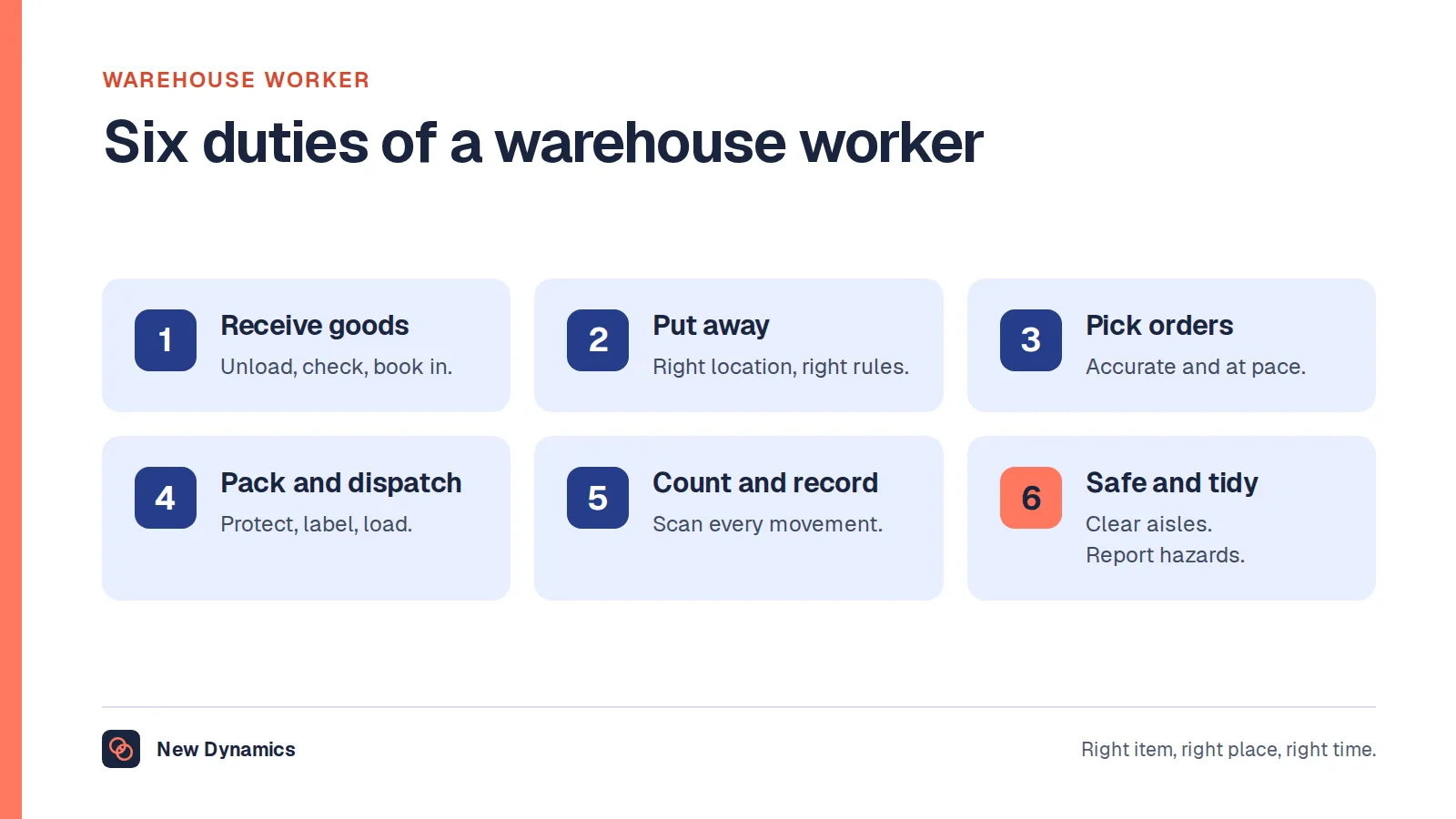
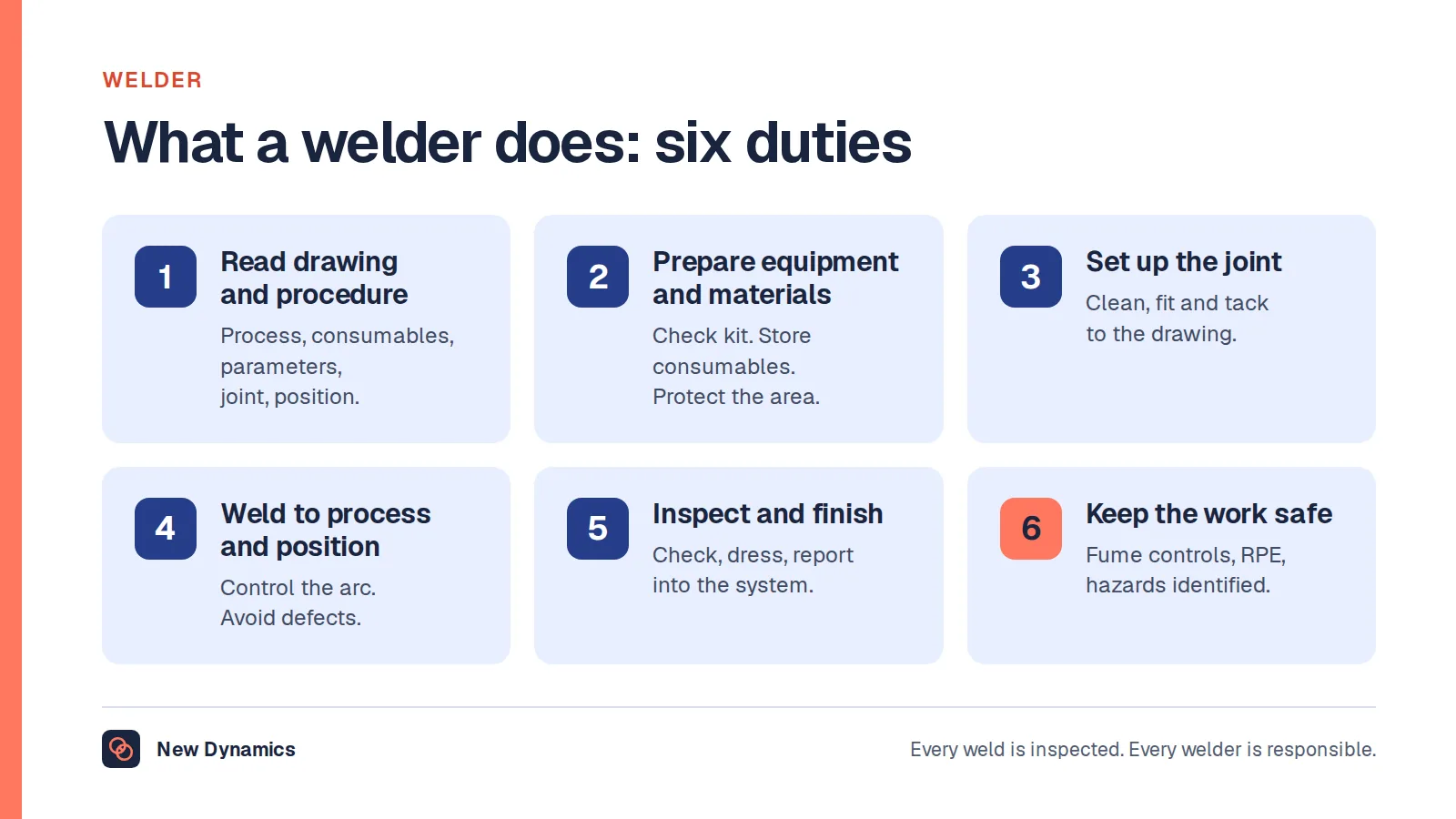
For the layout of the whole document, use our job description template. For the neighbouring roles that move the materials, see our warehouse worker job description, and for the trade that joins the metal, our welder job description.
How to describe machine operating on a CV
Employers want the machines, the products, the standards and the record. The lines below are invented examples, to show the form.
- Name the machines. “Operated three injection moulding machines producing automotive trim on rotating shifts.”
- Show quality. “Carried out hourly dimensional checks; line scrap rate under 1% for two years.”
- Show safety. “Two years without a lost-time incident; trained in isolation and lockout procedures.”
- Show changeovers. “Completed tool changeovers within the 20-minute standard.”
- Show improvement. “Proposed a fixture change that cut set-up time by a quarter.”
Common mistakes in machine operator adverts
No machines named. A press operator and a packaging line operative are different jobs to the people who do them. Name the equipment.
Hidden shifts. Nights and rotating patterns belong in the first paragraph, with the premiums.
Nothing on training. Candidates without experience of your machines will apply if you say you train them. The law requires that you do.
Running only. If the job includes quality checks, changeovers and improvement, say so. It makes the job more interesting and the applicant pool better.

Frequently asked questions
What are the duties and responsibilities of a machine operator?
A machine operator sets up and checks the machine, runs it to the standard operating procedure and the schedule, carries out quality checks and records results, keeps the area safe and clean, stops and reports problems, and clears down and changes over at the end of each run. Many operators also contribute to continuous improvement.
What does a machine operator do all day?
Loads materials and tooling, runs the machine through its cycles, monitors gauges, speeds and output, checks parts against the specification at set intervals, records batch data, clears faults or calls for help, keeps the area clean and changes over for the next product or shift.
What is a CNC operator?
A CNC operator runs computer numerically controlled machines, such as lathes, mills and routers, from a proven program. The operator loads material, starts and monitors the program, checks parts against the drawing and changes worn tools. Programming is usually the setter's or machinist's job, so an advert should say whether it is included.
What is the difference between a machine operator and a setter?
The setter sets up and adjusts the machine and tooling for each job and proves the first piece. The operator runs the machine once it is set, checks quality and reports problems. Many small plants combine the two as a setter-operator.
What qualifications do you need to be a machine operator?
Usually none. Employers train operators on their machines and procedures, and in Great Britain the Provision and Use of Work Equipment Regulations require adequate training before anyone uses work equipment. Level 2 manufacturing and process operative apprenticeships are a work-based route in England.
What should a machine operator job description include?
The machines the operator will run, the products and the quality standard, the shifts and premiums, the six duties, the training given before running alone, the safety measures and procedures, the physical demands and the route to setter, technician and team leader roles.
Your next step: write the advert around the machine
- Name the machines, the products and the quality standard.
- Put the shifts and the premiums in the first paragraph.
- Say what training you give before an operator runs alone, and how it is recorded.
- Include quality checks, changeovers and improvement in the duties.
An operator's first weeks are training weeks, and they should be planned. Read and download our employee onboarding guide. The guide is free to read, and the PDF uses our short download form.
Want output, quality and safety targets visible to every operator and team leader? Book a New Dynamics demo and bring your current shift targets. You can also email contact@new-dynamics.com.