TL;DR
- An assembly worker, assembler or production line worker builds products on a line of machines and workers that a product moves along while it is being built. In the UK the role sits inside the Skills England lean manufacturing operative standard, which lists team member production and manufacturing assembly operative among the job titles it covers.
- The duties and responsibilities of a production worker fall into six groups: build to the sequence and the standard operating procedure, check components and quality, work safely, keep the area organised, record and report, and contribute to improvement. The standard's assembly role option adds checking components, positioning, aligning and securing them, and producing assemblies that comply with the specification.
- Write the description around the products, the line, the shift pattern and the physical demands, and ask for the behaviours the standard names: punctual, reliable, follows instructions, attention to detail and maintains quality under pressure.
The assembly line is over a century old and still the way most physical products are made: a product moves, and each person along the line adds, fits, fastens or checks something before it moves on. The assembly worker is the person at one of those stations. The title varies, assembler, production worker, production line worker, production operative, team member, but the job is recognisably the same.
This article gives an assembly worker job description: what the role is, the duties and responsibilities of a production worker as the Skills England apprenticeship standard sets them out, the skills and behaviours to ask for, routes in and a template to adapt. The standard is English; the duties travel anywhere there is a line.
Line work is judged on output, quality and safety every shift. See how New Dynamics Goals & OKRs keep targets and progress in one place.
What is an assembly worker?
The Cambridge Dictionary defines an assembly line as “a line of machines and workers in a factory that a product moves along while it is being built or produced”. An assembly worker is one of those workers.
In England the role is described by Skills England's lean manufacturing operative apprenticeship standard, a level 2 programme. The standard says a lean manufacturing operative “will be expected to carry out their work safely and meet the exacting quality standards demanded in a fast paced and efficient processing environment and develop into a multi-skilled operator through process ownership”, and lists the job titles it covers: “Team Member Production ; Manufacturing Production Operative; Manufacturing Assembly Operative; Manufacturing Inspection/Quality Assurance Operative; Manufacturing Logistics Operative; Manufacturing Material Handling Operative; Manufacturing Process/Finishing Operative.”
So an assembler and a production worker are, in the standard's terms, the same occupation with a production or assembly job role. A machine operator is a neighbouring role that runs and sets equipment rather than building the product; our machine operator job description covers it.
Duties and responsibilities of a production worker
The standard's assembly role option is specific. In our words, a production or assembly operative must be able to check components for damage and that they are usable; correctly position, align and secure components using the specified fastening device or method; obtain and follow the job instructions, standard operating procedures and assembly specifications within the time constraints; produce components that comply with the specification and quality requirements; and carry out quality checks on parts and completed assemblies, dealing with concerns and defects within their responsibility.
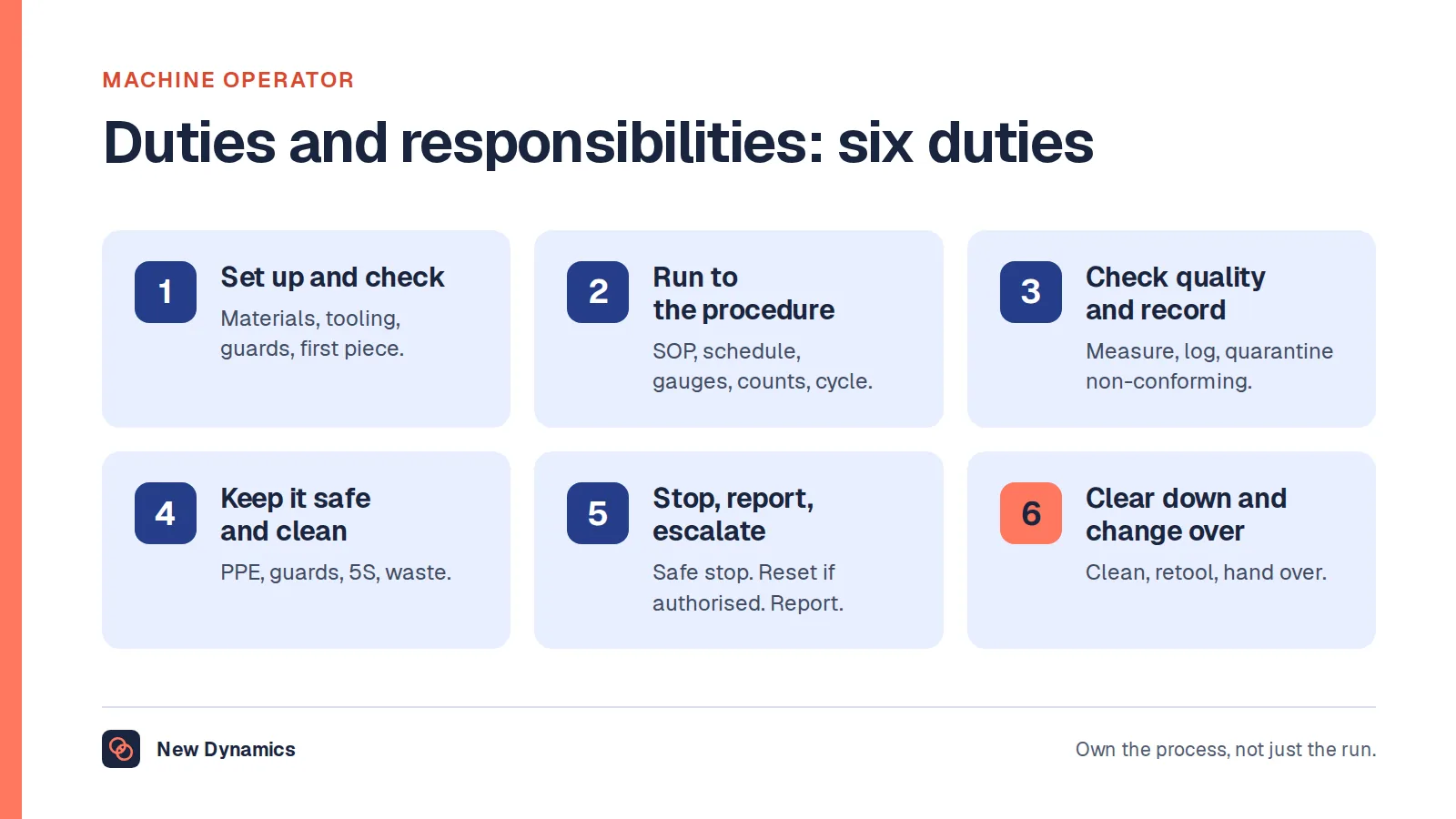
Around that sit the core requirements the standard sets for every lean manufacturing operative. Grouped for a job description, the work has six duties.
- Build to the sequence. Follow the specified assembly sequence, the standard operating procedure and the specification, every time, at the line's pace.
- Check components and quality. Inspect parts before use, check the assembly against the quality standard, and raise defects rather than pass them on.
- Work safely. The standard names wearing the correct personal protective equipment, correct use of equipment and tooling, safe stopping and resetting of machinery, and safe disposal of waste.
- Keep the area organised. The standard uses 5S, which it spells out as sifting, sorting, sweeping, spick and span, and sustain.
- Record and report. Complete check sheets and process data accurately and legibly, and escalate problems to the team leader, line leader or supervisor.
- Contribute to improvement. Generate ideas and take part in improvement activity; the standard names kaizen tools and the seven wastes: defects, overproduction, transportation, waiting, inventory, motion and processing.

Skills, knowledge and behaviours
The standard's core knowledge covers health and safety, environmental compliance, the operative's role in meeting cost and delivery targets, standard operating procedures, quality control, problem solving, continuous improvement, communication and workplace organisation. Its core skills match: working safely and managing tooling and materials, following procedures across several processes, selecting the right tools, keeping process documentation, solving problems within the limits of responsibility, and sharing information orally, in writing and on information boards.
The behaviours are the part most job descriptions leave out and most supervisors care about. The standard says an operative must be “Punctual, reliable and takes responsibility for their own actions”, must respond positively to change, integrate within the team and support others, work independently in challenging situations, and “Maintains quality of work under pressure”, and must follow “instructions and guidance and demonstrates attention to detail”.
For an assembly job specifically, add manual dexterity, the stamina to stand and repeat precise movements for a shift, and the discipline to stop the line rather than let a doubtful part through.
Settings and shift patterns
Assembly work covers vehicles and their components, electronics, furniture, white goods, medical devices, food packaging lines and much else. The standard notes that operatives may work on multiple products with different specifications consecutively, giving multi-model vehicle manufacturing as its example. What changes between settings is the pace, the tolerances, the cleanliness rules and the shift pattern.
Say in the description: the products and the line, the takt or target rate if you use one, the shift pattern and rotation, overtime expectations, the physical demands (standing, lifting, repetitive movement), and whether the job includes rotation between stations or lines.

Routes in and qualifications
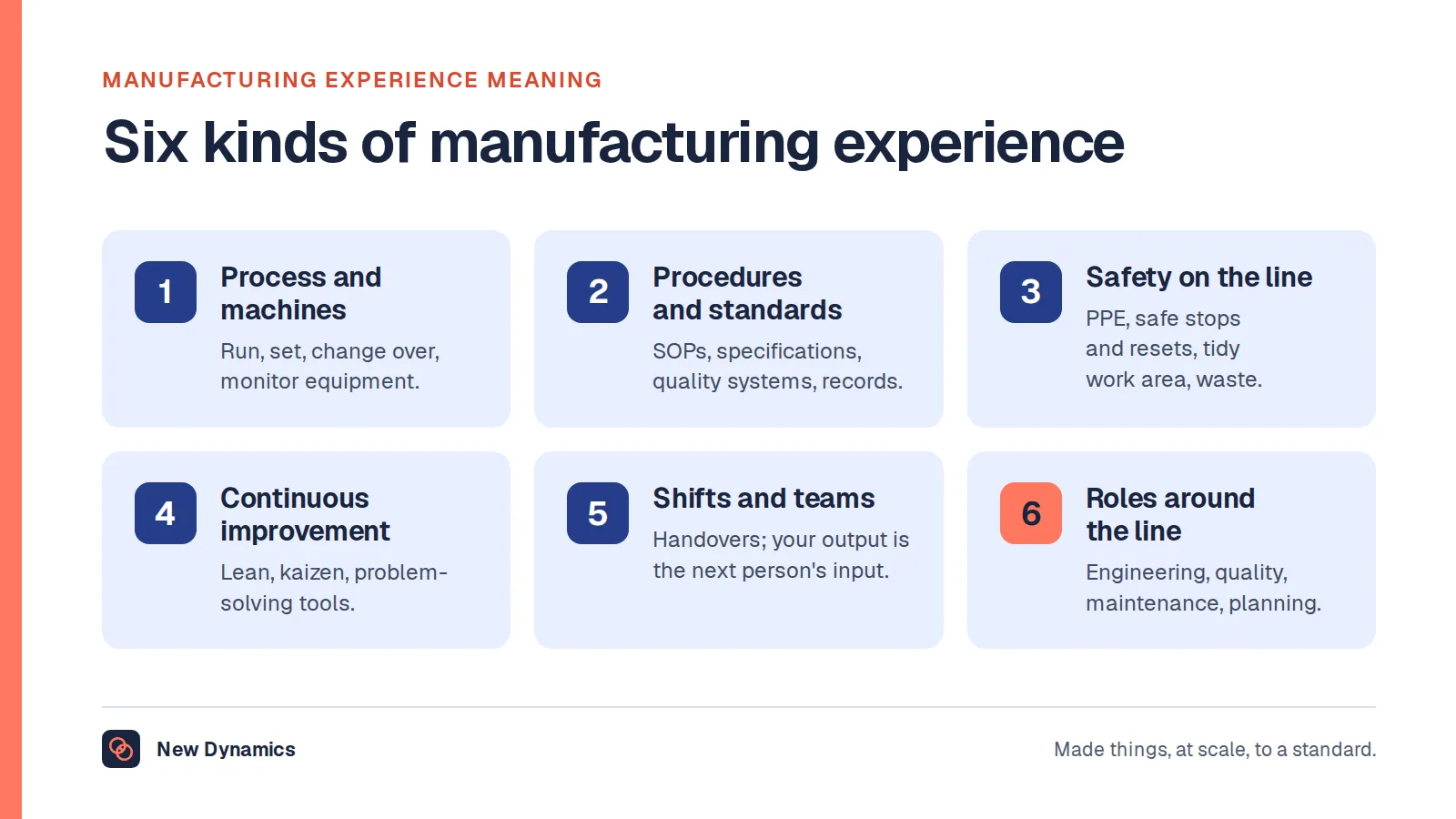
Most assembly workers start with no specific qualification and learn the stations on the job. In England the lean manufacturing operative apprenticeship at level 2 formalises that training. Experience on any line is transferable, though the tolerances and the quality system will be new. Our guide to manufacturing experience explains what to ask for and what counts.
An assembly worker job description template
Job title: Assembly Worker (or Production Operative, Team Member Production)
Reports to: Team Leader or Line Leader
Purpose: Build products to the specified sequence, standard and rate, safely, so that every assembly leaving the station meets the quality standard.
Responsibilities:
- Assemble components following the assembly sequence, standard operating procedures and specifications.
- Check components for damage before use; position, align and secure them with the specified method.
- Carry out quality checks on parts and completed assemblies; raise and record defects; stop the line when instructed or required.
- Work safely: wear the correct PPE, use equipment and tooling correctly, stop and reset machinery safely, dispose of waste correctly.
- Keep the workstation organised to 5S standards.
- Complete check sheets and process records accurately and legibly.
- Escalate problems to the team leader and support problem-solving activity.
- Contribute ideas to continuous improvement.
- Rotate between stations and lines as trained.
Skills and experience:
- Ability to follow written and visual instructions with attention to detail.
- Manual dexterity and the fitness to stand, lift and repeat precise movements for a full shift.
- Punctual, reliable and consistent under time pressure.
- Basic numeracy and literacy for check sheets and data.
- Experience on a production line: desirable, not essential; we train.
Working pattern: Shift pattern and rotation, overtime, breaks, PPE provided.
Our job description template explains each section, and our employee onboarding guide covers the first weeks, when the stations are learned.

Frequently asked questions
What does an assembly worker do?
An assembly worker builds products at a station on a production line: checking components, positioning, aligning and securing them with the specified method, following the assembly sequence and standard operating procedures, checking quality, working safely, keeping records and raising problems to the team leader.
What are the duties and responsibilities of a production worker?
Six groups: build to the sequence and procedure, check components and quality, work safely with the right PPE and equipment practice, keep the area organised, record and report, and contribute to continuous improvement. The Skills England lean manufacturing operative standard sets these out as the core of the occupation.
What is the difference between an assembler and a production worker?
Very little. The Skills England standard lists team member production, manufacturing production operative and manufacturing assembly operative as titles for the same occupation. Assembler usually signals a station where components are fitted together; production worker is the broader label for anyone working on the line.
What skills does an assembly worker need?
The ability to follow instructions with attention to detail, manual dexterity, stamina for shift work, reliability and punctuality, basic numeracy and literacy for records, and the discipline to raise a defect rather than pass it on. The standard also names problem solving, communication and workplace organisation.
What qualifications does an assembly worker need?
Usually none. Most employers train on the job; in England the lean manufacturing operative apprenticeship at level 2 provides a structured route. Employers may ask for GCSE-level English and maths for the records and check sheets.
What is a production line worker?
A production line worker is an assembly or production worker whose station is on a moving line: the product moves along a line of machines and workers, and each person adds or checks something before it moves on. The duties are those described above, at the pace the line sets.
Your next step: describe the line
- Name the products, the line and the target rate.
- State the shift pattern, rotation and physical demands.
- Use the six duties and the standard's behaviours for the description and the interview.
- Plan the first weeks: station training, quality standards and a named trainer.
For a structured start on the line, read and download our employee onboarding guide. The guide is free to read, and the PDF uses our short download form.
Want output, quality and safety targets visible for every team member and team leader? Book a New Dynamics demo and bring your current job descriptions. You can also email contact@new-dynamics.com.