TL;DR
- Zero hours contracts are lawful in the UK. GOV.UK calls them casual contracts and says the employer does not have to give work and the worker does not have to accept it. Most zero hours staff are workers rather than employees, and that distinction decides which rights they have.
- Some rights apply whatever the status: the National Minimum Wage, holiday and holiday pay, rest breaks, protection from discrimination and payslips. Exclusivity clauses cannot be enforced. Statutory Sick Pay needs an employment contract, some work done under it and a full working day of sickness, and since 6 April 2026 it is paid from the first day with no lower earnings limit.
- The Employment Rights Act 2025 legislates guaranteed hours, reasonable notice of shifts and payment for shifts cancelled at short notice, but Acas says the government has not announced when those changes will happen. This is general information rather than legal advice, and the area is moving, so check the current GOV.UK page.
Most employers do not get into trouble for using a zero hours contract. They get into trouble for using one long after the work stopped being casual: the same four people, the same shifts, every week for two years, on paperwork that says the company owes them nothing. The contract is lawful. The way it is being used is the problem, and it is both a legal risk and the reason good casual staff leave for a competitor who offered them a rota.
This article sets out what a zero hours contract is, what the law actually requires, which rights apply whatever the employment status, where the sick pay and notice answers really land, what the Employment Rights Act 2025 changes and what it does not change yet, and then the half that employers skip: how to schedule, record and include casual staff so the arrangement works for both sides.
If you want shift offers, refusals and availability sitting on one visible path instead of in a manager's text messages, see how New Dynamics workflows handle a process with handoffs in it.
What a zero hours contract is
A zero hours contract is an arrangement where the employer does not guarantee any minimum hours, and offers work shift by shift as it comes up. GOV.UK puts the arrangement plainly: "Zero-hours contracts are also known as casual contracts," and they are "usually for 'piece work' or 'on call' work, for example for interpreters." Under the arrangement, employers "do not have to give them work" and the staff "do not have to do work when asked" (GOV.UK, zero hour contracts).
Acas describes the same thing from the worker's side: "Your employer does not have to give you any minimum working hours" (Acas, zero-hours contracts).
So yes, they still exist, and they are widely used. The government's own factsheet on the reforms cites Office for National Statistics Labour Force Survey analysis for October to December 2025 showing "there are around 1.2 million people in employment on zero hours contracts in the UK, representing around 3.6% of all people in employment in the UK during that period," concentrated in hospitality, transport, arts and other services, health and social care, and wholesale and retail (GOV.UK factsheet: reforms of zero hours and similar contracts). For the wider workforce picture, see our HR statistics hub.
Is a zero hours contract legal in the UK?
Yes. There is no ban on zero hours contracts in the UK, and none is proposed. What has been restricted is a specific abuse of them: an exclusivity clause that stops someone working elsewhere. GOV.UK states that workers "can ignore a clause in their contract if it bans them from looking for work" or "accepting work from another employer." Acas puts the duty on the employer: "Your employer must not try to stop you working for another employer by putting an exclusivity clause in your contract."
If your casual contract template still contains an exclusivity clause, it is unenforceable and it should come out. Keeping it in sends a signal to staff that the company either does not know the law or expects them not to check.
One duty often missed: GOV.UK is explicit that "You are still responsible for health and safety of staff on zero-hours contracts." Casual does not mean outside the induction, the risk assessment or the training record.
The employment status question underneath every zero hours contract
This is the part that decides almost everything else, and it is the part most casual arrangements never settle. Acas states the principle in one line: "Your rights are based on your employment status, not on having a zero-hours contract."
In UK law there are three broad statuses. An employee works under a contract of employment and has the full set of rights, including the right not to be unfairly dismissed after the qualifying period, statutory redundancy pay and statutory notice. A worker has a narrower set, covering pay, working time, holiday and discrimination. Someone genuinely self-employed has fewer still.
Most zero hours staff are workers rather than employees, because there is usually no mutual obligation to offer and accept work. But the label on the paperwork does not decide it. What decides it is how the relationship actually runs. If the same person is rostered every week, is expected to turn up, cannot realistically refuse without consequence and is managed exactly like the permanent team, an employment tribunal may well find they are an employee whatever the contract says.
That is the real legal exposure in casual working, and it is not a technicality. If the arrangement is found to be employment, dismissal procedure, notice and redundancy all arrive with it, usually at the worst possible moment.
Audit it honestly. Pull the last six months of shifts for every casual worker and look at who is working a de facto fixed pattern. Our post on HR compliance covers how to keep that kind of review as a standing check rather than a panic.
The rights that apply whatever the status
Some rights do not depend on resolving the status question, because they belong to workers and employees alike. Acas lists them: "By law, as an employee or worker you have employment rights including: National Minimum Wage and National Living Wage, holiday and holiday pay, rest breaks, protection from discrimination, receiving pay slips."
GOV.UK says the same about the two that get shortchanged most often: "Zero-hours workers are entitled to statutory annual leave and the National Minimum Wage in the same way as regular workers."

In practice, four things go wrong here:
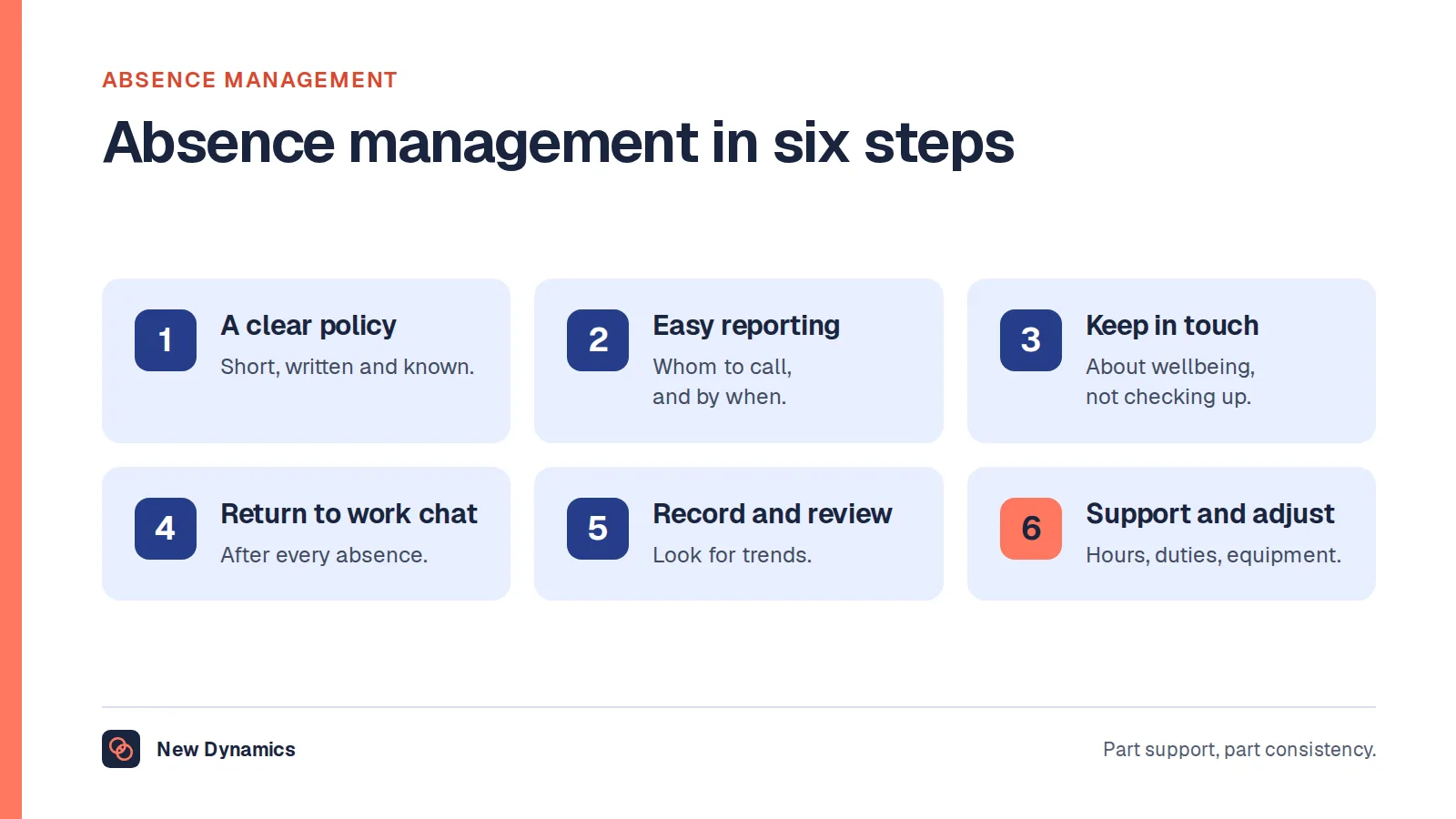
- Holiday is treated as a perk rather than an entitlement. Casual staff accrue statutory leave, and someone has to calculate it, record it and pay it. If nobody owns the calculation, it surfaces as a dispute when the person leaves. Our post on absence management covers keeping one record for everyone rather than a separate spreadsheet for casuals.
- Travel, training and waiting time are unpaid. If it counts as working time, it counts for the minimum wage.
- Rest breaks are not scheduled, because the shift was built around demand and not around the Working Time Regulations.
- Discrimination protection is forgotten in scheduling. Cutting someone's shifts after they disclose a pregnancy, a disability or a religious observance is not a neutral scheduling decision, and a schedule is evidence.
Do zero hours contracts get sick pay?
This is the most searched question in this area, and it has a precise answer rather than a yes or no.
Statutory Sick Pay is for employees, and GOV.UK sets out the qualifying conditions: "To qualify for Statutory Sick Pay (SSP) employees must: have an employment contract; have done some work under their contract; have been sick for at least one full working day - known as a 'period of incapacity for work'; give you notice and proof of illness when needed" (GOV.UK, statutory sick pay: eligibility).
On the amount and duration, GOV.UK states: "The weekly rate for Statutory Sick Pay (SSP) is £123.25 or 80% of average weekly earnings - whichever is lower. It's paid for up to 28 weeks." It also notes that "SSP is paid for the days an employee normally works - called 'qualifying days'," and that calculations "are usually based on average weekly earnings over an 8-week period" (GOV.UK, SSP entitlement).
Two changes already in force matter a great deal for low and variable hours. Acas records that from 6 April 2026, "statutory sick pay is paid from the first day of illness, instead of the fourth day" and "the lower earnings limit has been removed" (Acas, Employment Rights Act 2025). Before that, a casual worker earning below the lower earnings limit got nothing at all. That barrier is gone.
So the honest employer answer is this. Sick pay turns on the employment contract test and the qualifying conditions above, not on the words "zero hours" on the paperwork, and the earnings barrier that used to exclude most casual staff has been removed. Many zero hours staff who previously fell outside SSP now fall inside it. Work the position out per person, write it down, and tell them what it is before they are ill rather than after.
Notice on a zero hours contract
Readers ask how much notice is required on a zero hour contract. Acas is blunt about the default position on shifts: "By law there's no requirement for either you or the employer to give notice."
That is the statutory floor, and it is not the whole answer. The notice position on a zero hours arrangement depends on two things.
What the contract says. A casual contract can commit the employer to a notice period for shifts, for assignments or for ending the arrangement altogether. If it does, that term binds you. Many casual templates say nothing, which is exactly why managers improvise.
Employment status. If the person is in fact an employee rather than a worker, statutory minimum notice applies to ending their employment, and so does dismissal procedure. This is the status question returning with a bill attached.
The practical advice is the same either way: decide a notice standard, write it into the contract, and hold managers to it. An employer that cancels shifts the night before, lawfully, is still training its best casual staff to find a job somewhere steadier.
What the Employment Rights Act 2025 changes, and what it does not change yet
Be careful here, because a great deal of commentary presents future commencement as current law.
The Employment Rights Act 2025 is on the statute book. It inserts a new "Part 2A of the Employment Rights Act 1996 (zero hours workers and similar)", and section 27BA(1) states that "An employer must make a guaranteed hours offer to a worker in accordance with section 27BB after the end of every period" that is a reference period in which the worker is a qualifying worker (Employment Rights Act 2025, section 1). Sections 1 to 4 of the Act cover the right to guaranteed hours, shifts and rights to reasonable notice, the right to payment for cancelled, moved and curtailed shifts, and the extension of all of it to agency workers.
The government's factsheet describes the three measures as:
- "A right to guaranteed hours, where the number of hours offered reflects the hours worked by a qualifying worker during a reference period"
- "A right to reasonable notice of shifts"
- "A right to payment for shifts cancelled, curtailed, or moved at short notice"

Now the part that matters for planning. These zero hours measures are not in force. Acas states that the zero hours and low hours contract changes have not yet been implemented, and that "The government has not announced when the zero-hours and low-hours contract changes will happen."
Nor is the detail settled. The factsheet is explicit that the length of reference periods "will be set in regulations", that the hours threshold "will be specified in regulations", that the regularity requirements are "to be set out in regulations", that the government "will use regulations to state how much notice should be presumed reasonable", and that the amount of a short notice payment and what counts as "short notice" "will be set in regulations". On sectors where notice is hard, it says: "Depending on the specific circumstances, it is possible that even very short notice could count as 'reasonable'."
Three things in the factsheet are worth knowing now, because they settle common fears.
- A worker can say no. "Individuals will be able to reject an offer of guaranteed hours and remain on their current arrangement if they wish."
- Worker-initiated changes do not trigger a payment. "Employers will not have to make a short notice payment where the cancellation, movement or curtailment is initiated by the worker."
- Agency work is not a way round it. The Act "extends the right to a guaranteed hours offer to qualifying agency workers", with hirers responsible by default.
What to do with that: do not rewrite your contracts today for rules whose numbers do not exist yet. Do start recording the hours each casual worker actually works, shift by shift, because every version of the guaranteed hours duty is calculated from a reference period of real hours. An employer who cannot produce that history will not be able to answer the question when it arrives.
The disadvantages, honestly
For the employer:
- Status risk. The longer a casual arrangement runs like employment, the weaker the paperwork gets.
- No reliable supply. The flexibility is mutual. Staff can refuse, and the people who refuse first are the ones with other options.
- Administrative weight per hour. Holiday accrual, variable pay, shift records and status reviews cost more per hour worked than a fixed contract does.
- Quality and turnover. Casual teams churn, so you are training continuously and carrying the error rate of people who are always new.
- Reputation in a tight local market. Shift cancellations travel fast within a town or a sector.
For the worker, and this feeds straight back into your retention problem:
- Income is unpredictable, which affects tenancies, credit and childcare.
- Hours can be withdrawn without a formal process, so raising a concern feels unsafe.
- Short notice makes a second job hard to hold, which is the practical reason exclusivity clauses are unenforceable.
- Underemployment is common. The government factsheet records that among people on zero hours contracts, "26% report that they would like to work more hours (underemployed), compared to 8% not on zero hours contracts."
When a zero hours contract is the wrong tool
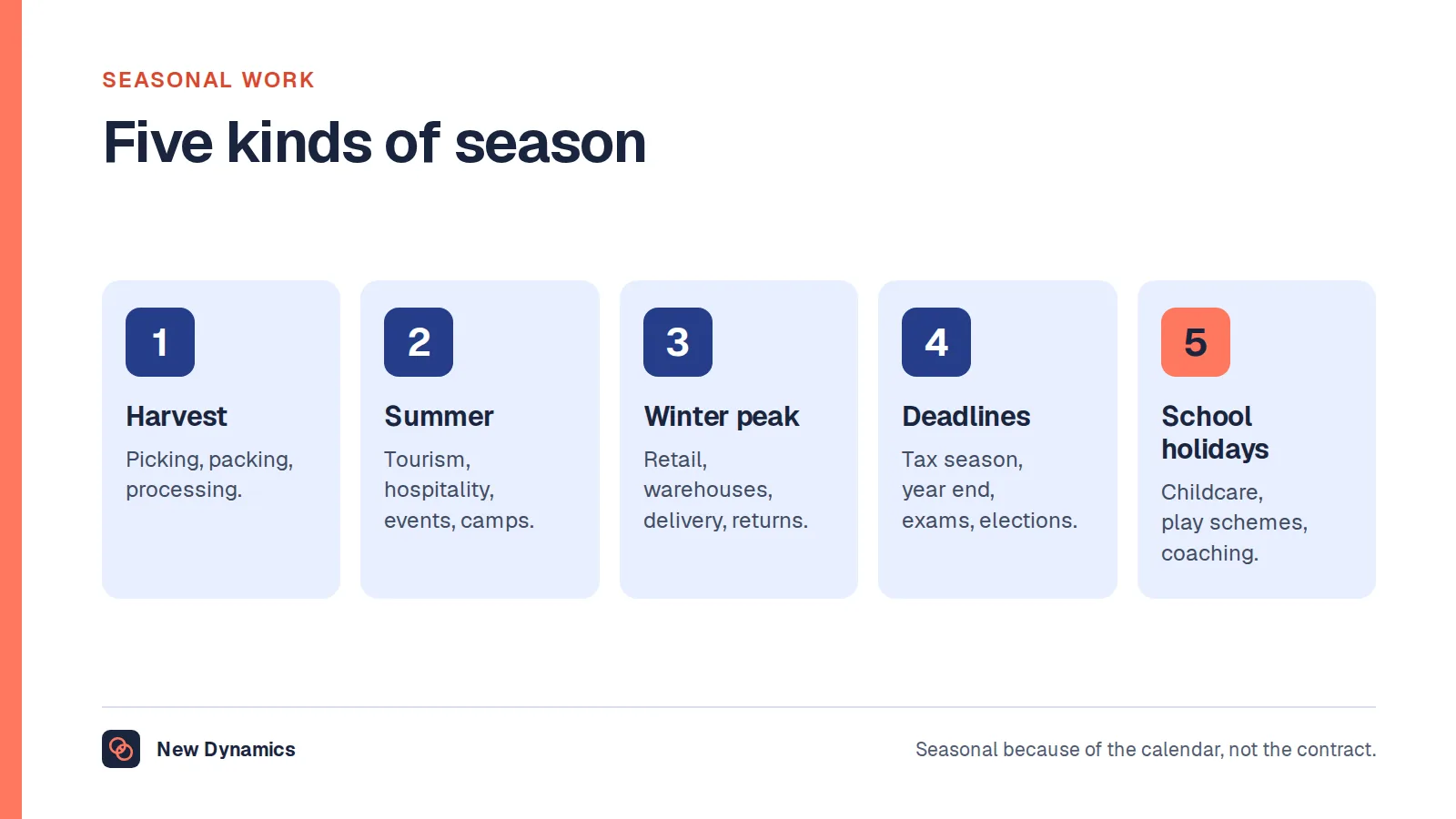
A zero hours contract fits genuinely unpredictable demand: a cover pool, event work, seasonal peaks, specialist call-off work. Our post on seasonal jobs covers that pattern properly.
It is the wrong tool whenever the work has become regular and predictable. Three tests:
- The pattern test. If you can predict next month's rota for this person from last month's, the work is not casual.
- The refusal test. If a refusal would cause a problem, or would quietly cost them shifts, the mutual flexibility is fiction.
- The management test. If they are supervised, appraised and disciplined exactly like your permanent staff, a tribunal will notice before you do.

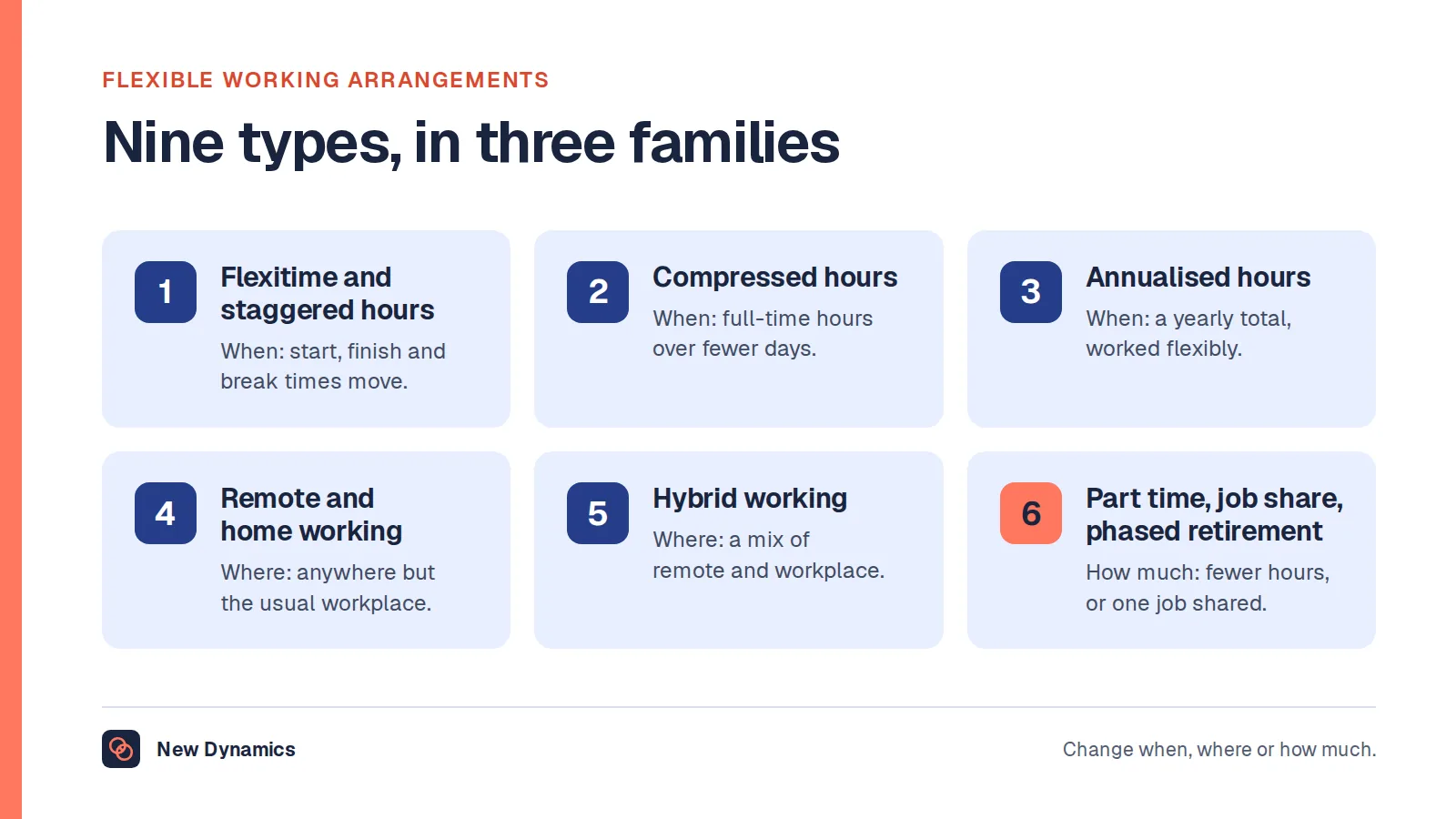
Where the work is regular, a part-time or annualised hours contract is usually the better answer, and it costs less than the churn it prevents. If flexibility is what both sides want, formalise it. Our post on flexible working arrangements covers the options that give predictability without giving up variation.
Running zero hours work well: the HR process half
The law is the floor. Nearly every complaint about casual working is a process failure rather than a legal one.
Schedule fairly, and make the method visible
- Publish shifts as far ahead as you honestly can, and say what that standard is. A stated two week horizon that you keep beats a vague promise you break. Note that reasonable notice of shifts is a legislated right waiting on regulations, so an employer who already schedules decently will have little to change.
- Offer shifts by a rule, not by favour. Rotation, availability, skill match, anything written down. Unwritten allocation is where favouritism and discrimination both live.
- Collect availability in one place rather than in whichever manager's phone the person happened to text.
- Set a cancellation standard and apply it to managers. Payment for shifts cancelled at short notice is legislated and awaiting commencement, so the practice is worth building now.
- Cap the gap between contract and reality. Make it somebody's job to flag any casual worker whose hours have looked like a fixed pattern for three months running.
Keep a record of offers and refusals
This single habit answers most of the hard questions later.
- Log every shift offered, to whom, when it was offered and whether it was accepted, refused or cancelled, and by which side.
- Log the hours worked per week per person, because that is the raw material of any guaranteed hours calculation.
- Review refusal patterns rather than reacting to them. Someone refusing every Tuesday has a Tuesday problem, not an attitude problem.
- Never let a refusal quietly reduce future offers. If refusals cost shifts, you have converted a right into a penalty, and the schedule records it.
- Keep the record for as long as your retention schedule says, and no longer.
Include zero hours staff in reviews, recognition and communication
This is where most employers quietly exclude people, usually by accident, because every HR cycle is built around a list of permanent employees.
- Give them an induction and a named manager. Casual staff are frequently the least trained people in front of your customers.
- Include them in review and feedback cycles, scaled to the hours they work. A short conversation twice a year is not a burden, and it is often the only chance they get to raise anything.
- Include them in recognition. If the team award list is drawn from the payroll report for salaried staff, they will never appear on it.
- Include them in communication. Someone working two shifts a month will miss the all-hands, the policy update and the engagement survey unless somebody designs for that.
- Include them in the exit question. Casual staff usually leave by simply stopping, so nobody asks why. Treat a person who has refused or ignored four consecutive offers as a leaver and have the conversation.
- Give them a route to raise concerns that does not run through the person who allocates their shifts.
A note on jurisdiction and scope. The GOV.UK and Acas guidance linked here describes the law in Great Britain, and Acas advises on employment law in England, Wales and Scotland. Employment law is devolved in Northern Ireland and parts of the position there differ, so check Northern Ireland guidance rather than assuming it is the same. This article is general information rather than legal advice. This area is changing, with the Employment Rights Act 2025 measures still awaiting commencement regulations, so check the current GOV.UK page before you act, and take advice on a specific case.
Frequently asked questions
Are zero hours contracts still legal in the UK?
Yes. There is no ban on zero hours contracts and none has been proposed. GOV.UK describes them as casual contracts under which the employer does not have to give work and the person does not have to accept it. What is restricted is the exclusivity clause: GOV.UK says workers can ignore a clause in their contract if it bans them from looking for work or accepting work from another employer. This applies to Great Britain and is general information rather than legal advice.
How does a zero hour contract work in practice?
The employer offers shifts as the work arises and guarantees no minimum hours, and the person can accept or decline. Pay is for hours actually worked, at least at the National Minimum Wage or National Living Wage. Statutory holiday accrues and must be paid. Rest breaks, payslips and protection from discrimination apply. The employer remains responsible for health and safety. Which further rights apply depends on whether the person is a worker or, in substance, an employee.
Do zero hours contracts get sick pay?
Statutory Sick Pay depends on the qualifying conditions rather than on the contract label. GOV.UK says that to qualify, employees must have an employment contract, have done some work under it, have been sick for at least one full working day, and give notice and proof of illness when needed. Acas records that from 6 April 2026 statutory sick pay is paid from the first day of illness instead of the fourth, and the lower earnings limit has been removed, so many low hours staff who were previously excluded now qualify.
How much notice is required on a zero hours contract?
Acas states that by law there is no requirement for either side to give notice. Beyond that statutory floor the answer depends on the contract, which can commit the employer to notice for shifts or for ending the arrangement, and on employment status, because statutory minimum notice and dismissal procedure apply to an employee. Set a notice standard in writing and hold managers to it, because lawful last minute cancellation still loses you good staff.
Does the Employment Rights Act 2025 ban zero hours contracts?
No. It legislates three new rights for qualifying workers: a right to guaranteed hours reflecting hours worked over a reference period, a right to reasonable notice of shifts, and a right to payment for shifts cancelled, curtailed or moved at short notice. Acas says these zero hours and low hours changes have not yet been implemented and the government has not announced when they will happen. Reference periods, hours thresholds, notice presumptions and payment amounts are all still to be set in regulations.
What are the main disadvantages of a zero hours contract?
For the employer: employment status risk if the work is really regular, no guaranteed supply of labour, more administration per hour worked, and higher turnover with the retraining that comes with it. For the worker: unpredictable income, difficulty holding a second job when notice is short, and no formal process when hours are simply withdrawn. The government factsheet records that 26 percent of people on zero hours contracts report wanting more hours, against 8 percent of those not on them.
Your next step: audit the pattern, not the paperwork
- Pull the last six months of shifts for every casual worker and mark anyone whose hours look like a fixed pattern. Those are your status risks and your retention risks, and they are usually the same people.
- Take the exclusivity clause out of your casual contract template if it is still there, and check the template states the pay rate, how shifts are offered, how holiday accrues and what notice applies.
- Start a single shift log now: offers made, who accepted, who declined, what was cancelled and by which side, and hours worked per person per week. Every version of the guaranteed hours duty will be calculated from exactly that history.
- Write down your scheduling rule and your cancellation standard, publish both to staff, and measure managers against them.
- Add casual staff to the review, recognition, communication and exit lists, then check next cycle whether they actually appeared on any of them.
For the policy wording that sits behind all of this, including how to explain shift offers, holiday and sick pay in language staff can read, use our employee handbook guide.
Want shift offers, refusals, availability and casual worker records on one visible path, with the hours history ready for whatever the guaranteed hours regulations say? Book a New Dynamics demo and bring your current casual worker process. You can also email contact@new-dynamics.com.