TL;DR
- The Abilene paradox describes a group that decides to do something that none of its members wants, because each person wrongly believes that the others are in favour and goes along to avoid conflict.
- The name comes from a story told by the management professor Jerry B. Harvey in 1974, about a family that drove to Abilene, Texas, for a dinner that nobody wanted. Harvey called the problem the management of agreement.
- Teams avoid the trip by asking for doubts, letting the leader speak last, collecting views in writing first, appointing a challenger and reviewing decisions afterwards.
The meeting ends. The project is approved, unanimously. In the corridor, one manager mutters to another that it will never work. “I thought so too,” comes the reply. “Then why did you vote for it?” “Because you all seemed so keen.”
That is the Abilene paradox. This article explains what it means, tells the story of the road to Abilene, separates it from groupthink, lists six signs that a team is heading that way and sets out five habits that keep a group honest.
The cure begins with people saying what they think. See how New Dynamics continuous feedback gives every employee a regular voice.
What is the Abilene paradox?
The Abilene paradox is a failure of group decision-making in which a group agrees on a course of action that none of its members actually wants. Each person privately has doubts. Each assumes that everyone else is in favour. To avoid seeming awkward, each goes along. The group then does, together, what no individual would have chosen alone.
The term comes from the American management professor Jerry B. Harvey. His article, The Abilene paradox: The management of agreement, appeared in the journal Organizational Dynamics in 1974. The subtitle carries the argument. Organisations put great effort into managing conflict. Harvey's point was that many of their worst decisions come from an inability to manage agreement: people already agree, in private, that the plan is a mistake, and nobody says so.
Harvey's article is not free to read, so what follows is a summary in our own words and does not quote him.
The road to Abilene: the story
Harvey illustrated the idea with a story from his own family. On a hot summer afternoon in a small Texas town, the family is sitting comfortably on a porch. His father-in-law suggests driving to Abilene, some fifty miles away, for dinner. Harvey's wife says that it sounds like a good idea. Harvey has his doubts about the heat and the drive, but he assumes that he is out of step, so he agrees. His mother-in-law says that she has not been to Abilene for a long time.
The drive is hot and dusty, and the meal is poor. Hours later they arrive home, tired. Someone says, without much conviction, that it was a good trip. Then the truth comes out. One by one, each of them admits that they would have preferred to stay at home. Even the father-in-law had suggested it only because he thought that the others might be bored.
Four sensible people had done the opposite of what each of them wanted, and nobody had been forced to.
How a trip to Abilene happens: four stages
- Private doubt. Individuals see problems with the proposal, and keep them to themselves.
- Public agreement. Each person says yes, or says nothing, because they believe that the others are keen. Silence is counted as support.
- Action that nobody wants. The group commits money, time and reputation to the plan.
- Blame afterwards. When it goes wrong, people discover that they all had doubts. Frustration turns into blame, often directed at whoever first made the suggestion.
Harvey explained the silence through fear. People imagine the worst consequences of speaking up, such as looking foolish, being labelled disloyal or being left out, and those imagined risks feel larger than the real cost of a bad decision. He called this action anxiety, fed by negative fantasies.

The Abilene paradox and groupthink
The two are close relatives, and people often confuse them. The Cambridge Business English Dictionary defines groupthink as “the process in which bad decisions are made by a group because its members do not want to express opinions, suggest new ideas, etc. that others may disagree with”.
Groupthink is the broader term, associated with the psychologist Irving Janis. It usually describes a close, confident group that comes to believe in its own view and brushes doubts aside. Members may leave the room convinced.
The Abilene paradox is a particular case. Nobody is convinced. Everyone privately disagrees with the decision, and nobody knows that the others do too.
| Question | Groupthink | Abilene paradox |
|---|---|---|
| What do members privately think? | Many come to share the group's view | Most or all disagree with the decision |
| What is the mood afterwards? | Satisfaction, until reality intervenes | Unease, then resentment and blame |
| What is missing? | Outside views and real challenge | Knowledge of what colleagues actually think |
| What helps? | Dissent, outsiders, evidence | Simply asking, in a way that makes honesty safe |
The practical difference matters. Against groupthink you need new information. Against the Abilene paradox the information is already in the room. You need only to get it said.
Six signs that your team is on the road to Abilene
- Big decisions pass quickly and unanimously, with little discussion.
- The real debate happens after the meeting, in corridors and private messages.
- People say “I assumed that you wanted it.” Everyone is guessing at other people's preferences.
- Nobody can say who wanted the project. It has momentum, but no champion.
- Doubt is treated as disloyalty. Questions are heard as a lack of commitment.
- Projects continue that everybody privately doubts. Each person is waiting for somebody else to call a halt.
A single sign proves little. Several together suggest that agreement is being performed, not reached.

Why it happens at work
Hierarchy. When a senior person floats an idea, it can sound like a decision. Our article on hierarchy culture explains how rank silences challenge.
Politeness and harmony. Teams that value getting along may treat disagreement as rudeness.
Time pressure. “Any objections?” at the end of a long meeting is an invitation to say nothing.
Low psychological safety. Google's research on what makes teams effective ranked psychological safety first among the dynamics of strong teams. In such teams, it says, teammates “feel confident that no one on the team will embarrass or punish anyone else for admitting a mistake, asking a question, or offering a new idea”. Where that confidence is missing, silence is the rational choice.
Ambiguous signals. A nod, a shrug or an “I suppose so” is read as a yes.
Five habits that keep a group off the road
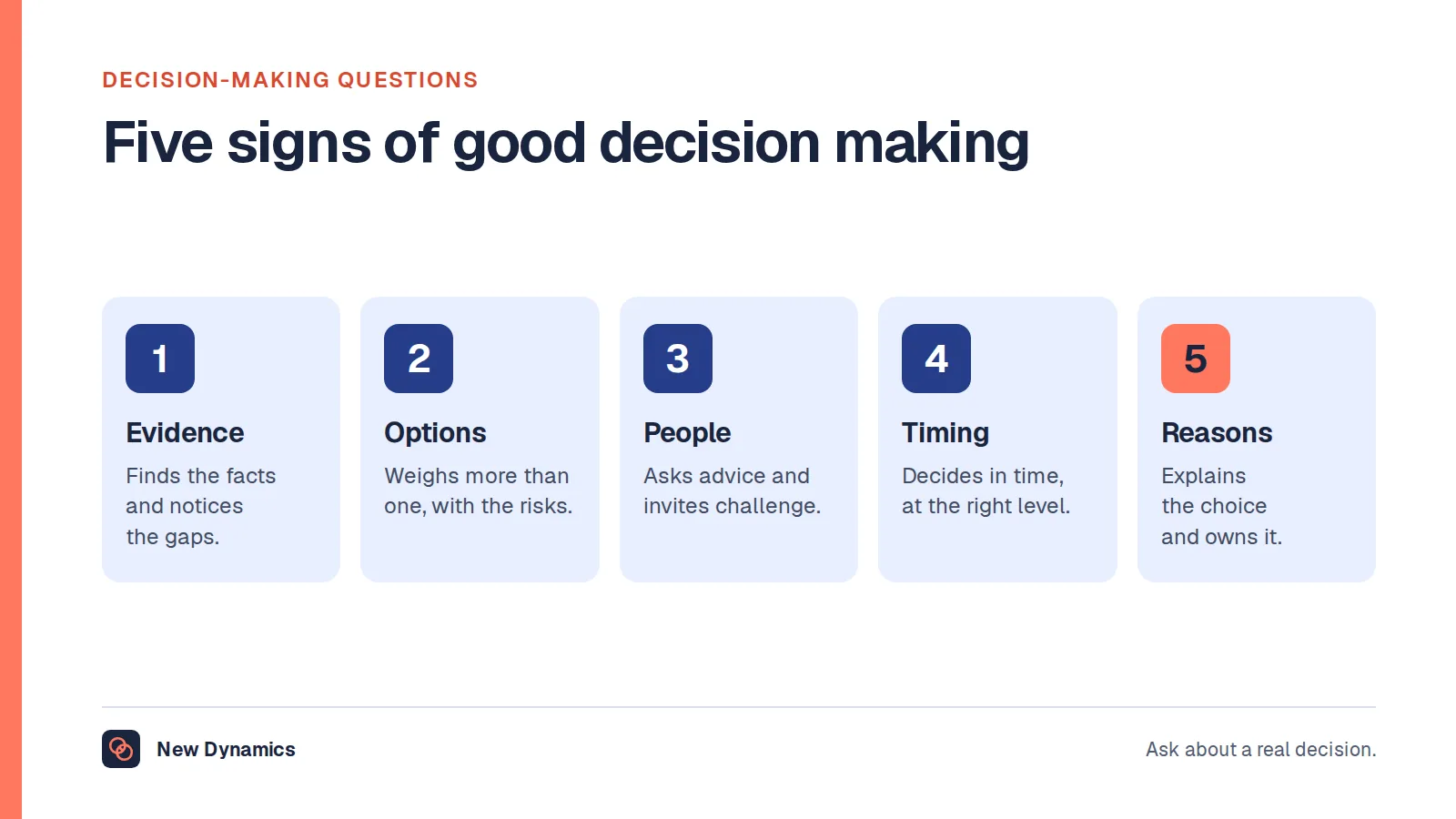
- Ask for doubts, not for objections. “What would make this a mistake?” invites thought. “Any objections?” invites silence. Go round the table, so that speaking is normal and not brave. Our list of decision-making questions offers more wording.
- Let the leader speak last. Once the most senior person has given a view, many people will adjust theirs.
- Write first, then talk. Ask everyone to note their view, or to vote privately, before the discussion. It reveals the real spread of opinion in two minutes.
- Appoint a challenger. Give someone the job of arguing against the proposal, and rotate the role, so that challenge is a duty and not a personality.
- Check back. Review important decisions after a few weeks and ask, “Knowing what we know now, would we still choose this?” Make it easy to change course.
For a leader, there is one further habit: when someone does raise a doubt, thank them, in front of the others. The team is watching what happens to the first person who speaks.

If you are the one with doubts
Assume that you are not alone. Say what you think as your own view, and ask a question: “I have a concern about the timing. Does anyone else see it, or am I missing something?” A question invites others to join you without forcing a confrontation.
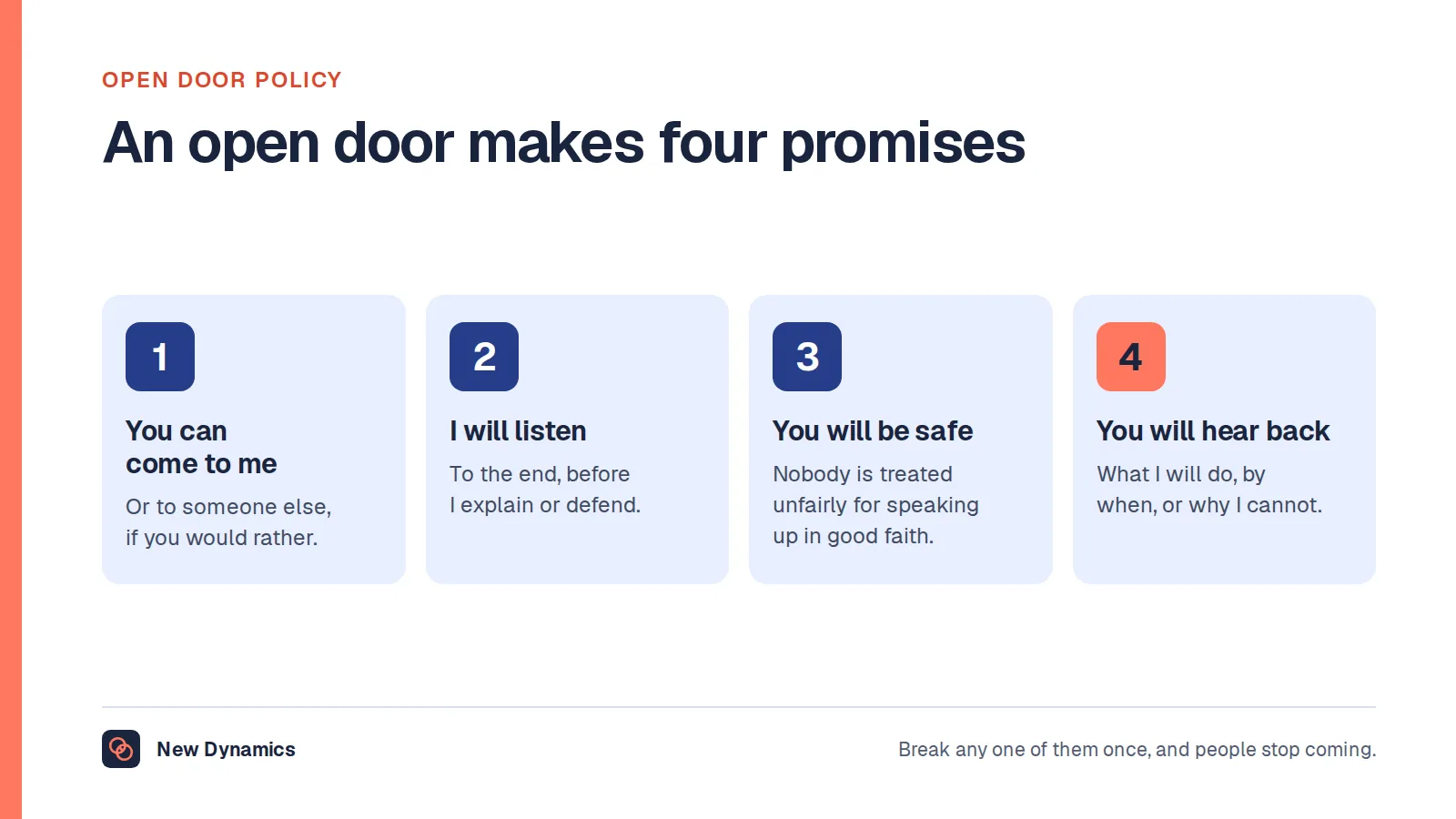
If the meeting is not the place, speak to the decision-maker afterwards, or use your one-to-one. Our one-to-one meeting questions and our guide to a genuine open door policy can help. Harvey's lesson is that the risk of speaking is usually smaller than it feels, and that the cost of silence is shared by everybody.
Common mistakes
Mistaking silence for agreement. Silence tells you nothing.
Asking once, at the end. Doubt needs time and an explicit invitation.
Punishing the messenger. One sarcastic reply to a doubter teaches the whole team to keep quiet.
Relying on anonymous channels alone. They help, but the aim is a team in which people can speak in the room.
Blaming the proposer afterwards. Everybody who stayed silent shares the responsibility.
Overcorrecting into endless debate. The goal is an honest decision, made once. It is not a veto for every participant.
Frequently asked questions
What is the Abilene paradox in simple terms?
It is when a group decides to do something that none of its members actually wants, because each person wrongly assumes that the others are in favour and goes along to avoid conflict. The result is a decision that everybody privately opposed.
Where does the name come from?
It comes from a story told by the management professor Jerry B. Harvey in a 1974 article in the journal Organizational Dynamics. His family drove to Abilene, Texas, for dinner on a hot afternoon, and discovered afterwards that none of them had wanted to go.
What is the road to Abilene?
The road to Abilene is a way of describing the process by which a group drifts into a decision that nobody wants. To say that a team is on the road to Abilene means that people are agreeing in public to a plan that they doubt in private.
What is the difference between the Abilene paradox and groupthink?
In groupthink, a confident group comes to believe in its own view and brushes doubts aside. In the Abilene paradox, members privately disagree with the decision but each assumes that the others support it, so nobody speaks.
How do you avoid the Abilene paradox?
Ask each person for doubts, let the leader speak last, collect views in writing before the discussion, appoint someone to argue against the proposal, review decisions afterwards and thank people who raise concerns. These habits make honesty normal.
What did Harvey mean by the management of agreement?
Harvey argued that organisations focus on managing conflict, while many bad decisions arise because people cannot manage agreement. Members already agree in private that a plan is wrong, but they fail to tell one another, and so act against their own shared judgement.
Your next step: test one decision
- Pick one decision that your team made recently without much debate.
- Ask each person, privately or in writing, how confident they are in it on a scale of one to five, and why.
- Share the spread of answers, without names.
- If the scores are low, reopen the decision, and thank people for their honesty.
For help with saying difficult things well, read and download our guide to useful employee feedback. The guide is free to read, and the PDF uses our short download form.
Want regular one-to-ones and feedback, so that doubts are voiced before decisions are made? Book a New Dynamics demo and bring your current approach. You can also email contact@new-dynamics.com.