TL;DR
- An assistant manager, or deputy manager, helps the manager run a store, branch, restaurant, site or department, runs the operation in the manager's absence and takes charge of a defined part of the work day to day.
- The six duties are running the shift or the day, leading and developing the team, keeping standards, handling customers and problems, managing stock, money and reporting, and deputising for the manager. What the role actually covers depends on the split agreed with the manager.
- The role is the usual step between supervisor and manager. Good adverts say which decisions the assistant manager owns, which they share and which are the manager's alone.
Ask three assistant managers what they do and you will get three answers: one runs every evening shift, one owns the rota and the stock, and one is the manager in all but name. The title is used across retail, hospitality, leisure, care, offices and branches, and its content depends entirely on the split agreed with the manager above.
This assistant manager job description explains what the role is for, sets out six duties that most versions share, shows how it differs from a supervisor and a manager, lists the skills employers look for, gives a template that you can adapt and notes the mistakes that make the role fail.
An assistant manager is usually a manager in training, and a training plan needs goals. See how New Dynamics Goals & OKRs keep targets and progress in one place, so that the step up to manager rests on evidence rather than on waiting.
What is an assistant manager?
An assistant manager helps the manager run a unit, such as a store, branch, restaurant, hotel, site, ward or department, takes charge of the unit when the manager is absent and owns a defined part of the work every day. In many organisations the same job is called deputy manager. The Cambridge Dictionary defines a deputy as “a person who is given the power to do something instead of another person, or the person whose rank is immediately below that of the leader of an organization”. Both halves of that definition apply.
In England the role sits within the occupation that Skills England lists as team leader, a level 3 standard, described as “Managing individuals, teams, or projects to meet private, public, or voluntary organisational goals.”
Three things define the job.
- It is a line management role. The assistant manager leads people, not just tasks.
- It carries delegated authority. Some decisions are the assistant manager's to make, and everyone should know which.
- It is a step on a ladder. The role exists partly to prepare the holder to run a unit.
Assistant manager duties: six responsibilities
The tasks vary by sector, so the list below draws on the retail version of the job, where the title is widely used, and generalises it. Prospects, the UK graduate careers service, describes the retail manager's responsibilities in its retail manager job profile, and an assistant manager shares most of them.
- Run the shift or the day. Open or close, plan the day, allocate work, cover absence and keep the operation running to plan.
- Lead and develop the team. Prospects lists the need to “manage, motivate and develop your team to maximise sales and efficiency” and to “oversee recruitment, training, appraisals and performance management”. The assistant manager typically runs inductions, one-to-ones and much of the day-to-day coaching.
- Keep standards. Ensure company standards for quality, customer service, and health and safety are met, and act when they are not.
- Handle customers and problems. Respond to customer feedback, complaints and service issues, and deal with incidents on the floor.
- Manage stock, money and reporting. Monitor stock levels and replenishment, control cash and costs, and use the systems to track sales, costs and performance.
- Deputise for the manager. Run the unit in the manager's absence, attend meetings in their place and communicate targets and updates to staff and senior managers.
Which of these the assistant manager owns outright, shares or supports should be written down. That document is the real job description.

Assistant manager, supervisor and manager
- Supervisor or team leader. Directs the work of a team during a shift. Usually does the work too. Limited authority over people decisions.
- Assistant manager. Runs the day, leads the team, owns defined areas and deputises. Shares people decisions with the manager, and makes some alone.
- Manager. Accountable for the unit's results, budget, people and compliance. Sets the plan the assistant manager runs.
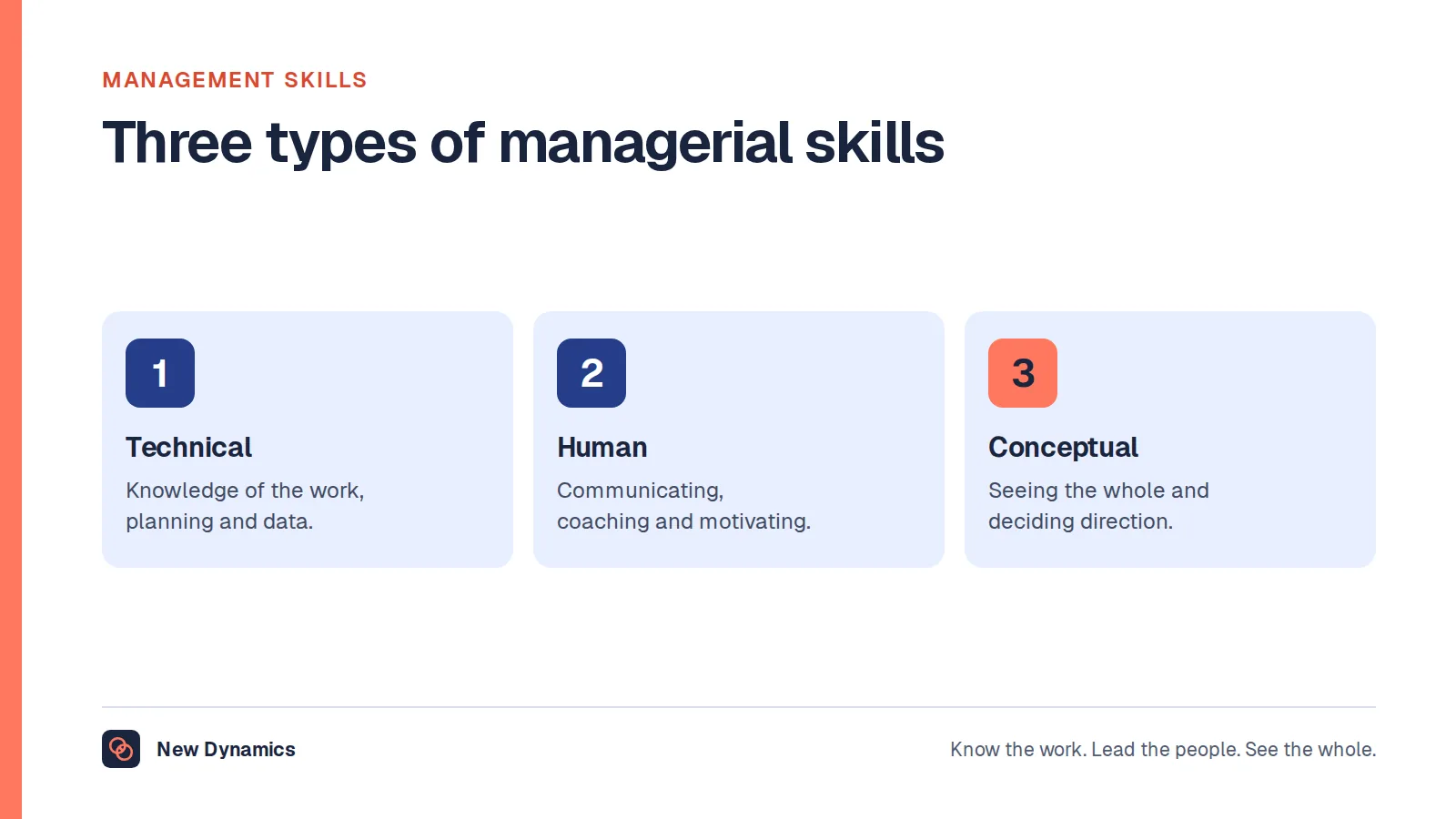
The step from supervisor to assistant manager is the move from directing tasks to managing people. The step from assistant manager to manager is the move from running the plan to owning it. Our guide to management skills describes how the mix of skills changes with each step.

Skills employers look for
- Leading people. Setting expectations, giving feedback and holding the team to standards without the manager in the room.
- Judgement under pressure. Deciding, on a busy shift, what to do now and what to escalate.
- Communication. Clear briefings, honest conversations and accurate handovers up and down.
- Organisation. Rotas, stock, cash and reporting done on time.
- Commercial sense. Understanding what drives the unit's results and the cost of getting it wrong.
- Coaching. Much of the assistant manager's value is in the people they develop.
- Integrity. Cash, stock, safety and people decisions all depend on it.
Prospects notes for retail managers that the job includes building relationships and communicating business updates, targets and initiatives to staff and senior managers. That two-way channel is where the assistant manager lives.
Assistant manager job description template
Adapt the template to your unit. Keep every line true, and fill in the decision split.
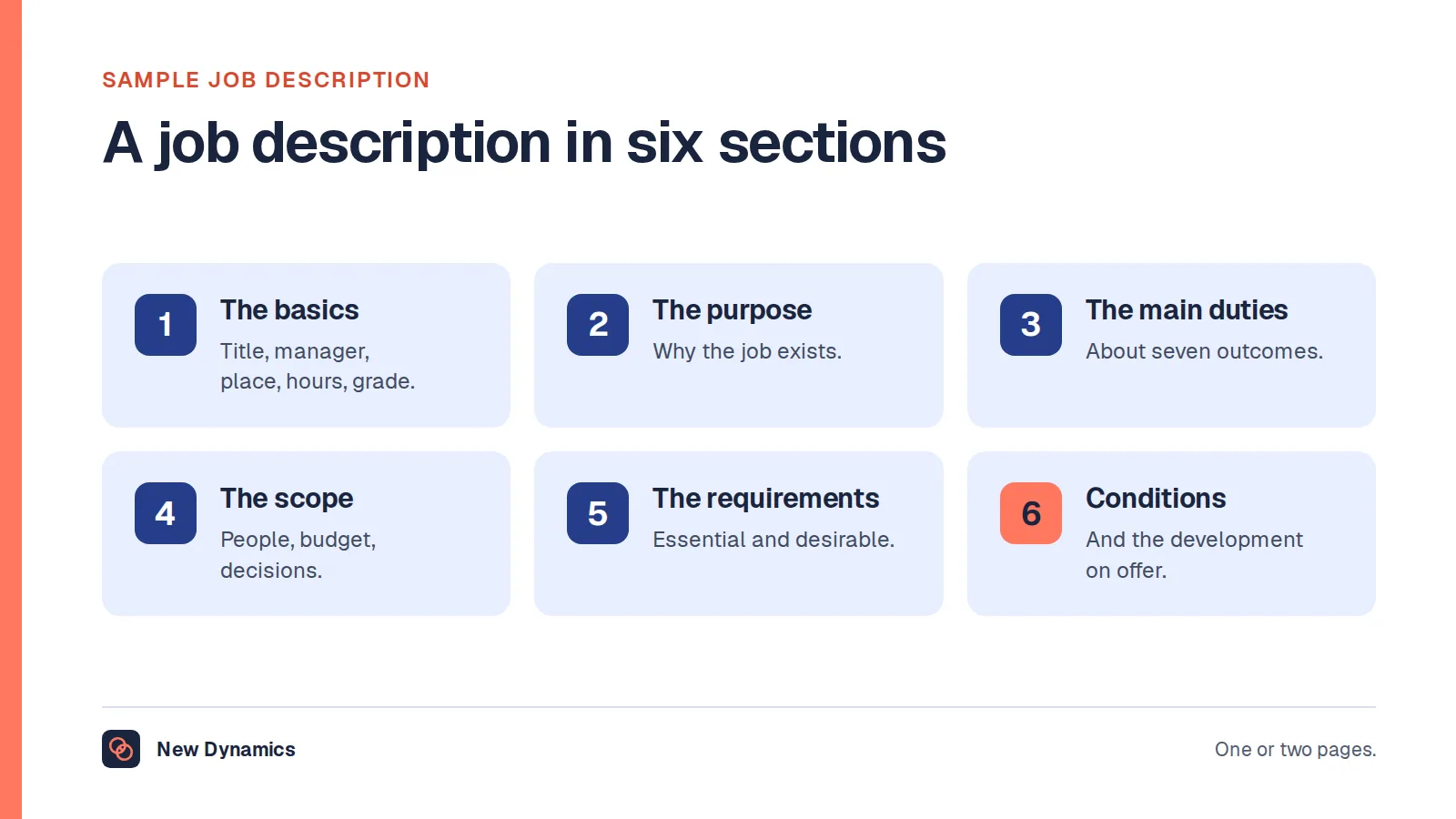
Job title: Assistant manager
Reports to: [Store, branch, restaurant or department] manager
Hours: [Full-time], including [evenings, weekends and shift work as applicable]
Purpose of the role: To help the manager run [the unit], to run it in their absence and to lead the team to the agreed standards every day.
Main duties:
- Plan and run shifts, allocate work and cover absence
- Lead, induct, coach and hold one-to-ones with team members
- Maintain standards of service, quality, health and safety and compliance
- Handle customer feedback, complaints and incidents
- Manage stock, cash, costs and reporting through [the systems]
- Deputise for the manager and represent the unit at meetings
- Own [the areas this role owns outright], share [the areas shared with the manager]
Decisions this role makes alone: [for example, shift allocation, first-stage customer resolutions, orders up to a value]
Decisions made with the manager: [for example, recruitment, performance management, budgets]
Skills and experience:
- Experience of leading a team in [the sector]
- Calm judgement under pressure and clear communication
- Organised with rotas, stock, cash and systems
- Coaching and feedback skills
- [Any qualifications or licences the unit needs]
We provide: A development plan towards a manager role, regular one-to-ones with the manager, training in [systems and standards] and objectives reviewed each quarter.
The two decision lines are the most useful part of the template. Our job description template explains the rest of the structure.
Common mistakes with assistant manager roles
No decision split. If nobody has written down what the assistant manager can decide alone, the team will ask the manager anyway, and the assistant manager becomes a well-paid supervisor.
A manager who cannot let go. The role only works if the manager delegates real authority and backs the decisions made with it.
Two managers, no plan. Without a development plan, the assistant manager either leaves for a manager's job elsewhere or stays and stalls.
Advertising a supervisor as an assistant manager. Title inflation attracts candidates who expect authority the role does not carry.
Covering, not developing. An assistant manager used only to fill gaps in the rota learns nothing about running the unit.

Frequently asked questions
What does an assistant manager do?
An assistant manager helps the manager run a unit such as a store, branch, restaurant or department. Typical duties are running shifts, leading and developing the team, keeping standards, handling customers and problems, managing stock, cash and reporting, and running the unit when the manager is absent.
What is the difference between an assistant manager and a manager?
The manager is accountable for the unit's results, budget, people and compliance and sets the plan. The assistant manager runs that plan day to day, owns defined areas, shares people decisions with the manager and deputises in their absence.
What is the difference between an assistant manager and a supervisor?
A supervisor directs a team's work during a shift, usually while doing the work too, with limited authority over people decisions. An assistant manager manages people, owns areas of the operation, makes some decisions alone and deputises for the manager.
Is an assistant manager the same as a deputy manager?
Usually, yes. Deputy manager is often the title in sectors such as care and the public sector, and assistant manager in retail and hospitality. In both cases the person runs the unit in the manager's absence and owns part of the work day to day.
What skills does an assistant manager need?
Leading people, judgement under pressure, clear communication, organisation, commercial sense, coaching and integrity. Employers usually look for experience of leading a team in the same sector.
What should an assistant manager job description include?
The title, the manager it reports to, hours including shifts, the purpose of the role, six or seven main duties, the areas the role owns and shares, the decisions it can make alone and with the manager, the skills and experience needed, and the development plan and support offered.
Your next step
If you are hiring, write the two decision lines before anything else, and agree them with the manager the role will report to. If you are an assistant manager, ask your manager for those two lines in writing, and for a date to review them.
For a plan that makes the manager's one-to-ones with a deputy useful, read and download our manager one-to-one guide. The guide is free to read, and the PDF uses our short download form.
Want an assistant manager's development goals, feedback and reviews in one place? Book a New Dynamics demo and bring your current approach. You can also email contact@new-dynamics.com.