TL;DR
- An assistant general manager, often written AGM and sometimes titled deputy general manager, is second in command of a whole site or business unit: a hotel, a pub, a restaurant, a store, a leisure centre or a depot. That is a different rung from assistant manager, which usually deputises for a department or a shift.
- AM is the short form of assistant manager and AGM the short form of assistant general manager. AGM also means annual general meeting, a term fixed in UK company law, so the full title belongs in contracts, org charts and payroll rather than the initials.
- The job is four things at once: deputy for the whole site, named duty manager on shift, owner of agreed budget lines, and escalation point. It becomes a holding pen whenever those four are left unwritten.
The advert says assistant general manager, and the title invites the obvious joke about being assistant to the general manager rather than an assistant general manager. In practice it is one of the least comfortable rungs in any site business. You are second in command of a whole hotel, pub, store, gym or depot, with enough authority to run the place on a Saturday night and not quite enough to decide what the place does on Monday.
This article sets out what the role is, where the rung sits, where it is common, what the job consists of, the parts adverts leave out, how to stop it becoming a holding pen, and a template to adapt. It also answers the plain vocabulary question, because two of the commonest searches on this subject are simply about the short form of assistant manager.
Most of the friction in this role comes from numbers nobody has allocated. See how New Dynamics Goals & OKRs keep targets and progress in one place, so a deputy's own lines are written down rather than inferred from the site total.
Where this article mentions law it names the nation the law applies to. It is general information and not legal advice. A specific case needs an employment solicitor, your own HR team or the relevant licensing authority.
What an assistant general manager is
An assistant general manager is the deputy for a whole operating unit. The general manager owns the unit's result. The deputy covers all of it, runs it whenever the general manager is not there, and owns a defined part of it outright every week.
The word doing the work there is "whole". A department deputy covers one function. An assistant general manager's remit is the site: front of house and back of house, labour and stock, customers and compliance.
The title is genuinely established at single-site level rather than being an inflated department title. The UK National Careers Service lists the hotel manager role under the alternative titles "Guest house manager, hotel general manager", and describes the route in like this: "You may be able to get into this career by getting experience as a deputy manager in front of house, guest services or catering operations. With further training on the job, you could be promoted to a more senior managerial position." That is the AGM rung described from the other end.
Three tests tell you whether a role is genuinely an assistant general manager rather than an assistant manager with a longer title.
- Scope is the site. The person answers for things happening in parts of the building they do not personally staff.
- It is the named cover. When the general manager is on leave, this is the person the rota, the suppliers and head office deal with.
- It carries a written slice of the budget. Not "supports the general manager with the P and L", but named lines with numbers attached.
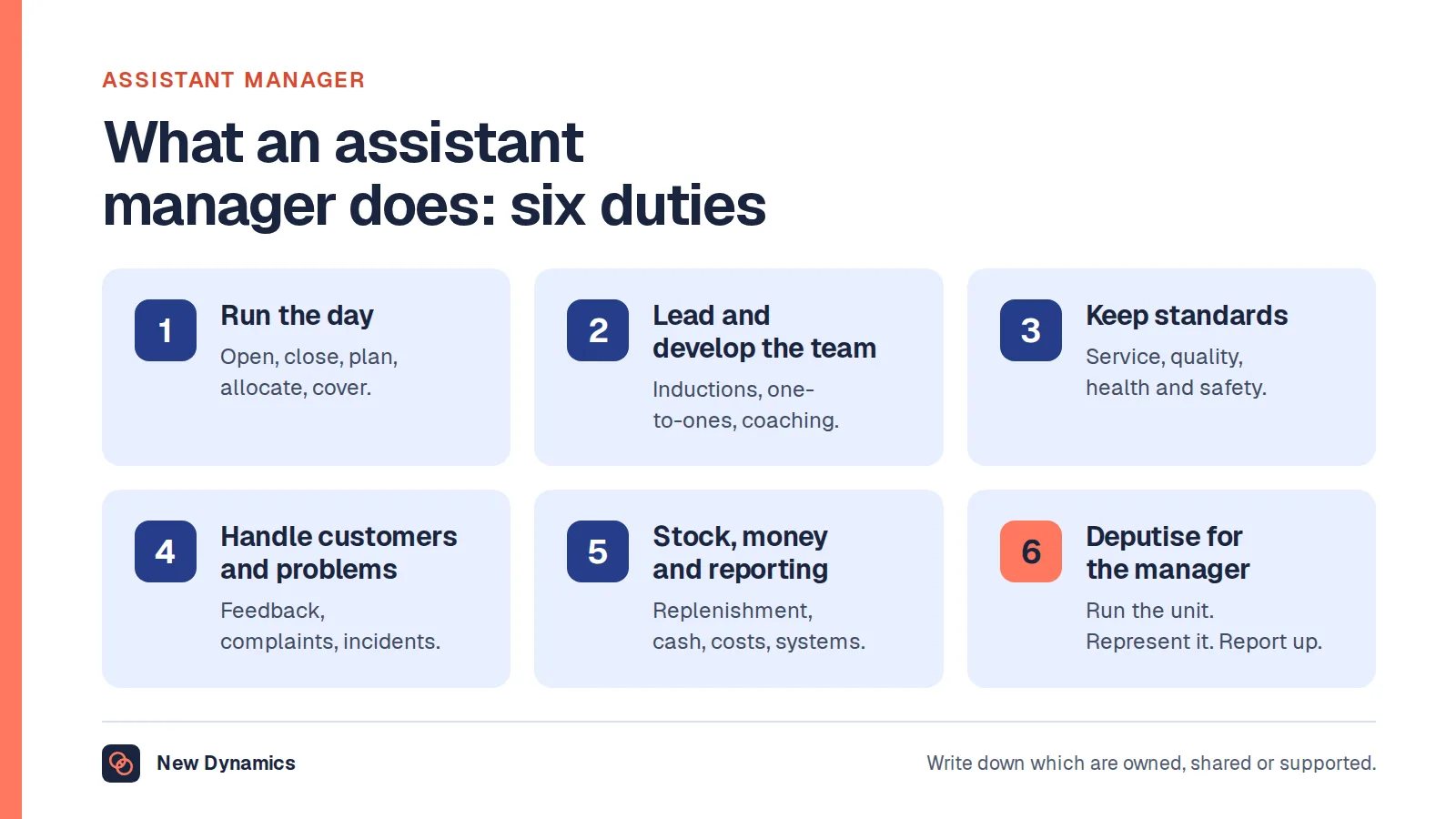
A role failing all three is an assistant manager role and should be advertised as one. Our assistant manager job description covers that rung.
The short form of assistant manager, and the AGM collision
This deserves a direct answer rather than a paragraph buried in a definition.
AM is the short form of assistant manager. It is the usual abbreviation on a rota, a handover sheet or a staffing plan.
AGM is the short form of assistant general manager. Some groups write Asst GM instead, and a few use DGM for deputy general manager, which is the same rung under another name. GM alone is the general manager.
AGM also means annual general meeting, and that is not loose business usage. It is fixed in UK company law. Section 336 of the Companies Act 2006 states that "Every public company must hold a general meeting as its annual general meeting in each period of 6 months beginning with the day following its accounting reference date". The provision, whose extent is the United Kingdom, is on legislation.gov.uk, and it gives a private company that is a traded company nine months instead.
So the three initials point at two unrelated things: a person who deputises for a site, and a meeting a company is obliged to hold. Context usually settles it. On a pub rota or a hotel staffing plan, AGM is a person. In a board paper or a letter to shareholders, AGM is a meeting.
The trouble is in writing. A group whose operations team abbreviates the deputy as AGM and whose finance team uses AGM for the shareholder meeting will eventually produce a calendar invitation nobody can interpret. Three habits fix it:
- Spell out assistant general manager in full on first use in any document that also discusses companies, boards, accounts or shareholders.
- Store the full title in the HR record, the org chart and payroll. A title held as "AGM" is ambiguous the moment somebody reports headcount by role.
- Use the full title in the employment paperwork. In Great Britain, Acas sets out that a principal statement must be given "on or before the first day of work" and must include the "job title or a brief description of the job" among the terms that must be included in a written statement. Initials are not a job title. That is general information, not legal advice.
Assistant general manager is not the same rung as assistant manager
The two titles get used interchangeably, and in a small business they genuinely collapse into one job. In a thirty-room hotel the assistant manager is the assistant general manager, because there is one unit and one deputy. In a four-hundred-room hotel there is a rooms division manager, a food and beverage manager, an events manager, and an assistant general manager above them as the general manager's deputy. The distinction worth holding is scope, not seniority on its own.
| Rung | Deputises for | Typically judged on |
|---|---|---|
| Supervisor or team leader | A team on shift | The shift running to plan |
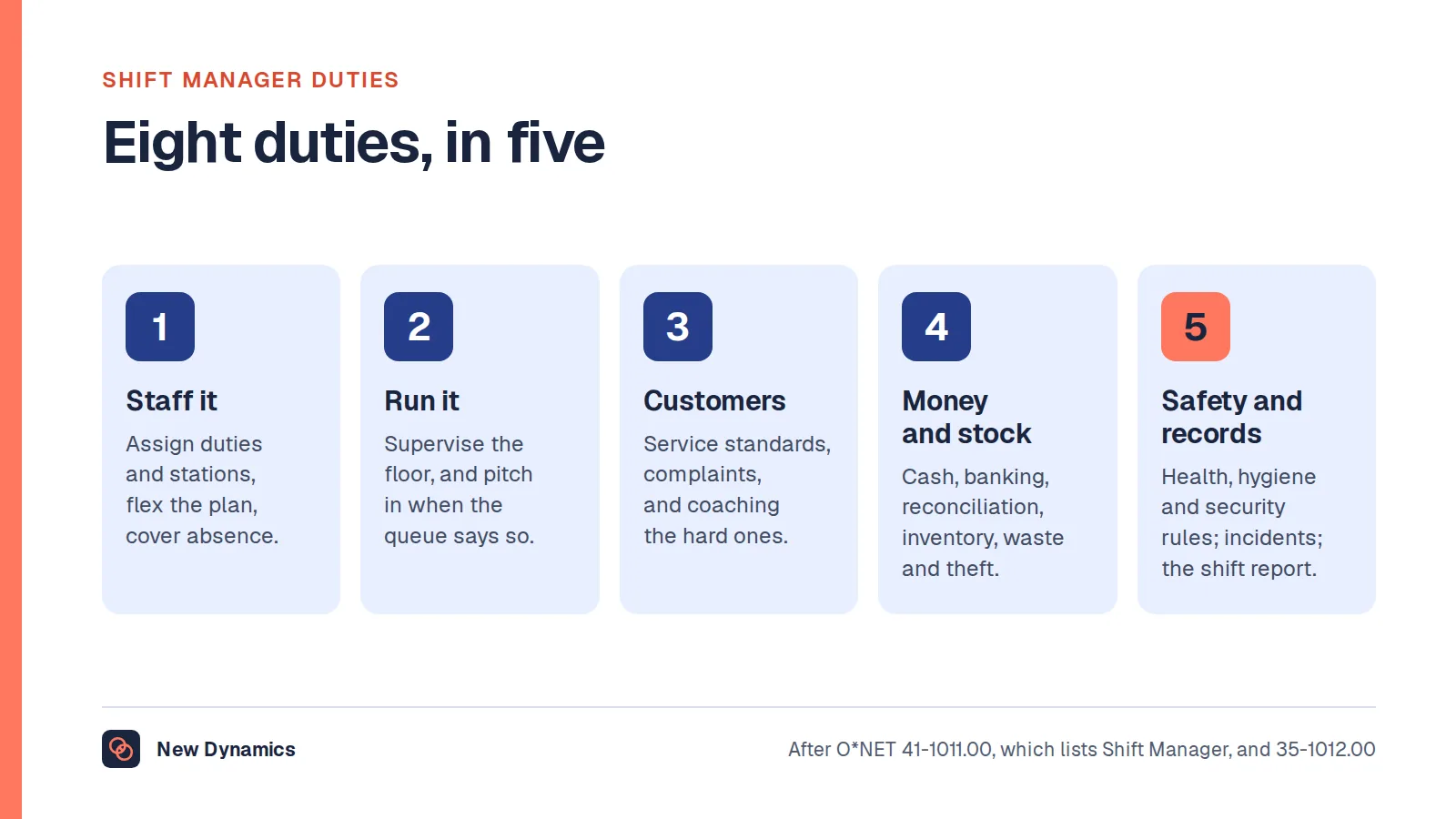
| Shift manager | The site, for a shift | What happened between open and close |
| Assistant manager | A department | That department's standards, costs and people |
| Assistant general manager | The whole site | Agreed site lines, plus the days they ran it |
| General manager | Nobody | The site result, outright |

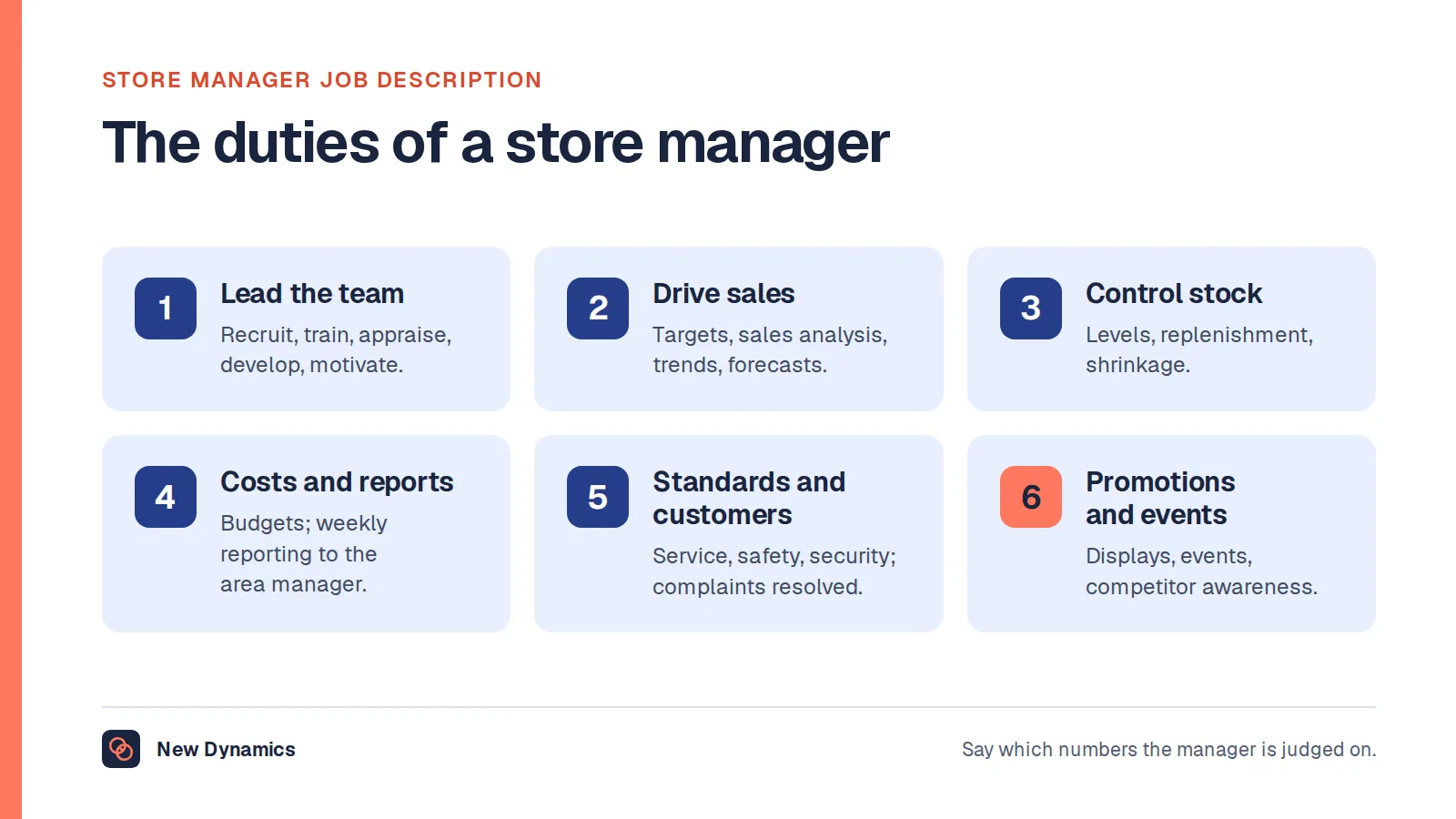
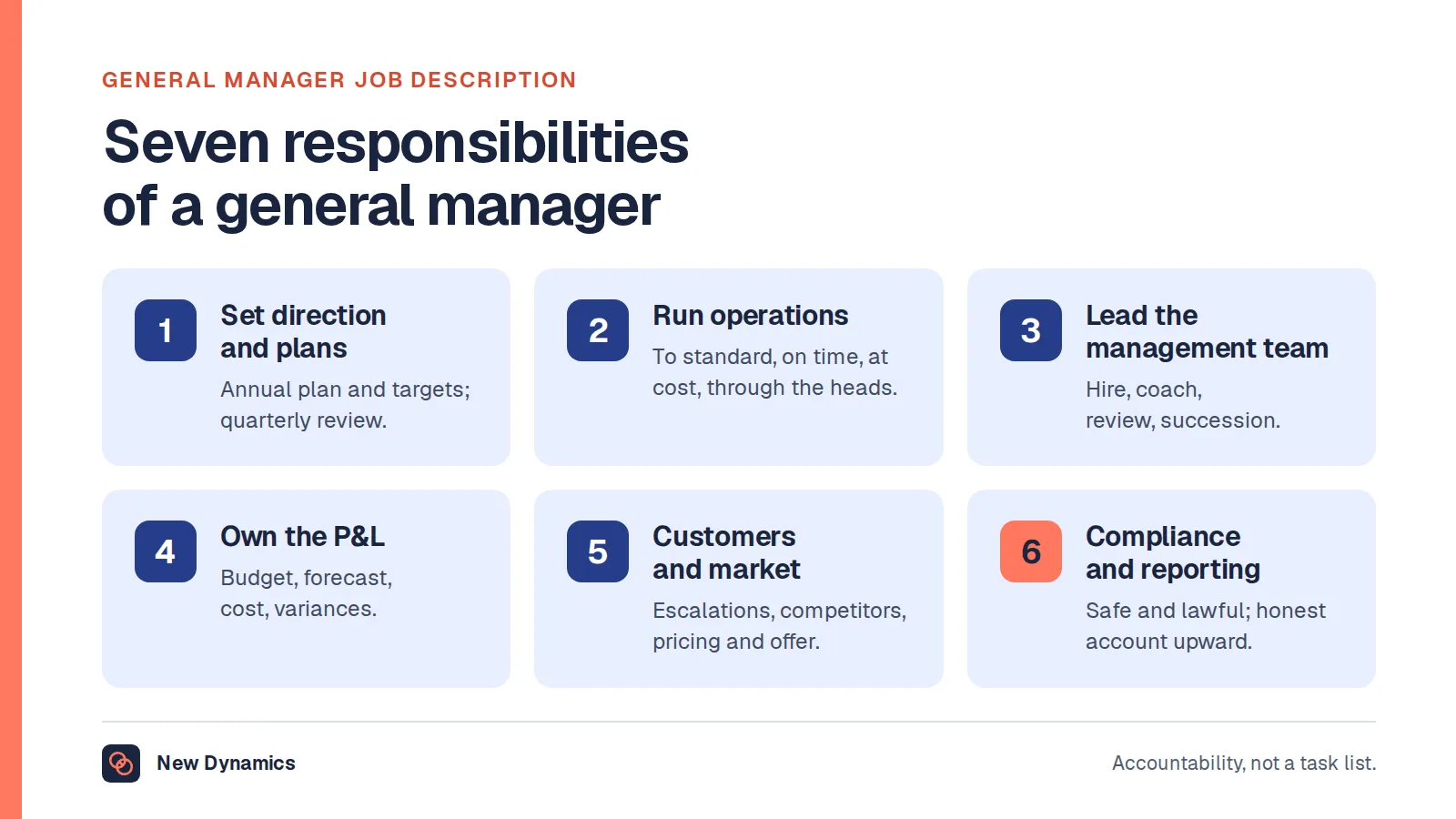
The overlap to watch is with shift manager, and the difference is permanence. Our shift manager job description covers a role that runs a site for one shift and hands it over; an assistant general manager still owns their budget lines on days off duty. Above the rung, our general manager job description sets out the job being covered, and in retail our store manager job description is the equivalent.
Where the role is common
Assistant general manager is a site title, so it clusters in businesses built out of sites. In each setting below, the National Careers Service profile for the manager's job gives the shape of what the deputy covers. The pay ranges are for the manager, not the deputy, and the service presents them as an average salary a year from starter to experienced.
Hotels
The clearest home for the title. The National Careers Service says hotel managers "are responsible for running operations like guest services, housekeeping, bar and restaurant facilities, and conferencing and events", on 40 to 45 hours a week including evenings, weekends and bank holidays, at £30,000 for a starter rising to £60,000 for someone experienced. It adds that "In a small hotel you may manage all of its operations. In a larger hotel, you may have more specific responsibilities, for example reservations or revenues management." The deputy holds those departmental responsibilities together.
Restaurants, pubs and bars
The restaurant manager profile describes managers who "organise the day-to-day running of their venue and make sure customers are happy with the food and service they receive", on 42 to 44 hours a week worked on split shifts at £26,000 to £40,000, with a food hygiene certificate and enhanced background checks required. The publican profile lists the alternative titles "Pub landlord, bar manager, licensed premises manager", 45 to 50 variable hours a week and £27,000 to £50,000, and describes the Hospitality Manager Level 4 Higher Apprenticeship in England as something that "might help you find work as a deputy bar manager". The deputy rung is in the official route map.
Retail stores
The retail manager profile lists tasks including "analyse sales figures and forecast future trends" and "control budgets and provide reports to company executives", on 40 to 42 hours a week at £26,000 to £60,000. In larger formats the deputy holds trading or operational lines while the manager holds the store.
Leisure, fitness and distribution
The leisure centre manager profile uses the duty management language that dominates that sector, and carries a filmed account from a duty manager named Abby, who describes a duty shift like this: "All the checks, pool tests if I'm at the pool. Meter readings on the morning, then checking the inboxes, dealing with customers. Nothing's the same, there's always something going on." It gives 37 to 42 hours a week, £24,000 to £36,000, and the Duty Team Manager Level 3 Advanced Apprenticeship in England as a route. The warehouse manager profile covers managers who "plan and co-ordinate operations at distribution centres, large retail stores and factories", at £25,000 to £42,000 on shifts, with progression through shift manager and site operations manager towards depot manager.
What the job actually consists of
Strip out the sector detail and the same six things remain. The first four are the ones an advert should name explicitly.
- Running the site when the general manager is off. Not covering the diary. Taking decisions, answering head office, signing what needs signing and owning what happens.
- Owning a slice of the profit and loss account. Usually labour cost percentage, wastage, stock loss, a department's revenue or a cost line such as maintenance. The slice is what makes this a management job rather than a senior supervisory one.
- Duty management. Being the named decision maker on shift, with authority to refund, discount, send someone home, close an area or call an engineer.
- Being the escalation point. The complaint the team leader cannot settle, the contractor without paperwork, the incident at eleven at night.
- Running the people routine. Inductions, one-to-ones, return to work conversations, rota publication, probation reviews. Much of the general manager's people work lands here, and it goes first when the site gets busy.
- Holding the standards and the compliance checks. Temperature records, fire checks, cleaning schedules, age verification, accident reporting.

For a longer task list, the American occupational description is worth reading as long as you treat it as American. The United States Department of Labor lists among the tasks for General and Operations Managers: "Review financial statements, sales or activity reports, or other performance data to measure productivity or goal achievement or to identify areas needing cost reduction or program improvement". The full list is in the O*NET summary for General and Operations Managers. That classification lumps the deputy in with the manager, which is itself the warning: the two jobs are hard to separate on paper, so the separation has to be written down locally.
Duty management and the licensing question
If the site is licensed, duty management intersects with licensing law, and it has to be right before the general manager goes on leave rather than after.
In England and Wales, the Licensing Act 2003 attaches two mandatory conditions to any premises licence that authorises the supply of alcohol. Under the first, no supply of alcohol may be made under the premises licence "at a time when there is no designated premises supervisor in respect of the premises licence", nor "at a time when the designated premises supervisor does not hold a personal licence or his personal licence is suspended". Under the second, "every supply of alcohol under the premises licence must be made or authorised by a person who holds a personal licence". Both are in section 19 on legislation.gov.uk.
The designated premises supervisor is a single named individual: section 15 of the same Act defines references to that person as being "to the individual for the time being specified in that licence as the premises supervisor". So a deputy covering a week does not become the designated premises supervisor by standing in. The condition that bites instead is the second one, because somebody holding a personal licence has to make or authorise every supply of alcohol. That is why licensed sites commonly want the deputy to hold a personal licence of their own.
The sections cited extend to England and Wales. Scotland and Northern Ireland have separate licensing legislation, so check the rules for the nation the site is in. This is general information and not legal advice, and the licensing authority for the premises is the place to confirm a specific arrangement.
The uncomfortable parts nobody writes about
Adverts describe a stepping stone. Here is what people in the role report, and what an employer can do about each.
Authority without final say
This is the structural problem of every deputy role, and health and safety guidance names its shape better than most management writing does. The Health and Safety Executive's Management Standards for work-related stress, which apply in Great Britain, define the Control standard as "How much say the person has in the way they do their work", and the Demands standard asks that "Jobs are designed to be within the capabilities of employees".
An assistant general manager usually scores high on demand and low on control. A deputy carrying full accountability on a Saturday, with a spending limit of nothing and no authority to change a rota they are judged on, is a job design problem rather than a resilience problem.
Being judged on numbers you only half control
The site profit and loss account is one number with many authors. The deputy influences labour cost percentage, wastage, stock loss and upselling. They do not influence pricing, the marketing calendar, capital spend, opening hours or the fact that a competitor opened two hundred metres away. Being measured on the site total is being measured on other people's decisions.
The fix is not to stop measuring but to split the measure: name the lines the deputy owns and review those lines with them. Where an area manager has a view on the deputy as well as the general manager, capture both rather than averaging them in a corridor. New Dynamics multi-manager reviews exist for that structure.
Deputising for somebody you may want to replace
Nobody writes this down, and everybody in the role has thought about it. The route to a general manager's job often runs through the chair occupied by the person who writes your review. That creates two bad incentives: a general manager slow to develop a credible successor, and a deputy who learns to manage upwards rather than outwards. Three things defuse it, and none is a conversation about loyalty.
- Make somebody other than the general manager see the deputy's work: an area manager, a peer site's general manager, or a central operations lead.
- Make the next vacancy visible across the group, so the route out is not through one door.
- Put the readiness conversation on a date. A deputy who knows they will be assessed against the general manager's job in April stops guessing.
The rota tax, and invisible credit
Every sector profile above records evening, weekend and bank holiday work, with split shifts in restaurants and 45 to 50 variable hours a week for publicans. The deputy generally works the shifts the general manager does not, so the role is paid as management and timetabled as operations. Say so in the advert if that is the deal. Credit runs the other way: a good month is reported by the general manager, a bad Saturday happened on the deputy's watch. Asking the general manager to name in writing what the deputy owned in any result reported upward fixes most of it.
What official sources publish about assistant general manager pay
Plainly: no official UK source publishes a pay figure for the job title assistant general manager. The National Careers Service publishes ranges by occupation, not by rung, so the figures quoted earlier are all for the manager's job rather than the deputy's. Office for National Statistics earnings data is classified by the Standard Occupational Classification 2020, which has no assistant general manager unit group. Anybody quoting a precise national figure for this title is quoting a job board, not a statistical release.
What is published is the general picture. The Office for National Statistics reports, in Employee earnings in the UK: 2026, released on 22 October 2026 and covering April 2026, that "median gross annual earnings for full-time employees who had been in their job for at least a year were £40,911 in April 2026, compared with £39,157 in April 2025, a 4.5% increase". It also reports that the largest increase in median weekly earnings was for "managers, directors and senior officials (6.7%)". All 2026 estimates are provisional. For the wider set of published figures we keep in one place, see the HR statistics hub.
So ask for the band rather than the number. Three questions get you there: what is the salary band for this role, where in the band would I start, and what is the general manager band at a site this size. The last one tells you what the step up is worth, which is the figure that matters if the role is a route rather than a destination.
Making the role work instead of becoming a holding pen
The failure mode of this rung is not conflict. It is stasis: a capable deputy who covers the rota, chases open jobs, decides nothing of consequence and waits eighteen months for a vacancy somewhere in the region. Four written lines prevent it.

One. List the decisions. Three lists, agreed with the general manager and visible to the team: decisions the deputy takes alone, decisions they take with the general manager, and decisions reserved to the general manager. Without the first list the team routes everything past the deputy and the title becomes decorative.
Two. Name the budget lines. Not "assists with the P and L". Labour cost percentage for named departments, wastage, stock loss, the maintenance line, the function revenue. Two or three lines with numbers beats a share of everything.
Three. Set a spending limit. A deputy who cannot authorise a £200 emergency repair is not running the site on a Sunday, whatever the rota says. Write the figure down, and what happens above it.
Four. Put a date on the readiness review. Not "when you are ready", but a date, a list of what will be assessed, and the general manager's honest view on that date.
Two more things help. Give the deputy a project of their own with a start, an end and a number. And make the handover written both ways, because a handover held in somebody's head is how a deputy ends up accountable for decisions nobody told them about.
Assistant general manager job description template
Adapt this to your site. The square brackets make it true for you, and the decision blocks are the most useful lines in it.
Job title: Assistant general manager
Reports to: General manager, [site]
Location: [One named site]
Hours: [Full-time], including evenings, weekends and bank holidays, on a rota covering [opening to close]
Purpose of the role: To deputise for the general manager across the whole site, to run the site whenever the general manager is not present, and to own the agreed operational and financial lines set out below.
Scope: [Number] colleagues across [departments], and [revenue or cost] of [figure] for the lines this role owns.
Main duties:
- Run the site in the general manager's absence, including contact with [head office, suppliers and contractors]
- Act as duty manager on [number] shifts a week, from opening checks to close
- Own and report on [labour cost percentage, wastage, stock loss, named revenue or cost lines]
- Lead, induct and coach [departments], hold one-to-ones and complete probation reviews
- Be the escalation point for complaints, incidents and contractor issues on duty
- Maintain [food safety, fire, licensing and health and safety] records and act on gaps
- Publish the rota for [departments] within [the agreed staffing budget]
- Hand over in writing at the end of each duty period and each absence cover period
Decisions this role takes alone: [for example, refunds up to £X, discounts within the published scheme, sending a colleague home, closing an area on safety grounds, spending up to £X]
Decisions taken with the general manager: [for example, recruitment, formal performance steps, the rota template, spend above £X]
Decisions reserved to the general manager: [for example, headcount, the annual plan, capital spend, a licence variation]
Experience and qualifications:
- Managing a department or a shift in [sector], with people and budget responsibility
- [A personal licence, or willingness to obtain one, if the site is licensed]
- [Food hygiene certificate at the level the site requires]
- Comfortable with the site's [till, stock, rota and reporting] systems
Development and review: Monthly one-to-one with the general manager, quarterly review of the lines this role owns, and a readiness review against the general manager role on [date].
Salary: [Band], reviewed [when]. General manager band at a site of this size is [band].
Two notes. Publish the salary band, because a role whose whole appeal is progression cannot credibly hide what that is worth. And if you cannot fill in the three decision blocks, the role is not ready to advertise. The general structure of a good advert is in our job description template.
From assistant general manager to general manager
The step up is a change of accountability, not of workload. The deputy runs the plan and owns part of it; the general manager owns the result and sets the plan. Most people in the role have already done nearly all of the manager's tasks, which is why the promotion conversation stalls on whether they can hold the whole thing with nobody to escalate to.
The official route maps agree on the direction of travel. For hotels, the National Careers Service describes progression from deputy manager experience to more senior managerial positions, then regional management. For retail it describes taking responsibility for several stores across a region, for leisure becoming an area or regional manager over a group of centres, and for distribution a path through shift manager and site operations manager to depot manager. In England, the apprenticeship routes named on those profiles include the Hospitality Manager Level 4 Higher Apprenticeship and the Retail Manager Level 4 Higher Apprenticeship.
Evidence is what converts a deputy into a credible candidate, and it has to be collected as it happens rather than reconstructed in an interview. Keep a record of four things:
- Periods in charge. Dates, length and what you decided that was not routine.
- Your lines. The budget lines you owned, the baseline when you took them, where they ended.
- People you developed. Who you inducted, coached or promoted, and what they do now.
- Things that went wrong on your watch. What happened, what you did, what changed. Panels trust this more than a clean record.
Our management skills guide covers how the mix changes with each rung, and our new manager guide covers the first ninety days of a bigger job, which is what a general manager appointment amounts to.
Frequently asked questions
What does an assistant general manager do?
An assistant general manager deputises for the general manager of a whole site or business unit, such as a hotel, pub, restaurant, store, leisure centre or depot. The job is four things at once: running the site when the general manager is away, acting as duty manager on shift, owning agreed budget lines such as labour cost or wastage, and being the escalation point for complaints and incidents.
What is the short form of assistant manager?
AM is the short form of assistant manager, and AGM is the short form of assistant general manager. Some employers write Asst GM, and DGM for deputy general manager describes the same rung. Note that AGM also means annual general meeting, which is why the full title belongs in contracts, org charts and payroll rather than the initials.
Is an assistant general manager the same as a deputy general manager?
Yes, in almost all cases. Deputy general manager tends to be the title in care, the public sector and parts of manufacturing, and assistant general manager in hotels, retail and leisure. Both describe the second in command of a whole site or business unit, rather than the deputy of one department.
What is the difference between an assistant manager and an assistant general manager?
Scope. An assistant manager usually deputises for a department or a shift and is judged on that department's standards, costs and people. An assistant general manager deputises for the whole site, is the named cover when the general manager is away, and carries budget lines of their own. In a small business the two titles describe the same job, because there is one unit and one deputy.
How much does an assistant general manager earn in the UK?
No official UK source publishes a pay figure for this job title. The National Careers Service publishes ranges for the manager's job rather than the deputy's, and Office for National Statistics earnings data is classified by occupation rather than by rung, so it has no assistant general manager line. Ask the employer for the band for the role, and for the general manager band at a site of that size.
Does an assistant general manager need a personal licence?
On licensed premises in England and Wales it is usually expected, because the Licensing Act 2003 requires every supply of alcohol under a premises licence to be made or authorised by somebody holding a personal licence. The designated premises supervisor is a single named individual, so deputising does not transfer that role. Scotland and Northern Ireland have separate licensing legislation. That is general information, not legal advice.
Your next step
If you are hiring, write the three decision blocks and the budget lines before anything else, and agree them with the general manager the role reports to. If you are already in the role, ask for the same three blocks in writing, plus a spending limit with a figure in it and a date for the readiness review. Those four things are the difference between a deputy and a holding pen.
For the development plan behind the promotion, read and download our career development guide. The guide is free to read, and the PDF uses our short download form.
Want a deputy's goals, budget lines, one-to-ones and reviews in one place rather than spread across a rota, a spreadsheet and somebody's memory? Book a New Dynamics demo and bring the review form you use today. You can also email contact@new-dynamics.com.