TL;DR
- Casual attire is clothing that is not formal or not suited to special occasions: jeans, t-shirts, trainers and similar everyday clothes. At work, a casual dress code allows those clothes while still expecting them to be clean, safe and appropriate for the setting.
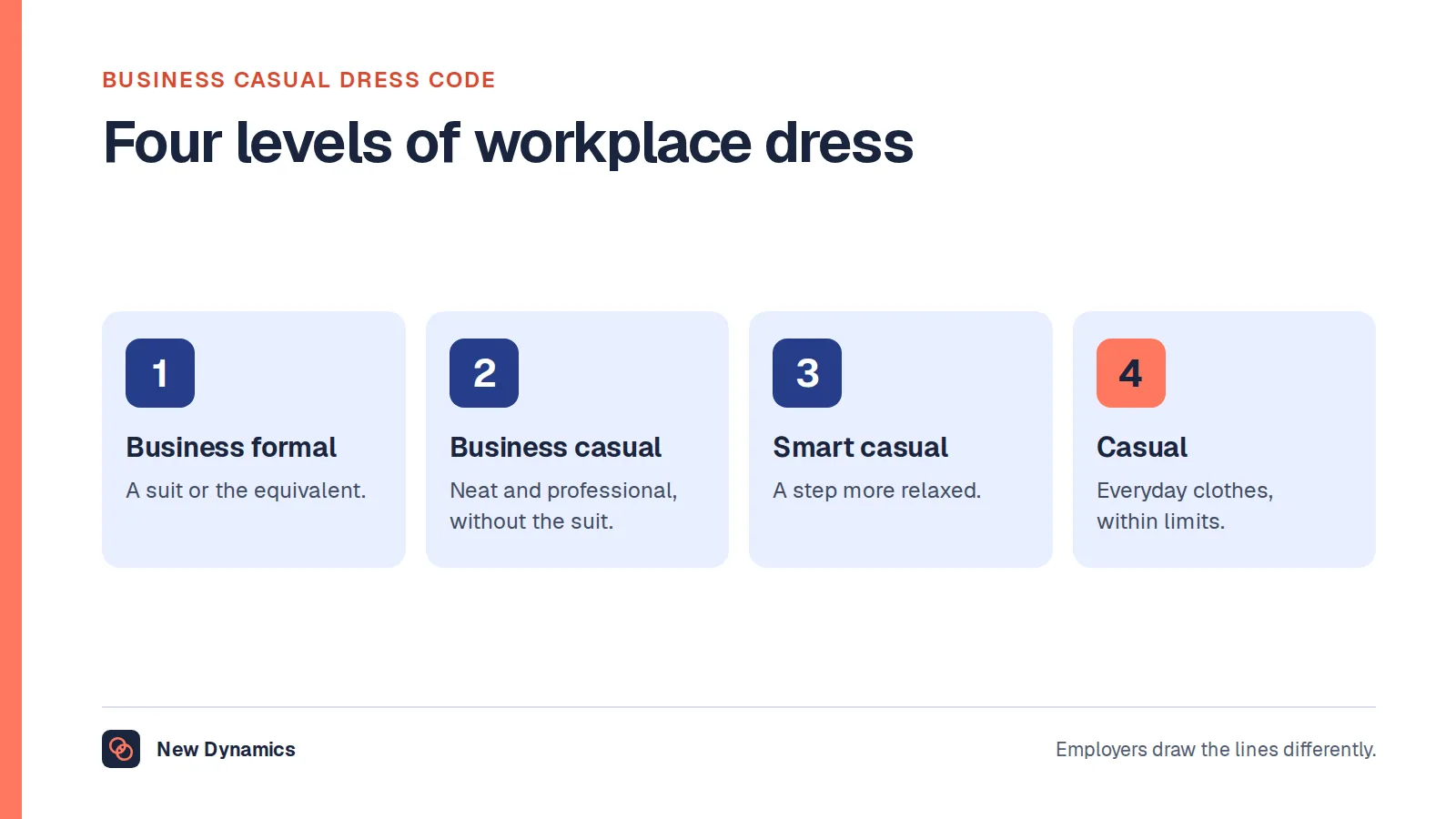
- Casual sits below smart casual, which is neat and stylish but not too formal, and below business casual, which keeps some office conventions. The three are different codes and a policy should say which one applies.
- In the UK, dress codes are lawful in principle, but standards for men and women should be equivalent, gender-specific prescriptive requirements should be avoided, and health and safety, religious dress and reasonable adjustments must be considered.
“Dress code: casual.” Two words, and half the new starters arrive in jeans and a t-shirt while the other half wear a shirt just in case. Then someone comes in shorts, someone else in a slogan hoodie, and the manager who wrote the two words has a policy to write after all.
This article gives the definition of casual attire, what it usually includes and excludes at work, how casual differs from smart casual and business casual, the rules a UK dress code must follow whatever its level, and a short template for a casual dress code that people can actually follow.
A dress code is one of the policies new starters need on day one. See how New Dynamics onboarding brings tasks, early goals and manager conversations into a clear path for a new starter.
What is casual attire?
Take the two words. The Cambridge Dictionary says casual clothes “are not formal or not suitable for special occasions”, with the example of someone “dressed in casual clothes - sneakers, blue jeans, and a t-shirt”. Attire is a formal word for “clothes, especially of a particular or formal type”.
Casual attire, then, is everyday clothing that is not formal: the clothes people wear when nothing about the occasion tells them what to wear. The word describes a level of formality, not a list of garments, which is why every workplace that adopts it ends up defining it.
A dress code, in Cambridge's UK sense, is “an accepted way of dressing for a particular occasion or in a particular social group”, and in the US sense “a set of rules for what you can wear”. A casual dress code is the rules an employer sets for casual clothes at work.
Casual, smart casual and business casual
The three codes are often confused, and the confusion is expensive when someone turns up to a client meeting in the wrong one.
| Code | What it means | Typical examples |
|---|---|---|
| Casual | Not formal; everyday clothes, clean and appropriate for the setting | Jeans, t-shirts, jumpers, trainers |
| Smart casual | Cambridge: “neat and stylish, but not too formal”, as the accepted way of dressing for the situation | Chinos or dark jeans, collared shirt or blouse, knitwear, clean shoes |
| Business casual | Relaxed office dress that keeps some conventions; see our business casual dress code guide | Trousers or skirt, shirt or blouse, no tie, closed shoes |
Cambridge defines smart casual as “neat and stylish, but not too formal, especially when this is the accepted way of dressing for a particular situation, place, or social occasion”. That phrase, the accepted way of dressing for a particular situation, is the point: the same person can be correctly dressed as casual in the office on Friday and incorrectly dressed at a client's site on Monday. A policy should say which code applies where.

What casual attire usually includes at work
A casual dress code normally allows:
- jeans, chinos, cords and other everyday trousers, without rips or heavy wear;
- t-shirts, polo shirts, casual shirts, blouses, jumpers, hoodies and cardigans;
- casual skirts and dresses;
- trainers, flat shoes, boots and other closed footwear;
- clothing that reflects religious practice, cultural identity and personal expression, within the limits below.
What matters more than the list is the standard: clean, in good repair, and not likely to cause offence or a safety problem. A casual code that says only "wear what you like" has not set a standard, and the first difficult conversation will be about a slogan.
What casual attire usually excludes at work
Most casual codes still rule out a short list, and say why.
- Offensive slogans or images. Because colleagues and customers have to look at them.
- Clothing that is dirty, torn or transparent. Because casual is a level, not the absence of one.
- Beachwear and nightwear. Flip-flops, swimwear and pyjamas in an office setting.
- Anything that breaches a safety rule. Open shoes on a shop floor, loose clothing near machinery, jewellery in food handling. Safety rules override the dress code.
- Anything that misrepresents the organisation to customers, where staff meet the public.
Keep the exclusions short and reasoned. Long lists of banned items read as distrust and date quickly.

What the law requires of any dress code in the UK
Casual codes have fewer rules than formal ones, but the law that applies is the same. The UK government's guidance on dress codes and sex discrimination, published in May 2018, defines a workplace dress code as “a set of standards that employers develop about what is appropriate for employees to wear to work” and says that dress codes “can be a legitimate part of an employer's terms and conditions of employment”.
It then sets out the limits. “Dress policies for men and women do not have to be identical, but standards imposed should be equivalent.” Dress codes “must not be a source of harassment by colleagues or customers”. “It is best to avoid gender specific prescriptive requirements, for example the requirement to wear high heels”, and any requirement to wear make-up, skirts, have manicured nails, certain hairstyles or specific types of hosiery “is likely to be unlawful”.
The guidance also asks employers to consider health and safety when setting a code, to make reasonable adjustments for disabled employees, to consider transgender staff and to consider dress codes and religious symbols. A casual code is the easiest kind to make lawful, because it prescribes little; the risk is in the exceptions and the enforcement.
This is general information about UK guidance as published, not legal advice, and the law differs in other countries. Our guide to the definition of discrimination at work explains the terms.
Writing a casual dress code: a template
Adapt the template to your organisation. Keep it short, and keep every line true.
Dress code: casual
Purpose. We want people to be comfortable at work and to use their judgement. This code says what casual means here and where a different standard applies.
Standard. Wear clean, everyday clothes in good repair that suit the work you are doing and the people you will meet. Jeans, t-shirts, jumpers, trainers and similar clothing are fine.
Not appropriate. Clothing with offensive words or images; clothing that is dirty, torn or transparent; beachwear and nightwear; anything that breaches a safety rule for your area.
When a different standard applies. For client meetings, site visits and events we ask for [smart casual / business casual], and your manager will tell you in advance.
Safety. Safety rules for your area override this code.
Fairness. This code applies equally to everyone. Clothing worn for religious or cultural reasons is welcome. If a health condition, disability or other circumstance affects what you can wear, speak to your manager or HR and we will make adjustments.
Questions. If in doubt, ask your manager before rather than after.
Put the code in the handbook, with the other policies people need on day one. Our employee handbook guide shows where it fits, and our code of conduct guide covers the behaviour standards that sit alongside it.

Managing the conversation when someone gets it wrong
- Check the code first. If the code did not say, the problem is the code.
- Have the conversation privately and briefly. Say what was wrong and what the code asks for; do not comment on the person.
- Apply it to everyone. The code is only fair if the manager who wears trainers does not challenge the colleague who wears trainers.
- Fix the code if it keeps happening. Repeated confusion means the words are unclear, not the people.
Frequently asked questions
What is the definition of casual attire?
Casual attire is clothing that is not formal or not suited to special occasions: the everyday clothes people wear when nothing about the occasion sets a standard, such as jeans, t-shirts, jumpers and trainers. At work, a casual dress code allows such clothes while expecting them to be clean, in good repair, safe and appropriate for the setting.
What is the difference between casual and smart casual?
Casual means not formal. Smart casual, as the Cambridge Dictionary defines it, means neat and stylish but not too formal, in the way accepted for a particular situation: chinos or dark jeans with a collared shirt or blouse rather than a t-shirt. A policy should say which applies where.
What is the difference between casual and business casual?
Business casual keeps some office conventions, such as trousers or a skirt with a shirt or blouse and closed shoes, without a suit or tie. Casual drops those conventions. Our business casual dress code guide covers what usually counts.
Can an employer have a casual dress code and still ban some clothing?
Yes. A casual code sets a level, not an absence of standards. Most exclude offensive slogans, dirty or torn clothing, beachwear and nightwear and anything that breaches a safety rule, and say why.
Is a casual dress code lawful in the UK?
Dress codes are lawful in principle. UK government guidance says standards for men and women should be equivalent, gender-specific prescriptive requirements should be avoided, and health and safety, reasonable adjustments, transgender staff and religious dress must be considered. A casual code prescribes little, so the main risks are in exceptions and uneven enforcement.
What should a casual dress code say?
The purpose, the standard, what is not appropriate and why, where a different standard applies, that safety rules override the code, that it applies to everyone with adjustments available, and whom to ask when in doubt.
Your next step
- Decide which code applies where: casual in the office, and what for clients, sites and events.
- Write the standard and the short exclusion list, with a reason for each exclusion.
- Check the code against the government guidance: equivalent standards, no gender-specific prescriptions, safety, adjustments and religious dress.
- Put it in the handbook and tell new starters on day one.
For the handbook it belongs in, read and download our employee handbook guide. The guide is free to read, and the PDF uses our short download form.
Want policies, acknowledgements and onboarding tasks tracked for every new starter? Book a New Dynamics demo and bring your current dress code. You can also email contact@new-dynamics.com.