TL;DR
- Business casual is a dress standard that sits between formal business wear and everyday casual clothes: neat, professional clothing without the need for a suit or tie.
- There is no official definition, so what counts varies by employer, sector and country. That is why a good dress code gives examples, and a good manager tells new starters what people actually wear.
- A dress code must be fair. UK government guidance says that standards for men and women should be equivalent, and the US EEOC says that employers must accommodate religion and disability unless that causes undue hardship.
The offer letter says “dress code: business casual”. The new starter spends the evening before their first day laying out three outfits and wondering which one is wrong. It is a small anxiety and an avoidable one, caused by two words that nobody has defined.
This article explains what a business casual dress code means, what usually counts and what does not, how business casual differs from smart casual and business formal, and what to wear when you are unsure. For employers, it sets out how to write a dress code that is clear, fair and lawful.
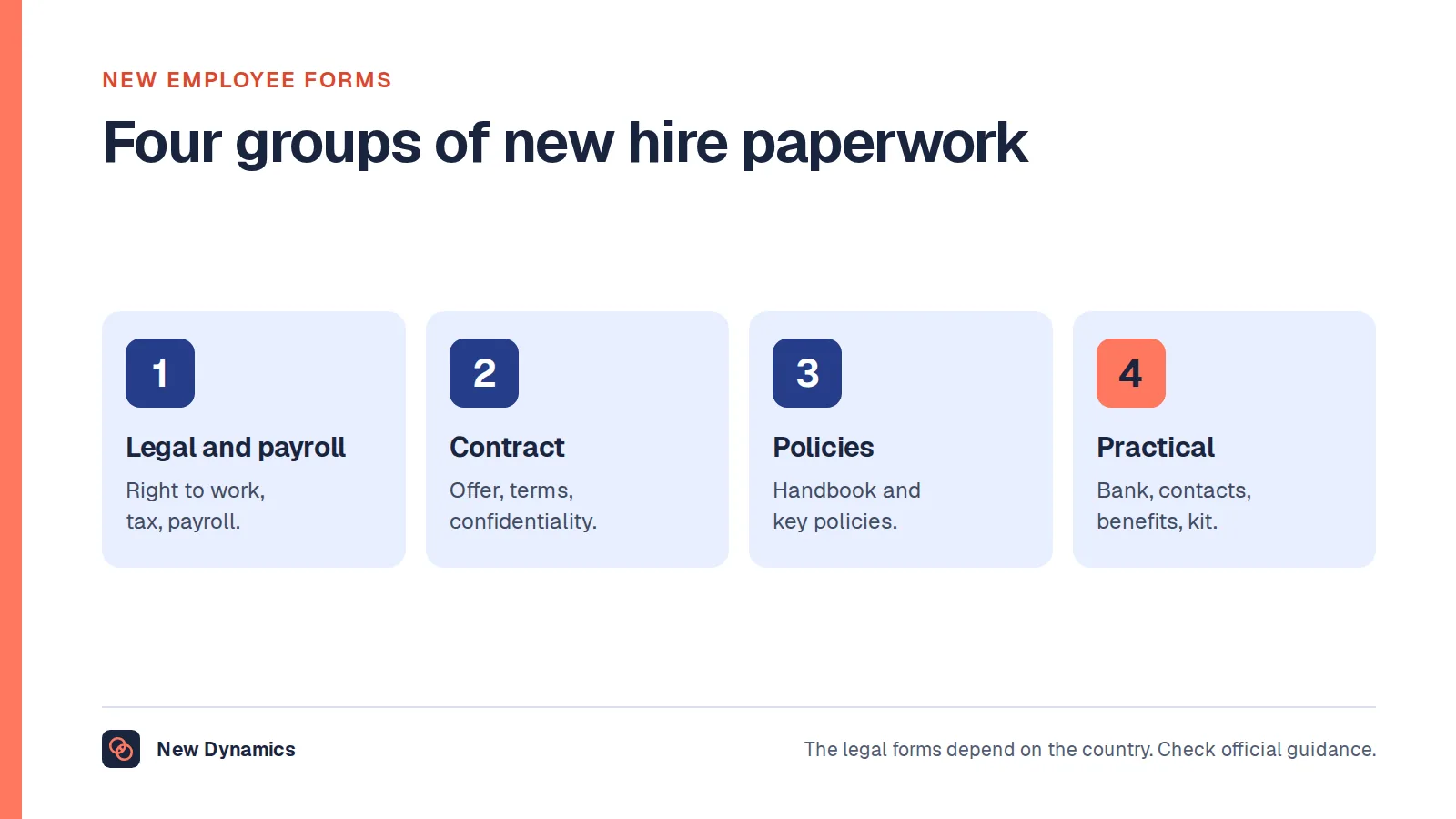
What to wear is one of the first questions that a new starter has. See how New Dynamics onboarding brings tasks, early goals and manager conversations into a clear path for a new starter.
What does business casual mean?
Business casual means clothing that is neat and professional, but less formal than a suit. Think of it as what you would wear to a meeting with a client whom you know well: clearly dressed for work, and comfortable.
There is no official definition. No law or standard fixes which garments count, and the phrase means different things in a bank, a design studio and a school. The nearest British term is smart casual, which the Cambridge Dictionary defines as clothing that is “neat and stylish, but not too formal, especially when this is the accepted way of dressing for a particular situation, place, or social occasion”. The last part of that definition is the important one. The standard is set by the setting.
Four levels of workplace dress
- Business formal. A suit, or the equivalent: tailored jacket, matching trousers or skirt, formal shoes, often a tie.
- Business casual. Professional and neat, without the suit. The subject of this article.
- Smart casual. A step more relaxed. Dark, smart jeans and clean, plain trainers are often accepted.
- Casual. Everyday clothes, within limits of cleanliness, safety and decency.
The borders are blurred, and employers draw them in different places. Some workplaces also shift with the day: smarter when clients visit, more relaxed on a Friday or when working from home.

What counts as business casual?
These lists describe what is typically accepted. Your employer's dress code, if it has one, comes first.
Usually fine
- Collared shirts, blouses, smart tops and fine-knit jumpers.
- Chinos, tailored trousers, smart skirts and dresses.
- Blazers, cardigans and smart jackets. A jacket is welcome and rarely required.
- Closed, clean shoes: loafers, brogues, flats, ankle boots, low heels.
- Simple accessories. Religious dress and symbols.
Depends on the workplace
- Dark jeans with no rips or fading.
- Clean, plain trainers.
- Polo shirts.
- Sleeveless tops.
- Visible tattoos and piercings.
Usually not
- Sportswear, gym leggings and tracksuits.
- Ripped, stained or faded clothes.
- T-shirts with large slogans or images.
- Beachwear, flip-flops and very short shorts.
- Anything that would be unsafe for the work that you do.
Two rules of thumb hold almost everywhere. Fit and condition matter more than price. And a tie is not needed.
What to wear when you are unsure
Five quick tests settle most doubts.
- The client test. Would I be comfortable if a customer or a senior leader walked in?
- The condition test. Is it clean, pressed and in good repair?
- The safety test. Is it safe and practical for what I will do today?
- The message test. Does it carry a slogan or image that could offend or distract?
- The context test. What do people in my team, and one level up, wear on an ordinary day?
For a first day or an interview, dress one step smarter than you think is needed. It is easier to take off a jacket than to find one. Or simply ask. “What do people usually wear?” is a perfectly good question to put to a recruiter or a manager, and a good manager will answer it before it is asked.

For employers: what the guidance says
A dress code is lawful in principle. The UK government's guidance on dress codes and sex discrimination, published in May 2018, says that dress codes “can be a legitimate part of an employer's terms and conditions of service”. It then sets limits.
- Equivalent standards. “Dress policies for men and women do not have to be identical. However, the standards imposed should be equivalent.”
- No gender-specific prescriptions. The guidance says that it is advisable to avoid them. Any requirement to wear make-up, have manicured nails, wear hair in certain styles or wear specific types of hosiery or skirts “is likely to be unlawful, assuming there is no equivalent requirement for men”. It gives a requirement to wear high heels as an example of a rule that could be unlawful.
- “Dress smartly” is allowed. A dress code that requires all employees to dress smartly would be lawful, the guidance says, “provided the definition of ‘smart’ is reasonable”.
- Health and safety. Employers should consider whether required items, such as particular shoes, make slips, trips or injuries more likely.
- Disability. Reasonable adjustments could include not applying dress code requirements where their impact is more onerous on a disabled employee.
- Religion. Employers “should be flexible and not set dress codes which prohibit religious symbols that do not interfere with an employee's work”.
In the United States, the Equal Employment Opportunity Commission takes a similar line in its summary of prohibited employment policies and practices. An employer may generally establish a dress code that applies to all employees, or to employees in certain job categories. But a dress code “must not treat some employees less favorably because of their national origin”. If a dress code conflicts with an employee's religious practices, and the employee asks for an accommodation, the employer must modify the dress code or permit an exception “unless doing so would result in undue hardship”. The same applies to a request that is made because of a disability.
This is a summary of official guidance in two countries. It is general information, not legal advice, and the law continues to develop.
How to write a business casual dress code in six steps
- Start with the reason. Why do you need a standard? Client contact, safety, hygiene and brand are good reasons. “We have always had one” is not. The UK guidance calls it good practice to consider the reasoning behind a dress code.
- Describe the standard in plain words, with examples. “Business casual” alone will not do. Give a short list of what is fine, and what is not, as above.
- Make it the same for everyone. Write one standard. Avoid separate lists for men and women, and avoid rules about make-up, heels, hair length or hosiery.
- Build in flexibility. Say that you will accommodate religious dress, disability, health conditions and pregnancy, and say whom to ask.
- Consult. The UK guidance notes that consulting employees, staff organisations and trade unions may better ensure that the code is acceptable to both the organisation and its staff.
- Communicate it, and apply it consistently. Tell candidates before they start. Apply the code to senior people as you do to junior ones. If someone gets it wrong, have a quiet word in private.

Sample wording
Dress code. Our dress code is business casual. We ask everyone to look neat and professional, and we trust you to judge what suits your day. A suit and tie are not needed.
Typical choices are collared shirts, blouses or smart tops, with chinos, tailored trousers, skirts or dresses, and clean closed shoes. Dark jeans without rips are fine on days when you have no external meetings. Please do not wear sportswear, ripped or stained clothing, beachwear, or clothes with slogans or images that could offend.
Wear what is safe for your work. Where protective equipment is needed, that requirement comes first.
This standard is the same for everyone. We welcome religious and cultural dress. If you need an adjustment for reasons of religion, disability, health or pregnancy, speak to your manager or to HR, and we will agree one.
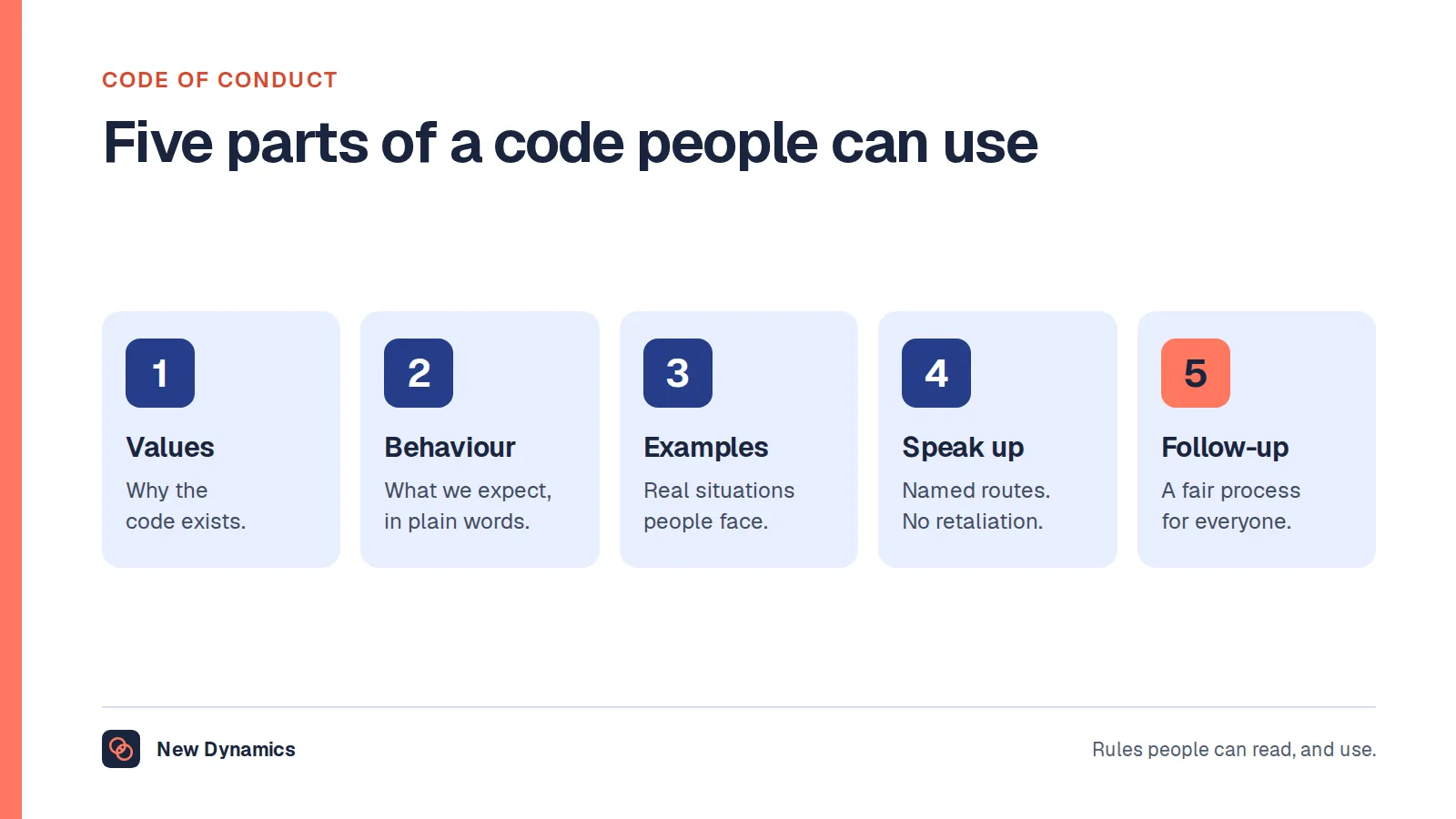
Put the dress code in your handbook, next to your standards of behaviour. Our code of conduct examples show how to write rules in plain language.
Common mistakes
Two words and no examples. “Business casual” means something different to each reader.
Separate rules for men and women. They invite claims of discrimination, and are rarely needed.
Policing appearance, not standards. Comments about someone's body, hair texture or religious dress are a different matter from a stained shirt. Train managers to know the difference.
Inconsistent enforcement. If a director wears trainers, the rule on trainers is dead.
Public correction. Speak in private, be specific and assume good faith.
Forgetting remote and hybrid work. Say what you expect on video calls, and keep it brief.
No reason behind the rule. People follow a rule more willingly when they can see its purpose.
Frequently asked questions
What does business casual mean?
Business casual means neat, professional clothing that is less formal than a suit: for example a collared shirt or smart top with chinos, tailored trousers or a skirt, and clean closed shoes. A tie is not needed.
What counts as business casual attire?
Collared shirts, blouses, smart tops, fine-knit jumpers, chinos, tailored trousers, skirts, dresses, blazers and clean closed shoes usually count. Sportswear, ripped clothing, slogan T-shirts, beachwear and flip-flops usually do not.
Are jeans business casual?
It depends on the employer. Many workplaces accept dark jeans without rips or fading, especially on days with no client meetings. Others do not accept jeans at all. Check the dress code, or ask what people usually wear.
What is the difference between business casual and smart casual?
Smart casual is a step more relaxed. Dark jeans and clean, plain trainers are more often accepted under smart casual, while business casual leans towards trousers, skirts and leather or similar shoes. Employers use the two terms loosely.
Can an employer enforce a dress code?
Generally yes. UK government guidance says that dress codes can be a legitimate part of terms and conditions, as long as standards are equivalent for men and women. Employers should be flexible about religious symbols, and must consider adjustments for disabled employees. Laws differ between countries.
Can a dress code require women to wear high heels or make-up?
UK government guidance says that such requirements are likely to be unlawful where there is no equivalent requirement for men, and advises employers to avoid gender-specific rules. This is general information, not legal advice.
Your next step: replace two words with ten lines
- Find where your organisation says “business casual”, in offers, handbooks or welcome emails.
- Add a short list of examples, and the reason for the standard.
- Check that the rules are the same for everyone, and that adjustments are offered.
- Tell every new starter what people actually wear, before their first day.
For help with putting policies like this into a clear staff handbook, read and download our employee handbook guide. The guide is free to read, and the PDF uses our short download form.
Want every new starter to arrive knowing what to expect? Book a New Dynamics demo and bring your current welcome pack. You can also email contact@new-dynamics.com.