TL;DR
- A chemical engineer designs, runs and improves the processes that turn raw materials into useful products, such as fuels, medicines, food, plastics and clean water, at industrial scale.
- The work includes designing plant and equipment, scaling processes up from the laboratory, commissioning, troubleshooting, optimising production and making sure that safety and the environment are considered at every stage.
- In the UK, the route to chartered status runs through an accredited degree, experience and the five competence areas of UK-SPEC, which also make a sound basis for goals and reviews.
A chemist can make a gram of a new compound in a flask. Someone then has to work out how to make forty tonnes of it a day, safely, at a price that people will pay, without harming the river next to the plant. That person is a chemical engineer.
This article explains what a chemical engineer does, where chemical engineers work, their responsibilities and skills, and the UK route to chartered status. For employers, it includes a job description template, and a section on setting goals and reviewing the performance of engineers fairly.
Engineers work to specifications. Their goals should be as clear. See how New Dynamics Goals & OKRs keep targets and progress in one place.
What is a chemical engineer?
The Cambridge Dictionary defines chemical engineering as “the design and operation of machinery used in industrial chemical processes”.
Prospects, the UK graduate careers website, puts it in terms of outcomes in its job profile of the chemical engineer: “Chemical engineers develop raw materials into a range of useful products.” The work, it says, focuses on “changing the chemical, biochemical and physical state of a substance to turn it into something else, such as making plastic from oil”.
The difference from a chemist is scale and purpose. A chemist studies substances and reactions. A chemical engineer designs and runs the process that makes a product in quantity, and has to weigh health and safety, cost and the environment. The role is often advertised under the title process engineer.
Where chemical engineers work
Prospects lists seven industries:
- energy;
- food and drink;
- oil and gas;
- pharmaceuticals;
- plastics;
- toiletries;
- water treatment.
It adds that any company involved in the large-scale conversion of raw materials into a product may need chemical engineers. Some work for the companies that operate plants. Others work for consultancies and contractors that design and commission them. Prospects also notes that modern chemical engineering is concerned with new materials and techniques, and gives nanotechnology, fuel cells and biomedical engineering as examples.
The setting varies with the job. Prospects says that work may take place in a laboratory, an office or a processing plant, and that jobs in processing and manufacturing may involve shift work, including evenings and weekends.
What does a chemical engineer do?
Prospects says that daily activities “will be extremely diverse and largely depend on the role and the sector”. Its list of typical responsibilities falls into six duties.
- Design plant and processes. Designing the configuration of plant and equipment so that it suits the products and the process technology, taking environmental and economic aspects into account.
- Scale up. Setting up scale-up and scale-down processes, and changing equipment design to suit. This is the step from the laboratory to the plant.
- Commission and troubleshoot. Designing, installing and commissioning new production plants, monitoring developments and solving problems as they arise.
- Optimise production. Analysing processes, finding bottlenecks, and testing options for expansion with process simulation models. This is done with process chemists and control engineers, so that the plant runs efficiently.
- Develop new products. Researching new products from trial through to commercialisation, improving product lines and applying new technologies.
- Keep it safe. Ensuring, in Prospects' words, that potential safety issues related to “the project operator, the environment, the process and the product are considered at all stages”.
The sixth duty runs through the other five. Prospects notes that safety is a high priority in chemical and nuclear-based industries, and that hygiene is critical in food and drink production and in water treatment.

Skills of a chemical engineer
Prospects lists the skills that a chemical engineer needs. They include:
- a strong understanding of engineering principles and mathematics;
- analytical and problem-solving ability;
- project management and resource management skills;
- oral and written communication skills;
- the ability to work as part of a team, and the capacity to motivate and lead one;
- strong IT skills;
- a careful and methodical approach, with good attention to detail;
- commercial and business awareness;
- creativity and innovation.
Notice how many of these are not technical. A design that cannot be explained to the operators who will run it, or to the manager who must pay for it, will not be built.
Qualifications and chartered status in the UK
Prospects states that you need a degree in chemical, process or biochemical engineering to become a chemical engineer. It adds that some employers may accept an HND or a foundation degree in the physical or applied sciences, although the person may start at a lower level.
Many chemical engineers work towards becoming a Chartered Engineer (CEng). Prospects explains that chartered engineers are registered with the Engineering Council, which it describes as the UK regulatory body for the engineering profession. To become chartered, a person needs learning to Masters level, usually through a degree accredited by the Institution of Chemical Engineers (IChemE), followed by industrial experience and professional development. They can apply for chartered membership of IChemE at the same time.
The five competence areas of UK-SPEC
The Engineering Council's standard is UK-SPEC, the UK Standard for Professional Engineering Competence and Commitment. The Engineering Council says that each registration title “requires demonstration of five broad areas”.
- Knowledge and understanding.
- Design, development and solving engineering problems.
- Responsibility, management and leadership.
- Communication and interpersonal skills.
- Professional commitment.
These five areas are useful to employers as well as to applicants. They are a ready-made competency framework for engineers, written by the profession.
Requirements differ in other countries, so check the rules where you work.

Career path
A typical path runs from graduate or junior process engineer, often on a company training scheme, to process engineer, and then to senior or lead engineer. From there, people tend to move in one of three directions: technical specialist, for example in process safety; project or engineering management; or operations and plant management.
Prospects notes that many companies run graduate training schemes, that IChemE accredits some of them, and that employers usually provide a mentor while an engineer works towards chartered status. Once chartered, engineers must keep up their continuing professional development.
We have not quoted salaries, because they vary by sector and date quickly. IChemE publishes a salary survey, which Prospects cites.
Chemical engineer job description template
Adapt this to your sector and site. Text in square brackets is for you to complete. It was written by our editorial team as a starting point, and should be checked by your engineering leadership.
Job title: Chemical Engineer [or Process Engineer]
Reports to: [Process Engineering Manager]
Location and pattern: [Site. Office, plant or both. Shift or on-call requirements. Travel.]
Purpose of the role: To design, operate and improve [the process or plant], so that it makes [product] safely, efficiently and to specification.
Main duties
- Design and specify process equipment and plant modifications, with the supporting calculations and drawings.
- Build and use process simulation models to test options and support decisions.
- Support the scale-up of new products and processes from laboratory or pilot scale.
- Take part in commissioning, start-up and troubleshooting on the plant.
- Analyse process data to improve yield, energy use, reliability and cost.
- Take part in process safety studies, and make sure that changes go through the site's management of change procedure.
- Make sure that work meets health, safety and environmental requirements.
- Write clear technical reports, and explain recommendations to operators, managers and contractors.
- Work with chemists, control engineers, maintenance and operations teams.
- [Supervise or mentor graduate engineers and technicians.]
Essential
- A degree in chemical, process or biochemical engineering, or equivalent experience. [State the level.]
- [Experience of your sector or process type, if it is truly needed.]
- Sound analytical skills, and clear written and spoken communication.
- A strong commitment to safe working.
Desirable
- Chartered Engineer status, or working towards it.
- Experience of [simulation software, regulated manufacturing or your process type].
Development: [Mentoring, support for chartered status, training budget.]
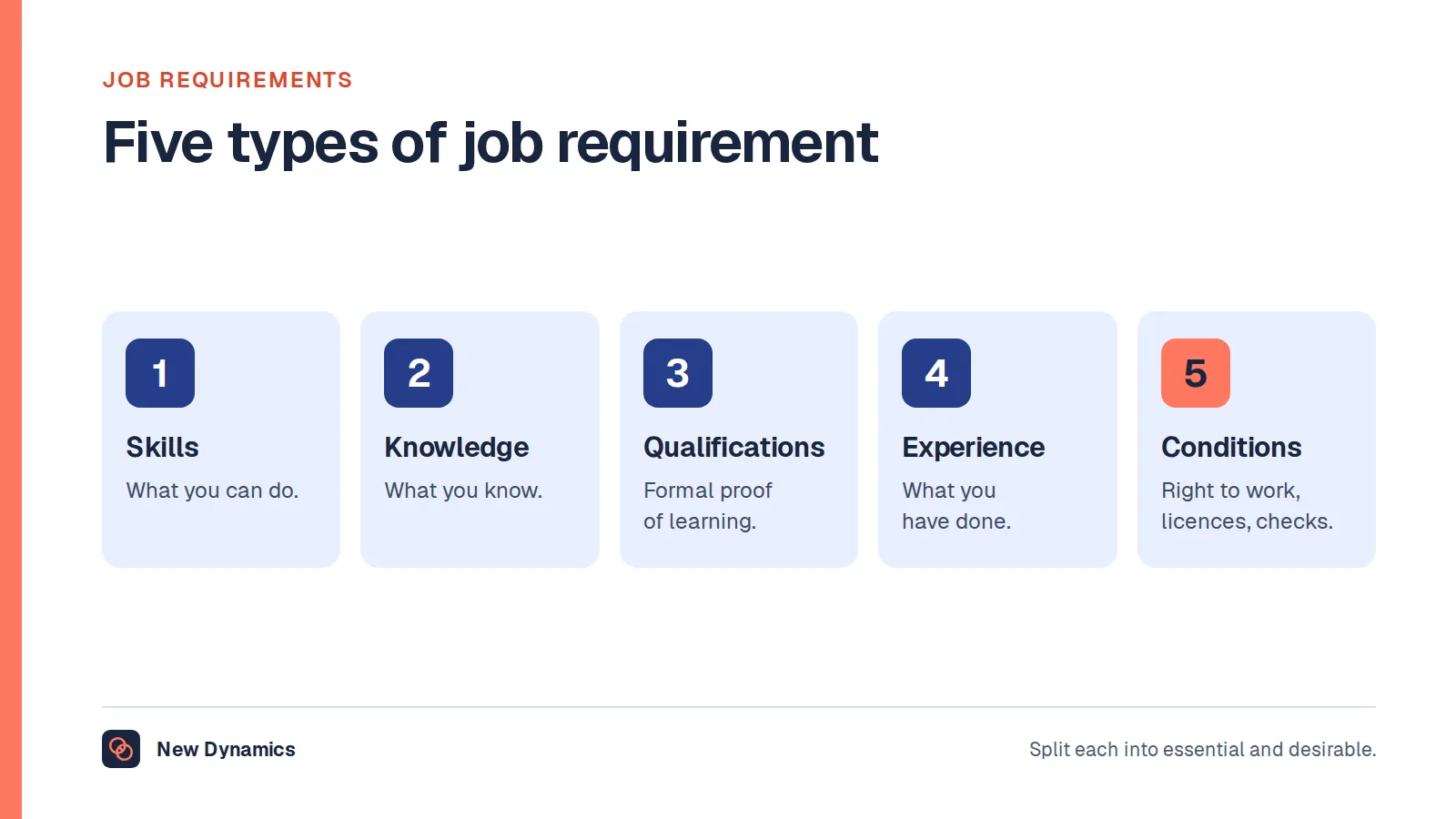
Be careful with the essential list. Our guide to job requirements explains how each extra requirement narrows the field.
Setting goals and reviewing performance for engineers
Engineers are used to evidence, so give them evidence-based reviews. Five things matter.
- Measures. Set a few measurable goals that are tied to the plant or project: yield, energy per tonne, uptime, a project milestone, the closure of safety actions.
- Safeguards. Never set a production goal without its safeguard. Output that is achieved by cutting safety or quality is a failure, so write the constraint into the goal.
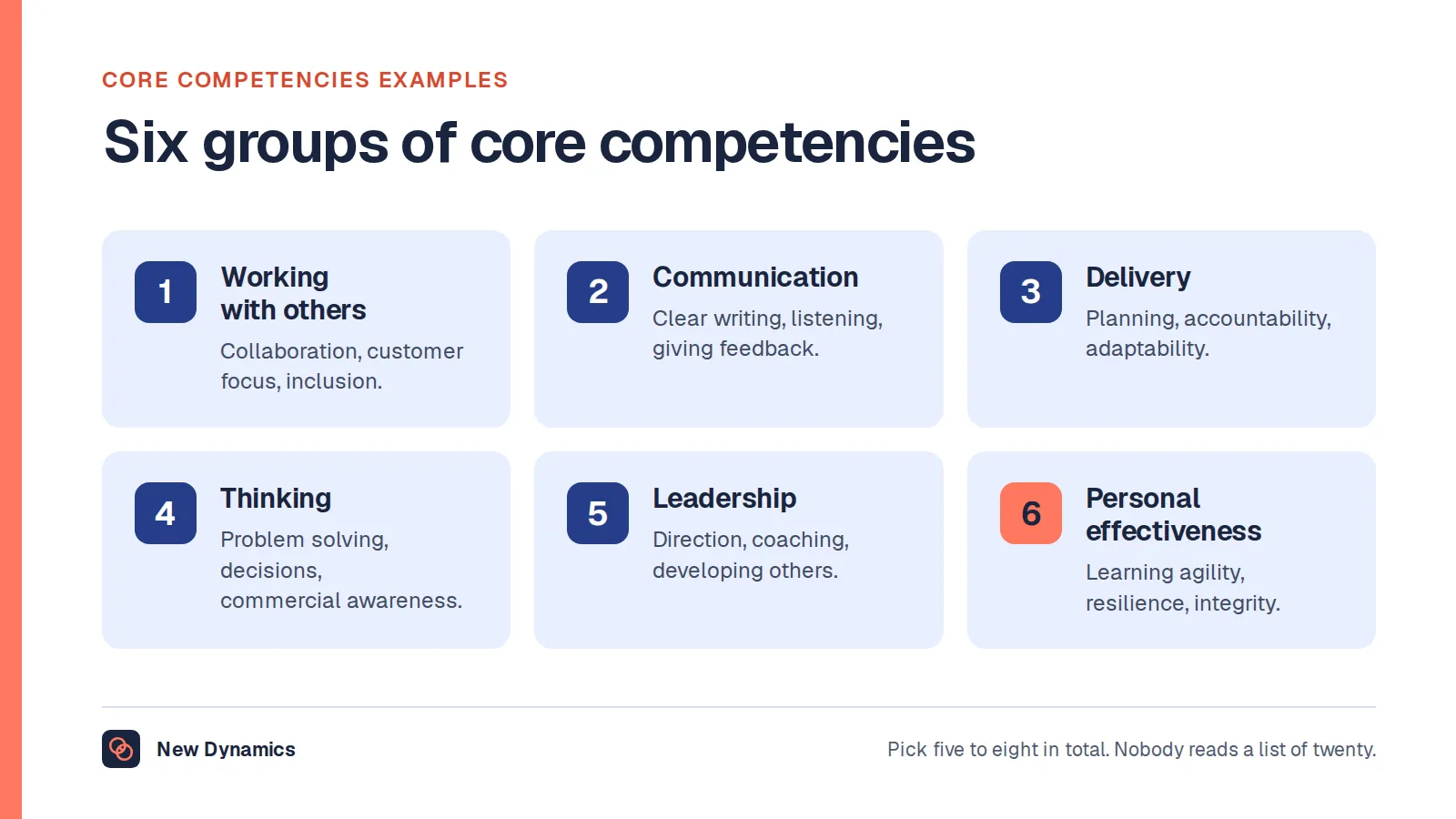
- Behaviour. Review how the work was done, as well as the results. The five UK-SPEC areas work well as headings. Our guide to core competencies shows how to describe each one as behaviour.
- Evidence from several people. Operators, project managers and fellow engineers all see different parts of the work.
- Development. Support the path to chartered status, which is a development plan that the profession has already written. Offer a technical route upwards too, so that a fine engineer does not have to become a reluctant manager to progress.

Common mistakes
A shopping list of requirements. Ten years of experience, three software packages and chartered status, for a mid-level salary. Few people will apply.
Confusing the chemist with the chemical engineer. They are different jobs. Say which one you need.
Hiding the shift pattern or the location. Process plants are often in industrial areas. Tell candidates.
Goals on output alone. See the safeguard above.
No development plan. Graduates who cannot see a route to chartered status may look for an employer who offers one.
Frequently asked questions
What does a chemical engineer do?
A chemical engineer designs, runs and improves the industrial processes that turn raw materials into products such as fuels, medicines, food, plastics and clean water. The work includes design, scale-up, commissioning, troubleshooting, optimisation and safety.
What are the main responsibilities of a chemical engineer?
Typical responsibilities are designing plant and equipment, scaling processes up, commissioning new plant, optimising production, modelling options for expansion, developing new products, and making sure that safety and environmental issues are considered at every stage.
Where do chemical engineers work?
Prospects lists energy, food and drink, oil and gas, pharmaceuticals, plastics, toiletries and water treatment. They work for plant operators, and for the consultancies and contractors that design and build plants, in laboratories, offices and processing plants.
What qualifications does a chemical engineer need?
In the UK, a degree in chemical, process or biochemical engineering is the usual requirement. To become a Chartered Engineer, a person needs accredited learning to Masters level, industrial experience and professional development.
What is the difference between a chemist and a chemical engineer?
A chemist studies substances and reactions, often at laboratory scale. A chemical engineer designs and operates the processes and equipment that make products at industrial scale, weighing safety, cost and the environment.
What should a chemical engineer job description include?
It should give the job title, the site and working pattern, the purpose of the role, the main duties, the essential and desirable requirements, and the development on offer, such as mentoring and support for chartered status.
Your next step: check one job description
- Compare your current chemical or process engineer job description with the template above.
- Add the site, the working pattern and the process type, if they are missing.
- Cut the essential list to what the job truly needs.
- Use the five UK-SPEC areas as headings in your next review of an engineer.
To plan how your engineers grow, read and download our career development guide. The guide is free to read, and the PDF uses our short download form.
Want clear goals and fair reviews for technical teams? Book a New Dynamics demo and bring your current competencies. You can also email contact@new-dynamics.com.