TL;DR
- UK employment law uses three main statuses. Acas states that 'There are 3 main types of employment status: employee, worker, self-employed', and each one carries a different set of rights.
- The contract label does not settle it. Acas says status is based on the contract, what was agreed at the offer, and 'the way the organisation and the individual work together'. Courts and HMRC look at personal service, mutuality of obligation and control before anything else.
- Tax status and employment-rights status are separate questions. gov.uk warns that 'HMRC may regard someone as self-employed for tax purposes even if they have a different status in employment law'.
Almost every argument about employment status starts with somebody holding up a piece of paper. The paper says consultant, or contractor, or self-employed associate, and the person holding it believes the question is therefore closed. It is not closed. A tribunal will read that paper, then look at how the work was actually done, and if the two disagree the paper loses.
That single point is the whole of this article. Everything else here is detail hanging off it: what the three statuses are, which rights each one brings, the tests that decide which box somebody falls into, why the tax answer and the employment-rights answer can differ, and what an employer should do about it before anyone complains.
Most of the evidence in a status dispute is simply a record of how the work ran: who assigned it, who approved the holiday, who could refuse a shift, who sent the invoice. Those records usually exist in a dozen inboxes rather than in one place. See how New Dynamics workflows keep task ownership, approvals and sign-off dates against the person rather than scattered through email.
This article covers employment in England, Scotland and Wales, where the gov.uk and Acas guidance quoted below applies. Northern Ireland has its own employment legislation and its own guidance, so check the position there separately. It is general information rather than legal advice, and a genuine status dispute is worth a professional read before you act on it. For what the contract itself is and where its terms come from, see our post on the employment contract.
What employment status means, and why it is the first question
Employment status is the legal category a working relationship falls into. It is not a job title, a pay grade or a line in a staff handbook. gov.uk puts the purpose plainly: "In employment law a person's employment status helps determine" their rights and their employer's responsibilities.
So status is the gate. Until you know somebody's status you cannot answer whether they are owed holiday pay, whether they can bring an unfair dismissal claim, whether the National Minimum Wage applies to them, or whether you should be running them through payroll at all. Answer it wrong and every downstream answer inherits the error.
Searches for "employment type meaning" or "what does type of employment mean" often mean something different and simpler: full time, part time, fixed term, casual. Those are shapes a contract can take. They sit inside status rather than replacing it. A part-time fixed-term person is almost always an employee; a casual person might be a worker or an employee depending on how the arrangement really runs.
The three UK employment statuses
Acas is direct about the count: "There are 3 main types of employment status: employee, worker, self-employed". The gov.uk list adds two further categories that behave differently again, giving "worker", "employee", "self-employed and contractor", "director" and "office holder". Directors and office holders matter for tax and company law, but for the everyday question of who is owed what, the three statuses are the ones that count.
Employee
gov.uk gives the definition in one line: "An employee is someone who works under an employment contract". The indicators it lists are the familiar furniture of a job. Someone is probably an employee if "they're required to work regularly unless they're on leave", if "they're required to do a minimum number of hours and expect to be paid for time worked", if "they cannot send someone else to do their work", if "the business provides the materials, tools and equipment for their work", and if "the business's disciplinary and grievance procedures apply to them".
Note where the contract wording appears on that list. gov.uk includes it as one indicator among a dozen: whether "their contract, statement of terms and conditions or offer letter uses terms like 'employer' and 'employee'". One indicator, not the decider.
Worker
Worker is the status people understand least and dispute most. gov.uk describes a worker as someone with "a contract or other arrangement to do work or services personally for a reward", where the reward is money or a benefit in kind, where they have only "a limited right to send someone else to do the work", where the employer must provide work for the duration of the arrangement, and where they are not doing the work through their own limited company.
The statutory root of this is section 230 of the Employment Rights Act 1996, which defines an employee as someone who works under "a contract of service or apprenticeship, whether express or implied" and then defines worker more widely, to take in anyone who undertakes to perform work personally under any other contract where the other party is not a client or customer of a business the individual runs. That second limb is what people mean when they search for a statutory worker: not a separate category of its own, but the part of the statutory worker definition that sits beyond employee status.
In practice: a bank nurse on an internal pool, a casual events steward, a delivery courier who must do the round themselves, a sessional tutor paid per class. None has an ordinary employment contract. All may well be workers.
Self-employed
gov.uk again: "A person is self-employed if they run their business for themselves and take responsibility for its success or failure". The indicators are the marks of a business rather than a job: "they put in bids or give quotes to get work", "they're not under direct supervision when working", "they submit invoices for the work they've done", "they're responsible for paying their own National Insurance and tax" and "they do not get holiday or sick pay when they're not working".

Which rights attach to each status
This is where status stops being an abstraction. Workers are the interesting case, because they get a real floor of protection and then stop.
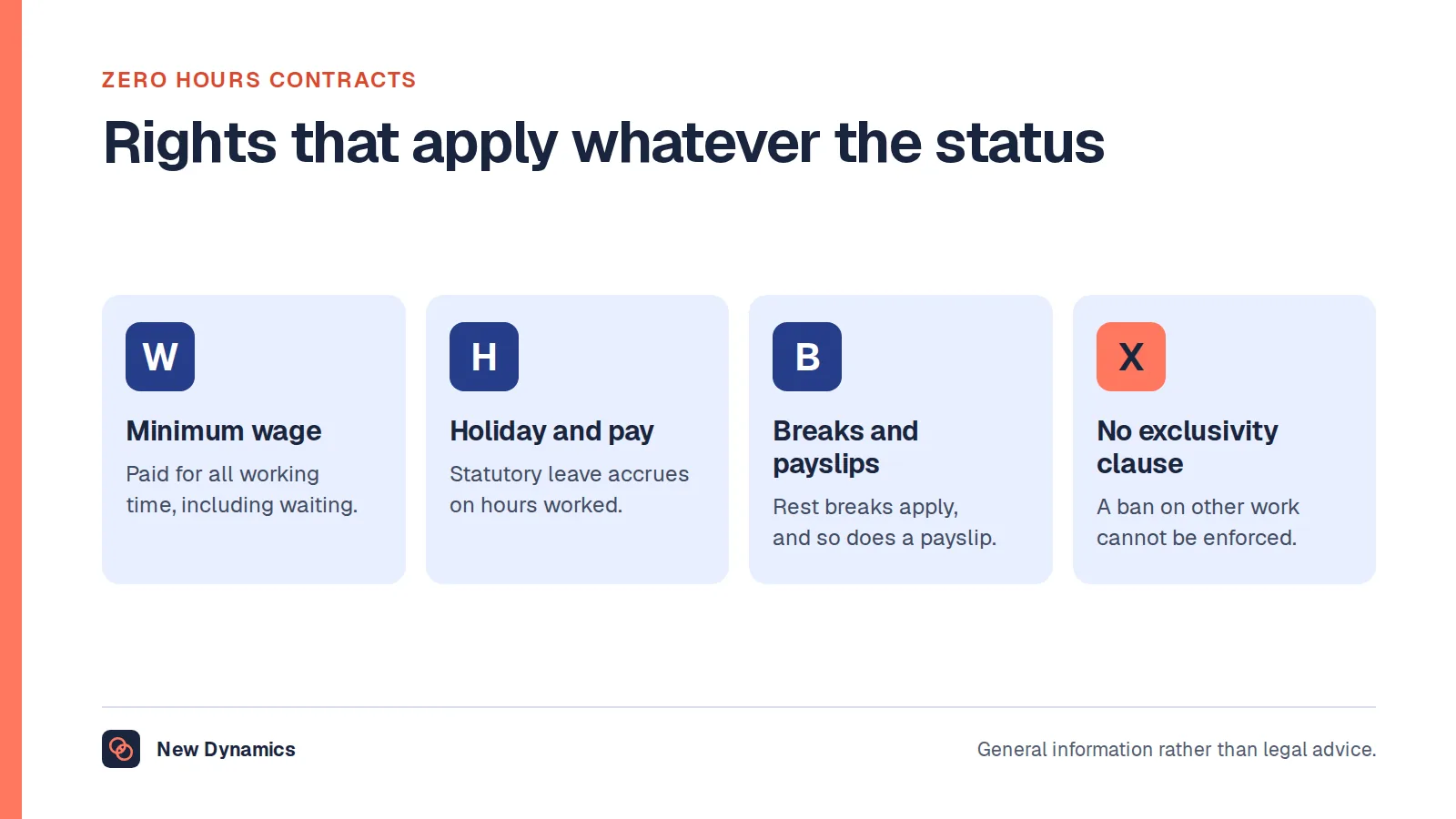
Workers are entitled to the National Minimum Wage, "protection against unlawful deductions from wages", "the statutory minimum level of paid holiday", statutory minimum rest breaks, the right to "work no more than 48 hours on average per week", protection against discrimination, whistleblowing protection and protection against less favourable treatment for working part time. Statutory sick pay and the statutory family pay entitlements may also apply.
Workers usually do not get "minimum notice periods if their employment will be ending", "protection against unfair dismissal", "the right to request flexible working", time off for emergencies, or statutory redundancy pay.
Employees get the worker list and then the rest of it: statutory sick pay, statutory redundancy pay, the full set of paid parental leave entitlements, minimum notice periods, protection against unfair dismissal, the right to request flexible working and time off for emergencies.
Self-employed people have very little under employment law. gov.uk says they have "protection of their health and safety" and "protection of their rights against discrimination (in some cases)", with everything else governed by the contract with the client, because "employment law does not cover self-employed people in most cases".
The gap between worker and self-employed is therefore the expensive one. Reclassify an engagement from self-employed to worker and you have potentially acquired years of unpaid holiday, a minimum wage shortfall and unlawful deduction claims. The gap between worker and employee adds unfair dismissal and redundancy exposure on top.
The tests: how status is actually decided
Acas sets out what a decision is built from. Status is based on "their employment contract or 'written statement of employment particulars'", "what was agreed when they were offered the job", and "the way the organisation and the individual work together". That third item is the reality test, and in a dispute it does most of the work.
Underneath that sit the tests the courts and HMRC apply. Three are usually treated as essential, and two more as the broader picture.
Personal service
Does this person have to do the work themselves? If they can freely send a substitute of their own choosing, paid by them, without asking permission, that points hard towards self-employment. A genuine, unfettered right of substitution is close to fatal to employee status.
Take two trades. A plasterer who finishes a job by sending his brother on the Thursday, invoices for the whole job and pays his brother himself is providing a service, not personal service. A hairdresser who is told she may swap with a named colleague only if the salon manager agrees has a limited right of substitution, which is exactly the wording gov.uk uses for a worker.
Mutuality of obligation
Is the employer obliged to offer work, and is the individual obliged to accept it? If both obligations exist, you are looking at an employment relationship. If neither does, you may have a string of separate engagements.
Take a shift app. A warehouse puts out shifts on an app; the operative takes them when he feels like it and the warehouse owes him nothing in a quiet week. That is thin mutuality. Change one fact, so that he is rostered in advance, penalised for declining and expected to be available, and mutuality appears whatever the app says. Note that workers need a lower level of mutuality than employees: gov.uk expects only that the employer "has to have work for them to do for as long as the contract or arrangement lasts".
Control
Who decides what is done, how it is done, when and where? Control over the manner of the work is the classic employee marker. Control only over the outcome is the classic client marker.
Take a software project. A business hires a developer to deliver a booking system by March, does not care how she builds it and accepts it when it works. That is control over the result. If instead she is in the daily stand-up, assigned tickets by a team lead, told which stack to use and expected online from nine, control has moved to the business and the consultant label is in trouble.
Integration
Is the person part of the organisation, or supplying it from outside? Integration is a feel-of-the-thing test built from concrete facts: a staff email address, a place on the org chart, a line manager, inclusion in appraisals, attendance at team meetings, a pass, a uniform, access to the benefits platform. None is decisive alone and all of them together are hard to argue away.
In business on their own account
Step back and ask whether this person is running a business. Do they have other clients, or one? Do they advertise, quote, carry their own insurance, buy their own equipment, hire help, risk a loss on a badly estimated job, and profit from working efficiently? Financial risk is the heart of it. Someone who cannot lose money on the engagement is not usually in business on their own account.

A note on "common law employee" and the "common law test"
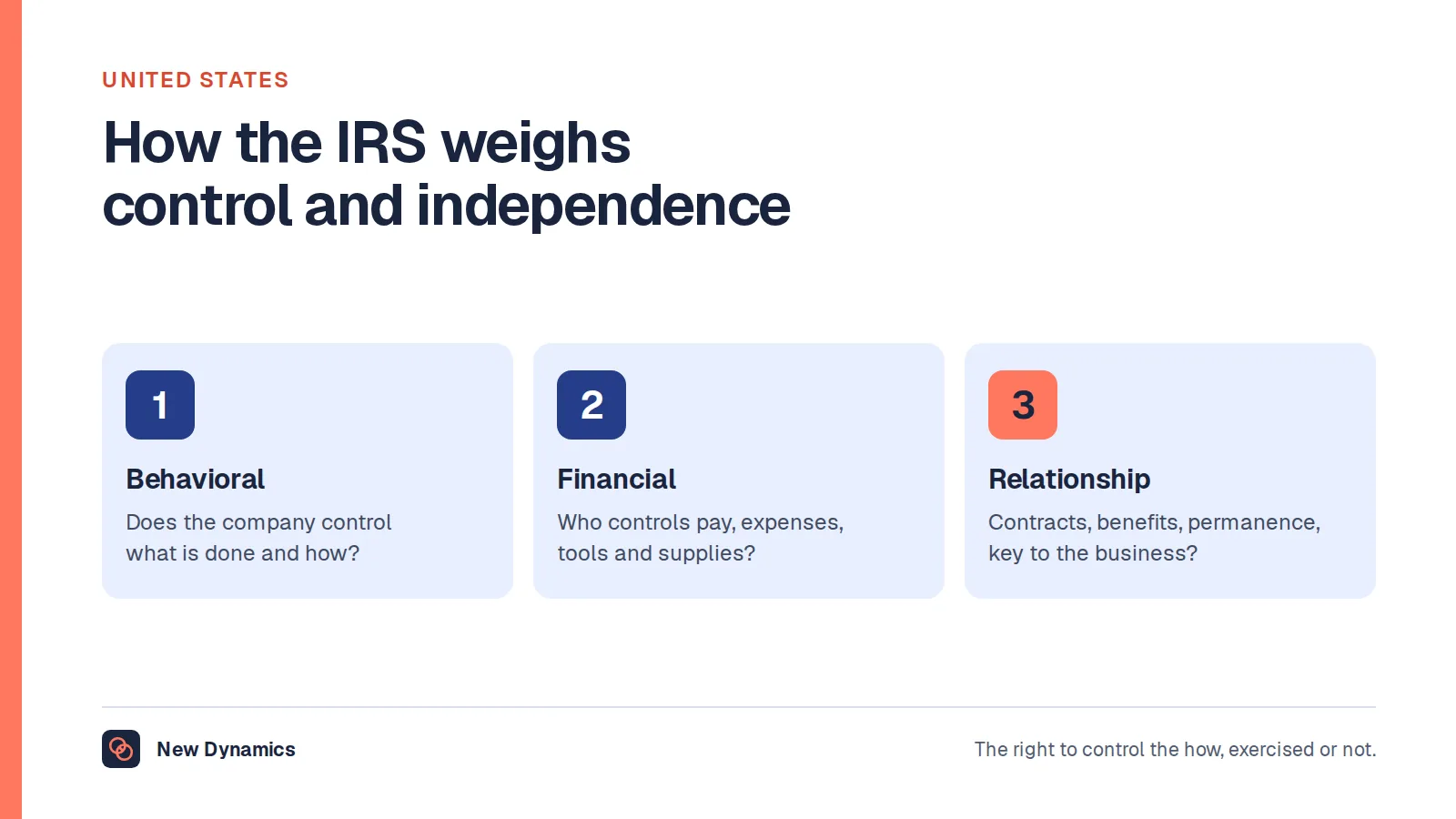
These phrases turn up constantly in employment status searches, and they are American. In the United States, a common law employee is a recognised category, and the common law test, also called the common law control test, is the framework the Internal Revenue Service and the courts there apply to decide whether a worker is an employee or an independent contractor.
The United Kingdom does not have a "common law employee" status. There is no third box called that, nothing to tick, and no UK authority will recognise the term. UK status questions are answered with the three statuses above, using the tests above. Where UK case law is doing the deciding, people talk about the employment status tests, the irreducible minimum of mutual obligation, or the multiple-factor approach, not about a common law employee.
This matters practically for anyone reading an American template, a US parent company's policy or an offshore payroll guide and trying to apply it here. The vocabulary does not transfer, and neither do the conclusions: a person safely classed as an independent contractor under the United States test can still be a worker in the UK. Our post on the independent contractor definition sets the two frameworks side by side.
Employment status for tax is a different question
This catches employers out more than anything else on this page. gov.uk states it directly: "HMRC may regard someone as self-employed for tax purposes even if they have a different status in employment law".
Two separate questions, two separate determinations, two different bodies deciding. HMRC decides tax status, and a tribunal decides employment-rights status. Nothing requires the answers to match, and settling one does not settle the other. An organisation that has satisfied itself on PAYE has not thereby answered its holiday pay exposure.
The off-payroll working rules, widely known as IR35, deal with the tax side where somebody works through an intermediary such as their own limited company. HMRC's guidance explains that the rules "make sure that a worker (sometimes known as a contractor) pays broadly the same Income Tax and National Insurance as an employee would". Where the rules apply, "the client is responsible for determining the worker's employment status for tax, and they should produce a status determination statement (SDS) including the reasons for their determination". For small private-sector clients the position flips, and "the worker's intermediary is responsible for deciding the worker's employment status".
Read the phrasing carefully: status determination for tax. A status determination statement concluding that a contractor is outside the rules says nothing about whether the same person is a worker for holiday pay purposes. If you engage contractors at any scale, our post on contractor management software covers keeping determinations, contracts and engagement records together.
Agency workers and umbrella arrangements
Agency and umbrella arrangements add a third party, and the first question is always who the employer is.
gov.uk defines the agency relationship simply: "You're an agency worker if you have a contract with an agency but you work temporarily for a hirer". Acas confirms that this does not fix status by itself, because "An agency worker could be an employee, worker or self-employed". Most agency temps are workers of the agency, and the hirer still carries health and safety duties for them on site.
Umbrella companies work differently. HMRC's guidance describes an umbrella company as "a business often used by recruitment agencies to pay temporary workers" and is clear about the employment relationship: "The umbrella company is your employer and will pay you", with the same employment rights as other employees. So the person works at your site, is supplied by an agency and is employed by a company you may never deal with. If you use umbrella labour, know which entity employs each person, because that is who owes them notice, sick pay and the rest.
What an employer should actually do
The useful exercise is short and uncomfortable: take the paperwork, take the reality, and compare them.
- List everyone who is not on the payroll as an employee. Contractors, consultants, associates, casuals, bank staff, agency temps, umbrella placements, freelancers on retainer.
- For each one, answer the three core tests from the facts, not the contract. Must they do the work personally? Is work obliged to be offered and accepted? Who controls how the work is done?
- Then test integration and business on own account. Line manager, org chart, staff systems, exclusivity on one side; other clients, own equipment, own insurance, real financial risk on the other.
- Flag every engagement where the paperwork and the reality disagree, and note which way the disagreement runs. A consultant who is managed like an employee is the risky direction.
- Fix the reality or fix the label. Either restore genuine independence, or move the person onto the correct status and start the rights they are owed.
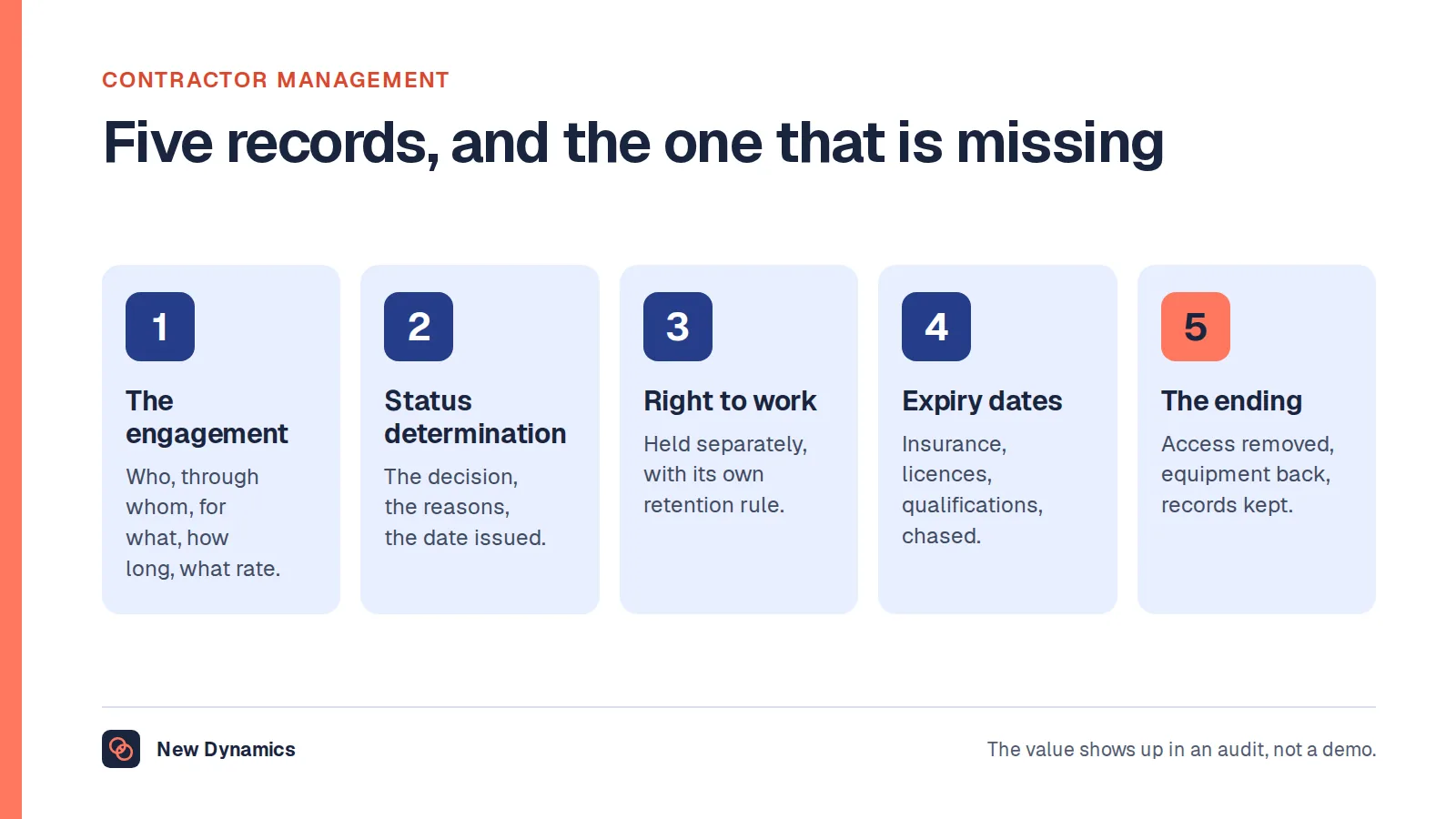
- Record the decision and the reasons at the point you make it, with the date. A contemporaneous note of why you concluded worker or self-employed is worth considerably more later than a reconstruction.
The risk if you leave it is cumulative rather than sudden. A tribunal finding that somebody was a worker all along opens unpaid holiday, National Minimum Wage shortfalls and unlawful deduction from wages, across the whole period of the engagement rather than from the date of the finding. A finding of employee status adds unfair dismissal and statutory redundancy exposure, and HMRC may separately come to its own view on PAYE and National Insurance for the same period. One finding rarely stays one claim either, because engagements of the same shape tend to be treated the same way.
Where status is genuinely borderline, Acas offers free advice and gov.uk's Check Employment Status for Tax tool answers the tax question specifically. Neither replaces legal advice on a disputed case.

Frequently asked questions
What is employment status?
Employment status is the legal category a working relationship falls into, and it determines what rights the individual has and what responsibilities the employer carries. Acas states that there are 3 main types of employment status: employee, worker and self-employed. Status is decided by the reality of the arrangement rather than by the job title or the wording of the contract.
What are the three types of employment status in the UK?
Employee, worker and self-employed. An employee works under an employment contract and holds the full set of statutory rights. A worker performs work or services personally for a reward and holds a core set of rights, including the National Minimum Wage and paid holiday, but usually not unfair dismissal protection. A self-employed person runs their own business and is outside employment law in most cases.
Can a contract say someone is self-employed when they are not?
It can say it, but saying it does not make it so. gov.uk lists the contract wording as one indicator among many, and Acas says status also depends on what was agreed at the offer and the way the organisation and the individual work together. If the reality shows personal service, mutual obligation and control by the business, a tribunal can find worker or employee status whatever the document says.
Is a common law employee a UK employment status?
No. Common law employee and the common law test are United States terms, used by the Internal Revenue Service and American courts to separate employees from independent contractors. The United Kingdom has no such category. UK status questions are answered using the three statuses, employee, worker and self-employed, and the tests of personal service, mutuality of obligation, control, integration and whether the person is in business on their own account.
Does employment status for tax match employment status for employment rights?
Not necessarily. gov.uk warns that HMRC may regard someone as self-employed for tax purposes even if they have a different status in employment law. The off-payroll working rules, known as IR35, settle the tax treatment where somebody works through their own company, and a status determination statement under those rules does not decide whether the same person is a worker for holiday pay or minimum wage purposes.
What is a statutory worker?
It is a loose way of describing somebody who falls within the statutory definition of a worker without being an employee. Section 230 of the Employment Rights Act 1996 defines employee narrowly, by reference to a contract of service, and worker more widely, to include anyone who undertakes to perform work personally under another kind of contract where the other party is not a client or customer of a business the individual runs. That second limb is the status most casual, bank and gig arrangements fall into.
Your next step: check the reality against the paperwork
- Pull the list of everyone engaged outside the employee payroll and put a name against each engagement's actual working pattern.
- Run the three core tests on each one, in writing, from facts rather than from the contract.
- Decide which engagements you are willing to defend, and change the ones you are not.
- Record each determination with its date and reasons, and diary a review when the working pattern changes.
- Confirm, for every agency and umbrella placement, which entity is the employer.
Status is usually decided by day-to-day records: who assigned the work, who approved the absence, who signed the work off. For putting that trail in one place from the first day of an engagement, read and download our employee onboarding guide. The guide is free to read, and the PDF uses our short download form.
Want engagements, approvals and determination dates held against each person with the history intact? Book a New Dynamics demo and bring your contractor list. You can also email contact@new-dynamics.com.