TL;DR
- A contract exists before anything is signed. gov.uk states that 'As soon as someone accepts a job offer they have a contract with their employer', and that 'An employment contract does not have to be written down'.
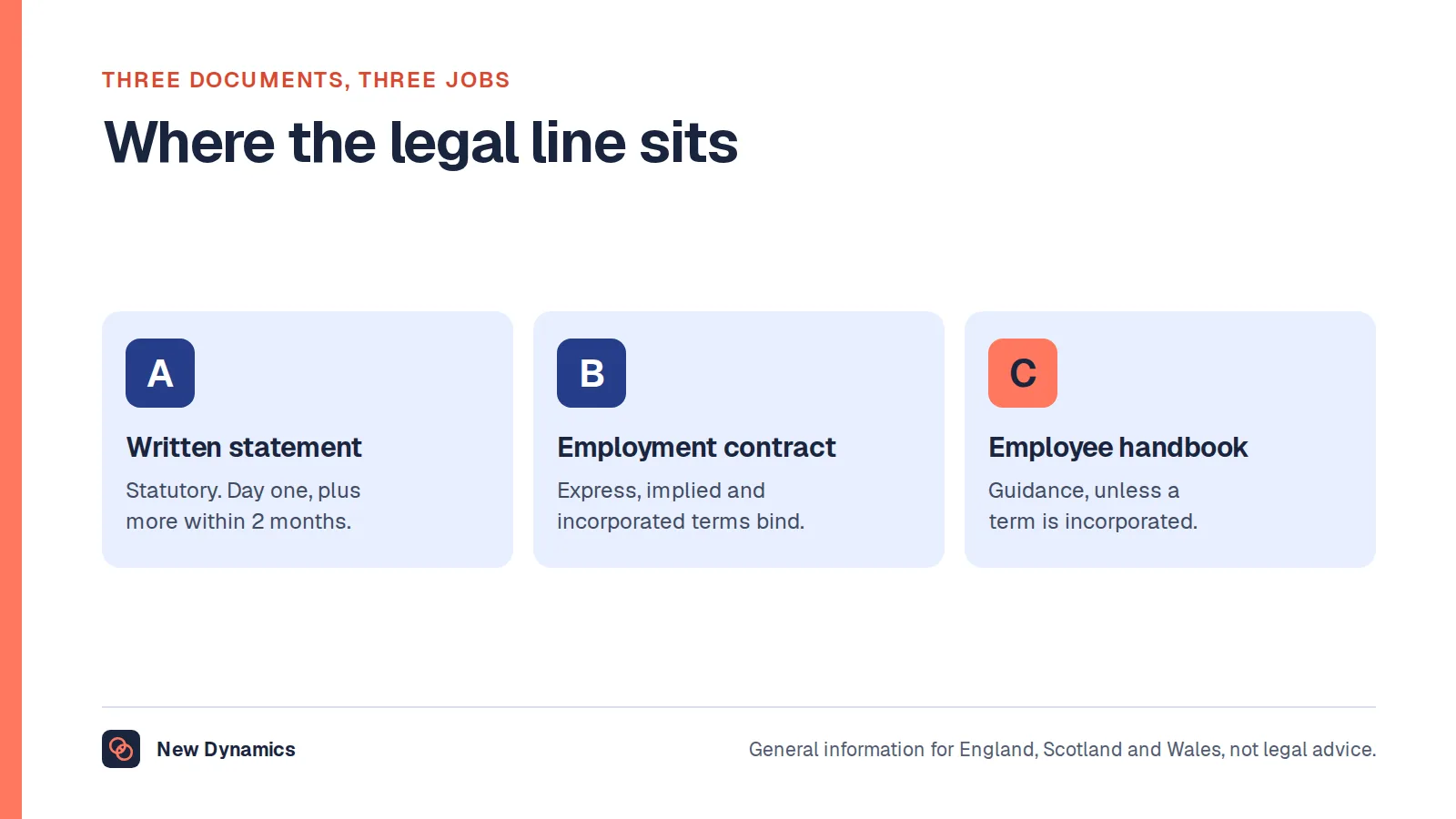
- The contract is wider than the document. Acas describes express terms, implied terms, custom and practice, incorporated terms from documents such as a handbook, and imposed or statutory terms, and says 'Employers cannot include anything in a contract that contradicts an imposed term'.
- The written statement of employment particulars is a separate statutory document. gov.uk says an employer 'must provide the principal statement on the first day of employment and the wider written statement within 2 months of the start of employment', for workers as well as employees.
Most employment contract questions arrive in the same shape: someone starts next Monday, nobody has signed anything yet, and a manager wants to know whether that matters. It matters less than people expect, and not in the direction they expect. The contract is already there. What is missing is the evidence of what is in it.
This article explains what an employment contract is, where its terms actually come from, what the law requires you to put in writing and by when, how a term can lawfully be changed, and what notice clauses and restrictive covenants do in plain terms. It covers employment in England, Scotland and Wales, where gov.uk and Acas guidance applies. Northern Ireland has its own employment legislation and its own guidance, so check the position there separately. It is general information rather than legal advice, and anything touching pay, dismissal, immigration status or post-employment restrictions is worth a professional read before it is issued.
The practical consequence lands on whoever runs onboarding, because the statutory paperwork has a first-day deadline attached. See how New Dynamics onboarding puts the written statement in the pre-start sequence rather than in the pile someone works through in week three.
A contract of employment exists as soon as the offer is accepted
This is the part most articles bury, and it is the single most useful thing to know. gov.uk puts it in one sentence: "As soon as someone accepts a job offer they have a contract with their employer". No signature is required, and no document is required. The same page states plainly that "An employment contract does not have to be written down".
Acas agrees and adds how agreement can be reached. It says "Employment contracts are legally binding agreements between employers and workers", and that a contract can be agreed "verbally, through conversations", in writing such as a job offer letter or emails, or "through conduct, when people's actions show there's an agreement".
So an unsigned contract is not an absent contract. It is a contract whose terms are harder to prove, which is a different and more awkward problem. If a dispute arises about holiday entitlement or notice, the question a tribunal asks is what was agreed, not what was countersigned. An employer with no record is arguing from memory against someone else's memory.
That is also why "contract of employment", "employment agreement", "contract job agreement" and "work contract" all describe the same legal thing. The phrasing varies; the arrangement does not. What differs between people is their employment status, which decides which rights attach, and that is a separate question covered further down.
Where the terms of an employment contract come from
The document in the filing cabinet is one source of terms among several. Acas sets out the routes, and knowing them is what stops an employer promising something it never meant to promise.

Express terms, written or spoken
Acas says "Some terms will be explicitly agreed. These are called 'express terms'", and that "Express terms are usually put down in writing. This might be in the 'written statement of employment particulars' or a job offer letter".
They do not have to be written, though. Express terms "can also be agreed verbally, in conversations between a worker and their employer", and Acas is explicit about the consequence: "Terms agreed verbally are usually still legally binding. This means that they are still part of the legal contract". A hiring manager who says "we always let people finish at four on a Friday" in an interview has potentially agreed a term.
Terms implied by law
Acas explains that "Some terms can be 'implied' in the employment contract, even if they have not been written down", and that implied terms "often fill in gaps where things have not been written down or agreed verbally". A term may be implied because it is "necessary to make the contract work", because it was too obvious to write down, or because it is clear in the conduct of the two parties.
Some duties are always present. Acas names them as "duty of care, duty of trust and confidence, duty of fidelity". The limit is worth remembering as well: "An implied term cannot contradict a written term".
Custom and practice
This is the route that creates entitlements by accident. For something to be implied through custom and practice, Acas says it must be "'notorious' or generally well-known in the business or industry, usually over a long period of time, reasonable, certain". Acas gives enhanced redundancy pay as the example: paid consistently, never written down, and well known across the organisation.
Again there is a limit. Acas says something "cannot become part of the contract through custom and practice if it contradicts a written term". A discretionary bonus paid in full every December for a decade stops looking discretionary, and writing "discretionary" in a policy is weaker protection than behaving as though it is.
Terms incorporated from a handbook or a collective agreement
Acas says "Some employment contract terms might be written in other documents. These are called 'incorporated terms'", and the point that catches employers out is what follows: "Incorporated terms might not have been agreed specifically between an individual worker and their employer. But they are still part of the employment contract". A collective agreement negotiated with a trade union works the same way.
How to word a handbook so it stays guidance rather than contract is a subject of its own, and our post on the employee handbook covers the drafting side.
Statutory terms that override anything less generous
Finally, the floor. Acas says "Some terms are part of the employment contract because they're required by law. These are known as 'imposed terms'", that imposed terms coming from acts of law "are sometimes known as 'statutory terms'. For example, that workers should be paid at least the minimum wage", and then the rule that settles any argument: "Employers cannot include anything in a contract that contradicts an imposed term".
A clause offering less than the statutory minimum is not a clever contract. It is an unenforceable one, and the statutory position applies regardless of what both sides signed.
The written statement of employment particulars
The written statement is the document the law makes you issue, and it is not the contract. It is evidence of the main terms, with a statutory list of contents and two deadlines.
gov.uk states that "An employer must give employees and workers a document stating the main conditions of employment when they start work", and that the employer "must provide the principal statement on the first day of employment and the wider written statement within 2 months of the start of employment".

What the principal statement must contain on day one
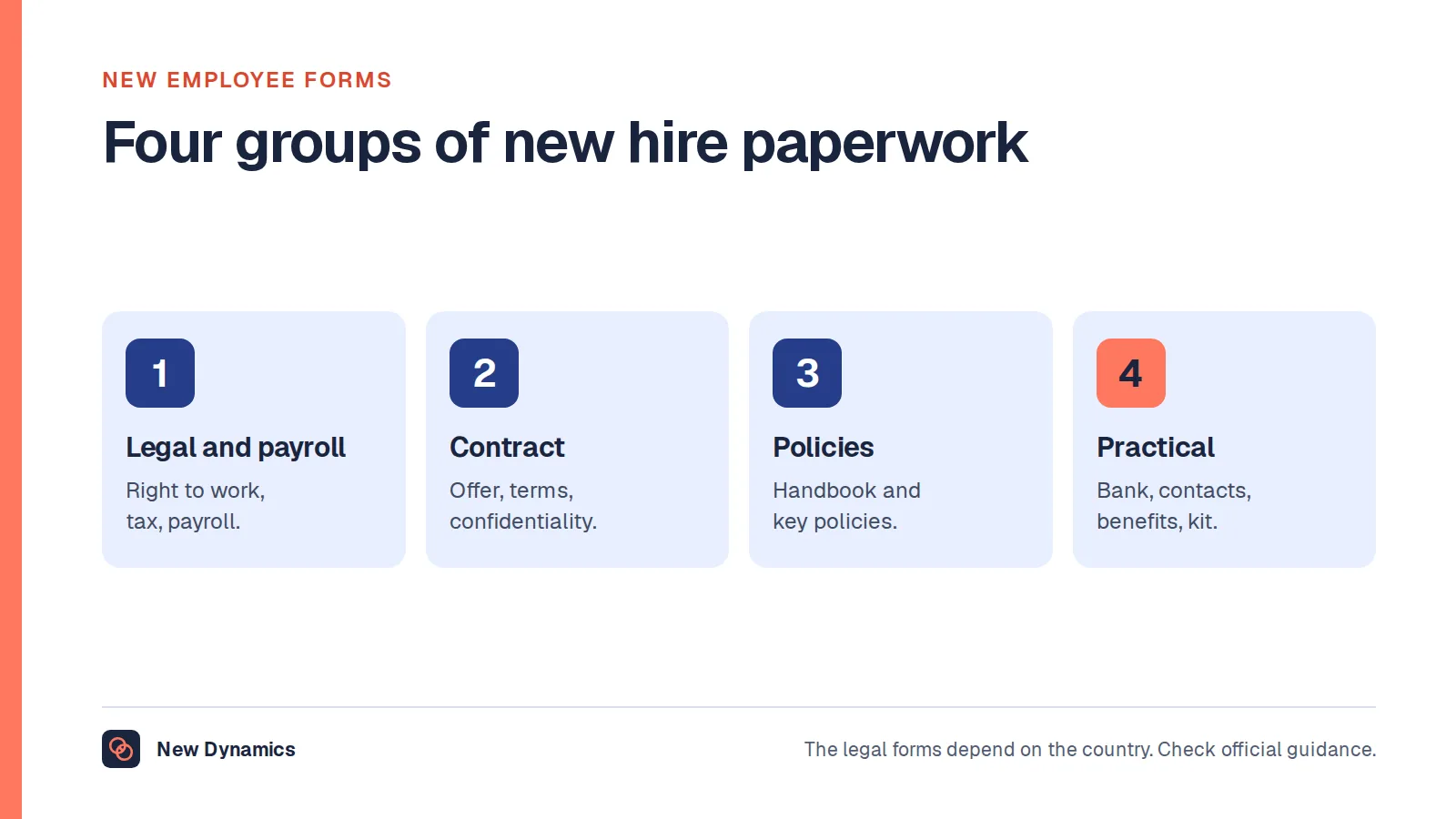
gov.uk lists the principal statement contents as "the employer's name", the employee's or worker's name, job title or a description of work and start date, "how much and how often an employee or worker will get paid", "hours and days of work and if and how they may vary", holiday entitlement, where the person will be working, how long a job is expected to last, "how long any probation period is and what its conditions are", any other benefits, and "obligatory training, whether or not this is paid for by the employer".
What can follow within two months
The items that can wait are "pensions and pension schemes", "collective agreements", any other right to non-compulsory training provided by the employer, and "disciplinary and grievance procedures".
That last item is the legitimate bridge to a handbook, provided the handbook genuinely holds those procedures and the person can reach the version that applied when they started.
A day one right, and it covers workers too
Two details get missed. The statement is due on the first day, not within a week or by the end of probation. And the duty runs to workers as well as employees, which gov.uk says in the same sentence that creates the duty. Casual staff, zero-hours staff and anyone else with worker status is in scope. gov.uk also notes that "There are special rules for agencies on documents that they need to provide to agency workers".
Changing an employment contract
A contract is not a document you can quietly reissue. gov.uk sets the default: "Employees and employers must stick to a contract until it ends (for example, by an employer or employee giving notice or an employee being dismissed) or until the terms are changed (usually by agreement between the employee and employer)".
Acas puts the employer duty directly: "Both you and the employee can propose changes to the agreed terms and conditions. You must both agree to the changes". Consultation comes first, as a genuine discussion with the affected people or their representatives about whether a change is needed and what change would work, not an announcement with a comment box.
Once a change is agreed, there is a deadline. Acas says "By law, you must put a change in writing within 1 month of the change", and removes a common excuse for delay: "Employees do not have to sign a new contract for changes to take effect". A letter or email recording what changed, and when, satisfies the duty.

Imposing a change instead carries real exposure. Acas lists the risks of changing a contract without agreement as "legal claims, for example claims of breach of contract or constructive dismissal", damaging working relations, reduced commitment and performance, discrimination claims, and valued people leaving. A flexibility clause may allow some unilateral change, but it is narrower than employers hope and does not convert a pay cut into an administrative step.
Employment status, briefly, because it decides which rights apply
The same contract wording can produce very different rights depending on status. gov.uk says that "In employment law a person's employment status helps determine: their rights" and their employer's responsibilities, and lists the main types as "worker, employee, self-employed and contractor, director" and office holder. It also notes that a person's status for tax can differ from their status in employment law.
The practical gap is wide. gov.uk says a person is generally classed as a worker if "they have a contract or other arrangement to do work or services personally for a reward", and that workers are entitled to "getting the National Minimum Wage", "the statutory minimum level of paid holiday" and "the statutory minimum length of rest breaks", while generally not being entitled to "minimum notice periods", protection from unfair dismissal, flexible working requests or statutory redundancy pay.
Status follows the facts of the working relationship, not the heading on the paperwork. Our post on the independent contractor relationship covers the tests used to decide it and the cost of getting it wrong.
Notice clauses and restrictive covenants in plain terms
A notice clause says how much warning each side must give to end the contract. The contract can offer more than the statutory minimum but not less. gov.uk tells employees "You must give at least a week's notice if you've been in your job for more than a month", and adds "Your contract will tell you whether you need to give notice in writing, otherwise you can do it verbally". An employer's minimum rises with length of service, so check the current statutory figures before relying on a clause someone drafted years ago.
Restrictive covenants work after employment ends. Acas says "Restrictive covenants restrict employee's activities after they leave, to protect the employer's business interests", and lists the usual four: non-competition, "preventing employees from working for a competitor or starting a competing business for a period of time, or within a certain distance"; non-disclosure, "preventing employees from sharing sensitive or confidential information after they leave"; anti-poaching, "preventing employees from encouraging others to leave with them"; and non-solicitation, "preventing former employees from trying to get the business of their previous employer's clients or customers".
Breadth is the enemy of enforceability. Acas warns that "An employer will not usually be able to enforce restrictive covenants unless they're clear, specific and time-restricted. Even then, this area of the law can be complex", and advises employers to take legal advice before including them. A separate point applies to exclusivity clauses, which stop someone working elsewhere: Acas says employers "must not use exclusivity clauses if a worker: is on a zero-hours contract" or has average weekly income at or below the lower earnings limit.
The HR process: issue it on time, then keep the history
Knowing the law is the easy half. The half that fails in practice is operational, and it fails in three predictable places.
Issue the statement during onboarding, not after it
The deadline is the first day, which means the work happens before the first day. Draft the principal statement when the offer is accepted, not when the new starter arrives, and treat it as a pre-start task with an owner and a date. Put the two-month items on a second, dated task so pensions and the procedures reference do not drift. Our employee onboarding checklist sets out where these sit alongside the rest of week one.
Keep a version history, so you can show what someone agreed to and when
This is the capability most employers discover they lack at the worst moment. A dispute is rarely about today's terms. It is about what the terms were in March two years ago, whether a change was agreed, and whether it was confirmed in writing within a month as Acas requires.
A version history means, for each person: the statement issued at the start, every variation letter since, the date each was sent, and what was superseded. Keep the old versions rather than overwriting them. If a bonus scheme or a sick pay arrangement changed, the question is what applied at the time of the event, not what applies now. A single current PDF per person cannot answer that, which is why contracts and variations belong in a record against the person rather than in a shared folder named after the person who last edited them.
Keep the records, but not more of them than you need
Contracts and variation letters are personal data, and the retention position has a source. The ICO says "The data minimisation principle says you must make sure the personal information you hold is adequate, relevant, and limited to what you need for your purposes", and that "The storage limitation principle says you can only keep personal information for as long as you need it".
There is no fixed period to copy. The ICO states that "Data protection law does not set specific time limits for how long you can keep your workers' personal information. This is up to you, and will depend on how long you need the information for your particular purposes". What it does ask for is a decision you can show: "You should set up a retention policy or schedule that lists: the types of record or information you hold; what you use it for; and how long you intend to keep it". And at the end of it, "Once you no longer need the information, you should erase it or, if possible, anonymise it".
The two pulls sit together more comfortably than they look. Keep the contractual history for as long as a claim or a legal obligation could need it, write down why that period applies, and stop keeping the recruitment debris, interview notes and draft offers that came with it.
Frequently asked questions
What is an employment contract?
An employment contract is a legally binding agreement between an employer and an employee or worker that sets out the terms of the working relationship: pay, hours, holiday, duties, notice and the rest. gov.uk describes it as an agreement setting out an employee's employment conditions, rights, responsibilities and duties, and Acas calls employment contracts legally binding agreements between employers and workers. Contract of employment, employment agreement and work contract all describe the same thing.
Do you need to sign a contract for it to be valid?
No. gov.uk says that as soon as someone accepts a job offer they have a contract with their employer, and that an employment contract does not have to be written down. Acas adds that a contract can be agreed verbally, in writing or through conduct. A signature is useful evidence of what was agreed, not the thing that creates the agreement.
Is the written statement of employment particulars the same as the contract?
No. The written statement is a statutory document recording the main conditions of employment, while the contract is wider and includes express, implied, incorporated and statutory terms. gov.uk says an employer must provide the principal statement on the first day of employment and the wider written statement within 2 months of the start of employment.
Can an employer change an employment contract?
Only by agreement, in the normal case. gov.uk says the parties must stick to a contract until it ends or until the terms are changed, usually by agreement, and Acas says both sides can propose changes but must both agree to them. Once a change is agreed, Acas says you must put it in writing within 1 month, and employees do not have to sign a new contract for the change to take effect. Imposing a change risks claims of breach of contract or constructive dismissal.
Are restrictive covenants in an employment contract enforceable?
Sometimes, and only if they are tightly drawn. Acas says an employer will not usually be able to enforce restrictive covenants unless they are clear, specific and time-restricted, and warns that even then the law here is complex. The common types are non-competition, non-disclosure, anti-poaching and non-solicitation clauses, and Acas advises employers to take legal advice before including them.
How long should you keep employment contracts?
There is no set period. The ICO says data protection law does not set specific time limits, that this depends on how long you need the information for your purposes, and that you should set up a retention policy or schedule listing what you hold, what you use it for and how long you intend to keep it. Keep the contractual history while a claim or legal obligation could need it, record why, and erase or anonymise what you no longer need.
Your next step: get the paperwork and the history right
- Check whether anyone starting in the next month has a drafted principal statement ready for day one, and whether your workers as well as your employees receive one.
- Compare the statement against the gov.uk list of principal statement contents, and schedule the two-month items separately.
- List the terms that live outside the main document: handbook clauses, collective agreements, long-standing practices. Decide for each whether you intend it to be contractual, and fix the wording if you do not.
- For every variation in the past two years, confirm it was agreed, confirmed in writing within a month, and stored with its date against the person.
- Write the retention position down: what you keep, why, and for how long.
For the first-day sequence in full, including who owns the statement and where it sits among the rest of the tasks, read and download our employee onboarding guide. The guide is free to read, and the PDF uses our short download form.
Want contracts, variations and acknowledgement dates held against each person with their history intact? Book a New Dynamics demo and bring your current statement template. You can also email contact@new-dynamics.com.