TL;DR
- Events manager covers three quite different jobs: corporate and internal events, venue and hospitality events, and agency or client-side management. A single job description cannot fit all three, which is why most downloadable templates are useless.
- The working pattern is the part templates leave out. Evenings, weekends and peaks have to be planned against the statutory floor: gov.uk says you “cannot work more than 48 hours a week on average - normally averaged over 17 weeks”, and workers have the right to “11 hours rest between working days”.
- Safety is an accountability, not a formality. HSE says the organiser is “responsible for ensuring that overall safety at the event is maintained”, and that “the key tool for creating a safety plan is the process of risk assessment”. Judge the post holder on what they control: budget accuracy, supplier management and incident-free delivery.
Search for an events manager job description and you will find a hundred of them, all broadly the same and all broadly unusable. They list the same twelve duties, ask for the same "excellent organisational skills", and could be pasted into a hotel, a software company or a four-person agency without anyone noticing. That is the tell. A document that fits every employer describes no job in particular.
The problem is not laziness. It is that the title covers three jobs that happen to share a name. An events manager at a manufacturer who runs the sales conference and the long-service awards has almost nothing in common, day to day, with an events manager at a hotel selling and delivering forty weddings a year, or with one at an agency billing their hours to three clients at once. Write one description for all three and you get a document that nobody can be assessed against.
This article is written for the employer rather than the candidate. It separates the three versions, gives a full description you can adapt, deals honestly with the evenings and weekends, sets out where the health and safety duty actually sits, and ends with the two or three interview questions that tell you something.
Accountabilities are only worth writing if someone later judges them, so they belong where the goals live. See how New Dynamics Goals & OKRs keeps objectives, owners and progress in one place, so the description and the review conversation discuss the same job.
Where the law is mentioned, the sources quoted describe Great Britain, and the health and safety regulator cited covers England, Scotland and Wales. Northern Ireland has its own working time regulations and its own regulator. This is general information rather than legal advice. No salary figures appear anywhere in this article, because we have no sourced data for the role and inventing a range would be worse than leaving it out.
What the events manager role covers
Strip away the sector and the job is this: someone owns the commitment that an event will happen, at a standard, on a date that cannot move, within a budget, without anybody getting hurt. Everything else in the description follows from that sentence.
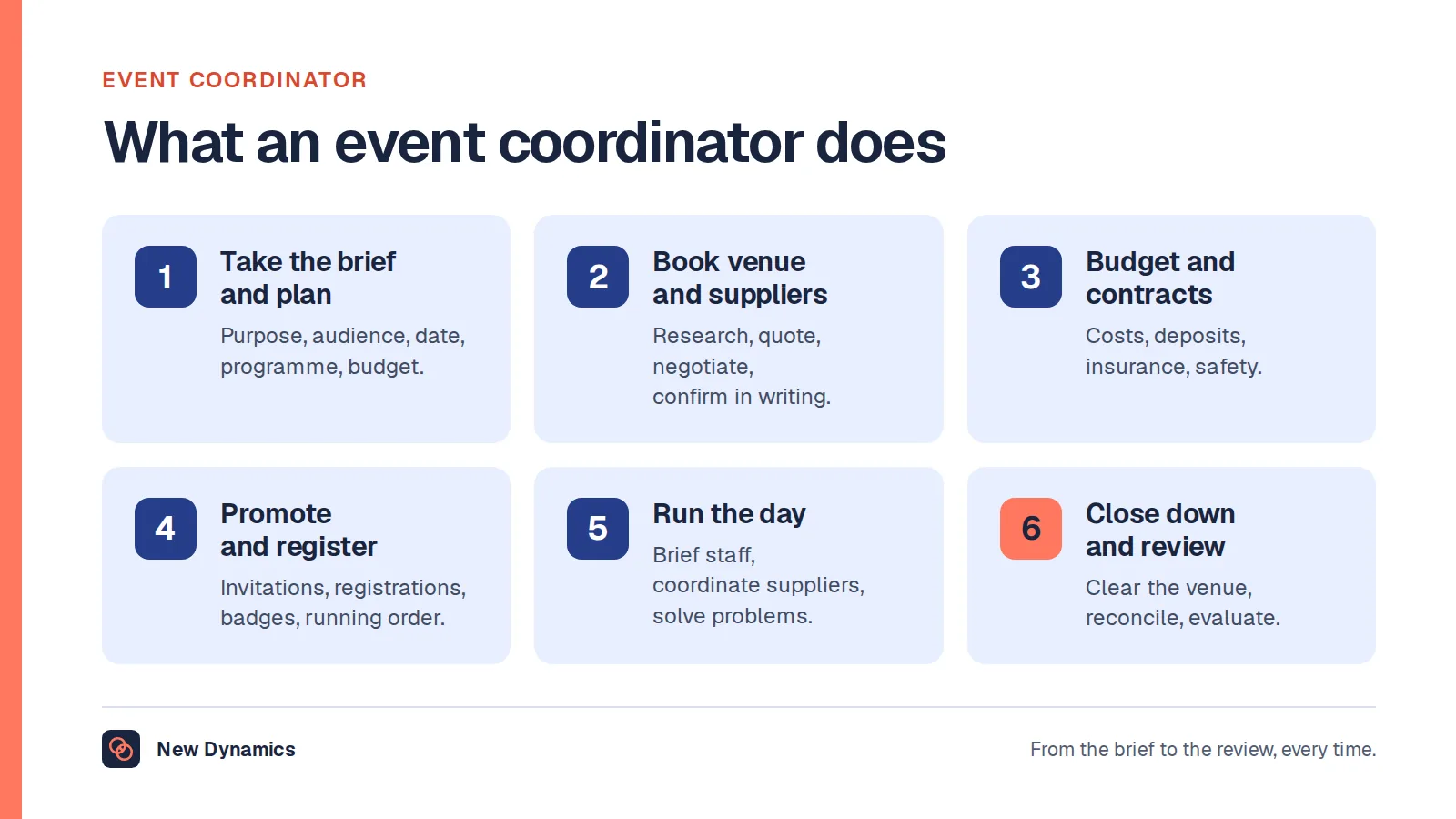
The work splits into five phases, and every version of the role does all five:
- Definition. What the event is for, who it is for, what success would look like, and what it is allowed to cost.
- Procurement. Venue, catering, audio visual, transport, accommodation, staffing, production. Quotes, negotiation, contracts, deposits.
- Build. The schedule, the running order, the delegate journey, registration, the signage, the brief for everyone working on site.
- Delivery. The event itself, which is the only part most people see and the smallest part of the job by hours.
- Close. Derig, final reconciliation, supplier debrief, incident review, and the report that makes the next one cheaper or better.
What changes between the three versions is not the phases. It is who the client is, where the money comes from, what repeats, and what counts as failure.
Three versions of the role, and why one template will not do

Corporate and internal events
The client is a colleague. The budget is a cost centre, not a revenue line, which means every pound spent has to be defended internally rather than recovered from a customer. The calendar is dictated by the business: the sales kick-off, the results announcement, the awards evening, the graduate induction, the customer forum.
The distinctive demands are stakeholder management and internal politics. The post holder negotiates with a sales director who wants a bigger stage, a finance team that wants last year's budget minus ten per cent, and a chief executive who will change the keynote the week before. Much of the skill is saying no to senior people and making the no stick.
Failure here is rarely a logistical disaster. It is an event that nobody wanted, a conference that cost more than it was worth, or a launch that embarrassed the brand internally.
Venue and hospitality events
The client is a paying customer, and the site does not change. The post holder sells and delivers against a repeating diary: weddings, conferences, Christmas parties, meetings, with the same rooms, the same kitchen and the same capacity constraints every time.
The distinctive demands are commercial. Enquiry conversion, yield on the space, upselling catering and accommodation, and turning a room round between a lunch and a dinner. Volume is the pressure: a venue events manager may be running two events on a Saturday while taking enquiries for next September. They also carry a licensing and capacity relationship with the venue that corporate and agency managers often do not.
Failure is a bad review, a complaint about a once-in-a-lifetime day, or a diary with holes in it.
Agency and client-side event management
The client is external and is being invoiced. Time is billable, so the job has a margin attached to it, and the post holder is judged on profitability as well as delivery. They may run a roadshow in four cities for one client and a single awards dinner for another, with different brand guidelines and different approval chains.
The distinctive demands are account management and estimating. An agency events manager who quotes badly loses money on a job that went perfectly. They also need the discipline to document change requests, because in agency work the scope always moves and the argument afterwards is about who pays for it.
Failure is a lost retainer, a job delivered below margin, or a client who stops returning calls.
Why this matters for the document
A generic template cannot express any of this, because the three versions value different things. Conversion rate is central in a venue and meaningless internally. Internal stakeholder management is central in a corporate role and secondary in an agency, where the stakeholder is a client with a contract. Margin exists only in the agency version.
So before writing a word, name the version. Then write accountabilities that only make sense for that version. If a line in your description would read equally well in all three, it is probably not telling a candidate anything. Our guide to writing a job description sets out the eight sections and the difference between a duty and an outcome; what follows applies that method to this role.
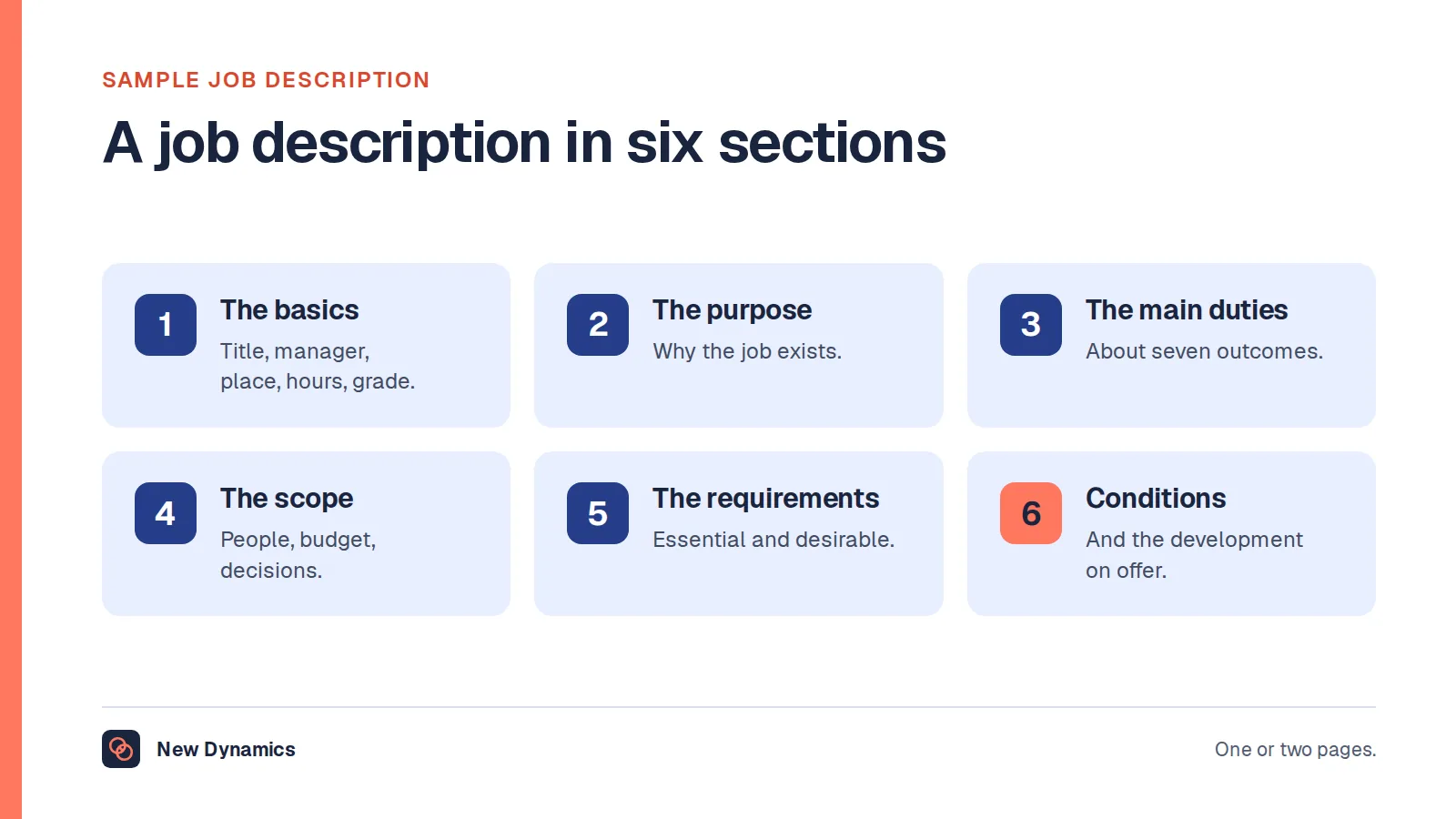
An events manager job description, written out
This example is written for an in-house corporate events function, because that is the version most HR teams are hiring for. Square brackets mark the parts you must replace with your own facts.
Job title: Events manager
Reports to: [Head of marketing / head of internal communications]
Team: [One events coordinator; agency and freelance support as required]
Location and pattern: [Site], with evening and weekend work around events and time off in lieu as set out below.
Purpose of the role: To own our programme of [customer and internal] events end to end, so that each one achieves a stated business purpose, is delivered safely and within an agreed budget, and is reviewed honestly afterwards.
Accountabilities. Each is written as an outcome, so that it can be judged rather than confirmed:
- Every event in the annual programme has a written purpose, audience and success measure agreed with its internal sponsor before any money is committed.
- Final event costs land within [5]% of the approved budget, with any variance identified and escalated before it is incurred rather than reported afterwards.
- Suppliers are appointed against written specifications and contracts, with competence checks completed, and no event runs with an unsigned principal supplier.
- A documented risk assessment and event safety plan exists for every event before build begins, is shared with everyone working on site, and is reviewed after delivery.
- Delegate-facing arrangements, from invitation to arrival to follow-up, work without the sponsor or the delegate having to chase anyone.
- Each event closes with a written review covering cost, attendance, feedback, incidents and a recommendation, delivered within [two weeks] of delivery.
- The events calendar is published [two quarters] ahead, so that colleagues, suppliers and the post holder's own leave can be planned around it.
Scope indicators. These are the facts that tell a candidate how big the job is:
- Annual programme: [number] events a year, ranging from [20] to [600] attendees.
- Budget held: [total annual programme budget], with authority to commit up to [single-event limit] without further approval.
- Headcount: [one] direct report, plus [number] casual or volunteer staff briefed on event days.
- Supplier spend: [number] contracted suppliers, of which [number] are appointed annually.
- Geography: [UK only / UK and two European offices].
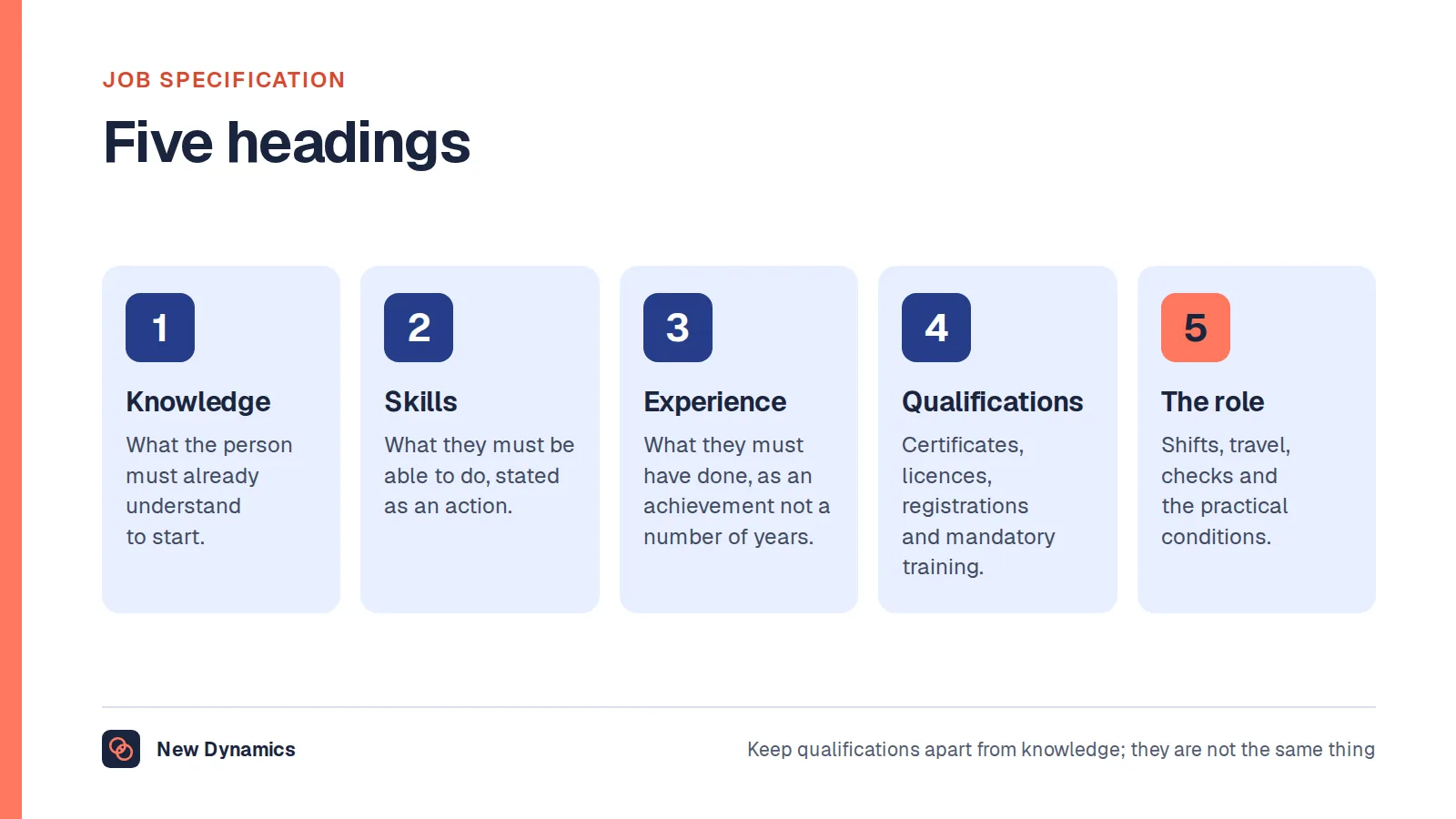
Person specification. Essential, with a reason beside each, which is the test of whether it belongs:
- Evidence of delivering [number] comparable events, because the programme starts in [month] and there is no ramp-up period.
- Experience of holding a budget and reconciling it, because the post holder commits spend without a project accountant.
- Working knowledge of event risk assessment and supplier competence checks, because this duty sits with the post holder on site.
- Ability to hold a position with senior stakeholders, because the role refuses requests from directors as part of its normal operation.
- [Full driving licence], because [sites are not reachable by public transport at build times].
Desirable: experience in [our sector]; familiarity with [registration platform]; [second language].
What good looks like after six months:
- The next twelve months of events are mapped, with purposes, budgets and sponsors agreed.
- Two events have been delivered, reconciled and reviewed, with no significant incident and no unexplained overspend.
- A single supplier list exists, with contracts and competence evidence held in one place.
- A standard risk assessment and event safety plan has been adopted and used twice.
- At least one event has been cut, merged or reduced because it did not justify its cost.
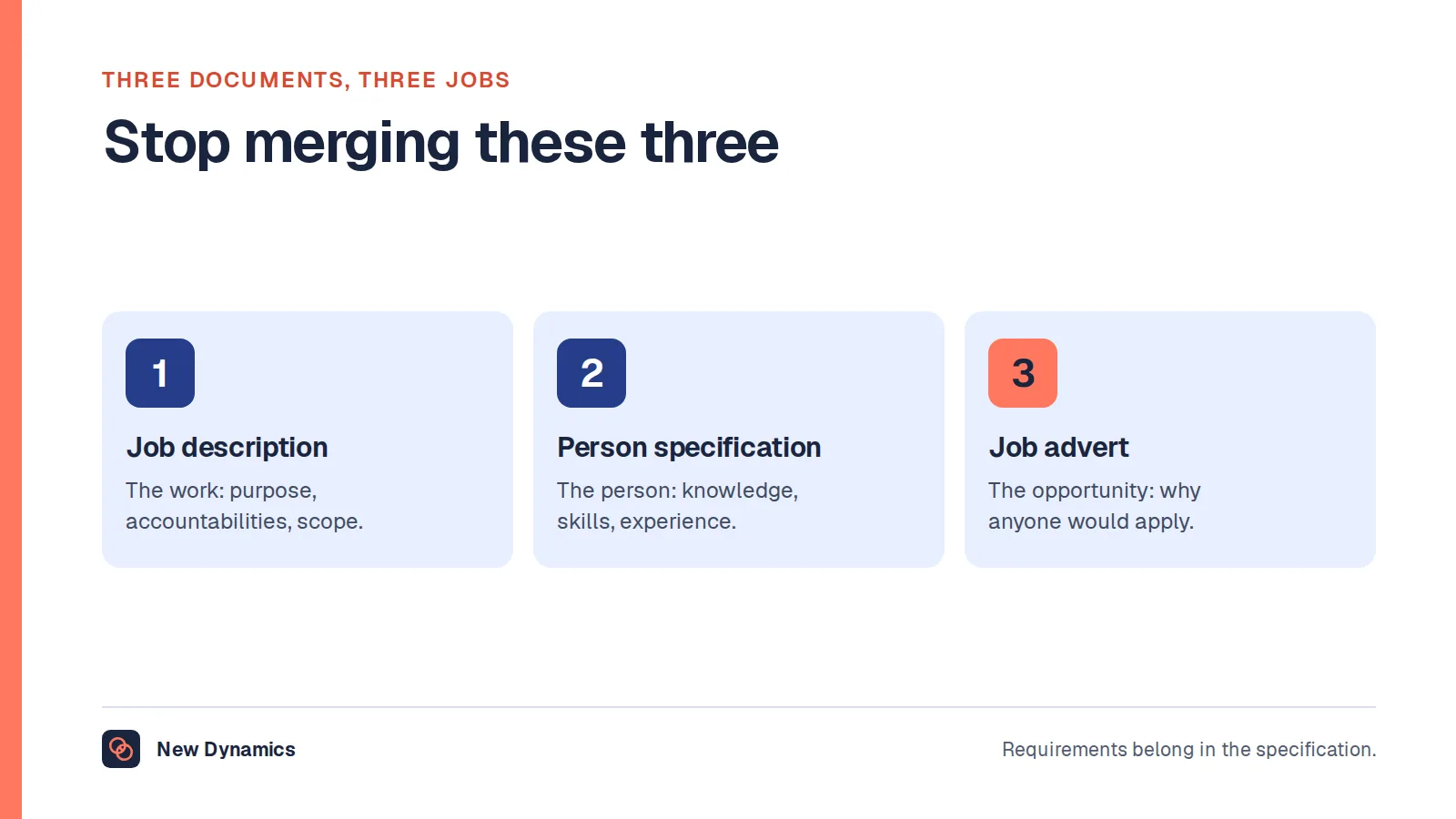
Use the same shape for a venue or agency role and change the accountabilities and scope lines, not the structure. For the surrounding document conventions, see our job description template and the distinction between the description and the job specification.
The working pattern, which is what templates ignore
Events happen when people are free, which means evenings, weekends and bank holidays, in bursts. A corporate events manager might work four ordinary weeks and then a conference week of fourteen-hour days. A venue manager works most Saturdays. An agency manager travels in blocks.
Say this in the advert and in the description, in specific terms. "Some flexibility required" is not a description of a working pattern. "Around eighteen event days a year, of which twelve fall on a Saturday or Sunday, with time off in lieu taken within the following month" is.
Then plan the peaks against the statutory floor rather than hoping nobody counts. On the weekly limit, gov.uk states that you "cannot work more than 48 hours a week on average - normally averaged over 17 weeks", and that "you can choose to work more by opting out of the 48-hour week". The averaging is the useful part for this role: a heavy event week is not automatically a breach, but a pattern of them across a season can be, and an opt-out has to be the worker's own choice rather than a line buried in a contract. Full detail is on the gov.uk guidance on maximum weekly working hours.
Rest is where event work most often goes wrong, because the build, the delivery and the derig run together. On rest breaks at work, gov.uk states that "workers have the right to one uninterrupted 20 minute rest break during their working day, if they work more than 6 hours a day", that "workers have the right to 11 hours rest between working days", and that workers have the right to either "an uninterrupted 24 hours without any work each week" or "an uninterrupted 48 hours without any work each fortnight".
Read those three together and a late derig followed by an early build the next morning is a problem to design out at the planning stage, not a badge of commitment. Practical answers include a second pair of hands for build and derig, a staggered on-site rota so nobody covers the whole day, and a rule that the post holder does not travel home after midnight and start at eight.

Holiday needs the same honesty. Acas states that "by law, workers are entitled to 5.6 weeks' statutory paid holiday a year", and that statutory paid holiday is "limited to 28 days", on its page on checking holiday entitlement. The entitlement is not the issue in this role; the timing is. If your events cluster in May, June, September and December, the post holder cannot take leave in those months, which leaves a narrow window and a real risk of untaken leave. Publish the event calendar far enough ahead that leave can be booked around it, and agree in writing when the post holder's protected weeks are.
Health and safety accountability at events
This is a real duty that templates reduce to a bullet point reading "ensure health and safety compliance". It deserves better, because on an event site the accountability is immediate and the people at risk include contractors, volunteers and the public.
The Health and Safety Executive is direct about where responsibility sits. On managing an event safely, HSE states: "You are responsible for ensuring that overall safety at the event is maintained so that as far as reasonably practicable, people setting up, breaking down and attending the event are not exposed to risks to their health and safety." It lists duties including "having health and safety arrangements in place to control risks", "ensuring co-operation and proper co-ordination of work activities", "ensuring the competence of staff to undertake their role safely", "monitoring health and safety compliance" and "reviewing your health and safety arrangements".
On risk assessment, HSE's getting started guidance states that "the key tool for creating a safety plan is the process of risk assessment", that "the level of detail in your planning should be proportionate to the scale of the event and the degree of risk", and that you should "make sure there is a clear understanding within the organising team of who will be responsible for safety matters". It also advises organisers to "liaise with the venue owner / management, emergency services and, where appropriate, local authority Safety Advisory Group for advice and information relevant to your planning".
Three consequences for the hiring document:
- Write the duty as an outcome with evidence. Not "ensure compliance", but "a documented risk assessment exists before build begins, names who is responsible for each safety matter, and is briefed to everyone working on site".
- Say who else is involved. If your organisation has a health and safety manager, a facilities team or a venue whose own plan applies, name them and name the boundary. HSE's wording on co-operation and co-ordination assumes someone has settled that question in advance.
- Make competence checking explicit. Appointing suppliers who can evidence a trained workforce is part of the job, so put it in the accountabilities rather than treating it as procurement's problem.
Ask about this at interview. A candidate who has genuinely held this duty will talk about specific decisions, such as refusing a supplier, changing a crowd flow or stopping a build. A candidate who has not will talk about having "always been very safety conscious".
Measuring performance in this role honestly
The numbers everyone reaches for are attendance and satisfaction scores. Both are shared outcomes. Attendance depends on who invited whom, on the speaker line-up, on the date, and in a venue on marketing and pricing. Satisfaction depends on the content, the keynote and the weather. Holding one person to account for either is a way of making performance management feel arbitrary.
Report those figures, because they tell you whether the programme is worth running. Judge the post holder on what they control:
- Budget accuracy. Variance between approved budget and final reconciled cost, and more tellingly whether variances were flagged before they were incurred. A manager who lands within a few per cent and warns you early is doing the job; one who lands on budget by cutting something you wanted is not.
- Supplier management. Proportion of events delivered with signed contracts and competence evidence in place beforehand, supplier issues raised and resolved, and whether rates improved on renewal.
- Incident-free delivery. Risk assessments completed before build, incidents and near misses recorded, and actions from reviews closed before the next comparable event. A rising near-miss count can be good news, because it usually means reporting has started working.
- Delivery against the plan. Events run on the published date, programme kept to time, and the sponsor not having to chase.
- Honest closure. Reviews delivered on time, including the uncomfortable recommendation that an event should not run again.
For the venue version, add enquiry conversion and yield on the space, which the post holder genuinely influences. For the agency version, add margin against estimate and documented change requests. For the corporate version, add whether each event had an agreed purpose before money was committed, which is the single most useful discipline the role can introduce.
Hiring: what to test at interview

Events candidates interview well. The job selects for people who are calm, personable and good at reassuring a nervous client, which is exactly the skill set that makes a competency interview pleasant and uninformative. Structure the conversation around specific past events and the paperwork behind them.
Three questions do most of the discriminating:
"Take one event you ran. What was the first cost estimate, what was the final cost, and what explains the gap?" This is the question weak candidates cannot answer. Strong ones know their numbers, name the line that moved, and say when they knew. It tests budget control, honesty and whether they ever reconciled anything at all.
"Tell me about a time you overruled a supplier, a client or your own manager on a safety or capacity decision." It tests whether the safety duty has ever actually sat with them. Listen for a specific decision with a cost attached, such as hiring extra stewards, moving a stage, reducing numbers or cancelling. Vagueness here is the most useful negative signal in the whole interview.
"Something failed on site. What was it, and what did you do in the next twenty minutes?" Every events person has this story, so the content is not the point. Listen to the order of operations: did they tell anyone, did they have a fallback, did it reach the sponsor or client before or after it was solved, and did it change the next event's plan.
Two more worth adding. Ask the candidate to describe your own programme back to you and say which event they would question, which tests judgement rather than compliance. Then ask directly how they protect their own rest and leave across a season of peaks, because a candidate who has no answer is telling you how the role will end.
Finally, test the paperwork. Ask to see an anonymised budget sheet, running order or risk assessment they produced. The documents reveal in two minutes what an hour of conversation will not.
Frequently asked questions
What does an events manager do?
An events manager owns events end to end: agreeing what each event is for, appointing and managing suppliers, holding the budget, building the schedule and delegate arrangements, running the event on site, and reviewing cost, feedback and incidents afterwards. The on-site day is the most visible part and the smallest part by hours.
What is the difference between an event coordinator and an events manager?
The coordinator runs logistics within an event or a strand of one: bookings, schedules, registration and the day itself. The manager owns the programme, the budget and the supplier relationships, carries the safety accountability, and usually has coordinators or agencies reporting to them. Our event coordinator job description covers the junior role in detail.
What should an events manager job description include?
Eight things: a one-sentence purpose, five to seven accountabilities written as outcomes, scope indicators such as number of events, budget held and headcount, the person specification with a reason beside each essential requirement, the working pattern in specific terms, the safety duty and its boundary, how performance will be judged, and what good looks like after six months.
What are the requirements for an event management role?
Evidence of delivering comparable events, budget ownership and reconciliation, supplier negotiation and contracting, working knowledge of event risk assessment, and the confidence to hold a position with senior stakeholders or clients. No specific degree is required for the role, and each requirement you list should have a reason that the job genuinely needs.
How do you handle evening and weekend work in the job description?
Quantify it. State roughly how many event days a year fall outside normal hours, how many fall at weekends, and how time off in lieu is earned and taken. Then plan the pattern against the statutory floor: gov.uk sets out the 48 hour average weekly limit normally averaged over 17 weeks, a 20 minute break when working more than 6 hours, 11 hours rest between working days, and weekly rest of 24 hours a week or 48 hours a fortnight.
Who is responsible for health and safety at an event?
HSE states that the organiser is responsible for ensuring that overall safety at the event is maintained, so that as far as reasonably practicable people setting up, breaking down and attending are not exposed to risks to their health and safety. It describes risk assessment as the key tool for creating a safety plan, and says the organising team must be clear about who is responsible for safety matters.
Your next step: write the version you are actually hiring
- Name which of the three versions this post is, and delete every accountability that would read the same in the other two.
- Fill in the scope indicators with real numbers: events a year, budget held, approval limit, headcount, supplier count.
- Write the working pattern in event days and weekend days, with the time off in lieu rule, and check the peak season against the rest entitlements above.
- Put the safety duty in the accountabilities with its boundary named, and decide what evidence you will ask to see.
- Agree the three or four measures you will judge at the first review, before the advert goes live.
For the process around the document, from designing the role to scoring applications consistently, read our recruitment and selection guide. It is free to read, and the PDF uses our short download form.
Want the accountabilities in a job description to be the same ones discussed at the review, rather than a filed document nobody opens? Book a New Dynamics demo and bring the description you are about to advertise. You can also email contact@new-dynamics.com.