TL;DR
- A job description exists to settle what a job is for. Most of them fail because they list duties rather than outcomes, so nobody can tell from the document whether the post holder is doing the job well.
- Three documents get merged and should not be. The job description describes the work, the person specification describes the person, and the advert sells the opportunity. Acas says applicants should be given the job description and the person specification, because they “help make clear what the job requires and reduce the risk of discrimination”.
- Every requirement you write down should be justifiable as something the job genuinely needs. Acas describes indirect discrimination as “when everyone's treated the same but people with a protected characteristic are put at a disadvantage”, which is exactly what an unnecessary requirement does. This is general information about Great Britain, not legal advice.
The job description is the only document in a recruitment process that is supposed to outlive the hire. The advert goes stale the day the vacancy closes. The shortlist is confidential and then it is gone. The description stays: it is attached to the offer, filed with the contract, and in most organisations never opened again until the post holder resigns.
That survival is the point, and it is also the problem. Because the document lasts, it is worth writing properly. Because nobody reads it in between, almost nobody does.
Open ten job descriptions at random and nine will be lists of duties. Duties tell you what a person will be busy doing. They do not tell the post holder, the manager, or anyone reading the file later whether the job is being done well. A duty list cannot answer the question every role eventually raises, which is what good looks like here.
Accountabilities are where goals start, so they belong in one place rather than three. See how New Dynamics Goals & OKRs keeps objectives, owners and progress together, so the description and the review conversation are discussing the same job.
This article explains what a job description is for, separates it from the two documents it keeps getting merged with, gives a template section by section, shows how to rewrite duties as outcomes, and sets out why every requirement you write down needs a reason. If you want the format with worked examples for three roles, our sample job description post covers that ground. If you want a finished description for a particular role, our accountant job description is one of several dozen on this site.
Where the law is mentioned, the sources quoted describe Great Britain, which means England, Scotland and Wales. Northern Ireland has its own equality legislation. This is general information rather than legal advice.
What is the purpose of a job description?
A job description exists to settle what a job is for, in writing, so that different people reading it at different times reach the same answer. It does at least five separate jobs, and the reason most descriptions disappoint is that they are written for the first one only.
- Recruitment. It tells candidates what they are applying for and gives the panel a common basis for assessment.
- Expectation setting. It tells the person who takes the post what they are accountable for from day one, which is the whole of induction in one page.
- Performance. It gives the manager something to set goals against and review against, rather than inventing criteria at review time.
- Grading and pay. It is the input to job evaluation, and therefore to the pay band and to any equal pay question that follows.
- Organisational design. Side by side, a set of descriptions shows duplication, gaps and work nobody owns.
Acas treats the description as one of the basic things a candidate is entitled to see. Its guidance on how to advertise a job says that when advertising, or when someone asks to apply, you should give them “the job description, a job application form, the person specification, information about your organisation, an equality and diversity monitoring form”, and that “These will help make clear what the job requires and reduce the risk of discrimination.”
Read that reason again, because it is the strongest argument for writing the document carefully. Clarity is not presentation. Clarity is the control that keeps selection honest.
Job description, person specification and job advert
These three get collapsed into one file, usually because one person writes all three in an afternoon. Each has a different subject and a different reader, and merging them loses something every time.
| Document | Subject | Reader | Lifespan |
|---|---|---|---|
| Job description | The work: purpose, accountabilities, scope | Post holder, manager, panel, HR | Years, reviewed annually |
| Person specification | The person: knowledge, skills, experience | Shortlisting panel, interviewers | Per campaign, reused |
| Job advert | The opportunity: why anyone would want it | Candidates who have never heard of you | Weeks |
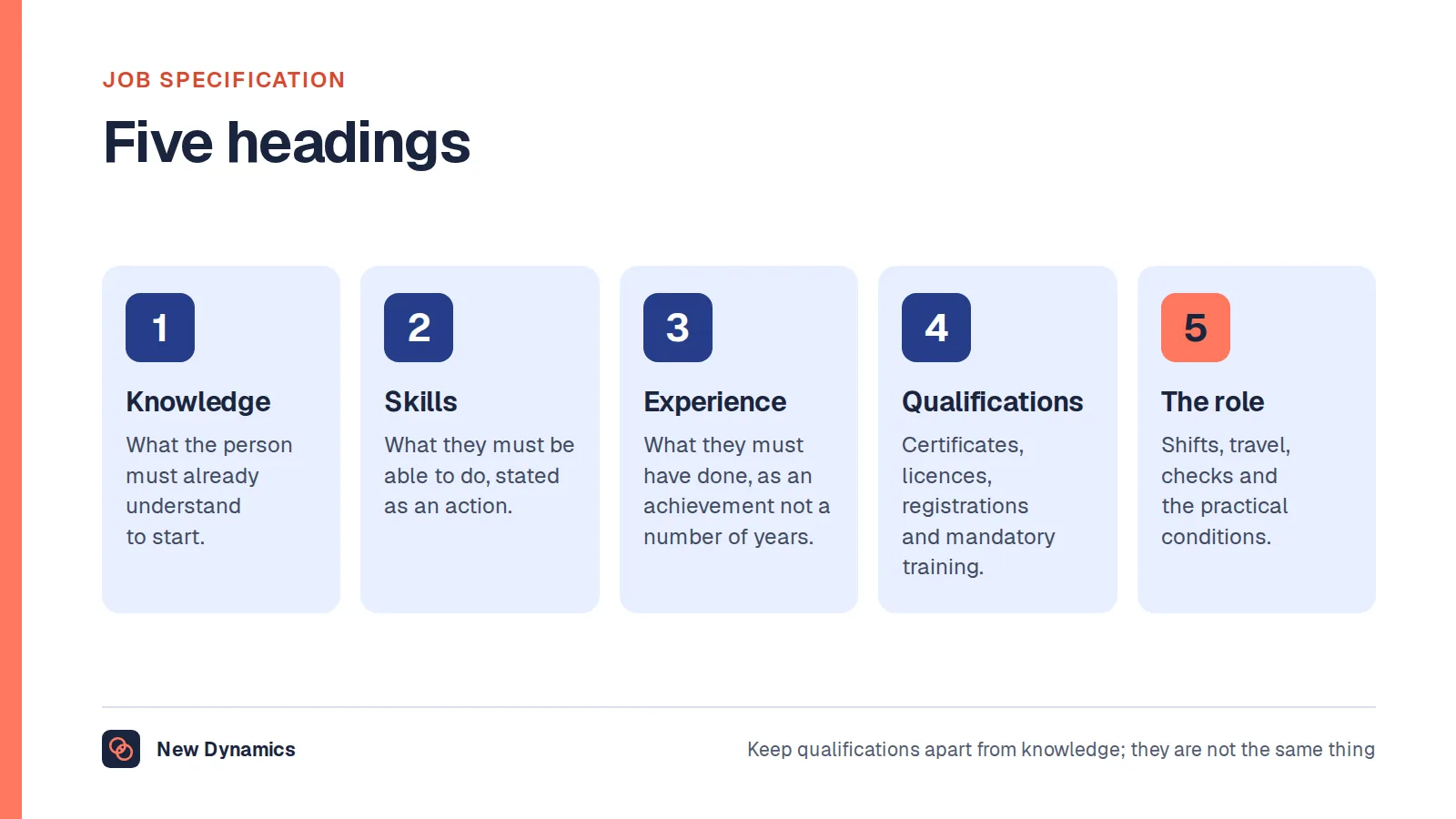
The job description answers "what is this job for". The person specification answers "who could do it", split into essential and desirable, with a note of how each criterion will be assessed; our job specification post sets out that method. The job advert answers "why would I apply", and it is marketing copy with a legal edge.
The practical consequence of keeping them apart is that requirements live in the specification, where they have to be defended one by one, instead of being sprinkled through a description where nobody notices them.

What does a job description include?
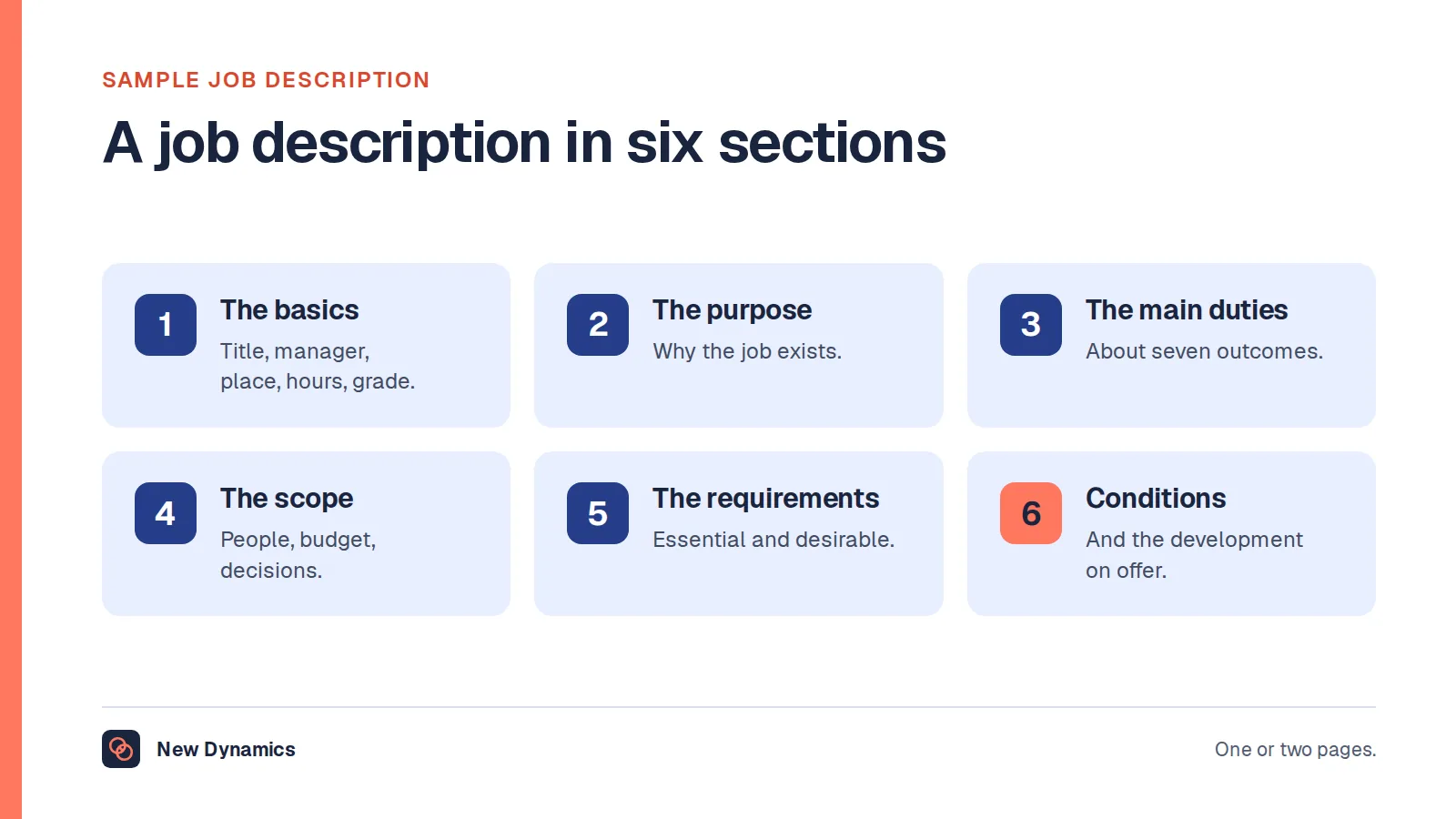
Eight sections, in this order. Anything that does not belong in one of them probably belongs in the advert or the specification.
- Identity and ownership
- Purpose
- Accountabilities
- Scope and decision rights
- Key relationships
- Requirements
- Conditions and development
- Status and review
A job description template, section by section
Copy the headings. The useful part is what goes in each one, and what to keep out.
1. Identity and ownership
Job title, the post it reports to, the team, the location and working pattern, the grade or band, the date it was last reviewed and the name of the manager who owns it.
Keep out inflated titles. A title is a signal to the market and to the organisation chart, and a "Head of" with no reports creates two problems: candidates who expected a department, and colleagues who now want the same label.
2. Purpose
One sentence on why the job exists. Not what the person does, but what would be missing if the post were empty.
A test that works: finish the sentence "This post exists so that...". If you cannot, the job may not be designed yet, and no amount of writing will fix that.
3. Accountabilities
Five to seven outcomes the post holder is answerable for. Each one names a result, not an activity, and says how it will be judged. This is the section that does the work, and the next part of this article is entirely about getting it right.
Keep out the fifteen-bullet wish list. If everything is a main accountability, nothing is, and the post holder will quietly pick the five they prefer.
4. Scope and decision rights
The size of the job: budget held or influenced, number of direct and indirect reports, the volume or value handled, the geography. Then the part most descriptions omit entirely, which is what the post holder decides alone, what they recommend, and what they must escalate.
Decision rights are where new starters waste their first month. Writing them down is cheap.
5. Key relationships
Who the post holder works with inside the organisation and outside it, and for what. Three or four lines. This is how a reader works out whether the job is as senior as the title suggests.
6. Requirements
Qualifications, licences, registrations and experience that the job genuinely needs, each marked essential or desirable, and each one justified. See the fairness section below for why the justification column is not bureaucracy.
Keep out requirements that describe the last post holder rather than the post. Keep out degree requirements that stand in for a skill you could simply assess.
7. Conditions and development
Hours, shifts, travel, physical demands, the equipment and protective kit provided, and the training, supervision and progression on offer. Candidates read this section more carefully than employers expect.
8. Status and review
Two lines. One says when the description was last reviewed and when it will be reviewed again. The other says how the document relates to the contract, which the next sections cover.
Writing accountabilities as outcomes, not task lists
This is the single change that turns a filing-cabinet document into a working one. An accountability names a result, the standard it must meet, and the frequency or condition attached to it. A duty names an activity and stops.
Before: a duty list
A payroll officer post, written the usual way.
- Process the monthly payroll
- Maintain employee records
- Deal with payroll queries
- Produce reports
- Liaise with HMRC
- Other duties as required
Every line is true and none of them is useful. Read them in a review meeting and the only available questions are "did you do it" and "how is it going". There is no standard, so there is nothing to be good or bad at.
After: accountabilities
The same job, written as outcomes.
- Payroll accuracy. Every employee is paid the correct amount on the published pay date, with corrections resolved in the same cycle rather than carried forward.
- Records. Employee and pay records are complete and current, so that any change of hours, pay or status is reflected in the next run without a reminder.
- Query resolution. Payroll queries are answered within two working days, and recurring causes are reported rather than repeatedly fixed.
- Reporting. Monthly payroll reporting reaches finance on the agreed date, reconciled, with variances explained.
- Statutory returns. Returns and submissions are made on time and correctly first time.
- Improvement. One payroll process is simplified or automated each year, with the time saved quantified.
Six accountabilities, each one a thing that can be done well or badly. The two-day target and the annual improvement are illustrative, not benchmarks; set your own and make sure they are realistic before they appear in a document.
Notice what happened to "other duties as required". It went. That catch-all is there to cover change, but it covers nothing legally useful and it tells the post holder that the list above it is not to be taken seriously. If the job genuinely flexes, say so properly: a line explaining that the post holder may be asked to take on comparable work within their grade, and that the description is reviewed annually, does the same work honestly.

Four moves get you from one to the other. Name the result rather than the activity. Add the standard, which is the quality, timeliness or volume that counts as done. State the condition or frequency. Then test the line against a review conversation: if a manager could not use it to say "this went well, this did not", rewrite it.
Justifying every requirement: fairness and the law
The most important reason to write a job description carefully is not clarity. It is that requirements which are not genuinely needed can shut people out of a job for reasons that have nothing to do with the job.
Acas's guidance on discrimination and the law describes two forms of unlawful discrimination that matter here. Direct discrimination is “less favourable treatment directly because of a protected characteristic”. Indirect discrimination is “when everyone's treated the same but people with a protected characteristic are put at a disadvantage”. The protected characteristics are “age, disability, gender reassignment, marriage and civil partnership, pregnancy and maternity, race, religion or belief, sex, sexual orientation”.
An unnecessary requirement is the textbook route to the second kind. Applied evenly to everyone, it still disadvantages a group: a driving licence on a post that does not travel excludes some disabled applicants, a requirement for continuous recent experience disadvantages people who have taken time out to care for children, and a physical standard above what the work demands narrows the field by age and disability. Acas notes the narrow circumstances in which less favourable treatment can be lawful. One is “objective justification”, which it describes as “when an employer can prove a legitimate need for less favourable treatment”. Another is an “occupational requirement”, meaning “recruiting someone with a certain protected characteristic to do a particular job”. Both are exceptions that have to be argued, not boxes to tick.
So the discipline is simple, and it belongs in the document rather than in someone's head. Beside every requirement, write the reason the job needs it. If the reason is "the last person had it", or "it is what we always ask for", delete the requirement or turn it into something you can assess directly. A requirement you cannot justify on paper is a requirement you would struggle to justify to a candidate who asks, and the person most likely to ask is the one you have excluded.
The same restraint applies to wording. Acas's advert guidance warns against terms such as “recent graduate” or “highly experienced” on the grounds that they can discriminate on age, and against gender-specific job titles. Inflated requirements have a commercial cost too: every unnecessary essential criterion shrinks the applicant pool, and a smaller pool is a slower, more expensive and usually worse hire.
We are not aware of an official source that publishes a figure for how many job descriptions are out of date or how many carry unjustified requirements, so we are not going to put a number on it. The figures that are published on hiring and people management are collected in our HR statistics hub.
Does a job description form part of the contract?
Often, yes, and that changes how you word it.
Acas is clear that the written statement an employer must issue is not the whole contract. Its guidance on what must be written in an employment contract says that “legally the contract is much broader than the written statement”. Terms can be express or implied, written or agreed in other ways, which is how a job description that is handed over at offer stage, or referred to in the contract, can end up forming part of the terms.
The statutory document itself requires a form of the description. Acas's list of what the written statement must include has “job title or a brief description of the job” among the items in the principal statement, alongside pay, working hours, holiday, sick leave, notice and any probation period. GOV.UK's guidance on the written statement of employment particulars describes the same requirement as “the employee's or worker's name, job title or a description of work and start date”, and the principal statement is due on the first day of employment.
Two practical consequences follow.
Word the description so it can change. State that it is a description of the post as at the review date and will be reviewed, rather than a fixed and exhaustive list. Avoid promises you do not mean to make contractual, such as a specific office, a specific team or a bonus arrangement, unless you intend them to be terms.
Keep the description and the contract consistent. If the contract says one job title and the description says another, the ambiguity is yours, not the employee's. Our employment contract post explains where a contract's terms come from and how one is varied, and our employee handbook post covers where the handbook sits in relation to it. Again, general information about Great Britain, not legal advice: take advice on any real case.
How a job description supports a performance review
This is where the duties-versus-outcomes point stops being a writing preference and starts costing money.
Picture a review meeting with a duty list on the table. Every line is an activity, so the only available conversation is attendance and effort: did you process the payroll, yes, how did it feel. The manager wants to discuss quality, so they invent criteria on the spot. Those criteria are undocumented, they differ between managers, and they differ between the two people doing the same job in different teams. That is how rating inconsistency is manufactured, and it is also how an employee ends up with no idea what they were assessed against.
Now put the accountabilities version on the table. Each line already states a result and a standard, so the conversation starts at the right question: did the outcome happen, what helped, what got in the way, what changes next quarter. Goals for the year can be derived from the accountabilities rather than invented alongside them, which is what stops goal setting from becoming a separate annual exercise with its own paperwork. Our performance goals examples post shows what those look like once written.
The test is blunt. If you cannot build a review agenda out of the job description, the job description is not finished. A document that supports selection, induction, goal setting and review is worth an afternoon of someone's time. A duty list supports only the first of the four.
Who owns job descriptions, and keeping them current
A description with no owner rots. The line manager owns the content, because they are the only person who knows what the job has become. HR owns the format, the consistency and the review cycle. The post holder contributes, because they know which parts of the written job never happen and which real parts were never written down.
Three triggers should prompt a rewrite, not just the annual pass: the job changes, the post becomes vacant, or the team is restructured. A vacancy is the best of the three, because it is the one moment when nobody is defending the status quo.
A review takes fifteen minutes with four questions. Does the purpose sentence still describe why the post exists? Are the accountabilities still the five to seven that matter, and could someone be judged against them? Is every requirement still genuinely needed and still justified? Does the scope match what the post holder actually decides?
What goes wrong

The fifteen-bullet wish list. Written by combining everything the last three post holders did, it describes no single job. Cut to seven accountabilities and move the rest into scope or delete it.
"Other duties as required". A catch-all that protects nobody and signals that the rest of the document is decorative. Replace it with an honest line about comparable work and annual review.
Inflated requirements. A degree where a skill would do, five years where two would do, a licence for a job that does not travel. Each one narrows the pool and each one needs a justification you would be willing to show a candidate.
Duties instead of outcomes. Covered at length above, and the root of most of the others.
Copy-paste from a template or a competitor. It produces a description of someone else's job. Use a template for the structure and write the content yourself.
No review date. Without one, the document ages until it is actively misleading, which is worse than having none, because people rely on it.
Frequently asked questions
What is the purpose of a job description?
To settle in writing what a job is for, so that candidates, the post holder, the manager and HR all read the same answer. It supports recruitment, sets expectations from the first day, gives a basis for goals and reviews, feeds job evaluation and pay decisions, and shows where work is duplicated or unowned across a team.
What does a job description include?
Eight sections: identity and ownership, a one-sentence purpose, five to seven accountabilities, scope and decision rights, key relationships, requirements that are each justified, conditions and development, and a status and review note. Person-level criteria belong in the person specification, and selling the opportunity belongs in the advert.
What is the difference between a job description and a person specification?
The job description describes the work: its purpose, accountabilities and scope. The person specification describes the person who could do it: the knowledge, skills, experience and qualifications needed, split into essential and desirable. Acas says applicants should be given both, because together they make clear what the job requires and reduce the risk of discrimination.
How do I write responsibilities rather than duties?
Name the result rather than the activity, add the standard that counts as done, state the frequency or condition, then check the line against a review conversation. "Process the monthly payroll" becomes "every employee is paid the correct amount on the published pay date, with corrections resolved in the same cycle". One can be assessed; the other can only be confirmed.
Can a job description be part of an employment contract?
It can. Acas says that legally the contract is much broader than the written statement, and a description handed over at offer stage or referred to in the contract may form part of the terms. The statutory principal statement itself must include a job title or a brief description of the job. Word the document as a description at a review date rather than a fixed list, and take advice on any real case.
How often should a job description be updated?
At least annually, and whenever the job changes, the post falls vacant or the team is restructured. A vacancy is the easiest moment to be honest, because nobody is defending the current wording. Record the review date in the document so a reader knows how much to trust it.
Your next step: rewrite one description
Pick the job description for a post you are about to advertise. Delete "other duties as required". Cut the duty list to seven lines, and rewrite each one as a result with a standard. Then put a reason beside every requirement, and delete the ones where the reason is habit.
For the process around the document, from designing the role to scoring applications consistently, read our recruitment and selection guide. It is free to read, and the PDF uses our short download form.
Want accountabilities, goals and review conversations to reference the same job rather than three different versions of it? Book a New Dynamics demo and bring one job description with you. You can also email contact@new-dynamics.com.