TL;DR
- There is no legal definition of full-time or part-time hours in the UK. gov.uk states that there is no specific number of hours that makes someone full or part-time, and Acas states that a part-time employee or worker is someone who works fewer hours than a full-time employee or worker in the same organisation. The employer sets the figure in the contract.
- What the law does set is a ceiling and a fairness rule. Working time is capped at an average of 48 hours a week, normally over 17 weeks, with a voluntary written opt out. Separately, a part-time worker must not be treated less favourably than a comparable full-time worker, which covers pay, holiday, pension and benefits, training and promotion.
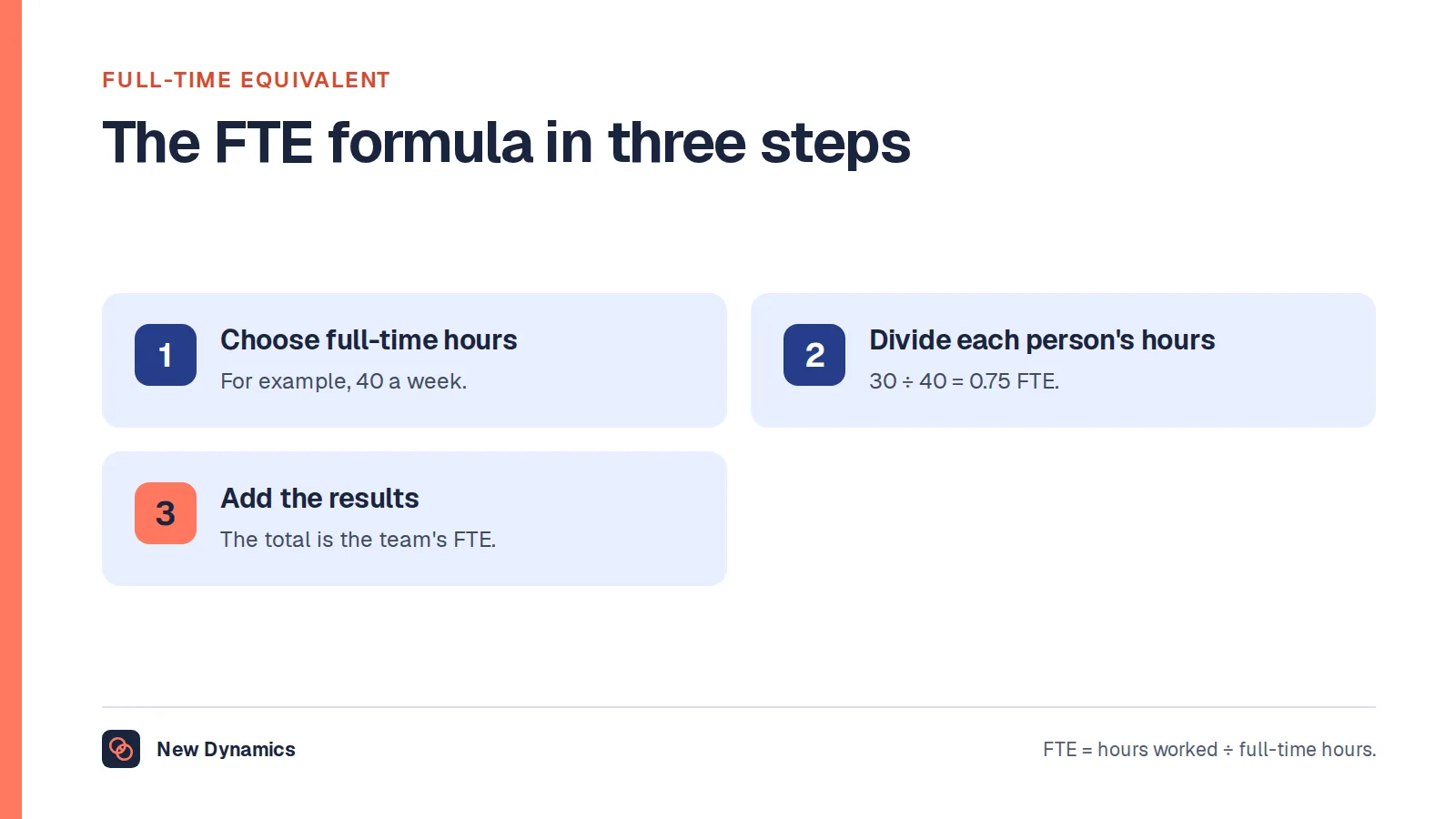
- Full-time equivalent is your own arithmetic, not a legal measure. Hours divided by your full-time week, added up. The same person is a different FTE in a 35 hour organisation and a 40 hour one, so the divisor has to be stated every time.
Someone asks how many hours a week is full time. They get an answer: 35, or 37.5, or 40, or "over 30". Every one of those answers is wrong as a statement of law, and almost every page on the subject gives one anyway.
Here is the honest version. There is no legal definition of full-time or part-time hours in the United Kingdom. No statute sets a threshold. No regulator publishes one. The employer sets the figure, and it lives in the contract of employment. Everything useful about this topic follows from that single fact, and this article works through what actually does apply: the limit on working time, rest entitlements, the part-time fairness rule most articles leave out entirely, holiday, and how to calculate full-time equivalent without producing a misleading number.
Whatever hours someone works, the process around them has to run the same way, which means the review, the check-in and the approval all need to find the right person on the right pattern. See how New Dynamics workflows keep a process consistent across different contracts and working patterns.
There is no legal definition of full-time hours
Start with the source that people assume contains a threshold. The gov.uk guidance on part-time workers' rights says plainly: "There is no specific number of hours that makes someone full or part-time, but a full-time worker will usually work 35 hours or more a week."
Read that carefully. The first clause is the rule. The second is an observation about what employers tend to do, and "usually" is doing a lot of work in that sentence.
Acas puts the definition relatively, not numerically. Its guidance on part-time workers states that "A part-time employee or worker is someone who works fewer hours than a full-time employee or worker in the same organisation", and that "There's no set number of hours that counts as full or part-time work."
"In the same organisation" is the part that matters. Part time is not a national category. It is a comparison inside one employer. A 30 hour contract is part time where the standard week is 37.5 hours and full time where the standard week is 30. The same hours, the same person, two different answers, and both correct.
So the questions people search for have local answers only:
- Is 30 hours a week full time? It is if your contract and your organisation's standard week say so.
- Is 32 hours full time? Same answer. A four day, 32 hour week is full time in an organisation that has defined full time that way, and part time in one that has not.
- Is 35 hours part time? Rarely in practice, because 35 is a common full-time week, but it is part time wherever the standard week is longer.
- Is 37 hours a week full time? Yes in most employers that use a 37 or 37.5 hour week, and that is a contractual fact rather than a legal one.
- What is the minimum number of hours for full time? There is no statutory minimum and no statutory maximum for the label. There is a statutory maximum for actual working time, which is a separate thing covered below.

One honest consequence: if your handbook says "full time means 37.5 hours", that sentence is the definition for your organisation, and it is the only definition that governs anybody's entitlements there. Write it down, because the alternative is an argument later about what was implied.
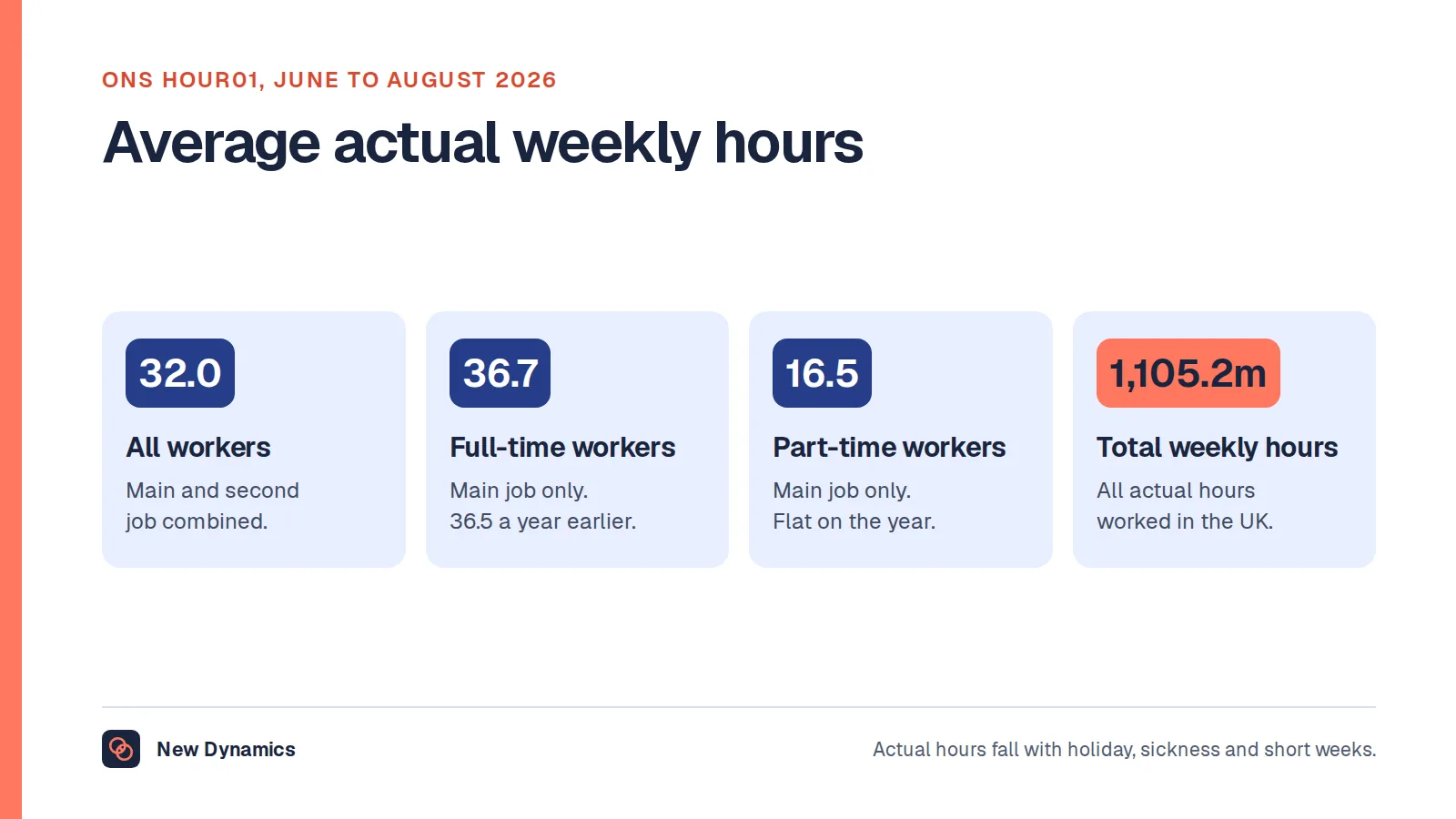
For what people in the UK actually work on average, rather than what contracts say, see our post on UK working hours statistics, which records the ONS average actual weekly hours figures with their reference period attached.
What the law does set: the 48 hour average limit
The absence of a full-time definition does not mean hours are unregulated. The Working Time Regulations set a ceiling on working time regardless of what the contract calls the role.
The gov.uk guidance on maximum weekly working hours states: "You cannot work more than 48 hours a week on average - normally averaged over 17 weeks." That 17 week reference period is why one busy week does not breach the limit on its own. The average is the test.
The same guidance adds a separate, stricter rule for young workers: "If you're under 18, you cannot work more than 8 hours a day or 40 hours a week." There is no opt out from that one.
For adults there is an opt out, and it is narrower than many employers assume. The gov.uk page on weekly maximum working hours and opting out states that "You can opt out for a certain period or indefinitely. It must be voluntary and in writing", that "Your employer must keep a record that you've opted out", and that "You can cancel your opt-out agreement whenever you want - even if it's part of your employment contract." Cancellation needs notice: "You must give your employer at least 7 days' notice. You may have to give your employer up to 3 months' notice depending on what's in your agreement." And the guidance is explicit that "Your employer cannot force you to cancel your opt-out agreement."
Three practical points fall out of this. The opt out is individual, not collective, so a clause buried in a template that everybody signs on day one is the version most likely to be challenged. The record is a duty, so you need to know who has opted out and when. And the limit applies to working time, not to the full-time label, so a part-time worker with a second job can approach the same ceiling.
Rest breaks, daily rest and weekly rest
Rest entitlements are set in hours and minutes, which makes them the one part of this topic with genuine numbers. The gov.uk guidance on rest breaks at work gives three:
- During the day. "Workers have the right to one uninterrupted 20 minute rest break during their working day, if they work more than 6 hours a day."
- Between days. "Workers have the right to 11 hours rest between working days."
- Each week. Either "an uninterrupted 24 hours without any work each week" or "an uninterrupted 48 hours without any work each fortnight."
The six hour trigger is where part-time patterns get missed. Someone working two long days a week is over six hours on each of them and is entitled to the break on both, even though their weekly total is modest. Rota software that applies breaks by weekly hours rather than by daily hours will get this wrong quietly.
The rule almost every article omits: less favourable treatment
This is the part of the topic that actually creates liability, and it is the part that the "is 30 hours full time" articles skip.
A part-time worker must not be treated less favourably than a comparable full-time worker because they are part time. gov.uk states it as: "Part-time workers are protected from being treated less favourably than equivalent full-time workers just because they're part time."
The comparison is specific. Acas describes the comparator as someone who "works full time for the same employer and is on the same type of contract" and who does "the same or broadly similar work". So the test is not a national average or a sector norm. It is a named colleague inside your organisation, on a comparable contract, doing comparable work.
The protection covers more ground than pay. gov.uk lists equal treatment for "pay rates (including sick pay, maternity, paternity and adoption leave and pay), pension opportunities and benefits, holidays, training and career development, selection for promotion and transfer, or for redundancy, opportunities for career breaks." Acas lists the same territory, including "pension opportunities and benefits", "training and career development", "promotions, career breaks and job transfers" and "redundancy selection and pay".
What pro rata actually means
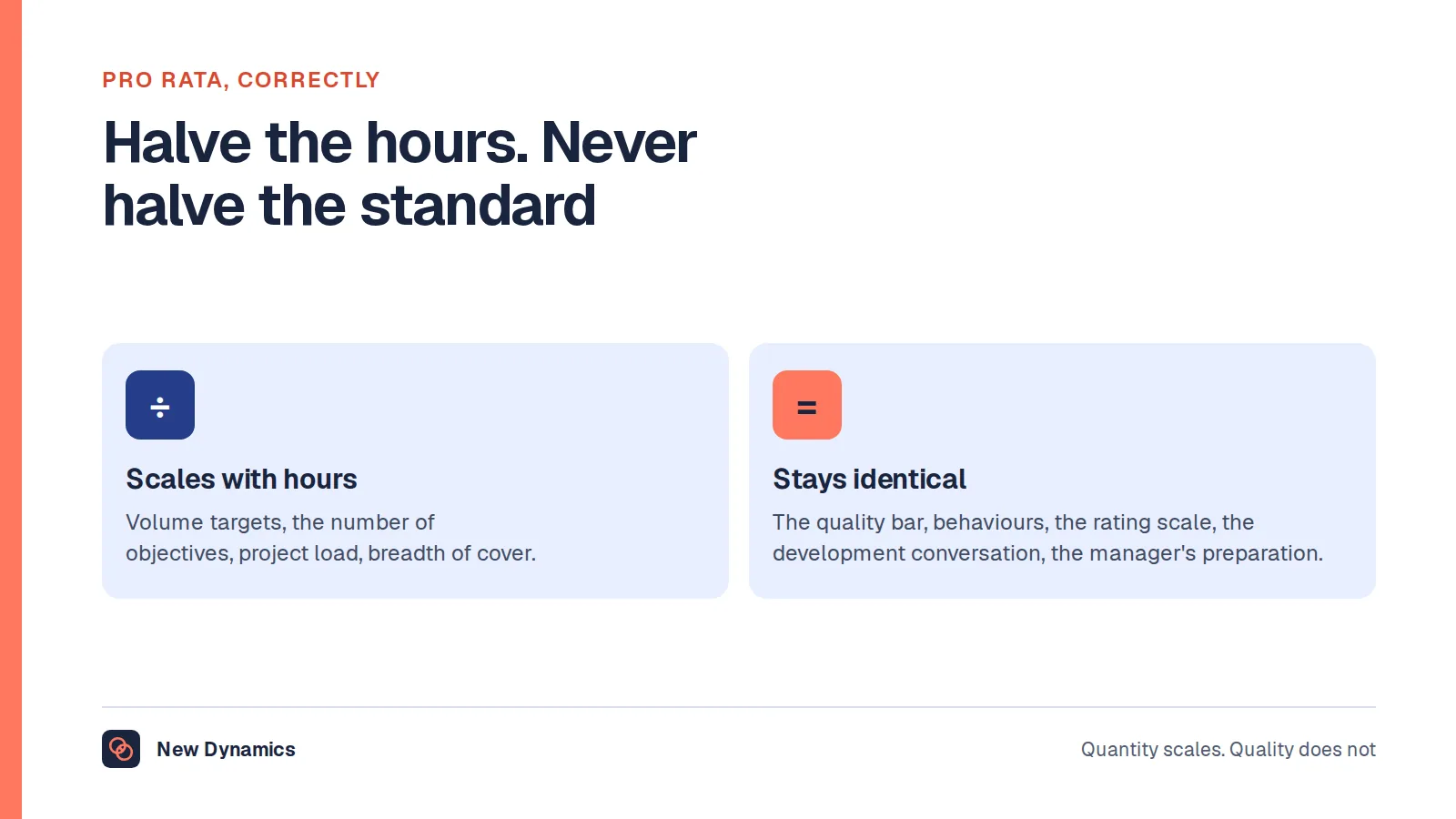
Pro rata means in proportion to hours worked, and both sources give an arithmetic example.
gov.uk: "if a full-time worker gets a £1,000 Christmas bonus, and a part-time worker works half the number of hours, they should get £500."
Acas: "someone who works full time gets paid £28,000 a year. Someone working in the same role for half the hours should get paid £14,000."
Note what pro rata does not license. It scales quantities. It does not scale access. A benefit that cannot sensibly be halved, such as membership of a scheme, eligibility for a training course or consideration for promotion, is not reduced to nothing because somebody works three days a week. Reducing the amount is pro rata. Removing the entitlement is less favourable treatment.

Our post on the performance review for part-time employees covers how this works out in practice when objectives, ratings and review conversations are set for a full-time weekday pattern.
Holiday entitlement: 5.6 weeks, and how it works pro rata
Holiday is where pro rata is most often miscalculated, usually by converting weeks into days too early.
The statutory entitlement is set in weeks. The gov.uk guidance on holiday entitlement states that "Almost all people classed as workers are legally entitled to 5.6 weeks' paid holiday a year", and that "Statutory paid holiday entitlement is limited to 28 days. For example, staff working 6 days a week are only entitled to 28 days' paid holiday."
For part-time staff the entitlement does not shrink in weeks. It shrinks in days. gov.uk: "Part-time workers who work regular hours for the whole year are entitled to at least 5.6 weeks' paid holiday, but this will amount to fewer than 28 days." Its example: "if they work 3 days a week, they must get at least 16.8 days' leave a year (3 × 5.6)."
Acas words the same rule as "Someone who works part time is still entitled to 5.6 weeks' statutory paid holiday. The entitlement will be in proportion to the hours they work."
So the correct method is to multiply the number of days or hours worked in a week by 5.6, and only then express the result in whatever unit your system uses. Calculating 28 days and scaling it by a percentage will usually land close, but it imports the 28 day cap into a case the cap was never meant to touch.
Bank holidays sit outside the entitlement. gov.uk: "Bank or public holidays do not have to be given as paid leave. An employer can choose to include bank holidays as part of a worker's statutory annual leave." This is the single most common source of unfairness for part-timers, because somebody who never works Mondays loses nothing when bank holidays are excluded from the allowance and loses several days of their proportion when they are included without adjustment. Decide the treatment, write it down, and apply it consistently.
Full-time equivalent, and how to calculate it
Once you accept that full-time hours are whatever you have defined, full-time equivalent stops being a lookup and becomes arithmetic you control. FTE expresses each person's hours as a fraction of your full-time week, so people on different patterns can be added together.
The method is three steps. Choose the full-time week. Divide each person's contracted hours by it. Add the results.

A worked example
The figures below are an example for illustration, not a benchmark or a target.
An example team has five people. Their contracted weekly hours are 37.5, 37.5, 30, 22 and 15, which is 142 hours in total. The organisation in this example has defined its full-time week as 37.5 hours.
- The person on 22 hours is 22 divided by 37.5, which is 0.59 FTE when rounded to two decimal places.
- The team is 142 divided by 37.5, which is 3.79 FTE.
- Headcount is still 5. Both numbers are true, and they answer different questions.
Why 35 hours and 40 hours give different answers for the same person
Change nothing about the people and only change the divisor:
- With a 35 hour full-time week, the person on 22 hours is 0.63 FTE and the team is 4.06 FTE.
- With a 37.5 hour week, the same person is 0.59 FTE and the team is 3.79 FTE.
- With a 40 hour week, the same person is 0.55 FTE and the team is 3.55 FTE.
That is a spread of roughly half an FTE across the team, produced entirely by a definition. It is why an FTE figure quoted without its divisor is not a figure at all, and why comparing your FTE with another organisation's is meaningless unless both use the same full-time week. Our post on full-time equivalent covers the formula, headcount comparisons and the places where a law sets its own FTE calculation.
What to write in the contract
The contract is where full-time hours acquire meaning, and there is a statutory list of what has to be in it. The gov.uk guidance on the written statement of employment particulars requires the principal statement to cover "hours and days of work and if and how they may vary (also if employees or workers will have to work on Sundays, during the 'night period' or take overtime)" and "holiday entitlement (and if that includes public holidays)". The principal statement is due on the first day of employment, and the wider written statement within two months. Acas sets out the same ground in its guidance on employment contracts.
A clear clause answers five things: the weekly hours, the days and pattern, whether and how the pattern can vary, what your organisation treats as its full-time week, and how holiday is expressed. That fourth item is the one most contracts leave out, and it is the one that decides whether a 30 hour colleague is part time in your organisation at all.
Two more things belong in writing nearby rather than in the contract itself. Any 48 hour opt out, as a separate voluntary document you can produce on request. And the pro rata rule for each benefit, so that the answer is on paper before anybody has to ask whether it applies to them.
Common mistakes
- Quoting a legal threshold that does not exist. "Full time is 35 hours by law" is simply untrue. gov.uk says there is no specific number.
- Treating a part-timer as ineligible for a benefit. This is the expensive one. A benefit that is reduced in proportion is pro rata. A benefit withheld altogether is less favourable treatment, and the list it covers includes pension opportunities, training and career development, and selection for promotion and transfer.
- Basing FTE on contracted hours when the real question is cost or capacity. Contracted FTE tells you what you have agreed to pay for. It does not tell you what capacity you have this month, because leave, sickness, vacancies and overtime all sit outside it. If the question is "can this team absorb the work", contracted FTE is the wrong instrument.
- Comparing FTE across organisations without the divisor. Half an FTE of difference can come from nothing but a different full-time week.
- Applying rest breaks by weekly hours instead of daily hours. The 20 minute break is triggered by working more than six hours in a day.
- Converting holiday to days before applying the proportion. Multiply the days worked per week by 5.6. Do not scale 28.
- Using a single template opt out signed by everybody on induction. The opt out has to be voluntary, recorded, and cancellable.
- Assuming one rulebook covers the whole UK. See below.
Which jurisdiction you are in
The gov.uk and Acas guidance quoted here applies in Great Britain, which is England, Scotland and Wales. Acas does not cover Northern Ireland.
Northern Ireland has its own, separately made equivalents, and the practical rules are close but the instruments are different. On working time, the nidirect guidance on working time limits states that "Most workers should not have to work more than an average of 48 hours a week, according to the Working Time Regulations", that "Your average working hours are calculated over a 17-week period", and that an opt out "must be voluntary and in writing". A handbook written for a Belfast employee should cite the Northern Ireland regulations and point to nidirect and the Labour Relations Agency rather than to Acas.
This article is general information about published guidance, not legal advice. Take advice on your own obligations before you write a policy or change a contract.
Frequently asked questions
How many hours a week is full time in the UK?
There is no legal answer. gov.uk states that "There is no specific number of hours that makes someone full or part-time, but a full-time worker will usually work 35 hours or more a week." The figure that governs anybody's entitlements is the one in their contract and in their employer's own definition, which is commonly 35, 37.5 or 40 hours a week.
Is 30 hours a week full time?
It depends entirely on the employer. Acas defines a part-time worker as someone who works fewer hours than a full-time worker in the same organisation, so 30 hours is part time where the standard week is 37.5 hours and full time where the organisation has defined full time as 30. Check the contract and the handbook, not a national rule.
What is the minimum number of hours for part-time work?
There is none. No statute sets a lower limit for the part-time label, and someone working a few hours a week is a worker with the same protection against less favourable treatment as someone on four days. Separately, a worker under 18 cannot work more than 8 hours a day or 40 hours a week.
Can an employee work more than 48 hours a week?
Yes, if they are over 18 and they opt out in writing. gov.uk caps working time at an average of 48 hours a week, normally averaged over 17 weeks, and states that an opt out "must be voluntary and in writing", that the employer "must keep a record that you've opted out", and that the worker can cancel it with at least 7 days' notice, or up to 3 months depending on the agreement.
How much holiday does a part-time worker get?
The same 5.6 weeks, which comes to fewer days. gov.uk gives the method and the example: someone who works 3 days a week "must get at least 16.8 days' leave a year (3 × 5.6)". Statutory entitlement is capped at 28 days, and bank holidays do not have to be given as paid leave, although an employer can choose to count them within the allowance.
What is the difference between part time and full time, legally?
Only the comparison, not a number of hours. Part time means fewer hours than a comparable full-time colleague in the same organisation on the same type of contract doing the same or broadly similar work. The legal difference it creates is a protection: a part-time worker must not be treated less favourably because of their hours, across pay, holiday, pension opportunities and benefits, training and career development, promotion and transfer, and redundancy.
Your next step: define it, write it down, then measure it
- Write your organisation's full-time week into the handbook as a number, and use the same number everywhere FTE is calculated.
- List every benefit and say, for each one, whether it is pro rata by amount or available in full. Publish the list rather than answering case by case.
- Check holiday for every part-time pattern using days or hours per week multiplied by 5.6, and settle the bank holiday treatment explicitly.
- Produce your 48 hour opt outs. If you cannot say who has signed one and when, that is the first gap to close.
- Review one part-time colleague's last twelve months for access, not amount: training offered, promotion considered, pension enrolled, review held at a time they actually work.
To put the definitions, the pro rata rules and the hours clauses in one place people can read, use our employee handbook framework. The guide is free to read, and the PDF uses our short download form. For the wider set of published UK workforce figures with publishers and periods attached, see our HR statistics hub.
Want reviews, check-ins and approvals to run the same way for a three day contract as for a five day one? Book a New Dynamics demo and bring your current working patterns. You can also email contact@new-dynamics.com.