TL;DR
- HR outsourcing usually means one of five arrangements, from a payroll bureau to a full HR service. Only one of them changes who the employer is in law.
- The duties GOV.UK sets out for employing someone (PAYE, pensions, a safe workplace, liability insurance, records) stay with the employer whoever does the administration.
- The penalties follow the duty. If payroll records are incomplete, “HMRC may estimate what you have to pay and charge you a penalty of up to £3,000”, and it charges the employer.
Every HR outsourcing conversation is really two conversations. One is about who does the work. The other, usually unspoken, is about who is answerable when it goes wrong, and the answer to the second rarely changes.
This article covers what HR outsourcing means, the arrangements it usually describes, the duties that stay with you whatever you sign, and what to check before you do.
Handing work over does not remove the need to see it. See how New Dynamics workflows keep each step's owner and due date explicit.
The five arrangements

The phrase covers at least five different things:
- Payroll bureau. Someone runs the pay calculation and the submissions. The commonest arrangement and the easiest to judge, because it is either accurate and on time or it is not.
- Recruitment process outsourcing. A provider runs some or all of hiring. Our RPO post covers how that works.
- Advisory retainer. Access to HR advice by phone or email, usually with document templates, for organisations too small to employ an HR person.
- Full HR service. Administration, advice, policies and case support, sometimes with someone on site periodically.
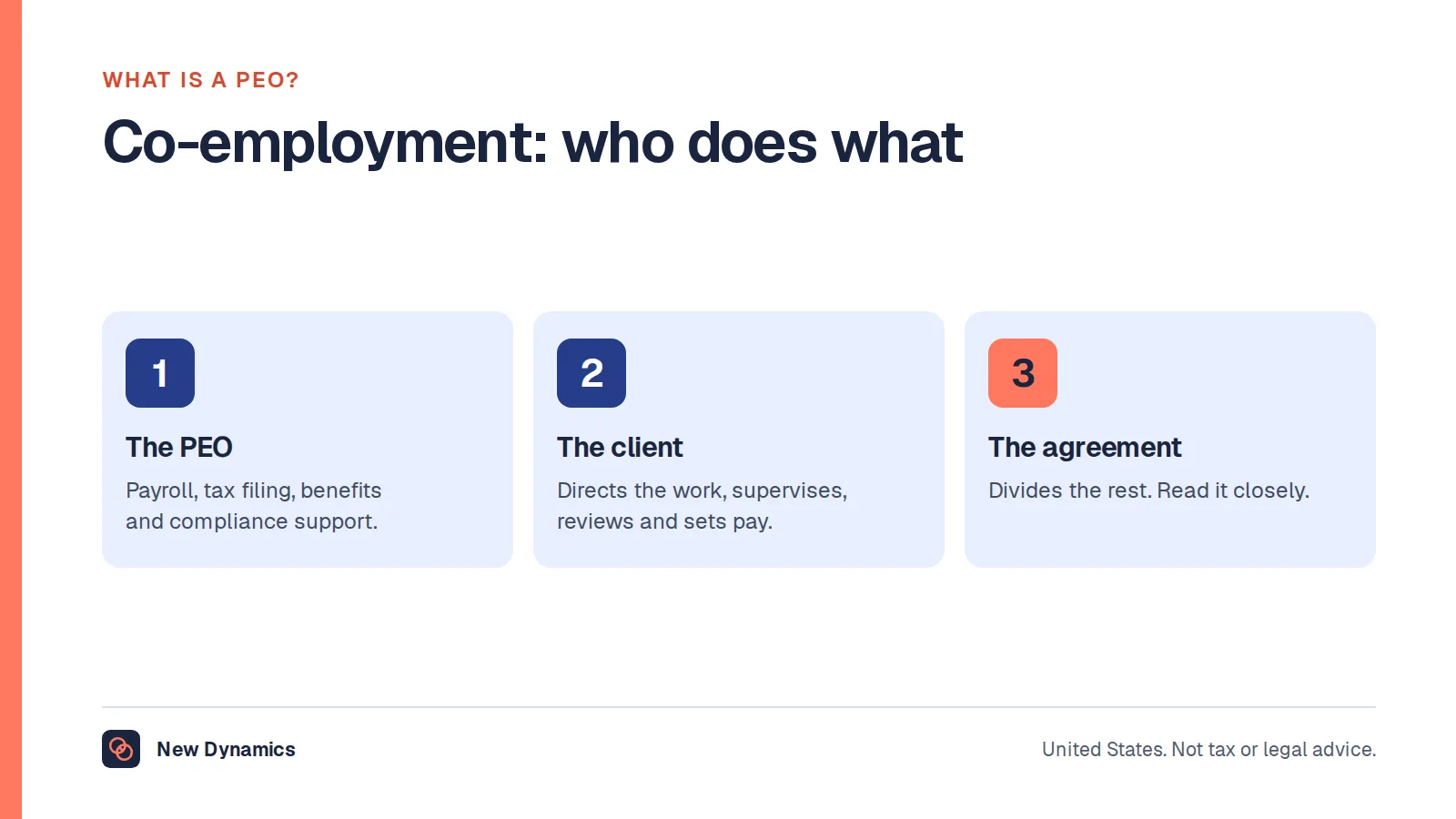
- Co-employment or employment by a provider. A professional employer organisation shares employment (see our PEO post) while an employer of record becomes the legal employer outright.
Our BPO post covers the wider family of outsourcing these belong to.
The question that separates them

Ask one thing: does the provider become the employer?
- No, for arrangements one to four. You remain the employer. The provider does work on your behalf.
- Partly, for a PEO, which shares defined employer responsibilities with you.
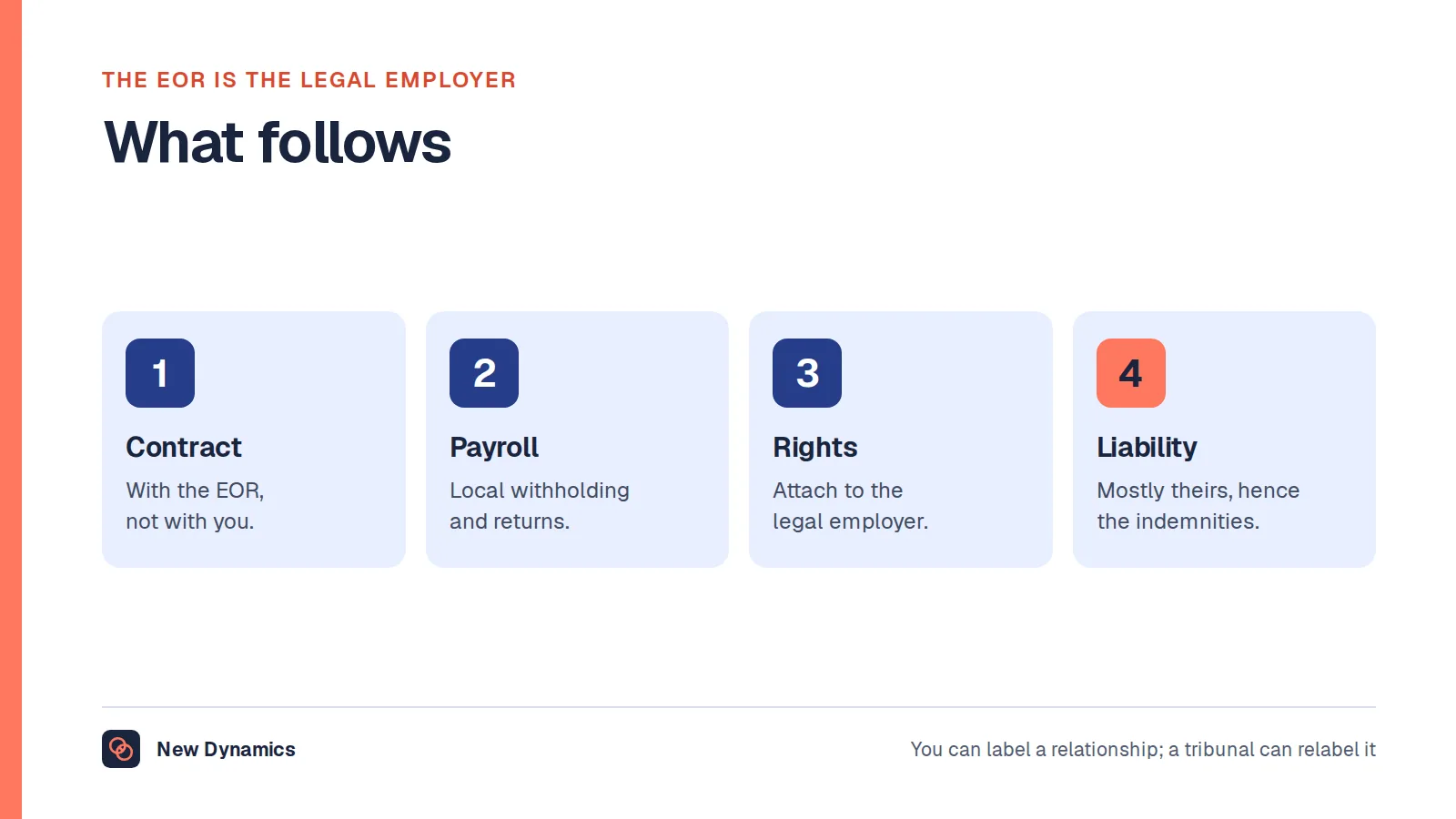
- Yes, for an employer of record, which is the legal employer of the person concerned.
That single answer determines where the contracts sit, who employment rights are exercised against, and who a tribunal or HMRC deals with. Everything else in the sales conversation is downstream of it.
What never moves
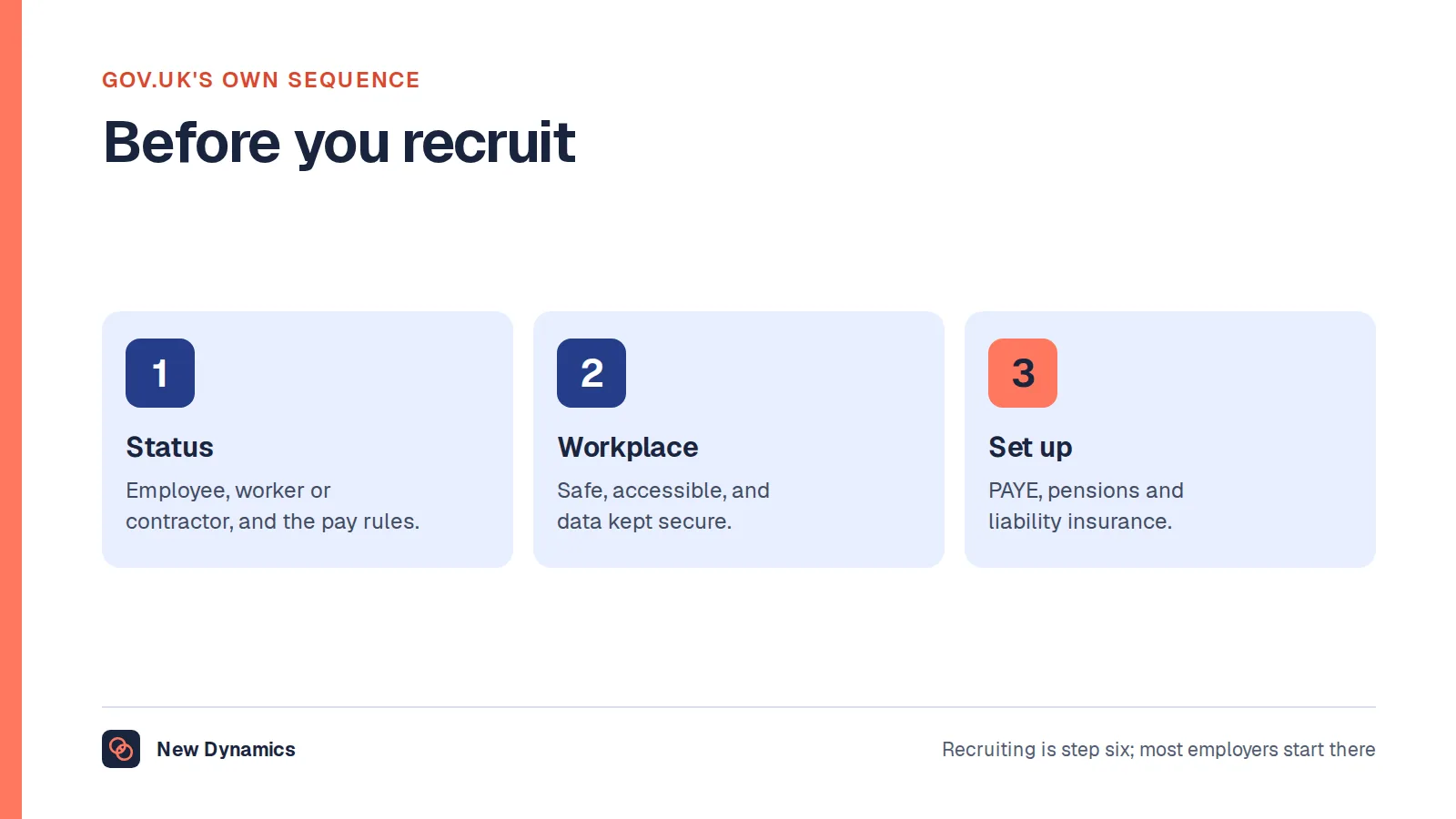
GOV.UK's step-by-step guide to employing staff lists what an employer must do: check the employment status of the person you are taking on, make the workplace "safe and accessible", keep "employee information and data safe", "register as an employer and set up PAYE" because "you need to register with HMRC so you can pay tax and national insurance for your employees", check "your responsibilities around workplace pensions", and get "Employers' Liability insurance".
None of those become somebody else's duty because you bought a service. A provider can prepare the submission, maintain the system and advise on the policy. The obligation remains yours.
Employers' liability insurance is the clearest example. GOV.UK's guidance on employers' liability insurance requires it "as soon as you become an employer", for "at least £5 million from an authorised insurer", displayed "where employees can access it" and shown "to inspectors when they ask", with a fine of "£2,500 every day you are not properly insured". No HR contract removes that.
This is general information rather than legal advice.
Records, and who gets the penalty
The record-keeping duty makes the point sharply. GOV.UK's guidance on keeping records requires an employer to collect and keep records of pay and deductions, "reports you make to HM Revenue and Customs (HMRC)", "payments you make to HMRC", "employee leave and sickness absences", "tax code notices" and "taxable expenses or benefits", for "3 years from the end of the tax year they relate to".
Then: "if you do not keep full records, HMRC may estimate what you have to pay and charge you a penalty of up to £3,000." HMRC charges the employer. If records are lost, the employer must "tell HMRC as soon as possible" and "must also do your best to recreate them".
Two practical consequences. Make sure you hold copies of your own records rather than only having access to a provider's system. And check what happens to those records if the relationship ends, our payroll records post covers what has to exist.
What tends to work, and what does not
Works well: payroll processing, benefits administration, high-volume recruitment scheduling, policy templates and first-line advice. These are rule-governed, repeatable and easy to judge against a service level.
Works badly: anything requiring judgement about specific people in your organisation. A provider can tell you what a fair procedure looks like; they cannot know that the manager involved has had two similar complaints, or that the team has been short-staffed since spring.
The honest middle: case support. An external adviser improves the procedure and reduces legal risk. They do not replace someone who knows the organisation, and expecting them to produces advice that is correct and unusable.
What to check in the contract

- Who is responsible for what, in writing, including which acts are reserved to you.
- Your data, on exit. What you get back, in what format, and how quickly.
- Accuracy and errors. What happens when a pay run is wrong, who corrects it and who bears the cost, noting that the penalty for bad records is charged to you.
- Continuity. Whether one named person knows your organisation, and what happens when they leave.
GOV.UK also reminds employers that "you must follow rules on data protection if your business stores or uses personal information", which does not stop applying because a supplier holds the file.
If you are a small employer
Outsourcing is often the right answer below the size where employing an HR person makes sense. Two rules keep it sound.
Keep the decisions. Sign off pay changes, disciplinary outcomes and dismissals yourself, on advice, rather than letting a provider decide them at arm's length.
Keep your own copies. Payroll records, contracts and case notes should exist somewhere you control. Our HR compliance post lists what those are.
Frequently asked questions
What is HR outsourcing?
Paying an external provider to carry out HR work: payroll processing, recruitment, advice, administration or a full service. It moves the work; it does not move the legal duties of being an employer unless the arrangement changes who the employer is.
What HR functions can be outsourced?
Payroll, benefits administration, recruitment processing, policy drafting, first-line advice and much routine administration. Judgement about individual cases is harder to outsource well, because it depends on knowledge of the organisation.
Does outsourcing HR transfer legal responsibility?
Generally no. PAYE registration, pensions duties, a safe workplace, employers' liability insurance and record keeping remain the employer's. Only an employer of record arrangement changes who the employer is; a PEO shares defined responsibilities.
What are the benefits of HR outsourcing?
Access to expertise without employing it, predictable cost, coverage for absence and peaks, and a defined service level for routine work. The gains are largest where the work is rule-governed and easy to measure.
Who is penalised if outsourced payroll goes wrong?
The employer. GOV.UK states that where full records are not kept, HMRC may estimate what is owed and charge a penalty of up to £3,000, and the record-keeping duty sits with the employer regardless of who runs the payroll.
What is the difference between HR outsourcing and a PEO?
Standard outsourcing leaves you as the sole employer with a supplier doing work for you. A PEO operates co-employment, sharing defined employer responsibilities. An employer of record goes further and becomes the legal employer.
What should you keep in-house?
Decisions about individuals (pay changes, disciplinary outcomes, dismissals) and your own copies of records. Advice can come from outside; the decision and the evidence should sit with you.
Your next step: list what you would lose
- Write down which records exist only in a provider's system.
- Check your contract for what you get back on exit, and how fast.
- Confirm who signs off decisions about individuals.
- Check the duties GOV.UK lists for employers, and name the person accountable for each.
For the wider function this sits inside, read and download our human resources management guide. The guide is free to read, and the PDF uses our short download form.
Want visibility of work you have handed over? Book a New Dynamics demo and bring your current arrangement. You can also email contact@new-dynamics.com.