TL;DR
- RPO recruiting, or recruitment process outsourcing, is paying another company to run part or all of an organisation's recruitment process: sourcing, screening, scheduling, offers and sometimes onboarding, usually under a contract of a year or more, working as an extension of the in-house team.
- It comes in three models: end-to-end, where the provider runs all hiring; project or on-demand, for a defined hiring burst; and selective or hybrid, where the provider takes specific stages or roles. It differs from an agency, which fills individual vacancies for a fee per hire.
- In Great Britain, a provider that finds workers for a hirer is regulated as an employment agency or business and must follow the conduct rules. The hiring decision, the employer's brand and the fairness of the process remain the employer's responsibility.
An organisation that hires two hundred people a year has a choice. It can build a recruitment team, use agencies vacancy by vacancy, or pay a specialist to run the whole process under its own name. The third option is RPO recruiting, and it is the least understood of the three, partly because its providers rarely explain it in plain words.
This article explains what recruitment process outsourcing is, the three models it comes in, what an RPO provider actually does, how it differs from a recruitment agency and an in-house team, the rules that apply in Great Britain, when it makes sense and what to check before signing.
Whoever runs the process, the hiring workflow should be the employer's, visible and consistent. See how New Dynamics workflows let you shape forms, stages and approvals around the way you work.
What is RPO?
The Cambridge Dictionary defines outsourcing as “the process of paying to have part of a company's work done by another company”. Recruitment process outsourcing is that, applied to hiring: paying a specialist provider to run part or all of the recruitment process, from attracting candidates through screening, interviewing logistics and offers to, in some contracts, onboarding.
Three features distinguish RPO from simply using recruiters.
- It is a process, not a vacancy. The provider takes on the flow of hiring over a period, usually a year or more, rather than one job at a time.
- It works as the employer. RPO recruiters typically operate under the client's brand, in its systems, with its careers page and its offer letters, so candidates experience the employer, not the provider.
- It is measured on the process. Time to hire, cost per hire, quality of hire, candidate experience and diversity of the pipeline, agreed as service levels, rather than a fee per placement.
“RPOs” or “RPO recruiting” in searches usually means one of two things: the providers themselves, or the practice. This article covers both.
The three RPO models
| Model | What the provider does | Typical use |
|---|---|---|
| End-to-end | Runs all recruitment for the organisation or a division: sourcing to offer, sometimes onboarding | Large employers with steady, high-volume hiring |
| Project or on-demand | Takes a defined hiring burst: a new site, a seasonal peak, a product launch | Employers whose volume spikes |
| Selective or hybrid | Takes specific stages, such as sourcing and screening, or specific roles, such as graduates or technical hires | Employers with an in-house team that needs capacity or expertise |
The model decides the contract. End-to-end RPO is a multi-year partnership with a dedicated team; project RPO is a scoped engagement with a start and end; selective RPO is closer to a managed service for one part of the funnel. Our guide to talent acquisition describes the in-house function that RPO supplements or replaces.

What an RPO provider does
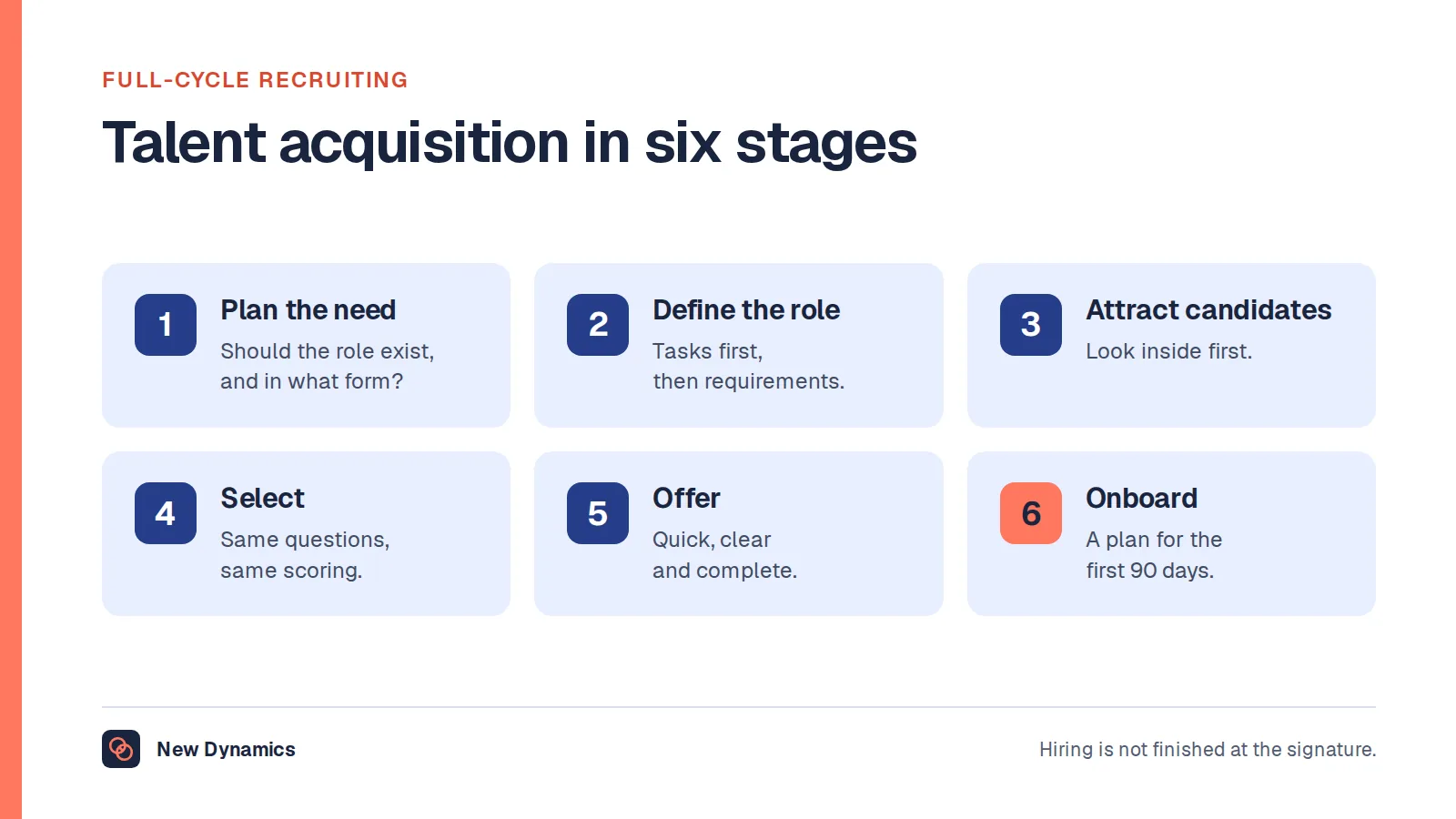
Across the models, an RPO team typically covers six things.
- Workforce planning input. Turning the hiring plan into a sourcing plan by role, location and timing.
- Attraction and sourcing. Careers pages, job adverts, job boards, search, talent pools and referrals, under the client's brand.
- Screening and assessment. Application review, telephone screens, tests and interview scheduling against criteria the employer sets.
- Hiring manager support. Briefing, shortlists, interview coordination, feedback collection and advice on the market.
- Offer and pre-boarding. Offer letters, right-to-work and reference checks, and keeping the candidate warm until day one, within the employer's process.
- Reporting and improvement. Pipeline data, service level reporting and changes to the process that the data supports.
What the provider does not do is decide. Shortlisting criteria, interview questions, the hiring decision and the employer brand are the employer's, and a contract that lets them drift to the provider has outsourced more than a process.
RPO, agency and in-house: the differences
| Question | RPO provider | Recruitment agency | In-house team |
|---|---|---|---|
| Scope | The process, over a period | One vacancy at a time | Everything, permanently |
| Brand candidates see | The employer's | The agency's | The employer's |
| How it is paid | Management fee, per-hire fee or both, under contract | Fee per placement, usually a percentage of salary | Salaries and overheads |
| Where recruiters sit | Client's systems, often on site | Agency's | Client's |
| Best for | Steady or spiky volume needing a system | Hard-to-fill or one-off roles | Organisations that hire enough to justify the team |
Many employers use all three: an in-house lead, an RPO for volume and agencies for the senior or specialist search. Our guide to the meaning of hiring compares the sources of hire more broadly.

The rules that apply in Great Britain
A provider that finds workers for a hirer is, in most cases, an employment agency or employment business under the law in Great Britain, whatever it calls itself. GOV.UK's guide to employment agencies and businesses says that those who run one “have to follow certain rules”. Among them, an agency or business cannot “charge a fee to a work-seeker for work finding services”, and must make sure workers are “given a key information document and written terms of engagement (often known as a contract) before you start looking for work for them”.
Before placing a work-seeker, GOV.UK says, the agency or business must get sufficient information from the hirer, including the identity of the hirer and the nature of its business, the start date and duration, “the type of work, location, working hours and any health and safety risks and controls” and “the experience, references, training and qualifications the hirer needs for the post or are needed by law”. An RPO contract should make clear which party holds which duty.
Two things stay with the employer whatever the contract says: the duty not to discriminate in recruitment, and responsibility for personal data that candidates give in the employer's name. This is general information about UK rules as published, not legal advice, and the law differs elsewhere. Our recruitment and selection guide covers the fair process the provider must run on your behalf.
When RPO makes sense
- Volume. Enough hiring, steady or spiky, that a process is worth building but an in-house team of that size is not.
- Speed. A new site, a contract win or a seasonal peak that the current team cannot staff in time.
- Capability. Sourcing in markets or for roles the in-house team does not know.
- Cost and data. Agency spend that has become large and invisible, replaced by a contract with service levels and reporting.
When it does not: a small number of senior or specialist hires, an organisation that cannot describe its own process, or a leadership team that wants to outsource the decision as well as the work.
What to check before signing
- Scope and model. Which stages, which roles, which locations, for how long.
- Service levels. Time to hire, cost per hire, offer acceptance, candidate satisfaction, pipeline diversity, and what happens when they are missed.
- Who decides what. Criteria, questions, shortlists and offers stay with the employer, in writing.
- Systems and data. Whose applicant tracking system, who owns the candidate data, and what happens at the end of the contract. Our guide to ATS meaning explains the system at the centre of it.
- Regulatory status. How the provider is set up under the employment agency rules and who holds which duty.
- Exit. How the process, the data and the knowledge come back in-house if the contract ends.

Frequently asked questions
What is RPO recruiting?
RPO recruiting is recruitment process outsourcing: paying a specialist provider to run part or all of an organisation's recruitment process over a period, usually under the employer's brand and in its systems, measured on service levels such as time to hire and cost per hire rather than paid per placement.
What does an RPO provider do?
Sourcing and attraction, screening and assessment, interview scheduling and hiring manager support, offers and pre-boarding checks, and reporting, according to the model contracted. The employer keeps the criteria, the interview decisions and the brand.
What is the difference between RPO and a recruitment agency?
An agency fills one vacancy at a time for a fee per placement, under its own brand. An RPO provider runs the process over a period, under the employer's brand, for a management or per-hire fee against service levels. Many employers use both.
What are the types of RPO?
End-to-end, where the provider runs all recruitment; project or on-demand, for a defined hiring burst; and selective or hybrid, where the provider takes specific stages or role types alongside an in-house team.
Is RPO regulated in the UK?
A provider that finds workers for a hirer is normally an employment agency or employment business under the rules in Great Britain, which GOV.UK sets out: no fees to work-seekers, written terms and key information documents, and duties to obtain information from the hirer before placing anyone. The employer remains responsible for a non-discriminatory process and for candidate data collected in its name.
When should a company use RPO?
When it hires enough, steadily or in bursts, to need a process but not a team of that size; when it needs speed or sourcing capability it lacks; or when agency spend has grown large and invisible. It suits high-volume hiring more than a handful of senior searches.
Your next step
- Write down your current process, volumes and cost per hire; RPO cannot fix what you cannot describe.
- Decide which model fits: end-to-end, project or selective.
- List the decisions that stay in-house and put them in the contract.
- Agree the service levels and the exit before the first hire.
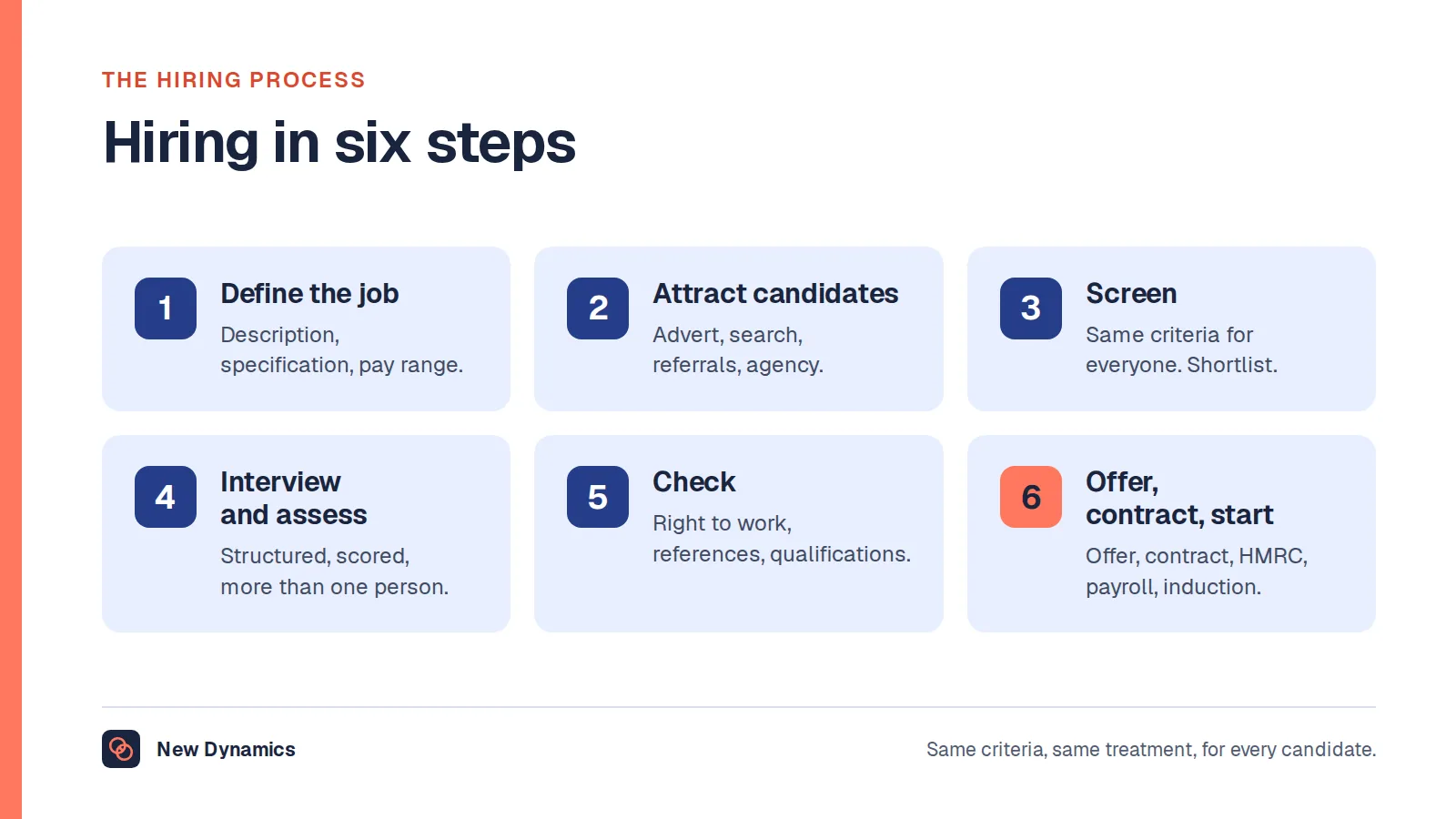
For the fair process any provider must run in your name, read and download our recruitment and selection guide. The guide is free to read, and the PDF uses our short download form.
Want one hiring workflow that your in-house team and your RPO provider both work to? Book a New Dynamics demo and bring your current process. You can also email contact@new-dynamics.com.