TL;DR
- The role exists because of one regulation. Regulation 7(1) of the Management of Health and Safety at Work Regulations 1999 requires every employer to appoint one or more competent persons to assist in complying with health and safety law, and regulation 7(5) defines competence without naming a single qualification.
- Appointing one does not move the duty. Section 2(1) of the Health and Safety at Work etc. Act 1974 places it on the employer, and HSE states that if you use a consultant or adviser, "as the employer, managing health and safety will still be your legal duty".
- The government's careers service has no job profile called health and safety manager. Its nearest is health and safety adviser, whose listed alternative title is health, safety and environment (HSE) adviser, and it requires no qualification by law.
Most adverts for this job open with the same line: responsible for ensuring the company's compliance with all health and safety legislation. That line is wrong as a matter of law, and it is why so many of these job descriptions fall apart the first time somebody asks who was accountable for what. The duty belongs to the employer and cannot be handed to a post holder. The post holder's job is to make it possible for the employer to discharge it.
This article sets out an HSE manager job description for the United Kingdom: how the HSE, EHS and SHEQ titles relate, the duties with the section or regulation behind each, the qualifications people hold, reporting lines, pay, a template and the mistakes to avoid. It is general information about the law in Great Britain and not legal advice.
A safety management system is a set of named owners, dated actions and approvals, and so is the review cycle that judges the people who run it. See how New Dynamics workflows let you define your own stages, forms and approvals, with a completion view instead of a spreadsheet.
What HSE, EHS and SHEQ mean
The initials are a filing convention, not a hierarchy.
- HSE is health, safety and environment. In Britain the same three letters are also the regulator, the Health and Safety Executive, so write the title out in full at least once in any advert.
- EHS is environment, health and safety: the same scope, in the ordering common in groups with a United States parent.
- SHEQ adds quality: the post holder also owns the quality management system, usually to ISO 9001. Say which half is larger.
- HSSE and HSEQ add security or quality in energy and construction. HSES manager is a typing variant, not a separate occupation.
The government's careers service lists no profile called health and safety manager or health and safety officer. Its nearest is health and safety adviser, and the alternative title it gives there is "Health, safety and environment (HSE) adviser". A manager grade adds budget, team and board reporting, not a different legal basis.
The regulation that actually creates the role
Regulation 7 of the Management of Health and Safety at Work Regulations 1999 is the reason the post exists, and most job descriptions never mention it.
Regulation 7(1) requires every employer to "appoint one or more competent persons to assist him in undertaking the measures he needs to take to comply with the requirements and prohibitions imposed upon him by or under the relevant statutory provisions". Read the verb. The appointee assists. The measures remain the employer's.
Three more paragraphs belong in the job description, because they decide whether the role can be done at all.
- 7(3) makes resourcing a legal test, not a budget preference. The number of appointees, "the time available for them to fulfil their functions and the means at their disposal" must be adequate to the size of the undertaking, the risks employees face and the distribution of those risks. One part-time adviser across fourteen sites is a 7(3) problem before it is a workload problem.
- 7(5) is the statutory definition of competence. A person is competent where he has "sufficient training and experience or knowledge and other qualities to enable him properly to assist". Note what is absent: any named qualification.
- 7(8) prefers in-house. A competent employee is to be appointed "in preference to a competent person not in his employment". Where several are appointed, 7(2) requires arrangements for adequate co-operation between them.
HSE's guidance on what competence means draws the distinction that matters for a manager post. "A competent person is not someone who simply has the competence to carry out a particular task safely," it says; the definition is "someone who has the necessary skills, experience and knowledge to manage health and safety".

HSE manager duties, with the law behind each one
Write the duties as accountabilities and put the reference beside each. A job description that cites its sources survives an investigation; a list of verbs does not.
- Hold and revise the written policy. Section 2(3) of the Health and Safety at Work etc. Act 1974 makes it the employer's duty "to prepare and as often as may be appropriate revise a written statement of his general policy" on health and safety, and "to bring the statement and any revision of it to the notice of all of his employees". HSE's guidance on preparing a policy states that "If you have five or more employees, you must write your policy down," and that it "should clearly say who does what, when and how". Drafting it is the post holder's work. Owning it is the employer's.
- Run the risk assessment programme. Regulation 3(1) requires "a suitable and sufficient assessment" of the risks to employees and to people outside the employer's employment arising from the undertaking. Regulation 3(3) requires review where there is reason to suspect the assessment is no longer valid or there has been a significant change. Regulation 3(6) requires an employer with five or more employees to record the significant findings, and regulations 3(4) and 3(5) require a separate assessment before a young person is employed.
- Specify information, instruction, training and supervision. Section 2(2)(c) extends the general duty to "the provision of such information, instruction, training and supervision as is necessary". That is the legal hook for the training matrix and the competence records.
- Make plant, substances and the workplace safe so far as is reasonably practicable. Section 2(2)(a), (b), (d) and (e) cover plant and systems of work, the handling, storage and transport of articles and substances, maintenance of the workplace with safe access and egress, and welfare facilities.
- Consult, and service the committee. Section 2(6) requires every employer to consult safety representatives on arrangements that let employer and employees "co-operate effectively" on health and safety measures "and in checking the effectiveness of such measures". Section 2(7) requires a safety committee where representatives ask for one.
- Report and record under RIDDOR 2013. Regulation 4(1) lists the specified injuries that trigger reporting, among them any bone fracture other than to a finger, thumb or toe, amputations, and loss of consciousness caused by head injury or asphyxia. Regulation 4(2) covers incapacity "for routine work for more than seven consecutive days (excluding the day of the accident)", reportable "within 15 days". Regulation 6 covers fatalities, regulation 7 dangerous occurrences and regulation 8 the listed occupational diseases. Regulation 12 requires a record of any injury incapacitating someone for more than three consecutive days, kept "for at least three years". HSE's page on when to report adds the deadline people miss: notification without delay, and "A report must be received within 10 days of the incident."
- Monitor, investigate and report upwards. Inspections, audits, investigation, action tracking and a board report. Nothing prescribes the format. Everything assumes somebody is checking.

One duty belongs to everyone else. Section 7 of the 1974 Act makes it the duty of every employee "to take reasonable care for the health and safety of himself and of other persons who may be affected by his acts or omissions at work" and to co-operate with the employer. An HSE manager written up as the person who keeps other people safe has been set up to fail.
HSE's key figures for Great Britain 2024 to 2025 show where the volume sits: 1.9 million working people suffering from a work-related illness, against 59,219 injuries to employees reported under RIDDOR. A job description built entirely around accidents is aimed at the smaller number. The practical layer underneath is in our post on health and safety tips at the workplace; the wider figures are in our HR statistics hub.
The distinction most job descriptions get wrong
Section 2(1) reads: "It shall be the duty of every employer to ensure, so far as is reasonably practicable, the health, safety and welfare at work of all his employees." The duty holder named there is the employer. Regulation 7 then provides for somebody to assist. Neither provision transfers anything.
HSE says it in one sentence on appointing a competent person. Where a business brings in a consultant or adviser because it lacks the competence in-house, "But remember, as the employer, managing health and safety will still be your legal duty."
That cuts both ways, and the second edge is the one candidates care about. Section 37 provides that where an offence by a body corporate was committed "with the consent or connivance of, or to have been attributable to any neglect on the part of, any director, manager, secretary or other similar officer", that person as well as the body corporate is guilty of it.
So write the document to match. Replace "responsible for compliance with health and safety legislation" with "appointed under regulation 7(1) of the Management of Health and Safety at Work Regulations 1999 to assist [employer] in discharging its duties", then list what the post holder decides, drafts, inspects, reports and escalates. Name the director who signs the policy under section 2(3). And say what happens when advice is refused: in writing, to whom, by when. That escalation route is the most useful line in the document.

Qualifications, and who awards them
Regulation 7(5) asks for training and experience or knowledge and other qualities, and names no certificate. HSE's guidance on appointing a competent person confirms it: "It's not usually essential for them to have formal qualifications and they're not required by law to have formal training, although it can help." Employers ask anyway, as a proxy for the 7(5) test.
The National Careers Service adviser profile recognises four routes: a degree in a subject such as occupational safety, health and environment, or environmental health; a postgraduate health and safety qualification on top of an industry-related degree; the Safety, Health and Environment Technician Level 3 Advanced Apprenticeship or the Environmental Health Practitioner Level 6 Degree Apprenticeship, taking between 2 and 4 years; or study while working, through approved courses from NEBOSH, the National Examination Board in Occupational Safety and Health, and IOSH, the Institution of Occupational Safety and Health. It also points to the Occupational Safety and Health Consultants Register and the Royal Society for the Prevention of Accidents.
None of these awards a licence to practise. They are evidence towards competence, which is why a good advert asks for a qualification and for the experience that makes it mean something.
Reporting lines
Regulation 7 settles more of this than most organisation charts admit. Seniority and resourcing follow 7(3). In-house beats outsourced under 7(8), so external consultants supplement rather than replace. Where there is a group HSE director and site HSE managers, co-operation between them is the employer's to arrange under 7(2), so write it down.
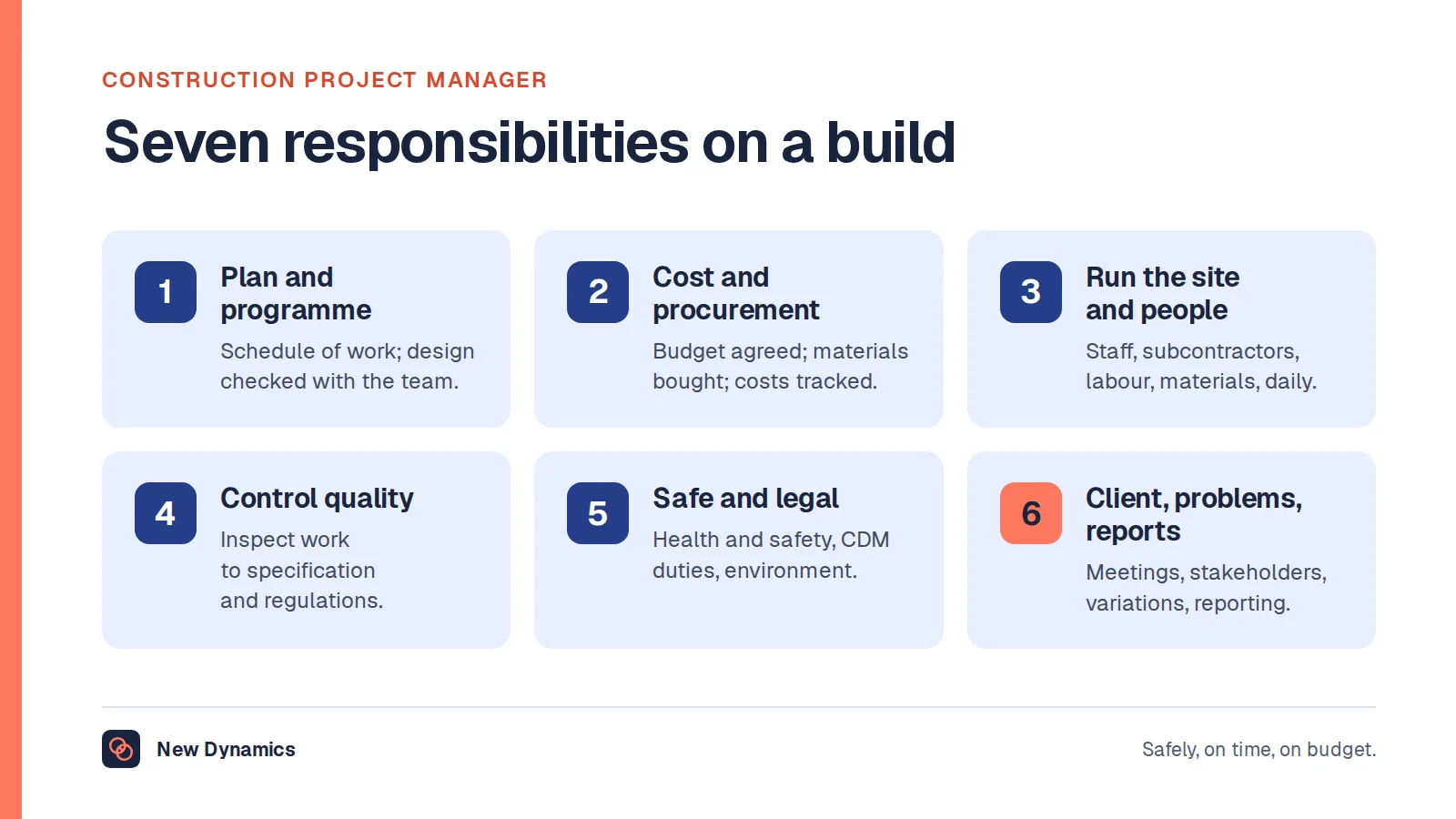
Nothing dictates the line itself, but a post holder who reports to the production director they are auditing cannot escalate the way the job demands. The common arrangement is a report to a board director or the chief executive, with a dotted line to site or operations management. The closest parallels here are our compliance officer job description and our risk manager job description. On construction projects the duties divide differently; see our construction project manager job description.
Pay: what is and is not published
No official source publishes a salary for an HSE manager. ONS reports earnings through its Annual Survey of Hours and Earnings by Standard Occupational Classification group rather than by job title, so there is no published median for this post. We do not invent one.
What is published is adjacent. The National Careers Service adviser profile gives an average salary of £26,000 for a starter and £48,000 for someone experienced, with typical hours of 37 to 40 a week. It carries no reference date, and it is the adviser role, not a manager grade. For a dated anchor, ONS's Employee earnings in the UK: 2025 bulletin, released 23 October 2025, reports that "Median gross annual earnings for full-time employees were £39,039 in April 2025, compared with £37,439 in April 2024". That is all full-time employees, not this role. Benchmark against your own pay structure and the regulation 7(3) scope of the job.
HSE manager job description template
Adapt it. Keep every line true.
Job title: Health, safety and environment (HSE) manager
Reports to: [Operations director / Chief executive], with direct access to the board
Appointment: Appointed under regulation 7(1) of the Management of Health and Safety at Work Regulations 1999 as a competent person to assist [employer] in complying with health and safety law. The duties under section 2 of the Health and Safety at Work etc. Act 1974 remain with [employer].
Scope: [n] sites, [n] employees and [n] contractors; principal risks [list].
Main accountabilities:
- Draft and maintain the written policy for signature by [director], and bring it and every revision to the notice of all employees, under section 2(3)
- Own the risk assessment programme: suitable and sufficient assessments, recorded findings, review on change, young persons assessments, under regulation 3
- Specify the training, instruction and supervision each role needs, and hold the competence records, under section 2(2)(c)
- Run the inspection, audit and investigation programme, and track actions to closure
- Report and record under RIDDOR 2013: a report received within 10 days, over-seven-day incapacity within 15 days, the over-three-day record kept three years
- Consult safety representatives and service the safety committee, under sections 2(6) and 2(7)
- Report risk and action status to [the board] [monthly], and escalate in writing any case where advice is not accepted
- Manage the HSE budget, the team, external advisers and the environmental duties in scope [list]
Essential: [NEBOSH certificate] or equivalent; [n] years in a [sector] safety role; experience of [specific risk]; able to evidence competence against regulation 7(5).
Desirable: Diploma-level qualification; chartered membership of a relevant professional body; [ISO 45001 / ISO 14001] experience.
Authority: Can stop work on reasonable grounds of imminent risk without prior approval, and can require a risk assessment before a new activity starts.
The overall structure is covered in our job description template, and a related estate-side role in our facilities manager job description.
Common mistakes in HSE manager adverts
Giving the post holder the employer's duty. It cannot be given. See section 2(1) and regulation 7(1).
No stop-work authority. If the post holder cannot halt an unsafe activity, the role is advisory. Say which it is.
Scope left vague. Sites, headcount, contractors and principal risks decide whether the job is doable, and 7(3) makes that the employer's problem.
Environment bolted on silently. If waste, permits, emissions or ISO 14001 are in scope, list them. They are a separate body of law.
A qualification instead of competence. Ask for both, and say what the experience has to cover.
Frequently asked questions
What does an HSE manager do?
An HSE manager is appointed under regulation 7(1) of the Management of Health and Safety at Work Regulations 1999 to assist the employer in complying with health and safety law: drafting and maintaining the written policy, running the risk assessment programme, specifying training and supervision, inspecting and auditing, investigating incidents, reporting and recording under RIDDOR 2013, consulting safety representatives, and reporting risk upwards.
Is an HSE manager legally responsible for health and safety?
No. Section 2(1) of the Health and Safety at Work etc. Act 1974 places the duty on the employer, and regulation 7(1) provides only for a competent person to assist. HSE states that if you use a consultant or adviser, as the employer managing health and safety will still be your legal duty. Section 37 of the Act does make a director or manager personally guilty of an offence committed with their consent or connivance, or attributable to their neglect.
What is the difference between HSE, EHS and SHEQ?
HSE is health, safety and environment. EHS is environment, health and safety, the common ordering in groups with a United States parent. SHEQ adds quality, usually meaning the post holder also owns the quality management system, and HSSE adds security. In Britain, HSE is also the name of the regulator, so write the title out in full in an advert.
What qualifications does an HSE manager need?
No qualification is required by law. Regulation 7(5) asks for sufficient training and experience or knowledge and other qualities, and HSE says formal qualifications and formal training are not usually essential, although they can help. The National Careers Service names degrees in occupational safety, health and environment or environmental health, postgraduate study, the Safety, Health and Environment Technician Level 3 apprenticeship, the Environmental Health Practitioner Level 6 degree apprenticeship, and approved courses through NEBOSH and IOSH.
Who should an HSE manager report to?
Regulation 7(3) requires the number of appointees, their time and their means to be adequate to the size of the undertaking and the distribution of its risks, which pushes the role towards a senior reporting line. Regulation 7(8) requires an in-house competent person to be appointed in preference to an external one. Most organisations report the role to a board director or the chief executive, so advice can be escalated without passing through the function being audited.
What must an HSE manager report under RIDDOR?
Specified injuries under regulation 4(1), such as most bone fractures, amputations and loss of consciousness from head injury or asphyxia; incapacity for routine work for more than seven consecutive days under regulation 4(2), within 15 days; fatalities under regulation 6; dangerous occurrences under regulation 7; and the listed occupational diseases under regulation 8. HSE states that for most incidents notification is without delay and a report must be received within 10 days.
How many employees before a written health and safety policy is required?
Section 2(3) of the 1974 Act requires every employer to prepare and revise a written statement of general policy except in prescribed cases. HSE's guidance states that if you have five or more employees you must write your policy down, and if you have fewer than five you do not have to write anything down, although it is useful to do so.
Your next step
- Replace any "responsible for compliance" line with the regulation 7(1) appointment wording and specific accountabilities.
- State the scope: sites, headcount, contractors and principal risks. Test it against regulation 7(3).
- Name the director who signs the policy under section 2(3).
- Write the escalation route and the stop-work authority in one sentence each.
The policy wording and the "who does what, when and how" test sit naturally alongside our employee handbook guide. The guide is free to read, and the PDF uses our short download form.
Want appointments, competence records, training evidence and the HSE team's own reviews held in one place rather than four spreadsheets? Book a New Dynamics demo and bring your current job description. You can also email contact@new-dynamics.com.