TL;DR
- Workplace health and safety rests on a legal minimum for employers in Great Britain: identify what could cause injury or illness, decide how likely and how serious the harm is, and act to eliminate the hazard or control the risk. The Health and Safety Executive turns that into five steps: identify hazards, assess the risks, control them, record the findings and review the controls.
- These fifteen tips apply the steps. Eight are for managers, from the risk assessment to the safety conversation. Seven are for employees, from following the safe method to reporting the near miss. Together they cover the most common causes of harm at work, including slips and trips, manual handling, equipment and stress.
- The tips are general information about Great Britain, not legal advice. The rules differ elsewhere, and a business's own risk assessment is what applies to its own workplace.
Most workplace injuries are not exotic. They are a wet floor, a box lifted badly, a guard left off, a ladder used for a job it was not meant for, and a workload nobody questioned. The tips that prevent them are not exotic either, but they only work if they are done every day.
This article gives health and safety tips for the workplace in two lists, one for managers and one for employees, built on the five steps the UK regulator uses to manage risk and on the common workplace risks it lists. It also states the legal minimum employers in Great Britain must meet, so that the tips sit on the right foundation.
Safety depends on people saying what they see. See how New Dynamics continuous feedback gives every employee a regular voice.
The legal minimum, and the five steps
The Health and Safety Executive's guide to managing risks and risk assessment at work states the employer's duty plainly: “As an employer, you're required by law to protect your employees, and others, from harm.” Under the Management of Health and Safety at Work Regulations 1999, it says, the minimum you must do is “identify what could cause injury or illness in your business (hazards)”, “decide how likely it is that someone could be harmed and how seriously (the risk)” and “take action to eliminate the hazard, or if this isn't possible, control the risk”.
HSE's page on the steps needed to manage risk describes risk management as “a step-by-step process for controlling health and safety risks caused by hazards in the workplace”, in five steps: identify hazards, assess the risks, control the risks, record your findings and review the controls. Its advice on identifying hazards is to look at how people work and how equipment is used, what chemicals and substances are used, what safe or unsafe practices exist and the general state of the premises, to look back at accident and ill health records, to take account of non-routine work such as maintenance and cleaning, and to think about hazards to health such as manual handling, chemicals and work-related stress. It adds: “Involve your employees as they will usually have good ideas.”
Every tip below is one of those steps in practice. This is general information about Great Britain, not legal advice; Northern Ireland and other countries have their own rules, and a business's own risk assessment is what applies to its own workplace.

Eight safety tips for managers
- Do the risk assessment, and do it with the people who do the work. Walk the workplace, ask the team what could hurt them, and write down the hazards, who could be harmed, what is already in place and what more is needed, with a name and a date against each action.
- Remove the hazard before you control it. HSE's first question about any risk is whether the hazard can be got rid of altogether, by redesigning the job or replacing the materials or machinery. Controls, training and protective equipment come after that question, not instead of it.
- Start with the common causes of harm. HSE's list of common workplace risks groups the most common causes of serious injury, such as slips and trips and working at height, and the health conditions caused or made worse by work, such as lung disease, stress and musculoskeletal disorders. Check yours against the list: slips and trips, manual handling, equipment and machinery, working at height, workplace transport, harmful substances, noise, electrical safety, fire, display screen equipment and work-related stress.
- Treat manual handling as a hazard, not a chore. HSE's guidance on manual handling at work sets out the employer's duty: avoid hazardous manual handling so far as reasonably practicable, assess the risk from what cannot be avoided, and reduce it to as low as reasonably practicable. It notes that the law does not set specific weight limits, which means the assessment has to be done.
- Keep floors, routes and lighting right. Slips and trips are commonly caused by spills, trailing cables, uneven surfaces, poor lighting and the wrong footwear. Fix the cause, mark the hazard while you fix it and keep walkways clear.
- Maintain, inspect and guard the equipment. Guards in place, emergency stops working, daily checks recorded, defects reported and repaired before the next shift, and nobody using equipment they have not been trained on.
- Train, and tell people their duties. HSE's basics for small businesses include providing information and training, consulting workers, first aid, welfare facilities and appointing a competent person. New starters, new tasks and new equipment each need their own training, and the induction should say what each person must do and report.
- Review after every incident, near miss and change. The fifth step is review. A near miss is free information; treat it as seriously as an injury, and revisit the assessment when the work, the equipment or the people change.

Seven safety tips for employees
- Follow the safe method, even when it is slower. The procedure exists because someone was hurt without it.
- Use the equipment you were given, and only the equipment you were trained on. Personal protective equipment, guards, lifting aids and the right ladder, every time.
- Lift with the aid, the technique or a colleague. If a load looks too heavy, awkward or far, it probably is. Ask, split it, or use the trolley.
- Report hazards and near misses. The spill, the frayed cable, the missing guard, the ladder that wobbles. Reporting it is not complaining; it is the fourth step of risk management done by the person closest to the risk.
- Keep your area clear. Cables, boxes, bags and spills cause many of the falls HSE lists among the most common causes of serious injury.
- Take the breaks and the rest you are due. Fatigue causes mistakes, and long hours are a hazard like any other. Our guide to the 8-hour working day explains where the limits came from.
- Say something about stress. HSE lists work-related stress among the health conditions caused or made worse by work. Workload, unclear demands and poor support are hazards, and the risk assessment should cover them. Our guide to absence management covers what happens when they are ignored.

Safety points for the whole workplace
A few points belong to everyone.
- First aid. Know where the kit is, who the first aiders are and how to call for help.
- Fire. Know the exits, the assembly point and the drill, and never wedge a fire door.
- Visitors and contractors. They do not know your hazards. Sign them in, brief them and escort them where the risks require it.
- Reporting. Certain injuries, dangerous occurrences and work-related illnesses must be reported to HSE, and every accident should go in the accident book.
- The poster and the policy. Employers must display the health and safety law poster or give workers the equivalent leaflet, and most need a written policy.
How to make the tips stick
Tips on a poster change nothing. Three things do.
Make safety part of the conversation. A minute at the start of every shift meeting on what went wrong yesterday and what is different today. A question in every one-to-one about hazards and near misses.
Recognise the report, not only the record. The person who reports the wobbly ladder has prevented an injury. Thank them in front of the team.
Measure what you want. Near misses reported, actions closed on time and inspections done tell you more than the injury count alone. Put them where the team can see them.
Frequently asked questions
What are the most important health and safety tips at the workplace?
For managers: assess the risks with the people who do the work, remove hazards before controlling them, start with the common causes of harm, treat manual handling as a hazard, keep floors and routes clear, maintain and guard equipment, train people and tell them their duties, and review after every incident and change. For employees: follow the safe method, use the equipment provided, lift safely, report hazards and near misses, keep the area clear, take breaks and speak up about stress.
What must employers do by law in Great Britain?
HSE says employers are required by law to protect employees and others from harm, and that the minimum under the Management of Health and Safety at Work Regulations 1999 is to identify hazards, assess the risks and act to eliminate the hazard or control the risk. Small businesses also need a policy, information and training, consultation, first aid, welfare facilities, accident reporting and a competent person. This is general information, not legal advice.
What are the five steps of risk assessment?
HSE's five steps to manage risk are: identify hazards, assess the risks, control the risks, record your findings and review the controls.
What are the most common workplace hazards?
HSE's list of common workplace risks includes slips and trips, manual handling, equipment and machinery, working at height, workplace transport, harmful substances, noise, electrical safety, fire, display screen equipment and work-related stress, and health conditions such as lung disease, stress and musculoskeletal disorders.
What are good safety suggestions for employees?
Follow the safe method, use the equipment and protection provided, lift with aids or help, report hazards and near misses, keep the work area clear, take the breaks and rest you are due, and raise workload and stress before they cause harm.
Why do near misses matter?
A near miss is an incident that could have caused harm but did not. Reporting and reviewing near misses is the fourth and fifth step of risk management applied before anyone is hurt, and HSE advises looking back at accident and ill health records to find less obvious hazards.
Your next step: walk the workplace this week
- Take the team's most experienced person and walk every area, asking what could hurt someone.
- Check what you find against HSE's list of common workplace risks.
- Write down the actions with a name and a date, and close the first three this month.
- Add a safety question to every team meeting and one-to-one.
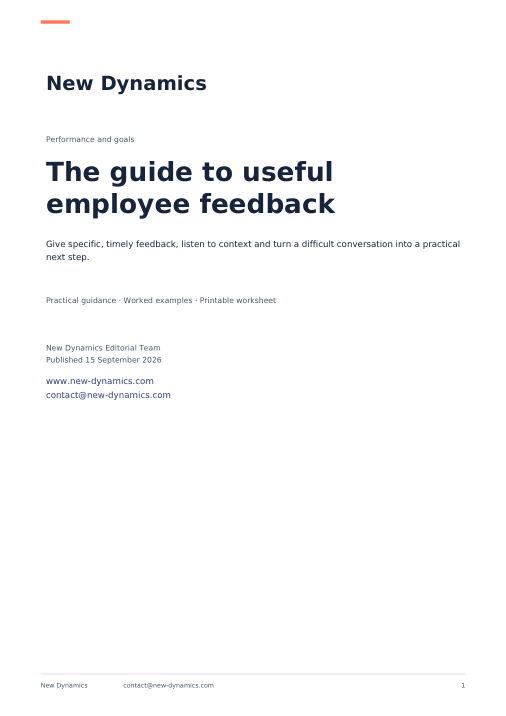
To build the habit of people telling you what they see, read and download our employee feedback guide. The guide is free to read, and the PDF uses our short download form.
Want near misses, safety actions and recognition for reporting them visible to every team? Book a New Dynamics demo and bring your current approach. You can also email contact@new-dynamics.com.