TL;DR
- An interview call message invites a shortlisted candidate to interview. A good one gives the role, the date, time and length, the place or link, the format and the people, what to prepare, and a way to ask for adjustments and to reply.
- Use a phone call or text for speed and an email for the record. Whatever the channel, confirm the details in writing, and give every candidate the same information.
- Before you send, check the names, the time zone, the link, the question about adjustments and the reply route. Seven templates in this article cover text, email, phone, video, reminders and rescheduling.
A candidate reads your interview invitation more carefully than anything else that you will ever send them. It is the first evidence of how your organisation treats people. A message that is clear, warm and complete earns a candidate who turns up prepared. A vague one earns confusion, no-shows and a poor first impression that the interview then has to repair.
This article explains how to write an interview call message, which some people call a call for interview message or an interview invitation. It covers what to include, which channel to use, seven templates that you can adapt and five checks to make before you press send.
The care that you show at this stage should carry on after the offer. See how New Dynamics onboarding brings tasks, early goals and manager conversations into a clear path for a new starter.
What is an interview call message?
An interview call message is the message that tells a shortlisted applicant that you would like to interview them, and gives them what they need to attend. It may be a text message, an email, a letter or a phone call that is followed by written confirmation.
It does three jobs.
- It informs. The candidate learns when, where, how and with whom.
- It sells. Good candidates have choices. The tone of the message tells them something about working for you.
- It protects. A written, consistent invitation is part of a fair process, and a record if your decisions are ever questioned.
Six things that every interview invitation needs
- The role, and thanks. Name the job and thank the person for applying. People apply for several jobs at once.
- Date, time and length. Give the day, the date and the time, with the time zone if there is any doubt, and say how long to allow. Offer an alternative or a way to ask for one.
- Place or link. The full address, how to get in, where to park and whom to ask for. For a video interview, the platform and the link.
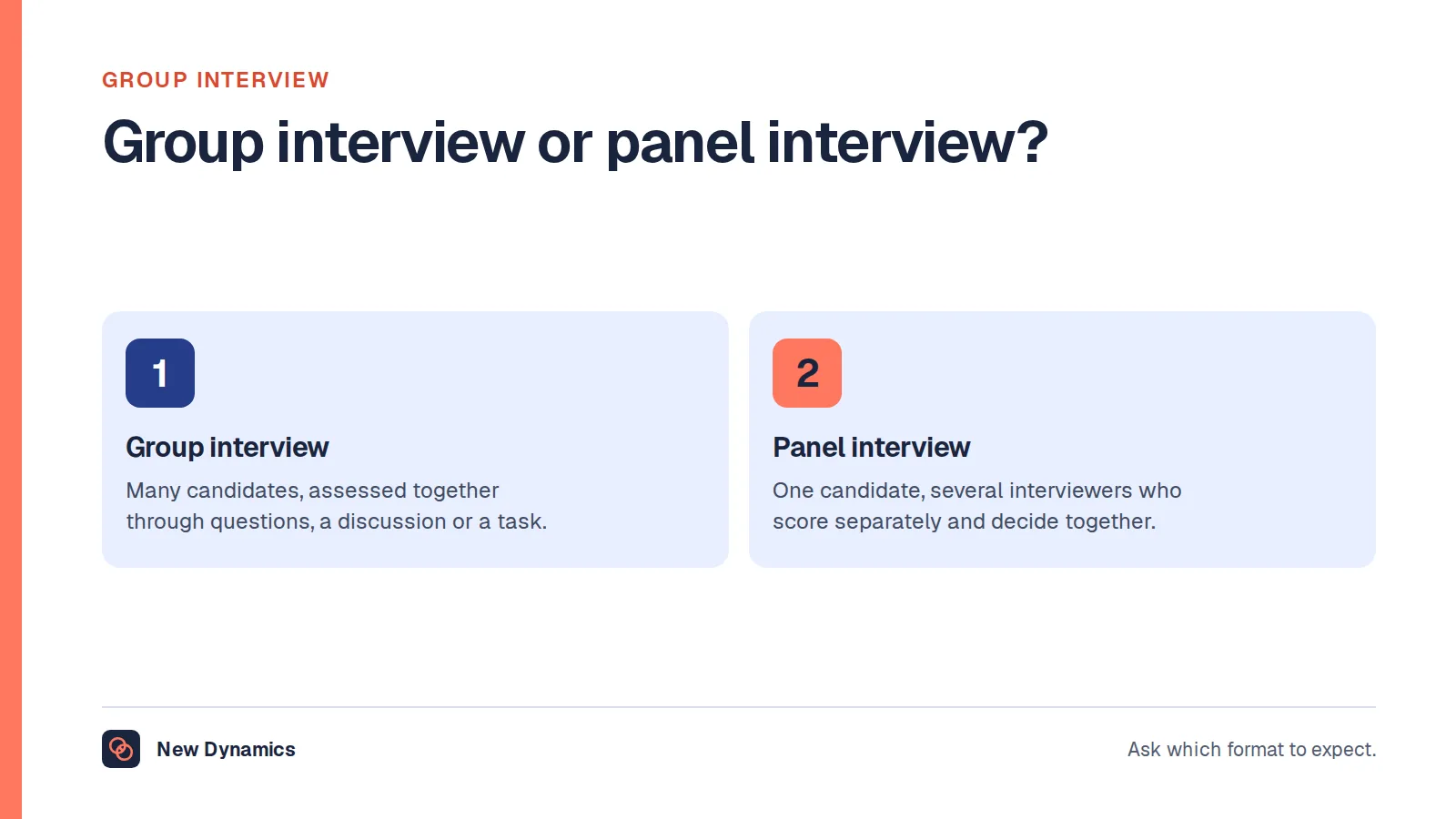
- Format and people. Say whether it is one-to-one, a panel, a group interview or a task, and give the interviewers' names and job titles. Our guide to the group interview explains the formats.
- What to prepare or bring. Identification, certificates, a portfolio, a presentation. If there is a test, say what kind.
- Adjustments and reply. Ask whether the candidate needs any adjustments, and say how and by when to confirm, with a named contact and a phone number.
The sixth point is a legal matter in Great Britain. Acas, in its guidance on interviewing job applicants, says: “By law you must ask anyone coming to an interview to tell you if they need reasonable adjustments so they can attend.” It gives examples, such as an accessible office for an applicant who uses a wheelchair, more time for a written test and a sign language interpreter.
GOV.UK's guide to recruitment and disabled people words it differently. It says that you can ask whether a candidate needs an adjustment to the recruitment process, “or you can wait to be told”, and that you must make adjustments if they are reasonable. The safe and courteous course is the one that Acas describes: ask everyone, every time. This is general information, not legal advice.

Phone, email or text: which channel?
- Phone call. Personal and fast, and you can agree a time on the spot. Nothing is on record, so always follow it with written confirmation.
- Email. The best record, with room for every detail, directions and attachments. It can sit unread, so ask for a reply by a date.
- Text or messaging app. Quick, and likely to be read soon. Keep it short, and put the full details in an email. Use it only if the candidate gave you the number for this purpose.
Many employers combine them: a call or a text to agree the time, then an email with everything in it. Whichever you choose, use the same channel and the same information for every candidate for the role.

Seven interview call message templates
Replace the text in square brackets. All seven are our own wording, and free to use.
1. Short text message
Hello [Name], this is [Your name] from [Company]. Thank you for applying for the [Job title] role. We would like to invite you to an interview on [day, date] at [time] at [location or “by video”]. I will email the full details now. Please reply YES to confirm, or call me on [number] if another time would suit you better.
2. Email invitation to an in-person interview
Subject: Interview invitation: [Job title] at [Company]
Dear [Name],
Thank you for applying for the [Job title] role. We enjoyed reading your application and would like to invite you to an interview.
Date and time: [Day, date], [time]. Please allow [length]. Place: [Full address]. [How to get in, parking, whom to ask for.] Format: [For example, a 45-minute interview with two people, followed by a 20-minute written exercise.] You will meet: [Name, job title] and [Name, job title]. Please bring: [Identification, certificates, portfolio.]
If you need any adjustments to take part in the interview, for any reason, please tell me and we will arrange them.
Please reply by [date] to confirm. If the time does not suit you, tell me and we will find another. You can reach me on [phone number].
We look forward to meeting you.
[Your name, job title]
3. Email invitation to a video interview
Subject: Video interview invitation: [Job title] at [Company]
Dear [Name],
Thank you for applying for the [Job title] role. We would like to invite you to a video interview.
Date and time: [Day, date], [time and time zone]. Please allow [length]. Platform and link: [Platform]. [Link.] You do not need an account. You will meet: [Names and job titles.] If something goes wrong: call me on [number], and we will continue by phone or rearrange.
If you need any adjustments to take part, please tell me. Please reply by [date] to confirm.
[Your name, job title]
4. Phone call script
“Hello, is that [Name]? This is [Your name] from [Company]. Is now a good time to talk for two minutes? Thank you for applying for the [Job title] role. We would like to invite you to an interview. Would [day, date] at [time] suit you? It will take about [length], at [place], with [names]. I will send everything by email in the next hour, including how to tell us about any adjustments that you need. Do you have any questions for now?”
5. Reminder, the day before
Hello [Name], a reminder of your interview for the [Job title] role tomorrow, [date], at [time] at [location or link]. Please ask for [Name] on arrival. If anything has changed, call me on [number]. We look forward to meeting you. [Your name]
6. Rescheduling at the employer's request
Dear [Name], I am sorry to say that we need to move your interview for the [Job title] role, because [brief honest reason]. Could you manage [option 1] or [option 2]? I apologise for the inconvenience, and we remain very keen to meet you. [Your name, phone number]
7. Reply when a candidate asks for another time
Dear [Name], thank you for letting me know. That is no problem. Could you manage [option 1] or [option 2]? Please tell me which suits you, and I will send a new confirmation. [Your name]
Five checks before you press send
- Names. The candidate's name and the job title are right. Copied messages are where mistakes hide.
- Time. The day matches the date, and the time zone is stated for remote candidates.
- Link and address. You have opened the video link yourself, and the address finds the right door on a map.
- Adjustments. The question about adjustments is there, in plain words.
- Reply route. A named person, a phone number and a date to reply by.
Acas adds a point for online interviews. It advises employers to make sure that the candidate has a reliable method of communication and that “you have a backup plan in case of connectivity issues”. It also says: “If you need to record the interview, you must get the person's permission first.” If you intend to record, say so in the invitation.

Keep it fair and lawful
- Same information for everyone. Acas's guidance on choosing who to interview recommends “a consistent decision-making process, such as a scoring system”. Consistency starts with the invitation.
- Do not ask for personal information that you do not need. GOV.UK tells employers that they must not ask candidates about protected characteristics, or whether they are married or have children. An invitation should not ask for a date of birth or a photograph.
- Use contact details only for the purpose given. Message candidates on the number or address that they supplied for the application, and store messages securely.
- Tell unsuccessful applicants too. A short, polite message to the people whom you are not interviewing costs little and protects your reputation.
This section summarises guidance for Great Britain. It is general information, not legal advice.
Common mistakes
Missing details. No length, no names and no address line produce a string of questions and a nervous candidate.
Too little notice. A day's notice favours people with flexible lives. Give several days where you can.
A cold tone. “You are required to attend” is how a court writes.
No way to say that the time does not suit. Good candidates who are in work need options.
A surprise format. Tell people if there is a test, a presentation or a group exercise.
Forgetting the reminder. A short message the day before can reduce no-shows.
Frequently asked questions
What is an interview call message?
It is the message that invites a shortlisted applicant to an interview and gives the details that they need: the role, the date, time and length, the place or link, the format, the interviewers, what to bring, how to ask for adjustments and how to confirm.
How do you write a message to call a candidate for interview?
Thank them for applying, name the role, give the date, time, length and place or link, say who they will meet and what to prepare, ask whether they need any adjustments, and tell them how and by when to confirm. Keep the tone warm and plain.
Should an interview invitation be sent by email or text?
Use both if you can. A call or text is quick and gets an answer. An email holds the full details and is a record. If you use only one, choose email, and ask for a reply by a date.
How much notice should you give for an interview?
There is no fixed rule. Several working days is courteous and gives candidates who are in work time to arrange it. Offer an alternative time, and send a reminder the day before.
Do I have to ask about reasonable adjustments?
Acas says that, by law, you must ask anyone coming to an interview to tell you if they need reasonable adjustments so that they can attend. Put a plain sentence in every invitation. This applies in Great Britain and is general information, not legal advice.
How should a candidate reply to an interview call message?
Reply promptly, thank the sender, confirm the date, time and place in your own words, ask any practical questions, and mention any adjustments that you need. If the time does not suit you, offer two alternatives.
Your next step: build your own template
- Copy the email template that fits your usual format.
- Fill in the parts that never change: address, directions, contact and the sentence about adjustments.
- Save it where every hiring manager can find it.
- Add a calendar reminder to message each candidate the day before.
For the whole hiring process, from the advert to the offer, read and download our recruitment and selection guide. The guide is free to read, and the PDF uses our short download form.
Want new hires to start with clear tasks and goals from the first day? Book a New Dynamics demo and bring your current approach. You can also email contact@new-dynamics.com.