TL;DR
- A phone screening interview is a short, structured call, usually 15 to 30 minutes, held before the main interviews to confirm the essentials: interest, availability, the basics of experience, pay expectations and anything that would rule the application out.
- Run it like any interview: the same questions for every candidate, scored against the same criteria, with adjustments offered and notes kept. Acas advises asking each applicant the same questions where possible, and OPM's structured interview standard applies as well on the phone as in the room.
- Candidates should treat the screen as a real interview and use their own questions to learn what the job actually involves, who they would work for, what happens next and by when.
Most hiring processes have a short call near the start that nobody quite treats as an interview. The recruiter calls it a screen, the candidate calls it a chat, and both sides make decisions in it that they later struggle to explain. Treated properly, it is the most efficient twenty minutes in the process.
This article explains what a phone screening interview is for, sets out how to run one in six steps, gives 20 phone screen questions grouped by purpose, lists the questions that candidates should ask back and names the mistakes that make screens unfair or useless.
A good screen ends with a record, and the record is what the next interviewer should read. See how New Dynamics workflows let you shape forms, stages and approvals around the way you work, so that what the screener learned reaches the panel.
What is a phone screening interview?
A phone screening interview, or telephone screening interview, is a short call between a recruiter or hiring manager and an applicant, held after the application has been shortlisted and before the main interviews. Its job is to confirm the essentials cheaply, for both sides, before anyone invests a half day.
Those essentials are usually five.
- Interest and understanding. Does the candidate know what the job is, and do they want it?
- Availability. Notice period, start date, hours, location and any travel the job involves.
- The basics of experience. The two or three essential requirements, checked in the candidate's own words.
- Pay expectations. Whether the range on offer and the candidate's expectation overlap.
- Knock-outs. Right to work, a required licence or registration, and anything else that would end the application at once.
A screen is not the place for deep competency questions, tests or case studies. Those belong to the main interview, where more than one person can score them.
How to run a phone screen in six steps
Two standards apply to screens as much as to any interview. Acas, the public body that advises on workplace relations, says in its guidance on interviewing job applicants that “When interviewing it's a good idea to ask each applicant the same questions where possible. This is to ensure you're treating applicants in the same way.” The US Office of Personnel Management describes a structured interview as one in which all candidates are asked the same predetermined questions in the same order and all responses are evaluated using the same rating scale and standards for acceptable answers.
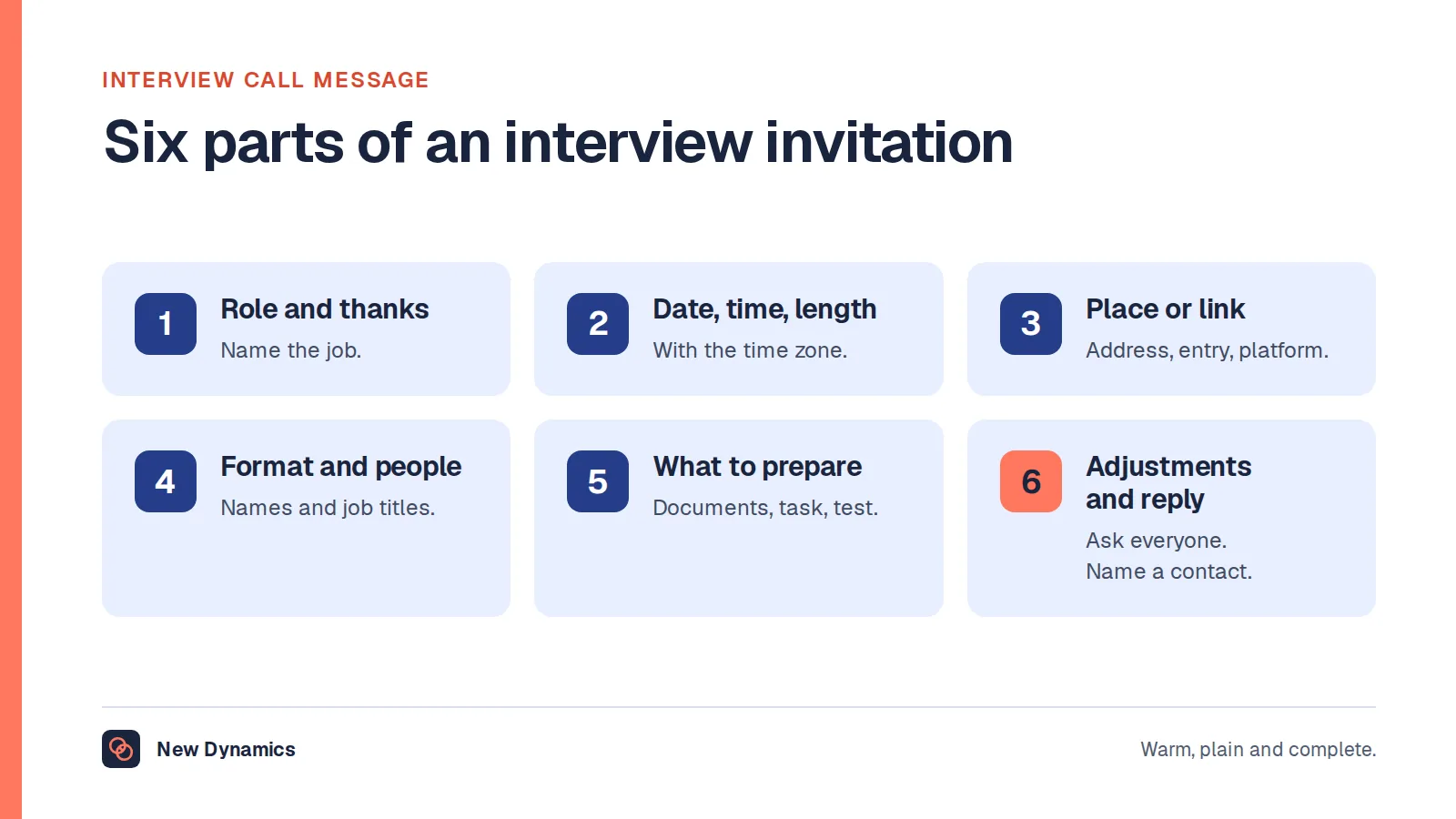
- Prepare. Write the question set and the scoring guide once, for the vacancy. Read the application before you dial. Book the call by message, with a time, a duration and a number, and ask whether the candidate needs any adjustments. Acas says that, by law, you must ask anyone coming to an interview to tell you if they need reasonable adjustments so they can attend. Our guide to the interview call message has templates.
- Open. Say who you are, how long the call will take, what it is for and what happens afterwards. Ask whether now is still a good time.
- Confirm the essentials. Availability, right to work, pay range and any knock-outs, early, so that neither side spends twenty minutes on a job that cannot happen.
- Ask the same questions. The prepared set, in order, with the same follow-ups. Take notes against the scoring guide as you go.
- Answer theirs. Leave five minutes. The questions a candidate asks tell you as much as their answers.
- Close with next steps. Acas advises that at the end of each interview you should ask the applicant if they have any questions, tell them when and how you will let them know the outcome and tell them how to ask follow-up questions. Then write up the score the same day.
If you need to record the call, Acas says you must get the person's permission first.

20 phone screen interview questions
Choose six to eight for a twenty-minute call. Ask every candidate the same ones.
Interest and understanding
- What attracted you to this role in particular?
- From the advert, what do you understand the job involves day to day?
- What would you want to know about the job before deciding to accept it?
Availability and practicalities
- What is your notice period, and when could you start?
- The role is [hours, location, pattern]. Does that work for you?
- The job involves [travel, shifts, on-call]. Is that something you can do?
Experience and essentials
- Tell me briefly about your current or most recent role and what you are responsible for.
- The role needs [essential requirement]. Where have you done that, and at what level?
- Which part of this job would you find easiest, and which would be the biggest stretch?
- What systems or tools have you used that are relevant here?
Motivation and fit
- Why are you looking to move now?
- What kind of manager and team do you do your best work with?
- What did you enjoy most, and least, in your last role?
Pay and offer
- The salary range for this role is [range]. Is that in line with your expectations?
- Are you interviewing elsewhere, and are there any timescales we should know about?
Knock-outs and next steps
- Can you confirm that you have the right to work in [country]?
- Do you hold [the licence, registration or qualification the job requires]?
- Is there anything in the advert that would stop you taking the job?
- Are there any adjustments we should make for the next stage?
- What questions do you have for me?
Note what is missing. Nothing about age, family plans, health, religion or any other protected characteristic. Acas's guidance on using protected characteristics in recruitment explains the narrow circumstances, such as a genuine occupational requirement, in which a protected characteristic can lawfully matter. On a screen it should not come up. Our guide to interview questions for candidates covers the deeper questions for the main interview.

Questions to ask the interviewer in a phone interview
Candidates should prepare five questions, and ask at least three. Good ones show interest in the work and get information that the advert did not give.
- What does a typical week look like in this role?
- Who would I report to, and how is the team organised?
- What are the first three months expected to achieve?
- Why is the role open?
- What are the next steps, and when will I hear?
Two questions to hold back until later: detailed salary negotiation, beyond confirming that the range works, and holiday or flexible working arrangements, which belong at offer stage. Ask the question about adjustments whenever you need to.
Common phone screening mistakes
Winging it. A screen with no question set and no scoring guide produces impressions, not evidence, and treats candidates differently.
Leaving the knock-outs to the end. Ask about right to work, pay and availability early. Nobody wants to discover in minute nineteen that the start date is impossible.
Asking for a life story. "Tell me about yourself" invites ten minutes you cannot score. Ask about the current role instead.
Screening on chemistry. A candidate who is nervous on the phone may be excellent in the job. Score the answers, not the voice.
No record. If the panel cannot read what the screener learned, the candidate answers the same questions twice and the screen was wasted.
Silence afterwards. Tell every candidate the outcome, by the date you gave them.

Frequently asked questions
What is a telephone screening interview?
A telephone screening interview is a short call, usually 15 to 30 minutes, between a recruiter or hiring manager and a shortlisted applicant, held before the main interviews. It confirms interest, availability, the basics of experience, pay expectations and anything that would rule the application out.
How long is a phone screening interview?
Usually 15 to 30 minutes. Long enough to ask six to eight prepared questions, confirm the practicalities and answer the candidate's questions; short enough that both sides can afford it before committing to a full interview.
What questions are asked in a phone screening interview?
Typically questions about what attracted you to the role, your current responsibilities, where you have done the essential requirements, your notice period and availability, whether the salary range works and whether you have the right to work. Good screens ask every candidate the same questions.
What questions should I ask in a phone interview?
Ask what a typical week looks like, who you would report to, what the first three months should achieve, why the role is open and what the next steps and timescales are. Confirm that the salary range works, but leave detailed negotiation and holiday arrangements until offer stage.
Should a phone screen be structured?
Yes. Acas advises asking each applicant the same questions where possible so that applicants are treated in the same way, and OPM's structured interview standard, with the same questions in the same order scored on the same scale, applies as well on the phone as in a room.
Can an employer record a phone screening interview?
In the UK, Acas says that if you need to record an interview you must get the person's permission first. Ask at the start of the call, explain why and what will happen to the recording, and respect a refusal.
Your next step
Write the question set and scoring guide for your next vacancy's phone screen before the first call, and give every candidate the same twenty minutes. If you are a candidate, prepare your five questions tonight and ask three.
For the full method from shortlist to offer, read and download our recruitment and selection guide. The guide is free to read, and the PDF uses our short download form.
Want what the screener learned to reach the panel without being retyped? Book a New Dynamics demo and bring your current approach. You can also email contact@new-dynamics.com.