TL;DR
- KSA stands for knowledge, skills and abilities: the three things a person needs to do a job. KSAO adds other characteristics, such as traits, attitudes and licences. The terms come from job analysis and are used most in United States federal hiring.
- Knowledge is what you know, a skill is a learned proficiency in doing something, and an ability is the underlying capacity to perform. A KSA statement names one of them and describes the level required for the job.
- The US Office of Personnel Management says the terms KSA and competency are often used somewhat interchangeably, and that job-related KSAs should be assessed in every hiring decision, even though long KSA essays can no longer be required at initial application for most federal jobs.
Job adverts for United States government posts once asked applicants to write short essays with a strange title: KSAs. The essays have largely gone, but the acronym has spread into job descriptions, competency frameworks and HR textbooks around the world, often without anyone explaining it.
This article gives the meaning of KSA and its longer cousin KSAO, explains how the four parts differ, says where the terms come from, shows how to write a KSA statement for a job description and explains how KSAs relate to competencies.
A KSA is only useful if someone measures it. See how New Dynamics performance reviews bring goals, feedback and development into one fair discussion, so that the knowledge, skills and abilities in the job description are the ones a review looks at.
What does KSA stand for?
KSA stands for knowledge, skills and abilities. The US Office of Personnel Management (OPM), which sets hiring policy for the federal government, puts it plainly in its summary sheet on KSAs and KSA narratives: “KSA is also an acronym for knowledge, skills, and abilities.” The “also” is there because the same letters once named a type of essay, which we come to below.
KSAO adds a fourth letter for other characteristics: the traits, attitudes, values, licences and physical requirements that a job needs but that are not knowledge, a skill or an ability. KSAOs, plural, are the full list of requirements for a job produced by job analysis.
The four parts are easy to state and easy to confuse.
- Knowledge is what a person knows: facts, principles, procedures and information. “Knowledge of UK payroll legislation.”
- Skills are learned proficiencies in doing something, usually observable and measurable. “Skill in building spreadsheet models.”
- Abilities are the underlying capacities that make performance possible, often more general and more stable than skills. “Ability to reason with numbers under time pressure.”
- Other characteristics are everything else the job requires: a driving licence, a professional registration, willingness to travel, integrity, persistence.
A rule of thumb: knowledge is learned by study, skills are learned by practice, abilities are developed more slowly and set limits on how fast skills can be learned, and other characteristics are checked rather than taught.

Where the terms come from
KSAs come from job analysis, the process of working out what a job involves and what a person needs to do it. OPM's page on job analysis describes it as the foundation for all assessment and selection decisions, and says the data is used to “establish and document competencies required for a job”, to identify the job-relatedness of the tasks and competencies, and to provide “a source of legal defensibility of assessment and selection procedures”.
That last point explains why the vocabulary is so exact. In US federal hiring, every requirement must trace back to the job, and knowledge, skills and abilities were the categories used to record them.
KSAs and KSA narratives
For years, applicants for federal jobs were asked to write essays showing how they met each KSA. OPM's summary sheet explains that the Presidential Memorandum on Hiring Reform of May 2010 “states that applicants can no longer be asked to complete essay-style questions upon initial application”, and that these questions “are often referred to as KSA narratives”. The sheet is emphatic that the requirement itself has not gone: “You can still (and always should) assess applicants' KSAs (Knowledge, Skills, and Abilities) as part of the selection process.” Instead of essays, it points to online questionnaires, CVs and cover letters, and other assessment methods after the minimum-qualification screen.
So if you see “KSAs” in an old federal job advert, it may mean the essays. In a job description or a competency framework, it means the requirements.
KSA and competency: the difference
OPM says: “The terms KSA and competency are often used somewhat interchangeably.” Its definition of a competency shows why: “A competency is a measurable pattern of knowledge, skills, abilities, behaviors, and other characteristics that an individual needs in order to perform work roles or occupational functions successfully.”
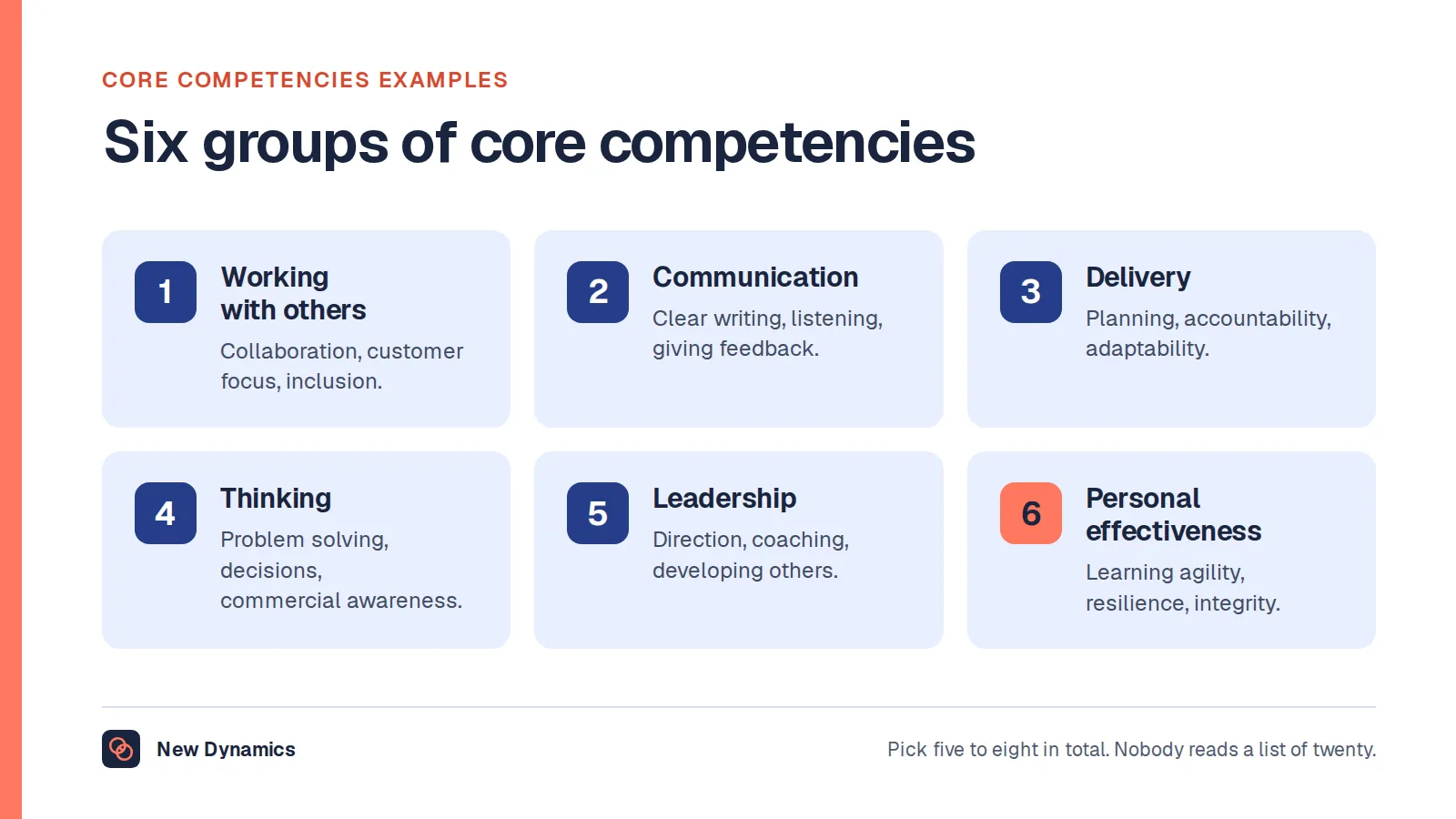
In other words, a competency is a bundle. Problem solving, as a competency, contains knowledge of methods, skill in analysis, the ability to reason and the persistence to keep going. A KSA is one of the strands. Our guide to core competencies explains how organisations build and use the bundles.
| Term | What it is | Example |
|---|---|---|
| KSA | One requirement: a piece of knowledge, a skill or an ability | Skill in negotiating supplier contracts |
| KSAO | The full set of requirements for a job, including other characteristics | The list produced by a job analysis |
| Competency | A measurable pattern of KSAOs that produces good performance | Commercial judgement |

How to write a KSA statement
A KSA statement in a job description names one requirement, says which kind it is and describes the level the job needs. Five rules keep them useful.
- One requirement per statement. “Knowledge of employment law and skill in drafting contracts” is two.
- Name the kind. Start with knowledge of, skill in or ability to. The wording forces you to decide what you are asking for.
- State the level. “Knowledge of employment law sufficient to draft a compliant contract without legal review” tells a candidate far more than “knowledge of employment law”.
- Tie it to a task. Every KSA should trace back to something the job actually involves. If it does not, it is a preference, not a requirement, and it may exclude people unfairly.
- Decide whether it is essential or desirable, and say so. Our guide to the purple squirrel shows what happens when everything is essential.
KSA statement examples
- Knowledge: knowledge of double-entry bookkeeping sufficient to prepare monthly management accounts unaided.
- Skill: skill in facilitating workshops of up to twenty people, including handling disagreement.
- Ability: ability to explain technical findings to non-specialist managers in plain language.
- Other: current registration with the relevant professional body, and willingness to travel to sites two days a week.
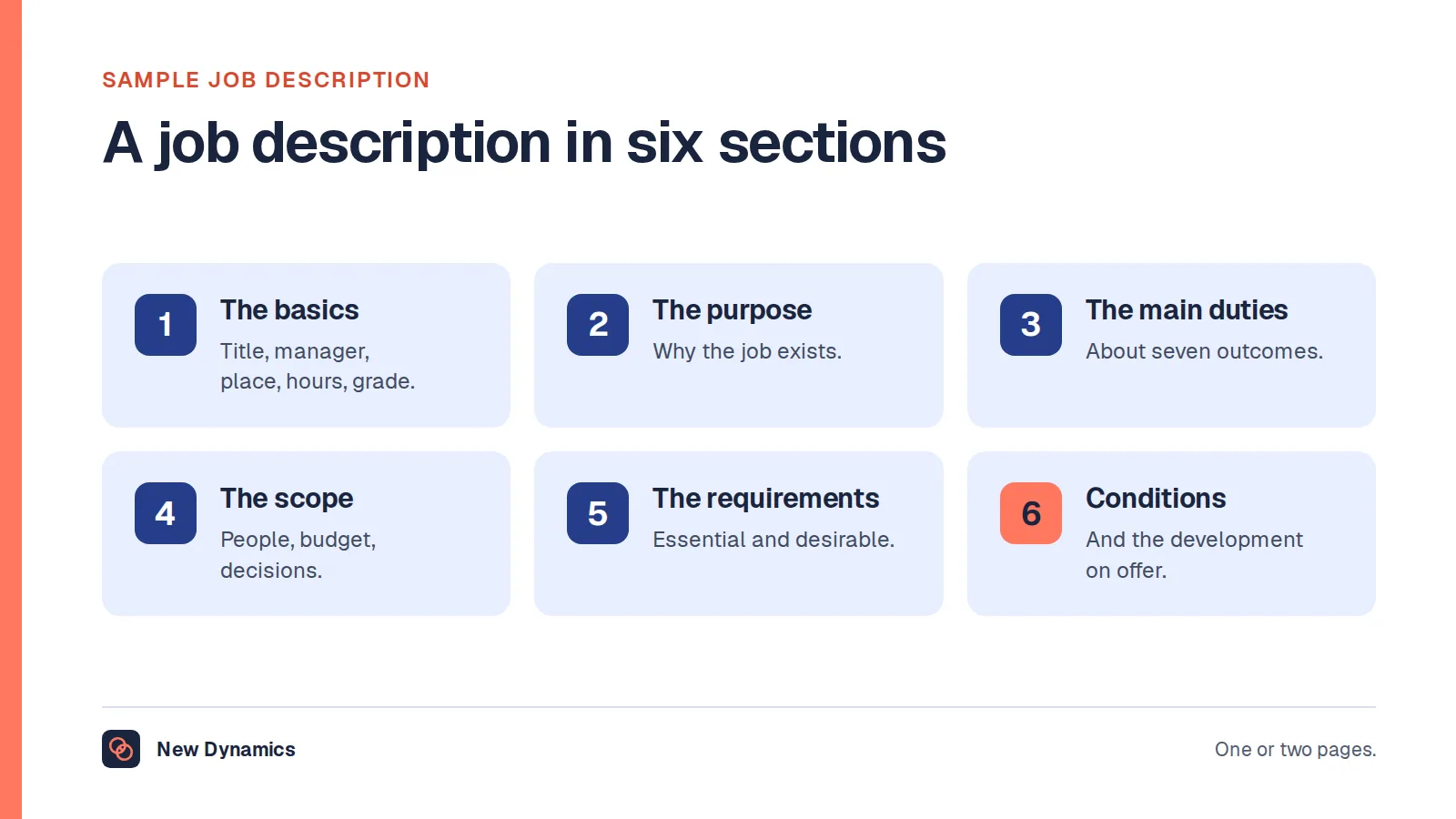
Our job description template shows where the statements sit in the wider document.

For candidates: answering a KSA
Some employers, in and out of government, still ask applicants to show how they meet each KSA, in an application form, a questionnaire or an interview. The method that works is the same in every case: one specific example per KSA, with the situation, what you did and the result, at the level the statement asks for. Do not restate the KSA in your own words; show it.
Frequently asked questions
What does KSA mean?
KSA stands for knowledge, skills and abilities: what a person knows, what they have learned to do and what they are capable of doing. Employers use KSAs to describe the requirements of a job and to assess applicants against them. The term comes from job analysis and is used most in United States federal hiring.
What is a KSAO?
KSAO stands for knowledge, skills, abilities and other characteristics. The fourth category covers requirements that are not knowledge, a skill or an ability, such as licences, registrations, traits and willingness to work particular hours. KSAOs is the full list of requirements for a job.
What is the difference between a skill and an ability?
A skill is a learned proficiency in doing a particular task, such as building a spreadsheet model. An ability is the more general, underlying capacity that makes learning and performing skills possible, such as numerical reasoning. Skills are learned by practice; abilities develop more slowly and set limits on how fast skills can be acquired.
What is the difference between a KSA and a competency?
A KSA is a single requirement. A competency is a measurable pattern of knowledge, skills, abilities, behaviours and other characteristics that together produce good performance. The US Office of Personnel Management notes that the terms are often used somewhat interchangeably.
Do US federal jobs still require KSA essays?
For most federal jobs, essay-style KSA narratives can no longer be required at initial application, following the 2010 Presidential Memorandum on Hiring Reform. Job-related knowledge, skills and abilities are still assessed, through questionnaires, CVs, cover letters and later assessment methods.
How do you write a KSA statement?
Name one requirement, start with knowledge of, skill in or ability to, state the level the job needs, tie it to a task the job involves and say whether it is essential or desirable. For example: skill in facilitating workshops of up to twenty people, including handling disagreement.
Your next step
Take one job description and rewrite its requirements as KSA statements, one per line, each starting with knowledge of, skill in or ability to. Requirements that cannot be written that way are usually preferences, and can go.
For a method that turns competencies into fair feedback, read and download our competency feedback guide. The guide is free to read, and the PDF uses our short download form.
Want the knowledge, skills and abilities in your job descriptions to be the ones reviews measure? Book a New Dynamics demo and bring your current approach. You can also email contact@new-dynamics.com.