TL;DR
- A purple squirrel is recruiters' slang for a candidate who matches every requirement of a vacancy exactly, including the ones that almost never occur together. Like the animal, the candidate is imaginary, and the hunt wastes months.
- Purple squirrel vacancies come from wish lists: requirements added by several people, copied from old adverts or set to describe the person who just left. The fix is to separate what is essential from what is desirable, and to score applicants against it.
- Acas advises employers to turn each point in the job description and person specification into a checklist and score applications against it, which is also the quickest way to find out that no candidate could score full marks.
Every recruiter has a vacancy like it. Fifteen essential requirements, two of which have never been found in the same person. Senior experience on a junior budget. Open for five months, with a hiring manager who rejects everyone as "not quite right". Recruiters have a name for the candidate this vacancy is waiting for: the purple squirrel.
This article explains what a purple squirrel is, gives five signs that a vacancy is hunting one, explains where the wish list comes from and sets out six ways to turn an impossible specification into a hire. It is written for hiring managers as much as for recruiters, because the hunt usually starts with the manager.
A vacancy is a goal with a deadline, and it should be managed like one. See how New Dynamics Goals & OKRs keep targets and progress in one place, so that a role open for months is visible rather than quietly tolerated.
What is a purple squirrel?
A purple squirrel is recruiting slang for a candidate who matches every requirement of a vacancy exactly: the qualifications, the experience, the specific systems, the sector, the salary and the start date, including combinations that rarely occur in one person. The term is not in the standard dictionaries, and this is our definition. The image is simple: squirrels are common, purple ones do not exist, and a search for one can go on for ever.
The same idea travels under other names. A unicorn candidate is the same thing. A "wish list" or "Christmas list" vacancy is the specification that produces it.
Three things distinguish a purple squirrel search from a hard-to-fill role.
- Hard to fill means the skills exist but are scarce or expensive. The market can supply them at a price.
- Purple squirrel means the combination barely exists at all. No price or channel will find it.
- The tell is the rejection pattern. Good candidates arrive and are rejected for the one requirement they lack, a different one each time.
Five signs you are hunting a purple squirrel
- Ten or more essentials. A person specification with ten essential criteria is a portrait of the last post-holder, or of three people.
- Two jobs in one. A designer who also codes the back end. A finance manager who also runs HR. Someone has merged two vacancies to save a headcount.
- Senior skills, junior pay. The requirements describe ten years of experience and the salary describes three.
- A specific past employer or exact system. "Must have worked at a top-four firm" or "must have five years on our exact software version" excludes everyone who could learn it in a month.
- Open for months, rejecting everyone. If shortlisted candidates keep failing for different reasons, the specification is the problem, not the candidates.

Where the wish list comes from
Several authors. The manager, their manager, the team and HR each add a requirement. Nobody removes one.
The last advert. Requirements copied from a previous post, or from a competitor's, without checking that the job still needs them. Our guide to writing a job ad lists this among the common mistakes.
Describing the leaver. The specification recreates the person who has just left, including the skills they picked up over eight years in the role.
Fear of a bad hire. Every requirement feels like insurance. In fact each one shrinks the pool, and the eventual hire is chosen from fewer people, not better ones.
Nobody owns the trade-off. Recruiters can see the market. Managers own the requirements. If neither is allowed to say "you cannot have both", the hunt continues.

Six ways to stop hunting and start hiring
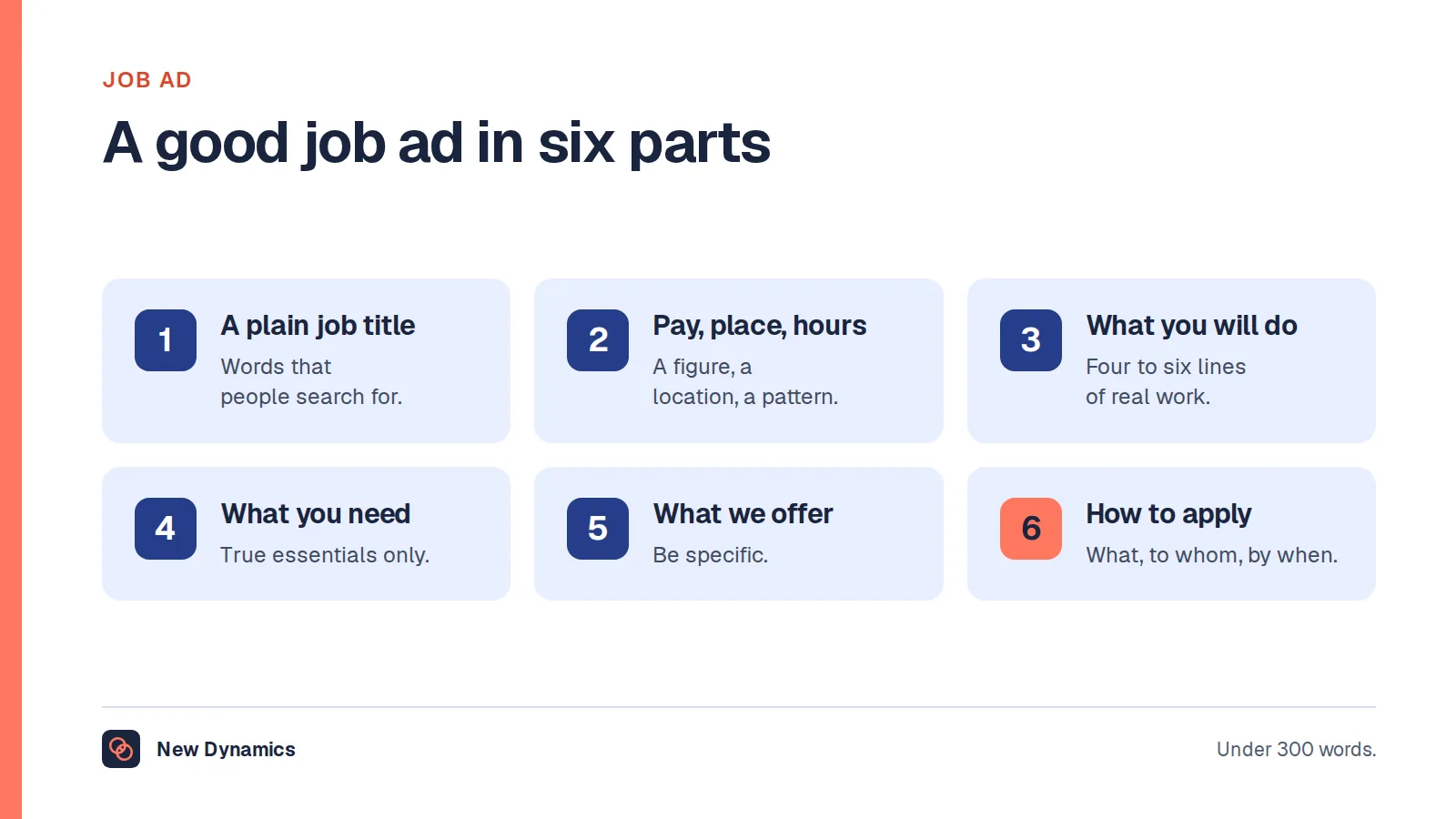
- Split essential from desirable. Acas, the public body that advises on workplace relations, says in its guidance on advertising a job that applicants should be given the job description and the person specification, which “will help make clear what the job requires and reduce the risk of discrimination”. A person specification with three to five essentials and a short list of desirables describes a real person.
- Test each essential. For every requirement, ask: what happens on day one if the person does not have this? If the answer is "they learn it in a month", it is desirable, not essential.
- Score, and look at the scores. Acas advises on choosing who to interview that one way to select fairly is a scoring system: “Turn each point in the job description and person specification into a checklist.” If no applicant scores above half, the checklist is wrong.
- Price the requirements. Show the manager what the specified combination costs in the market, and what a nearby combination costs. Wish lists tend to shrink when priced.
- Split the job. If the specification is two roles, advertise two roles, or one role now and a plan for the second.
- Hire for the trainable gap. Choose the candidate who has the hard-to-teach essentials and a plan to close the rest. Our guide to the job requisition shows how to get the requirements agreed before the advert goes out.

Purple squirrel and the law
Piling on requirements is not only slow. Requirements that are not needed for the job can indirectly disadvantage groups protected by discrimination law, for example an unnecessary degree, an arbitrary number of years' experience or a demand for unbroken employment history. Acas notes that a clear job description and person specification reduce the risk of discrimination. This is general information about the UK, not legal advice.
For candidates
If an advert reads like a purple squirrel hunt, apply anyway if you meet the essentials that matter. Long lists are usually wish lists. Say which requirements you meet, which you would learn and how quickly, and how you would close the gap. A clear account of that is what a sensible hiring manager wants to read. The hiring manager who wrote fifteen requirements usually cannot say which five they meant.
Frequently asked questions
What does purple squirrel mean in recruiting?
A purple squirrel is a candidate who matches every requirement of a vacancy exactly, including combinations that rarely exist in one person. The term is recruiters' slang for an ideal that cannot be found, and the hunt for one keeps a vacancy open for months.
Where does the term purple squirrel come from?
It is recruiting jargon rather than a dictionary word, and its origin is not documented in the sources we use. The image is that squirrels are everywhere but a purple one does not exist, however long you look.
Is a purple squirrel the same as a unicorn candidate?
Yes. Both describe a candidate who meets an unrealistic combination of requirements. Unicorn tends to be used in start-up and technology hiring; purple squirrel is recruiters' slang.
How do you avoid a purple squirrel job description?
Limit essential requirements to those the person must have on day one, list the rest as desirable, score applicants against the list as Acas advises, price the requirements against the market, split the job if it is two roles and hire for the trainable gap.
Why is hunting a purple squirrel a problem?
The vacancy stays open, the team carries the work, good candidates are rejected for the one requirement they lack, and unnecessary requirements can indirectly disadvantage groups protected by discrimination law.
Should I apply for a job if I do not meet every requirement?
If you meet the essentials that matter to the work, yes. State which requirements you meet, which you would learn and how quickly. Long requirement lists are usually wish lists, and a clear account of how you would close the gaps is worth more than a tick against every line.
Your next step
Take your longest-open vacancy and count the essential requirements. Cut the list to five by asking what happens on day one without each one. Then re-run the shortlist against the shorter list and see who appears.
For a method that gets requirements agreed and scored before the advert goes out, read and download our recruitment and selection guide. The guide is free to read, and the PDF uses our short download form.
Want vacancies, hiring goals and manager check-ins visible in one place? Book a New Dynamics demo and bring your current approach. You can also email contact@new-dynamics.com.