TL;DR
- Management by objectives, or MBO, is a style of management in which managers and employees agree specific objectives together, employees plan how to reach them and monitor their own progress, and performance is assessed against the agreed results.
- The process has five steps: set organisational objectives, cascade and agree individual objectives, plan the actions, monitor progress with feedback, and review results before the cycle begins again.
- Research summarised by OpenStax found productivity gains in 68 of 70 MBO programmes studied, strongest where top management used the system itself. MBO fails when it is half-hearted, rushed, treated as a gimmick or reduced to paperwork.
Ask where the annual objectives on your appraisal form came from and the trail leads back seventy years, to a management idea with three initials. Management by objectives, or MBO, is the ancestor of SMART goals, OKRs and most of the goal-setting done in organisations today. It is still used, often without the name.
This article explains what MBO means and where it came from, sets out the five-step process, summarises what the research says about whether it works, lists the conditions under which it fails and compares it with the goal-setting methods that grew out of it.
MBO lives or dies on whether agreed objectives stay visible between reviews. See how New Dynamics Goals & OKRs keep targets and progress in one place.
What does MBO stand for, and what does it mean?
MBO stands for management by objectives. The Cambridge Business English Dictionary defines management by objectives as “a style of management that involves giving people particular things to do in relation to particular aims, and measuring how well they do them”. It lists management by results, or MBR, as another name.
The open textbook Principles of Management, published by OpenStax, gives a fuller account in its section on management by objectives as a planning and control technique. It describes MBO as “a philosophy of management, a planning and controlling technique, and an employee-involvement program”, and explains the core of the method: “Although there are many variations in the practice of MBO, it is basically a process by which an organization's goals, plans, and control systems are defined through collaboration between managers and their employees.”
The word to notice is collaboration. As OpenStax puts it, rather than managers telling workers what their goals are, “managers ask workers to join them in deciding what their goals should be”. That is what separates MBO from simply handing out targets.
A note on the other MBO. In finance, the same three letters mean something else. Cambridge defines that MBO as an abbreviation for management buyout: “a situation in which the managers of a company buy all the shares in the company and so get control of it”. If you meet MBO in a news story about a company changing hands, that is the one.
Where MBO came from
The term is usually credited to Peter Drucker, who set it out in his 1954 book The Practice of Management. The idea was a reaction against management by command and by crisis: if every manager knew the objectives of the business and their own contribution to them, they could direct their own work and be judged on results rather than on activity or obedience.
OpenStax places the philosophy in the human relations tradition. It says that, as a management philosophy, MBO stems from the human resource model and from Theory Y's assumption that employees are capable of self-direction and self-control, and that it “is anchored in Maslow's need theory”. The reasoning is that involving people in planning and control makes work more meaningful, satisfies higher-order needs and so raises motivation and performance. Our guide to motivation theories explains Theory Y and Maslow's hierarchy.
The MBO process in five steps
OpenStax describes the process as a cycle in which goals are agreed, action plans are developed, employees monitor their own performance and the cycle begins again. Most descriptions of MBO break it into five steps.
- Set organisational objectives. Senior management defines what the organisation must achieve in the period. OpenStax is clear that “MBO requires top management commitment, and it should be initiated from the top down”.
- Cascade and agree individual objectives. Each manager and employee identify common goals and define the results expected from the individual, through what OpenStax calls “a give-and-take, collaborative process”. The objectives should be specific, measurable and realistic.
- Plan the actions. Employees “play a major role in developing an action plan for achieving these goals”. The plan says what will be done, by when and with what resources.
- Monitor progress and give feedback. In OpenStax's description, employees develop control processes, monitor their own performance and recommend corrections if things drift. Managers add feedback along the way, not only at the end.
- Review results. At the end of the period, performance is assessed against the agreed objectives, and the process starts again with the next cycle.

Why MBO is supposed to work
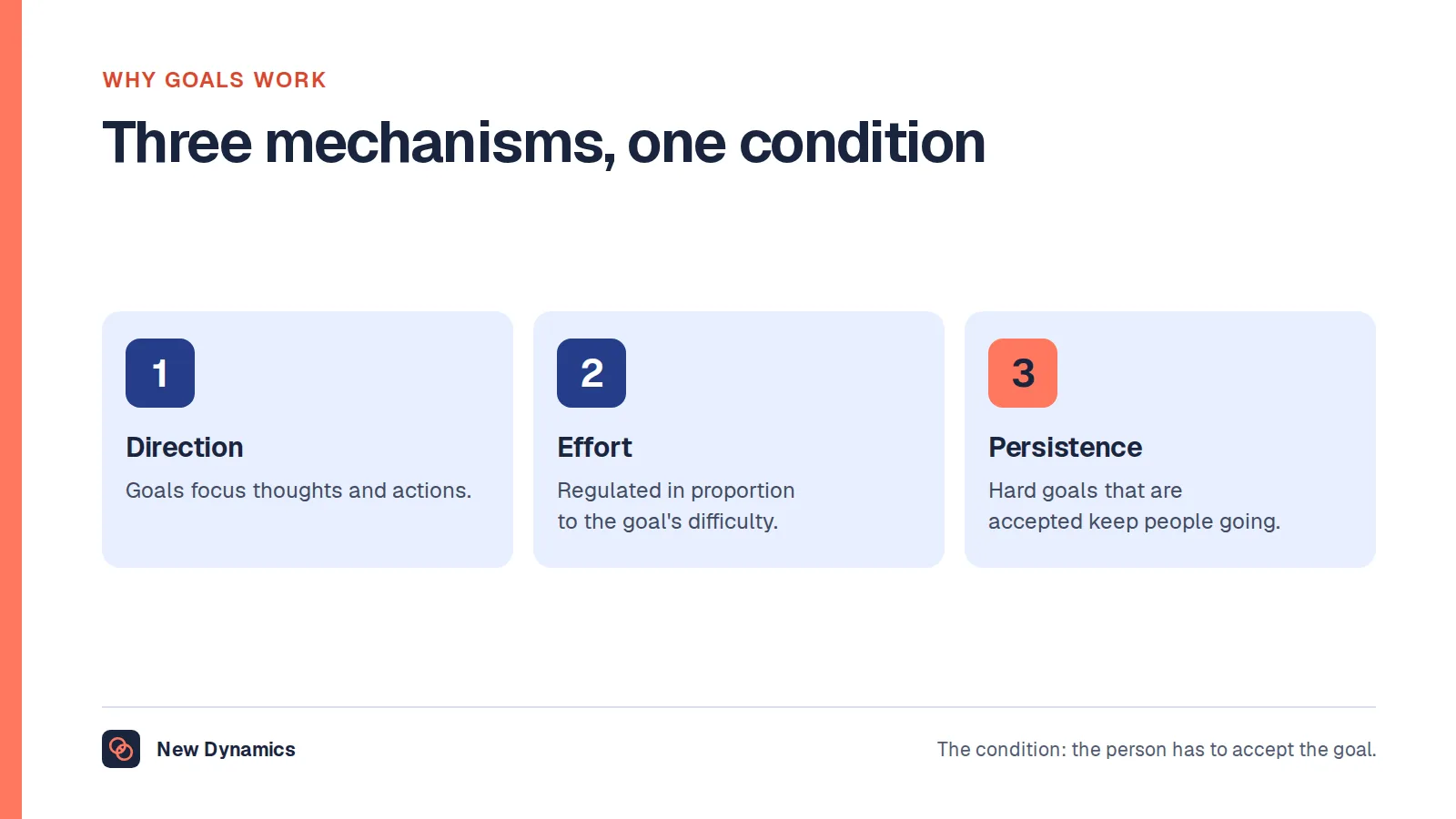
OpenStax names four components that are believed to make MBO effective: “(1) setting specific goals; (2) setting realistic and acceptable goals; (3) joint participation in goal setting, planning, and controlling; and (4) feedback.”
Each has a reason behind it. Employees working with goals outperform employees working without them. Participation is assumed to produce realistic goals that people accept and commit to. And feedback is the only way that people learn whether to sustain or redirect their effort. Our article on the definition of goal setting covers the research on specific, difficult goals that sits behind the first point.
Does MBO work? What the evidence says
OpenStax summarises the research. In a review by Robert Rodgers and John Hunter of 70 MBO programmes, “68 showed increased productivity gains, and only 2 showed losses”, and the textbook reports that the mean increase in performance exceeded 40 percent.
The gains depended on one thing above all: top management commitment. The strongest effects appeared where senior managers were committed emotionally, intellectually and behaviourally, meaning that they used MBO themselves. The weakest effects appeared where top management did little to talk about its value and did not use the system, “even as they implement it for others”.
OpenStax also reports a review of 185 studies which concluded that MBO is effective under some circumstances but not all. It tends to work better in the short term (under two years), in the private sector and in organisations removed from direct contact with customers. Those are findings from the studies the textbook cites, and organisations differ.

Why MBO fails
The same OpenStax section lists the factors that decide whether an MBO programme succeeds. Turned around, they are a list of the ways it fails.
- Half-hearted commitment. OpenStax says that half-hearted commitment from upper-level managers “is associated with a higher failure rate”.
- Not enough time. People need time to learn how to set meaningful goals, write good action plans and monitor their own work, and to learn to take responsibility in a new way.
- No legitimacy. OpenStax asks whether the system is integrated into an overall philosophy of management: “Or does it seem like a gimmick to seduce employees into being more productive?”
- Poor integration. Individual goals that do not add up to the goals of the wider unit.
- No share in the gains. OpenStax observes that MBO systems typically give employees no mechanism for sharing in the economic gains from their expanded role, and suggests that long-term effectiveness probably needs some form of gainsharing.
Practitioners add three more from experience.
- Paperwork replaces conversation. Objectives are typed into a form in April and read again in March.
- Only what is measurable gets managed. Quality, collaboration and learning are squeezed out by whatever is easiest to count.
- Objectives freeze while the world moves. An annual cycle cannot keep up with a business that changes quarterly, which is one reason later methods shortened the cycle.
MBO, SMART goals and OKRs
MBO is the parent. SMART goals and OKRs are two of its children, each fixing a different weakness.
| Method | What it adds to MBO |
|---|---|
| SMART goals | A checklist for writing each objective well: specific, measurable, achievable, relevant, time-bound. See our SMART goals guide |
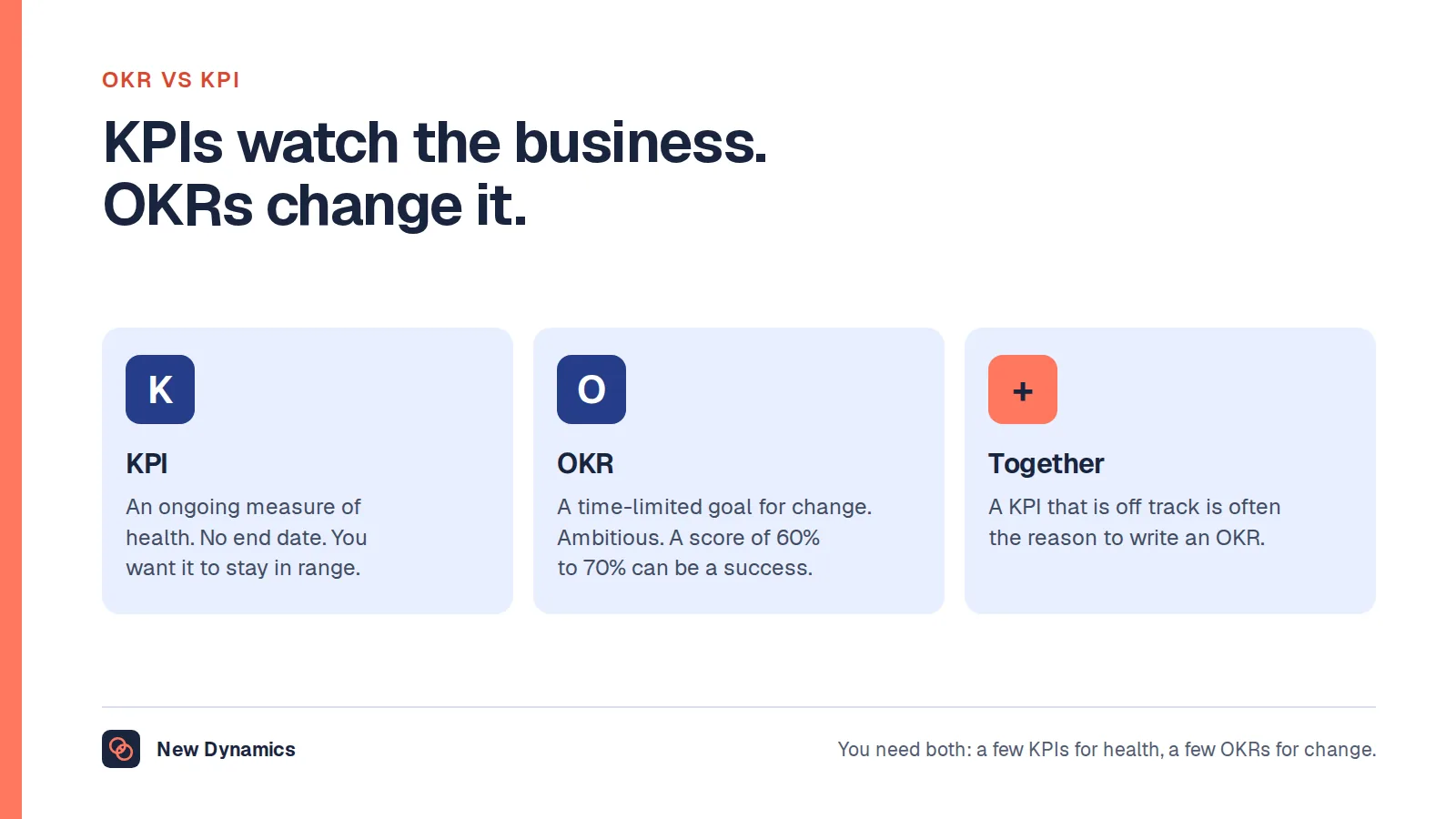
| OKRs | A shorter cycle, usually quarterly, objectives that are ambitious rather than safe, and transparency across the organisation. See OKRs vs KPIs |
| KPIs | Standing measures of health, tracked continuously, rather than period objectives. Our KPI tracker shows how they sit alongside goals |
If your organisation runs annual objectives agreed between manager and employee and reviewed at appraisal, you are running MBO, whatever it is called. Our guide to performance appraisal methods describes the objectives-based appraisal that grew from it.
Making MBO work today
- Start at the top, visibly. Senior leaders set and publish their own objectives first.
- Keep it to a few objectives per person. Three to five, each with a measure.
- Agree, do not assign. The conversation is the method. If the employee did not shape the objective, it is a target, not MBO.
- Shorten the cycle. Quarterly objectives with a monthly check-in keep goals alive. Our performance goals examples show what well-written ones look like.
- Feed back continuously. Progress should be visible to both people between reviews, not reconstructed at the end.
- Judge results in context. When the world changes, change the objective, and say so in writing.

Frequently asked questions
What is MBO in management?
MBO, or management by objectives, is a management method in which managers and employees agree specific objectives together, employees plan how to achieve them and monitor their own progress, and performance is assessed against the agreed results at the end of the period.
What does MBO stand for?
In management, MBO stands for management by objectives, also called management by results. In finance, MBO stands for management buyout, where a company's managers buy the business they run. The context usually makes clear which is meant.
What are the steps of the MBO process?
Five steps: set organisational objectives at the top; cascade and agree individual objectives between each manager and employee; plan the actions; monitor progress with regular feedback; and review results against the objectives before the next cycle begins.
What are MBO objectives?
MBO objectives are the specific, measurable results that a manager and an employee agree the employee will achieve in a period. They are derived from the organisation's objectives, agreed jointly rather than imposed, and used as the standard for assessing performance.
Does management by objectives work?
Research summarised by OpenStax found productivity gains in 68 of 70 programmes studied, with the strongest results where top management was fully committed and used MBO itself. A wider review found it effective in some circumstances but not all, and half-hearted or rushed implementations fail more often.
What is the difference between MBO and OKRs?
OKRs are a descendant of MBO. Both agree objectives and measure results. OKRs usually run on a quarterly cycle, set ambitious rather than safe objectives, separate the objective from its key results, and make everyone's goals visible across the organisation.
Your next step: test your objectives against MBO
- Take one employee's current objectives and ask whether they shaped them or received them.
- Check that each objective has a measure and a date.
- Ask when progress was last discussed. If the answer is the last review, shorten the cycle.
- Look at the senior team's objectives. If they are not written down, start there.
For writing each objective well, read and download our SMART goals guide. The guide is free to read, and the PDF uses our short download form.
Want objectives, progress and feedback visible all year? Book a New Dynamics demo and bring your current goal-setting process. You can also email contact@new-dynamics.com.