TL;DR
- Statutory maternity leave is 52 weeks: 26 weeks of ordinary maternity leave and 26 weeks of additional maternity leave. It is a day one right, with no qualifying service, and at least 2 weeks after the birth are compulsory (4 weeks for factory workers).
- Statutory maternity pay runs for up to 39 weeks: 90 per cent of average weekly earnings for the first 6 weeks, then the lower of 90 per cent or the flat weekly rate for the next 33 weeks. The rate changes every April, so the figure below names its tax year and you should check the current one.
- The employer pays SMP, then reclaims it. GOV.UK says you can usually reclaim 92 per cent, or 109 per cent with Small Employers' Relief. This describes Great Britain, Northern Ireland has its own rules, and this is general information rather than legal advice.
Someone tells their manager they are pregnant. Within a fortnight the employer has to work out three different things: what leave the person is entitled to, what they will be paid and by whom, and who is going to do the job for the best part of a year. Most organisations handle the first two badly because the rules sit in five places, and the third badly because nobody starts it until six weeks before the leave begins.
This article sets out the statutory position for an employer, with every rule quoted from GOV.UK or Acas and linked where it sits. It then covers the part no legislation tells you how to do: planning cover, keeping the person connected without turning protected time off into work, handling a performance cycle that they are only half present for, and running a return that does not quietly end in a resignation.
It is written for employers, but employees ask the same questions in different words, so the answers are plain enough for both. If you want the notice dates, the confirmation letter, the payroll trigger and the return conversation running on one visible path instead of in four inboxes and one person's memory, see how New Dynamics workflows handle a process with fixed deadlines in it.
What maternity leave means, and how long it lasts
Maternity leave is statutory time off from work around the birth of a child, with the right to return to a job at the end of it. The headline number is the one most people already half know, and GOV.UK states it plainly: "Statutory Maternity Leave is 52 weeks. It's made up of: Ordinary Maternity Leave - first 26 weeks, Additional Maternity Leave - last 26 weeks".
So "ordinary maternity leave" is not a vague phrase for normal maternity leave. It is the legal name for the first 26 weeks, and the distinction matters later, because the right to return is stronger after ordinary maternity leave than after additional maternity leave. More on that below.
Three timing rules follow from the same page. The earliest start: "Usually, the earliest you can start your leave is 11 weeks before the expected week of childbirth". The early birth rule, where leave begins "the day after the birth if the baby is early". And the trigger employers most often miss, where leave starts "automatically if you're off work for a pregnancy-related illness in the 4 weeks before the week (Sunday to Saturday) that your baby is due". That last one is not a choice either party makes. A pregnancy-related absence inside that window starts the clock whatever the agreed date said.
There is also a minimum, which surprises employers who assume all of this is optional for the employee. GOV.UK says mothers "must take 2 weeks' leave after your baby is born (or 4 weeks if you work in a factory)". That period is compulsory maternity leave, and an employer cannot allow an early return inside it.
Leave itself carries no service qualification. GOV.UK's employer guide gives the condition for statutory maternity leave as having "an employment contract" and giving the right notice, with length of service irrelevant. In other words, leave is a day one right. Pay is not, and that is where the two tests separate.

Statutory maternity pay: who qualifies and what it is worth
Statutory maternity pay (SMP) is the statutory minimum payment during maternity leave. It is paid by the employer through payroll, and GOV.UK describes it as paid "in the same way as your wages (for example monthly or weekly). Tax and National Insurance will be deducted."
The qualifying conditions
The employer guide lists what an employee must do to be eligible for SMP, including being on the payroll in "the 15th week before the expected week of childbirth", giving the correct notice, providing proof of the pregnancy, having been "continuously employed by you for at least 26 weeks" up to that qualifying week, and earning "at least £125 a week (gross) in an 8-week 'relevant period'".
Treat that earnings figure as the one to re-check, because it tracks the lower earnings limit and moves each April. The employer rates and thresholds for the 2026 to 2027 tax year give the lower earnings limit as "£129 per week". Run the employee's actual relevant period through HMRC's calculator rather than working from a remembered number.
How long it lasts and how much it is
SMP "can be paid for up to 39 weeks", in two parts. GOV.UK's employer guide sets them out as "the first 6 weeks: 90% of their average weekly earnings (AWE) before tax" and "the remaining 33 weeks: £194.32 or 90% of their AWE (whichever is lower)".
That £194.32 is the figure for the 2026 to 2027 tax year, and the employer rates page gives it as "£194.32 or 90% of the employee's average weekly earnings, whichever is lower" applying from "5 April 2026". It is uprated almost every April. If you are reading this in a later tax year, check the current rate on that page before you quote it to anyone or load it into payroll.
Two practical consequences. First, 52 weeks of leave against 39 weeks of pay leaves 13 weeks unpaid at the end, which is why many people return before the full year is up. Second, SMP is a replacement for pay during leave, not an addition to it. Where someone appears to receive more than the statutory minimum, that is contractual or enhanced maternity pay offered by the employer on top of SMP, and it is a policy choice rather than a legal duty. Write the policy down, apply it consistently, and keep it in the handbook rather than in a precedent nobody can find.
Who pays maternity leave in the UK
This is the single most asked question in the whole subject, and the answer has two halves that people tend to collapse into one.
The employer pays. SMP goes out through your own payroll, on the normal pay dates, with tax and National Insurance deducted, exactly as GOV.UK describes above. The government does not pay your employee directly. Where someone does not qualify for SMP from an employer, a separate state benefit, Maternity Allowance, may be available instead, and that is claimed from the government rather than paid by you.
Then the employer reclaims it from HMRC. GOV.UK states that "you can usually reclaim 92% of employees' Statutory Maternity Pay (SMP)", and that "You can reclaim 109% if your business qualifies for Small Employers' Relief". A small employer therefore recovers slightly more than it paid out, which is the mechanism's way of compensating for the National Insurance cost.
The qualifying test for Small Employers' Relief is about your National Insurance bill, not your headcount. GOV.UK puts it as getting the relief if "you paid £45,000 or less in Class 1 National Insurance (ignoring any reductions like Employment Allowance) in the last complete tax year before" the qualifying week, which is the fifteenth week before the due date.
The reclaim itself is a payroll action, not a form in the post. GOV.UK says to "Calculate how much you'll get back using your payroll software. To reclaim the payments, include them in an Employer Payment Summary (EPS) to HM Revenue and Customs (HMRC)."
One more point worth saying out loud to a nervous finance director: the reclaim is capped at the statutory amount. GOV.UK notes that "Even if you pay an employee more than the statutory amount, you can usually only reclaim 92% of that amount". Enhanced maternity pay is a real cost to the business, and it should be budgeted as one.
Notice, the MATB1, and what you have to confirm back
Both sides have deadlines here, and the employer's deadline is the one that gets missed.
The employee's notice. Acas states that at least 15 weeks before the expected week of birth the employee must tell the employer "they're pregnant", "the expected week of childbirth" and "when they intend to start statutory maternity leave". GOV.UK adds that an employee can move the start date later with 28 days' notice, and that for pay specifically, "Your employees must give you 28 days' notice of the date they want to start their SMP".
Proof of the pregnancy. The employer guide says the proof is "usually a doctor's letter or a maternity certificate (known as an MATB1 certificate)" from a doctor or midwife. There is an outer limit on waiting for it: "You do not have to pay SMP if you have not received proof of the due date 13 weeks after the SMP start date."
What you must confirm, and by when. GOV.UK is specific: "You must then confirm their leave start and end dates in writing within 28 days." Acas describes the same duty as replying to the employee within 28 days, telling them they are entitled to up to 52 weeks' statutory maternity leave and confirming their return to work date. Put that in a letter, keep a copy on the record, and do not rely on a verbal conversation in a corridor.
What you cannot do. GOV.UK says you may only refuse SMP where the employee has not given the required 28 days' notice without a good reason, and is blunt about leave itself: "You cannot refuse maternity leave or change the amount of leave your employees want to take."

Before the leave starts: risk assessment and antenatal appointments
Two duties bite as soon as the employer knows about the pregnancy, long before any leave begins.
Paid time off for antenatal care. GOV.UK states that "Employers must give pregnant employees time off for antenatal care and pay their normal rate for this time off", and that antenatal care "can also include antenatal or parenting classes if they have been recommended by a doctor or midwife". The partner has a narrower right: "The father or pregnant woman's partner has the right to unpaid time off work to go to 2 antenatal appointments."
The risk assessment. Once the employee tells you she is pregnant, you should assess the risks in her role. GOV.UK gives examples including "heavy lifting or carrying, standing or sitting for long periods without adequate breaks, exposure to toxic substances, long working hours", and says the employer must "take reasonable steps to remove them. For example, offering the employee different work or changing their hours". Where that is not possible, "The employer should suspend the employee on full pay if they cannot remove any risks."
Keeping in touch days
Keeping in touch (KIT) days exist so that a long absence does not turn into a cold start. Acas says that "An employee could have up to 10 keeping in touch (KIT) days during their maternity leave", useful for things like a training session or a team meeting, or for working part of a week as a gradual way back in.
Three things employers get wrong about them. They are voluntary on both sides: Acas says "Keeping in touch days need agreement from the employer", and the employee equally cannot be required to take one. Pay must be settled first, because "An employer and employee should agree pay for keeping in touch days in advance", with normal pay the simplest option and never below the minimum wage. And part of a day counts as a whole day, with the leave and pay ending altogether if the ten are exceeded.
Separately, and regardless of KIT days, you still have to keep the person informed. Acas lists what employers must tell an employee on maternity leave about, including "promotions or other job opportunities", "training", "redundancies" and "any reorganisation", and warns that failing to do so could be discrimination. Agree how you will keep in touch before the leave starts, and respect the employee's stated preference.
Returning to work, and the redundancy protection
The right to return depends on which block of leave was taken, which is where the ordinary and additional distinction earns its keep.
Acas states that "Someone has the right to return to the same job if they have taken 26 weeks or less". After more than 26 weeks, "They have the right to return to the same job unless the employer has a genuine reason why this is not possible. In these cases, they have the right to return to a suitable alternative role", and that alternative must match the original on pay, benefits, holiday, location and seniority.
Changing the return date is formal, not a text message. Acas says an employee "must tell the employer in writing at least 8 weeks before they're due to return to work if they want to stay on maternity leave longer than planned", and the same notice applies to returning sooner than planned. GOV.UK gives the employee-facing version of the same rule: you "must give your employer at least 8 weeks' notice if you want to change your return to work date".
On redundancy, Acas is direct: "By law, an employer cannot make an employee redundant for taking maternity leave". And there is an additional, stronger protection: "Employees who are pregnant or on maternity leave have extra redundancy protection. By law, employers must offer them a suitable alternative vacancy, if there is one." That obligation to offer a suitable vacancy, rather than merely to include the person in a fair selection exercise, is the one that catches employers out in a reorganisation.
Jurisdiction, and the April problem
Everything above describes the position in Great Britain. Northern Ireland operates its own employment law and its own guidance, so if your employee works there, check the Northern Ireland rules rather than assuming these pages apply. This article is general information rather than legal advice, and you should take advice on your own circumstances.
Build one habit into your process: the rates and thresholds change each April. The weekly SMP rate, the earnings threshold and the Small Employers' Relief limit are all annual figures. Any policy document, offer letter template, intranet page or spreadsheet with a cash amount typed into it needs a date in the diary every spring, because the most common maternity error in HR is not a misunderstanding of the law, it is last year's number in this year's letter.

The HR half: cover, contact, reviews and the return
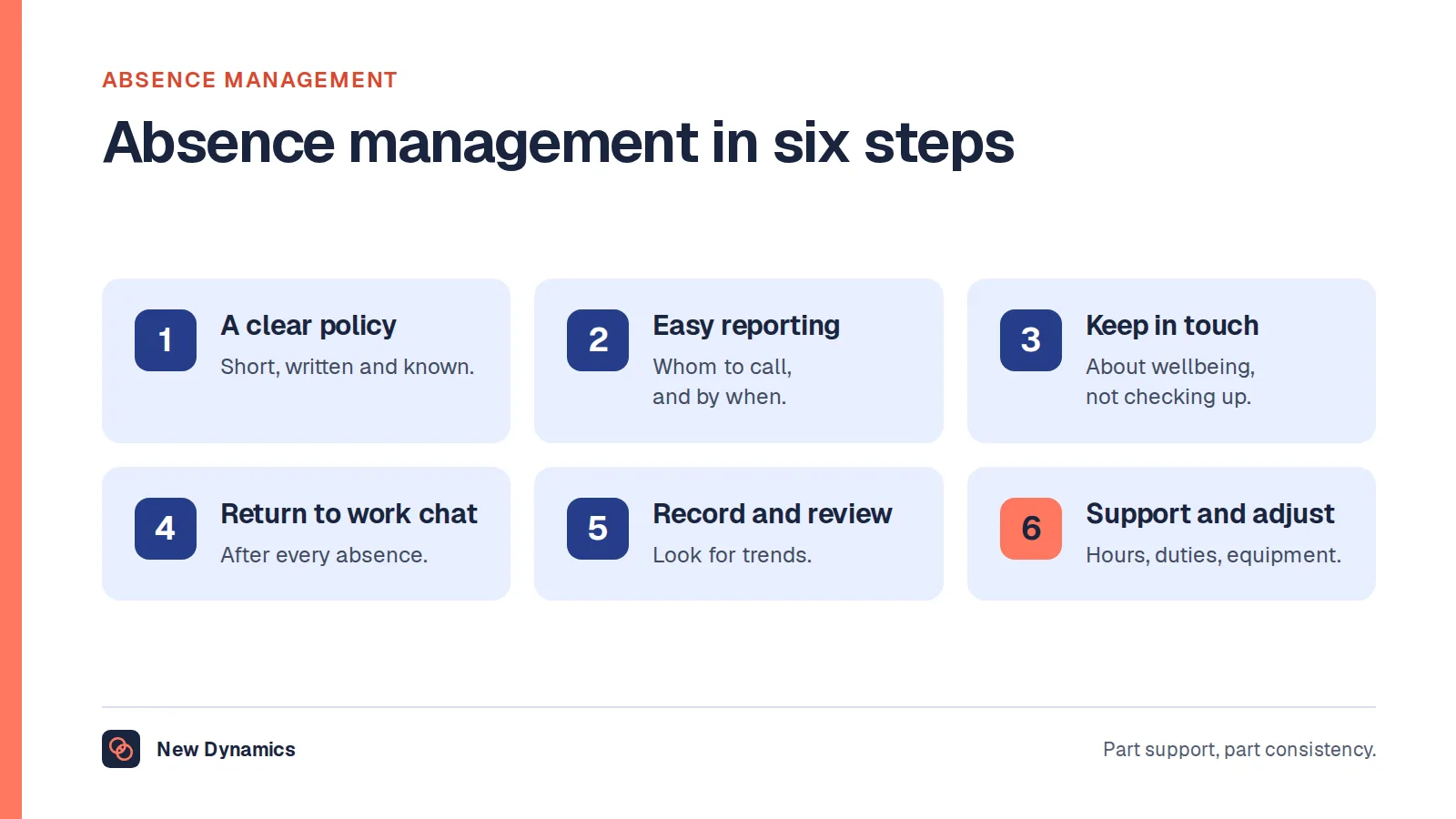
The statutory part is a checklist. The part that decides whether the person comes back, and comes back well, is not written down anywhere.
Plan cover from the fifteen-week notice, not from the last fortnight
You usually know the expected week of birth about six months in advance. That is enough time to make a real decision and far more time than most teams use.
Decide which of the three options you are actually choosing, and write down why. Backfill with a fixed-term hire or an agency contractor, which works where the role is self-contained and the handover can be taught. Redistribute across the team, which works for short, cheap absences and quietly fails over a year, because the extra load becomes permanent and nobody ever hands it back. Promote internally into a secondment, which is the strongest option for retention and the one that requires the most honesty, because you have to say up front what happens to the secondee when the original post-holder returns.
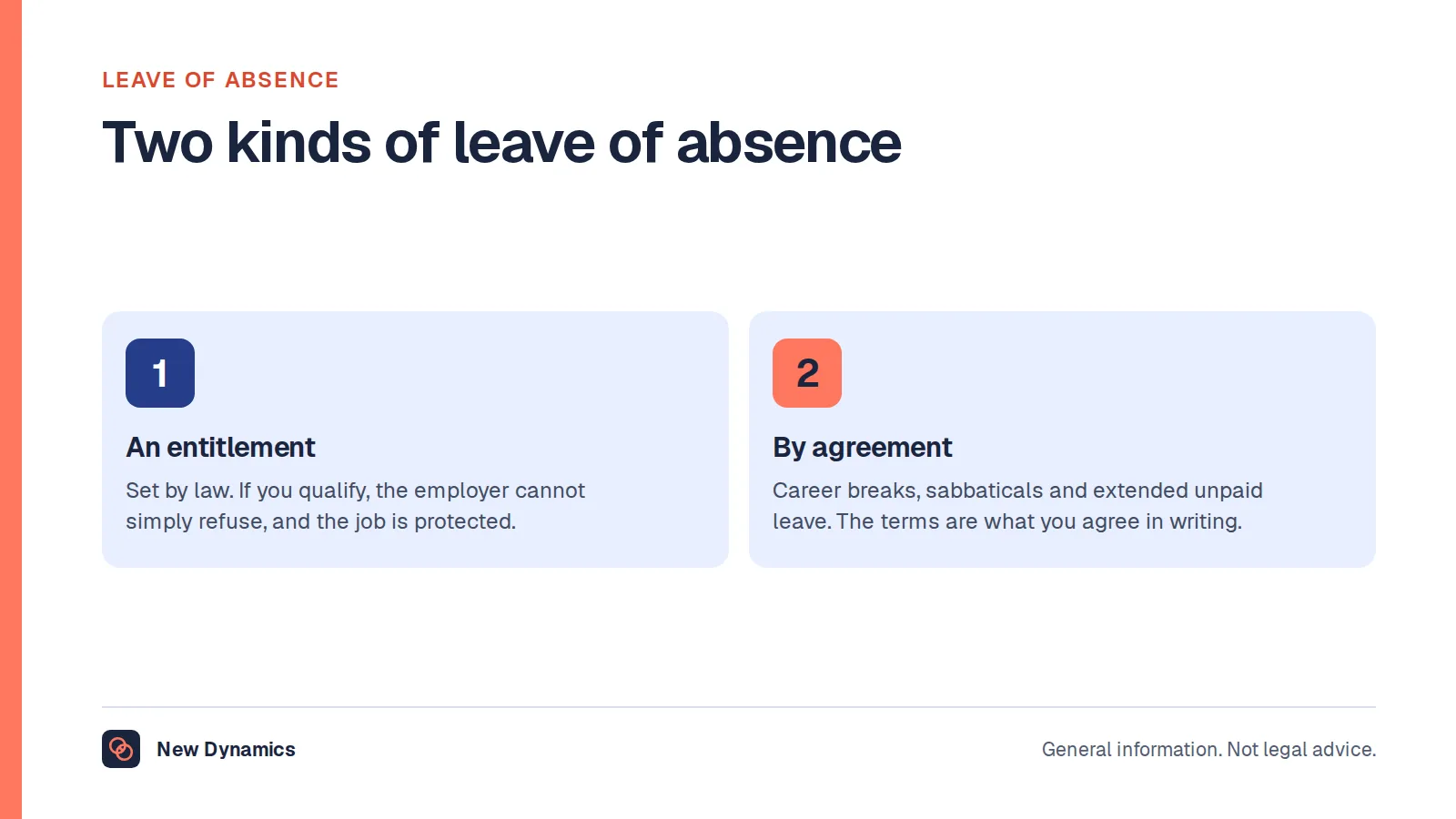
Then do the unglamorous work in the three months before the leave starts: name the successor for every responsibility, run working sessions rather than writing a handover document nobody opens, move files out of personal drives, and reassign approvals, rotas and inbox duties with dates. The failure pattern is identical to a badly run exit, which is why our post on the leave of absence and our employee handbook guide both treat the handover as the deliverable rather than the document.
Keep the person connected without making it work
The contact rule is simple: information flows to them, work does not. They get told about the reorganisation, the vacancy, the restructure and the training, because Acas says they must be. They do not get asked to approve something because they are the only person who knows how.
Agree the channel and the cadence before the leave starts, record what they asked for, and let them change it. Default to less contact than you think, and never let a manager's personal relationship become the only route in. If the only person who ever messages someone on leave is their manager, and the manager leaves, the employee is invisible.
The review cycle they are only half present for
A performance cycle that opens while someone is away is where good intentions turn into an unfair outcome, usually by accident. The two defaults are both wrong: emailing a review form to someone on protected leave, and silently leaving them out of the ratings and therefore out of the pay round and the promotion list.
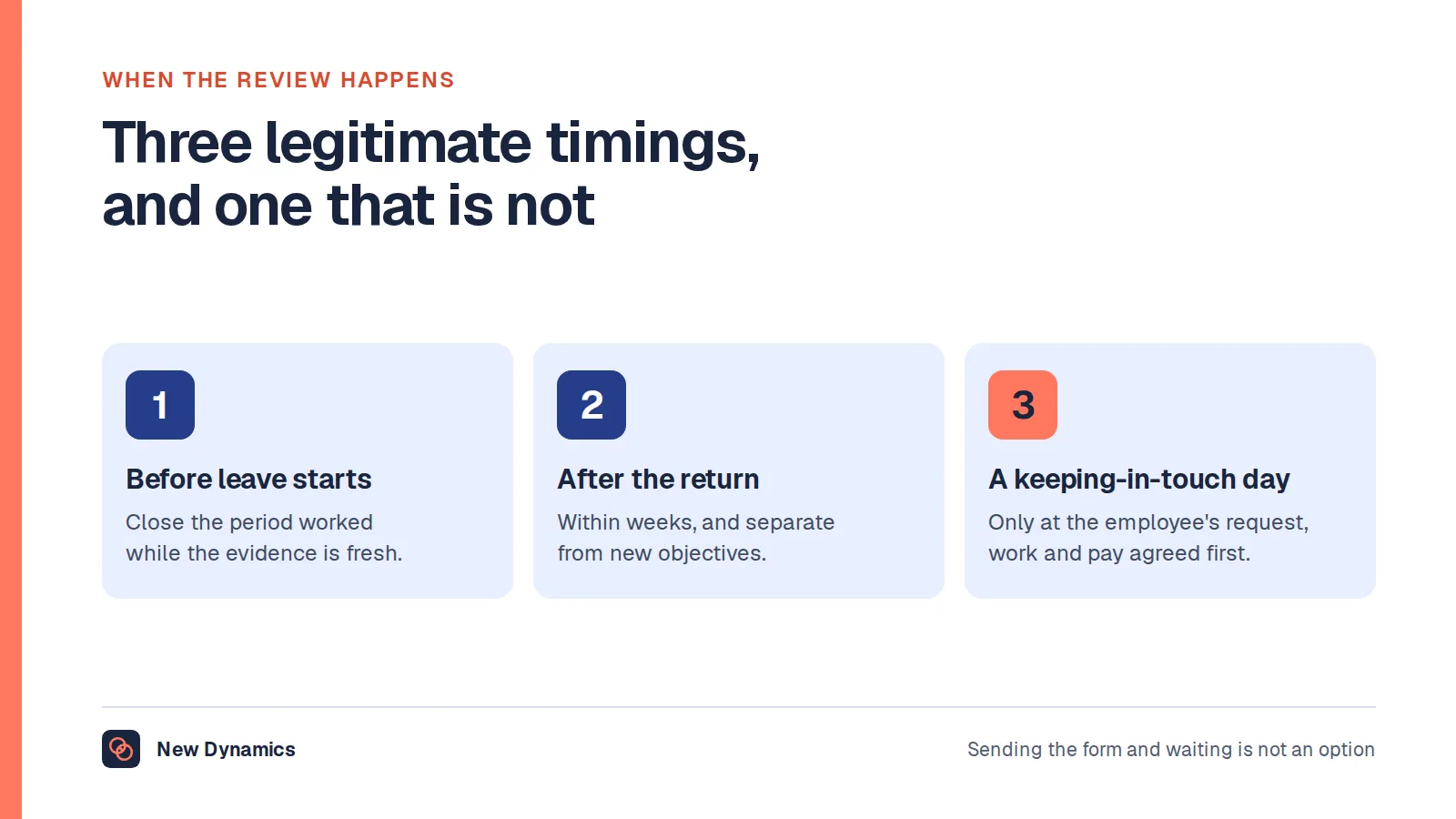
Rate the period actually worked, say which period that is, and do not treat an objective whose window fell inside the leave as a missed objective. Our post on reviewing an employee on maternity leave sets out the three legitimate timings, how to handle the pay and promotion rounds that fall during the leave, and what to settle before the leave starts.
Run the return as a process, not a date
The return is the most fragile moment in the whole year, and it is the one nobody owns.
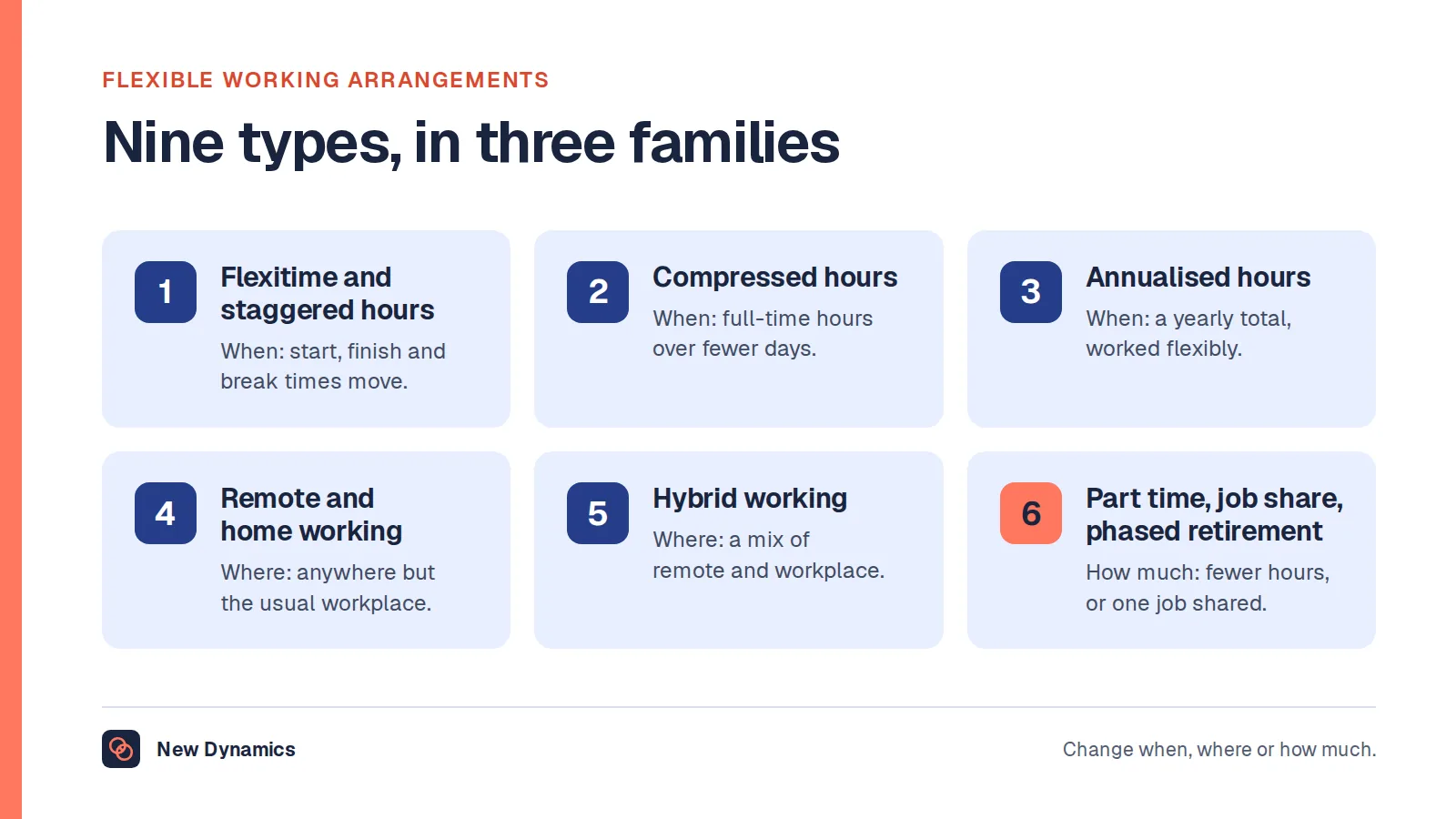
Hold a conversation before the return, not on the first morning. Cover what has changed, who the person now reports to, what their first fortnight actually contains, and what is coming off their plate. Confirm the role in writing against the right-to-return rule above. Deal with the practical items early: any flexible working request, which is a formal statutory process rather than an informal chat, and which our post on flexible working arrangements covers; and the facilities and breaks a returning parent may need.
Then plan a phased few weeks deliberately, and check in at one month and three months, because the resignations that follow maternity leave rarely happen in week one. They happen in month four, after a return that was treated as an administrative event.
Frequently asked questions
How long is maternity leave in the UK?
Statutory maternity leave is 52 weeks, made up of 26 weeks of ordinary maternity leave followed by 26 weeks of additional maternity leave, according to GOV.UK. An employee does not have to take all of it, but at least 2 weeks after the birth are compulsory, or 4 weeks for factory workers. The earliest leave can usually start is 11 weeks before the expected week of childbirth.
How much is statutory maternity pay a week?
Statutory maternity pay runs for up to 39 weeks. GOV.UK gives the first 6 weeks as 90 per cent of the employee's average weekly earnings before tax, and the remaining 33 weeks as £194.32 or 90 per cent of average weekly earnings, whichever is lower. That rate is the one for the 2026 to 2027 tax year, applying from 5 April 2026. It is uprated most Aprils, so check the current figure on the GOV.UK rates and thresholds page for employers before using it.
Who pays statutory maternity pay, the employer or the government?
The employer pays it, through its own payroll, with tax and National Insurance deducted in the normal way. The employer then reclaims it from HMRC by including it in an Employer Payment Summary. GOV.UK says employers can usually reclaim 92 per cent of SMP, rising to 109 per cent for a business that qualifies for Small Employers' Relief. Someone who does not qualify for SMP may be able to claim Maternity Allowance from the government instead.
Do you get statutory maternity pay on top of your salary?
No. SMP replaces pay during maternity leave rather than being added to it, and it is paid like wages on the normal pay dates. Where an employee appears to receive more, the employer is offering contractual or enhanced maternity pay above the statutory minimum, which is a policy choice. GOV.UK notes that an employer paying above the statutory amount can usually still only reclaim 92 per cent of the statutory figure.
Is maternity leave a day one right?
Yes for leave. GOV.UK's employer guide gives the condition for statutory maternity leave as having an employment contract and giving the correct notice, with no minimum length of service. Statutory maternity pay is different and does have a service test: the employee must have been continuously employed by you for at least 26 weeks up to the qualifying week, which is the 15th week before the expected week of childbirth, and must meet the weekly earnings threshold.
What must an employer confirm, and by when?
Once the employee has given notice, at least 15 weeks before the expected week of birth, GOV.UK says you must confirm their leave start and end dates in writing within 28 days. Acas describes the same duty as replying within 28 days, telling the employee they are entitled to up to 52 weeks' statutory maternity leave and confirming the return to work date. You cannot refuse maternity leave or change the amount of leave the employee wants to take.
Your next step: get the dates and the money out of one person's head
- Write your maternity process as dated steps rather than a policy paragraph: the 15-week notice, the MATB1, your 28-day written confirmation, the payroll trigger, the KIT day agreement, the 8-week return notice and the return conversation.
- Put one review in the diary for every April to update the weekly SMP rate, the earnings threshold and the Small Employers' Relief limit wherever you have typed a figure.
- Check that your payroll software is reclaiming through the Employer Payment Summary, and confirm whether your National Insurance bill qualifies you for Small Employers' Relief.
- Decide your cover approach, backfill, redistribute or second, at the point of notice rather than in the final fortnight, and name a successor for every responsibility.
- Agree how the review cycle treats a part-year, so no manager has to improvise it.
For the policy wording that holds all of this together in one place staff can actually find, read our employee handbook guide.
Want the notice deadlines, the confirmation letter, the payroll handoff and the return conversation on one tracked path, with nothing depending on somebody remembering a date? Book a New Dynamics demo and bring your current maternity process. You can also email contact@new-dynamics.com.