TL;DR
- Meets expectations means you did the job you were hired to do, to the standard agreed, for a whole year. That is the design centre of the scale. It reads as a disappointment only where the scale has drifted upwards and everyone expects to sit above the middle.
- Exceeds expectations is not working hard or being liked. It is sustained delivery beyond the agreed scope or at the level above, evidenced well enough that a manager from another team would recognise it without explanation.
- Needs improvement is a named gap with support and a date, not a disciplinary step. Acas expects employers to try to help someone improve before any formal procedure, and a low rating should never be the first time a concern is heard.
You open the form and it says "meets expectations". Somewhere between the words and your stomach, that turns into "average", and then into "they do not rate me". A colleague got "exceeds" for a year that looked much like yours. Nobody has explained what any of it means.
This article covers what the three labels are supposed to mean, why the middle one feels worse than it is, the test a manager should apply before choosing, what each implies for pay and progression, and what to do if you have just been given a "needs improvement".
Labels only mean something when the evidence behind them is visible. See how New Dynamics performance reviews keep goals, feedback and notes from the year in one place.
The three labels

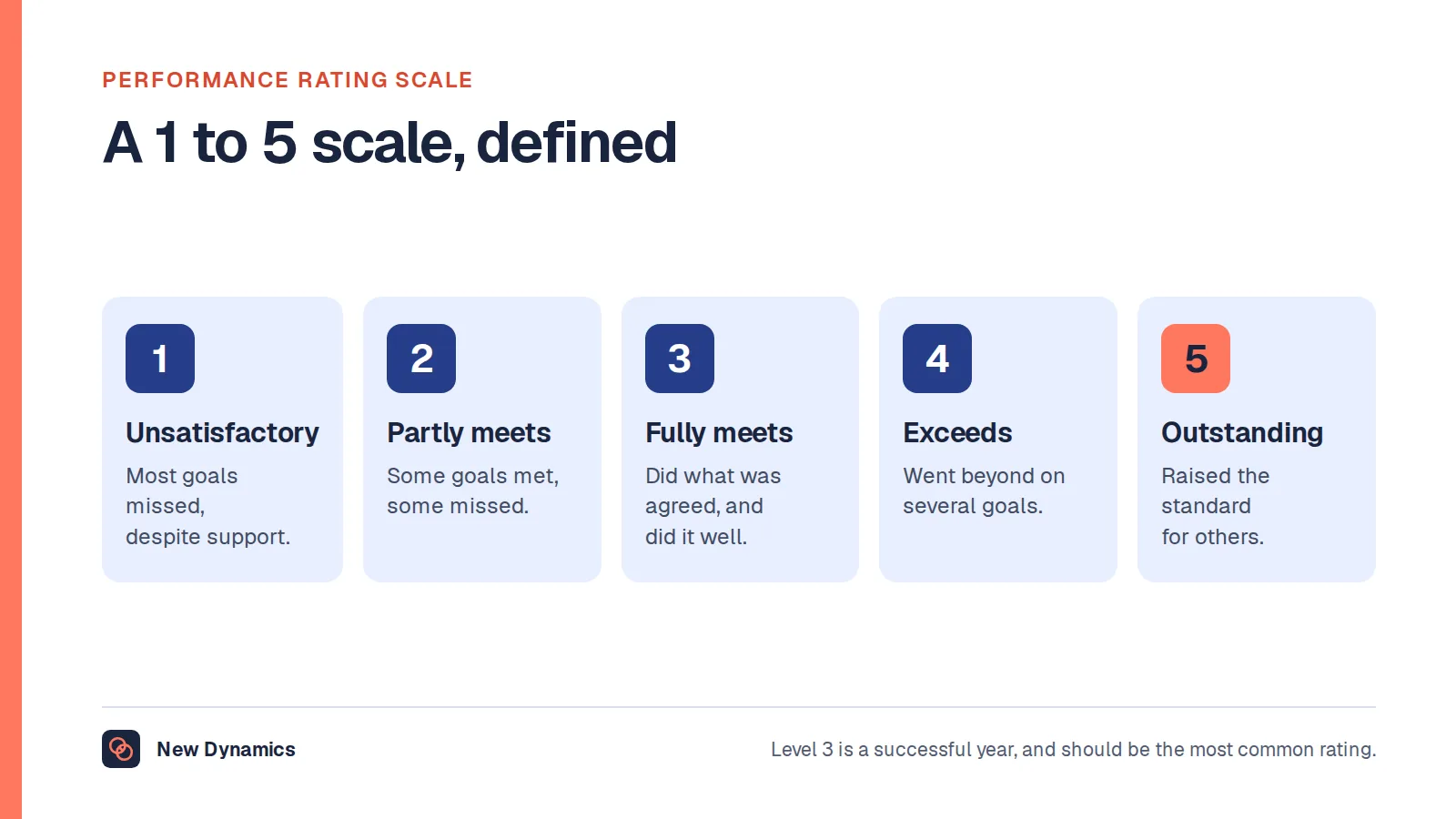
Meets expectations. You did the job you were hired to do, to the standard agreed, across the whole period. Objectives achieved, behaviours right, no sustained gap. Acas describes a review as based on things like whether someone is "meeting or has met any agreed objectives" and "demonstrating the right behaviours in their work". Meeting them is the design centre of the scale, and in a well-run organisation it is where most people sit most years.
Exceeds expectations. Sustained delivery beyond the agreed scope, or consistently at the level above. Not one good quarter, not working long hours, not being visible. The test is evidence: could a manager from another team read two sentences about it and recognise the difference without you explaining?
Needs improvement. A specific gap between the agreed standard and what happened, named, with support and a date attached. It is a performance rating, not a disciplinary step. Acas says employers "should take steps to try and help someone to improve, before starting a formal disciplinary procedure".
Why "meets" feels like bad news
Three things make a perfectly good rating land badly.
Scale drift. Where most of an organisation sits above the middle, the middle becomes the lowest socially acceptable rating and reads as a demotion. That is a property of the distribution, not of the person, and our post on rating an employee fairly covers how it happens.
The wording. "Meets expectations" sounds like a pass mark on a test rather than a description of a year of work. Some organisations relabel it, and plain alternatives such as "performing well in role" or "fully effective" do less damage for no loss of meaning.
No sentence attached. A label with no explanation invites the reader to supply one, and people reliably supply the worst available. A rating should always come with the reason, which is part of why Acas says the written record of a review should be shared with the employee.
The manager's test

Before you pick a label, answer in this order.
- Can you write two sentences of evidence for "meets"? What they were asked to do, and what they delivered. If yes, the floor is meets, and the only remaining question is whether anything takes it higher.
- For "exceeds", is it beyond scope and sustained? One success is a strength to write up, not a rating. Ask whether a manager outside your team would see the difference from the evidence alone.
- For "needs improvement", is there a written standard, a named gap and a prior conversation? If the concern has never been raised, the rating is a surprise, which makes it a management failure rather than a performance one. Our post on the underperformance conversation covers raising it properly.
A fourth question keeps all three honest: would you give the same label to someone else with the same evidence whom you find harder work?
What each label means for pay and progression
The honest answer is that it depends on your organisation, and the organisation should have written it down. Where that link is published, people can plan. Where it is not, the label becomes a rumour with a number attached.
Three things worth saying plainly:
- "Meets" is not a block on progression. Promotion is usually about operating at the next level, which is a different judgement from this year's rating. A solid run of "meets" with evidence of next-level work is a stronger case than one inflated year.
- "Exceeds" is not a promotion promise. It describes last year. Confusing the two is how a good rating turns into a bad conversation in March.
- "Needs improvement" usually pauses an increase rather than triggering a process, and your organisation should tell you which.
If nobody will tell you how the label connects to money, that is a reasonable question to ask in the meeting, and a reasonable thing for HR to publish.
If you have been given "meets expectations"
Ask three questions, in a tone of curiosity rather than challenge.
- "What would exceeds have looked like in this role this year?" A manager who cannot answer specifically has not applied a standard, and the answer tells you what next year needs.
- "What is the one thing that would move it?" Better than a list, and it produces an objective.
- "Does this affect pay, and when will I know?" Dates reduce anxiety more than reassurance does.
Then look at the evidence rather than the word. A review that describes your year accurately and lands on "meets" is a good review.
If you have been given "needs improvement"

- Ask for specifics with dates. What was the standard, what happened, and when. A rating that cannot be evidenced cannot be improved against.
- Ask whether this is informal or formal, and ask for the answer in writing. Acas says that before starting a disciplinary procedure an employer should "first see whether the problem can be resolved in an informal way", so in most cases the answer is informal.
- Ask what support comes with it. Acas says an improvement plan should set out "specific objectives for the employee", "a reasonable timeline to meet them" and "any further support or training they need".
- Say what is behind it, if something is. Workload, a health condition, an adjustment that was never made, late inputs from elsewhere. These change the right response, and your manager may not know.
- Get the review date in the diary before you leave the room, and keep your own note of what was agreed.
Disagreement is allowed. Ask for your comments to be recorded alongside the rating, correct anything factually wrong, and if it still sits badly, raise it informally first and then formally.
For HR: three fixes that remove most of the pain
- Publish the definitions, with two worked examples of the difference between adjacent labels.
- Publish the pay link, or stop implying there is one.
- Require a sentence with every label. A rating without a reason is the single biggest source of appeals, and the cheapest thing to fix. Our post on the performance rating scale covers writing the definitions themselves.
Frequently asked questions
Is "meets expectations" a bad rating?
No. It means you did the job you were hired to do, to the standard agreed, for the whole period, which is what most people do in most years. It reads as bad news mainly where a scale has drifted so that nearly everyone expects to sit above the middle.
What does "exceeds expectations" actually mean?
Sustained delivery beyond the agreed scope, or consistently working at the level above, with evidence a manager from another team would recognise without explanation. One strong quarter, long hours or high visibility are not the same thing, and writing them up as a strength is better than inflating a rating.
Is "needs improvement" a warning?
Not by itself. It is a performance rating describing a named gap, with support and a date attached. Acas expects employers to try to help someone improve before starting any formal procedure, so ask whether the conversation is informal or formal and get the answer in writing.
Can you be promoted with a "meets expectations" rating?
Often, because promotion usually turns on whether you are operating at the next level rather than on this year's label. A consistent record with evidence of next-level work is a stronger case than a single inflated year. Ask your manager what the promotion criteria are, separately from the rating conversation.
Does "meets expectations" mean no pay rise?
That depends entirely on how your organisation links ratings to pay, which it should have written down. Ask what the link is, who decides and when you will hear. If nobody can tell you, that is worth raising with HR, because an unpublished link produces rumours rather than motivation.
How should you respond to a rating you disagree with?
Ask for the evidence behind it, correct anything factually wrong, and ask for your own comments to be recorded alongside the rating rather than instead of it. If it affects pay or progression, ask for a second pair of eyes. Raise it informally first, and formally only if that does not resolve it.
Your next step: ask for the sentence
- If you received a label with no explanation, ask for two sentences of evidence behind it.
- Ask what the next label up would have required, specifically, in your role.
- If you are a manager, check your own drafts for any rating that has no sentence attached.
- If you are in HR, publish the definitions and the pay link before the next cycle opens.
For an agenda and a fair process around the whole conversation, read and download our performance review guide. The guide is free to read, and the PDF uses our short download form.
Want ratings that arrive with the evidence attached? Book a New Dynamics demo and bring your rating definitions. You can also email contact@new-dynamics.com.