TL;DR
- A rating is a judgement made between the evidence and the form, and five things bend it on the way: recency, the halo from one visible success, visibility itself, similarity, and last year's number. Each has a check that catches it in about ten minutes.
- A distribution where almost everyone sits in the middle is not fairness. It usually means the scale was never defined, the rating has a pay consequence nobody wants to be responsible for, or the conversation above the middle band is too expensive to have.
- The remedy is not a forced curve. Acas's advice on unconscious bias points the other way: more than one person involved in the decision, time to make it, and a written record of why it was made.
The ratings come in. Eighty per cent of the team sits in the middle band. One manager has never given anything below the second-highest, another has never given the top. The person who carried a project through a difficult autumn has the same number as the person who did not. Nobody decided any of this, and everyone can feel that it is wrong.
This article covers what bends a rating, why distributions go flat, what inflation costs, why a forced curve is not the fix, and the checks worth running before anything is final. It describes the position in Great Britain and is general information, not legal advice.
Ratings are only comparable when more than one person looks at them. See how New Dynamics multi-manager reviews bring input from everyone who worked with a person into one record.
Fair means comparable, not identical
A fair rating is one where the same standard was applied to everybody, and where someone who was not in the room could follow the reasoning. It does not mean the same number for everyone, and it does not mean a tidy shape across the team.
Acas describes reviews as based on things like whether someone is "meeting or has met any agreed objectives" and "demonstrating the right behaviours in their work". Those are the inputs. The rating is the judgement made from them, and the judgement is where the trouble starts.
Five things that bend a rating

Recency. The last six weeks fill the whole year. Check: read your notes from the start of the period before you write, not after.
The halo, and its opposite. One visible success or one bad incident colours everything else. Check: rate each objective separately before you decide an overall level, and see whether they agree.
Visibility. The people you see most, in the office or on your screen, accumulate more evidence and therefore more credit. Check: sort your draft ratings by how much contact you have with each person and look at the shape.
Similarity. Acas describes unconscious bias as including when a person thinks "better of someone because they believe they're alike" or "less of someone because that person is different to them", and notes that "everyone can think in a way that involves unconscious bias at some point". Check: for your two highest and two lowest, write the evidence without adjectives and see whether it still supports the gap.
Last year's number. Anchoring is quiet and strong: the previous rating becomes the starting point and the year has to argue its way out of it. Check: draft this year's rating before opening last year's form.
Why everyone gets a three

A flat distribution is a symptom, and it has five usual causes.
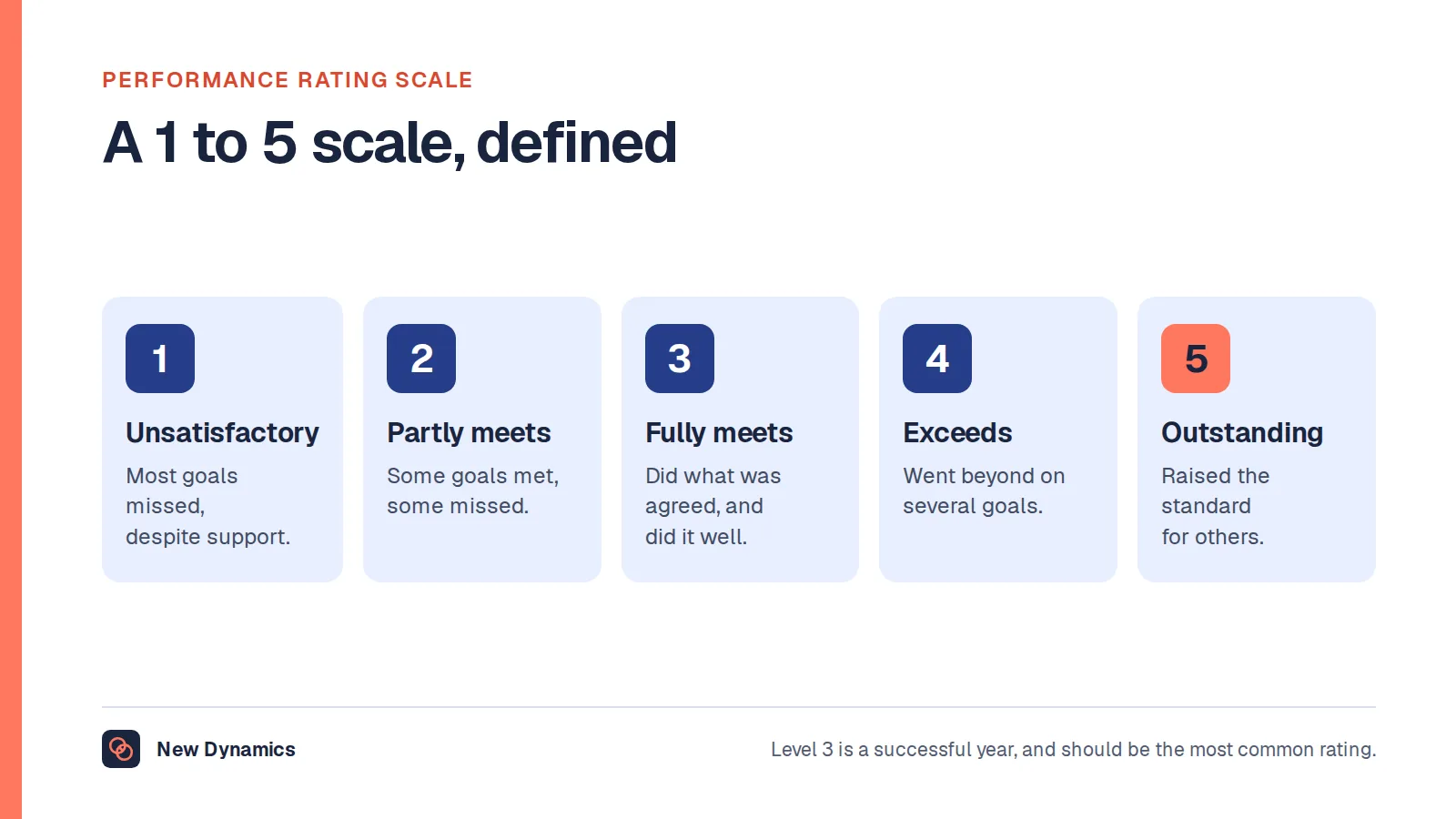
- The scale was never defined. If nobody has written what separates the middle band from the one above it, the middle is the only defensible answer. Our post on the performance rating scale covers writing those definitions.
- The rating decides pay. When a number is money, the manager who gives it owns an argument about money. The middle is the quiet option.
- The conversation above the middle is expensive. A higher rating invites a promotion conversation the manager cannot fund, so it is avoided.
- Moderation is feared. Managers who expect their ratings to be cut back start low, or start safe.
- There is no evidence. Without specifics, every rating is a guess, and the middle is the guess least likely to be challenged.
Each cause has a different fix, which is why "tell managers to use the whole scale" never works on its own. Definitions fix the first, decoupling or delaying the pay conversation helps the second and third, a calibration process that managers have seen fixes the fourth, and the fifth is a year-round evidence habit rather than a rating problem at all.
What inflation costs
Rating inflation is the opposite failure and it feels generous at the time. Over two or three cycles it costs four things:
- The top band stops meaning anything, so the people who genuinely did exceptional work are no longer distinguishable.
- The pay budget spreads thin. Everyone above the middle means everyone gets a little, which is a worse outcome for the people who earned more.
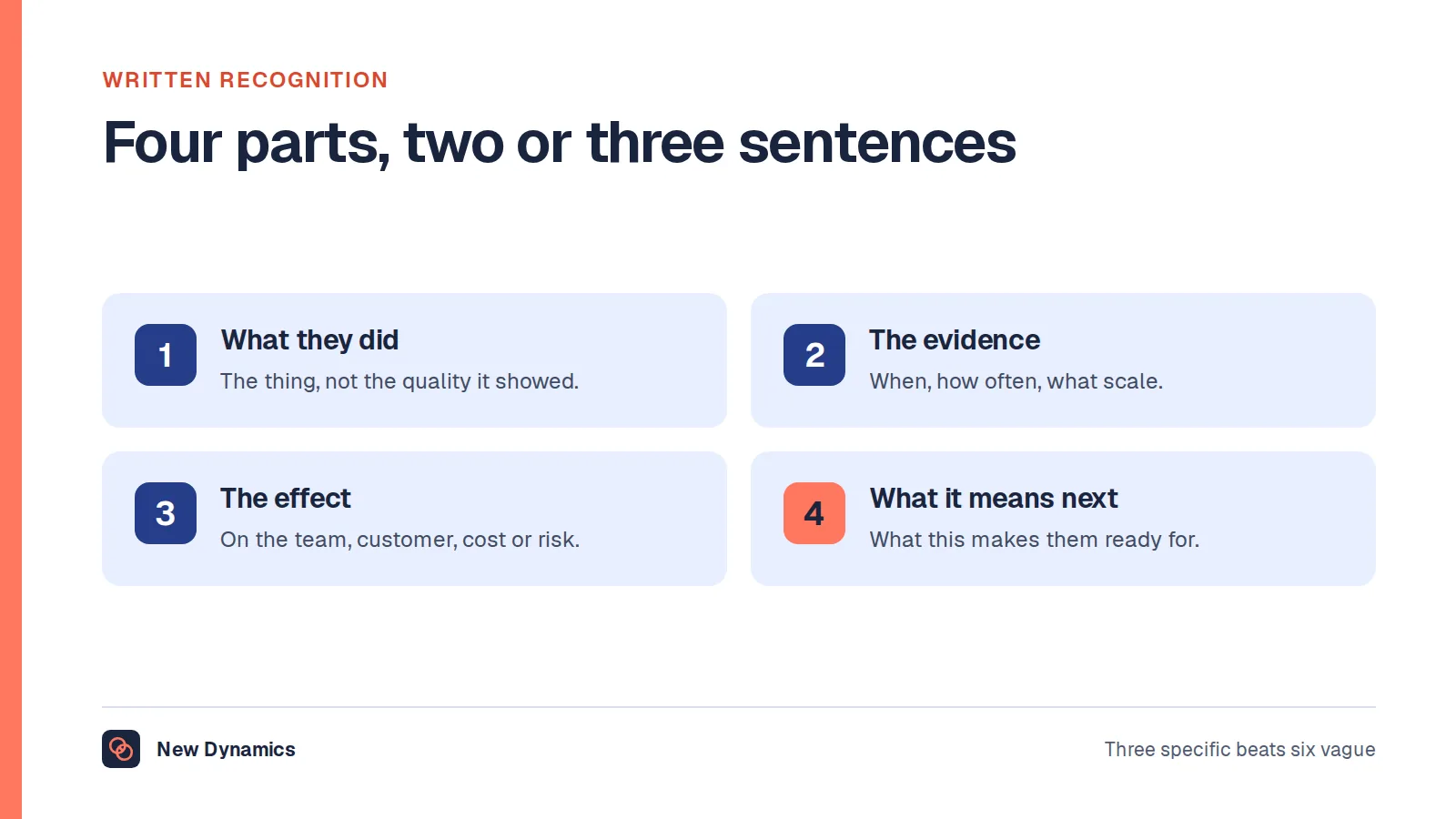
- Recognition loses force. If the written praise is warm for everyone, it stops being evidence for anyone, as our post on recognising good performance sets out.
- The record stops matching reality. A capability concern raised after three years of above-standard ratings is hard to run fairly and harder to defend.
A forced curve is not the fix
Distribution targets look like discipline and behave like a lottery. In a team of six, a required percentage in the bottom band means someone is marked down for arithmetic. In a strong team it punishes people for their colleagues, and in a weak one it protects somebody who should have had a different conversation months ago.
What actually produces a spread is definitions people can apply, evidence behind each rating, and a conversation between managers before anything is final. Acas's own suggestions for countering unconscious bias point the same way: "getting recruiting managers to tell each other if they notice any signs of being biased", "having more than one person" involved at each stage, "allowing time to make decisions", and "keeping a written record of why decisions were made".
Six checks before ratings are final

- Distribution by manager. A manager using one point of a five-point scale is a finding, in either direction.
- Distribution by working pattern and location. Compare part-time with full-time, remote with on-site, and anyone who had a period of leave. Our posts on part-time, shift and seasonal staff and remote employees explain what tends to go wrong.
- Evidence density. Sample a few reviews at each rating level and count the specific, verifiable examples. A rating with no evidence is not a rating.
- Movement against last year. How many people moved at all? If almost nobody did, the anchor is doing the work.
- The surprise check. For every rating below the middle, ask whether the concern appears anywhere earlier in the record. If it does not, that is a management failure, not a performance one.
- Where the data allows, the protected characteristic check. Acas warns that less favourable treatment "might include: excluding someone from opportunities or benefits" and that "it can still be discrimination even if the less favourable treatment was not intended". Ratings decide opportunities and benefits. Look at the pattern with HR, carefully and in aggregate, rather than not looking.
Running the calibration conversation
Keep it short, evidence-led and genuinely two-way. Each manager defends two ratings in three sentences each. Anyone can ask "what would that person have had to do to be one level higher?", and if nobody can answer, the level is wrong. Record the reasons, because a decision that changed without a recorded reason is the one nobody can explain in a year.
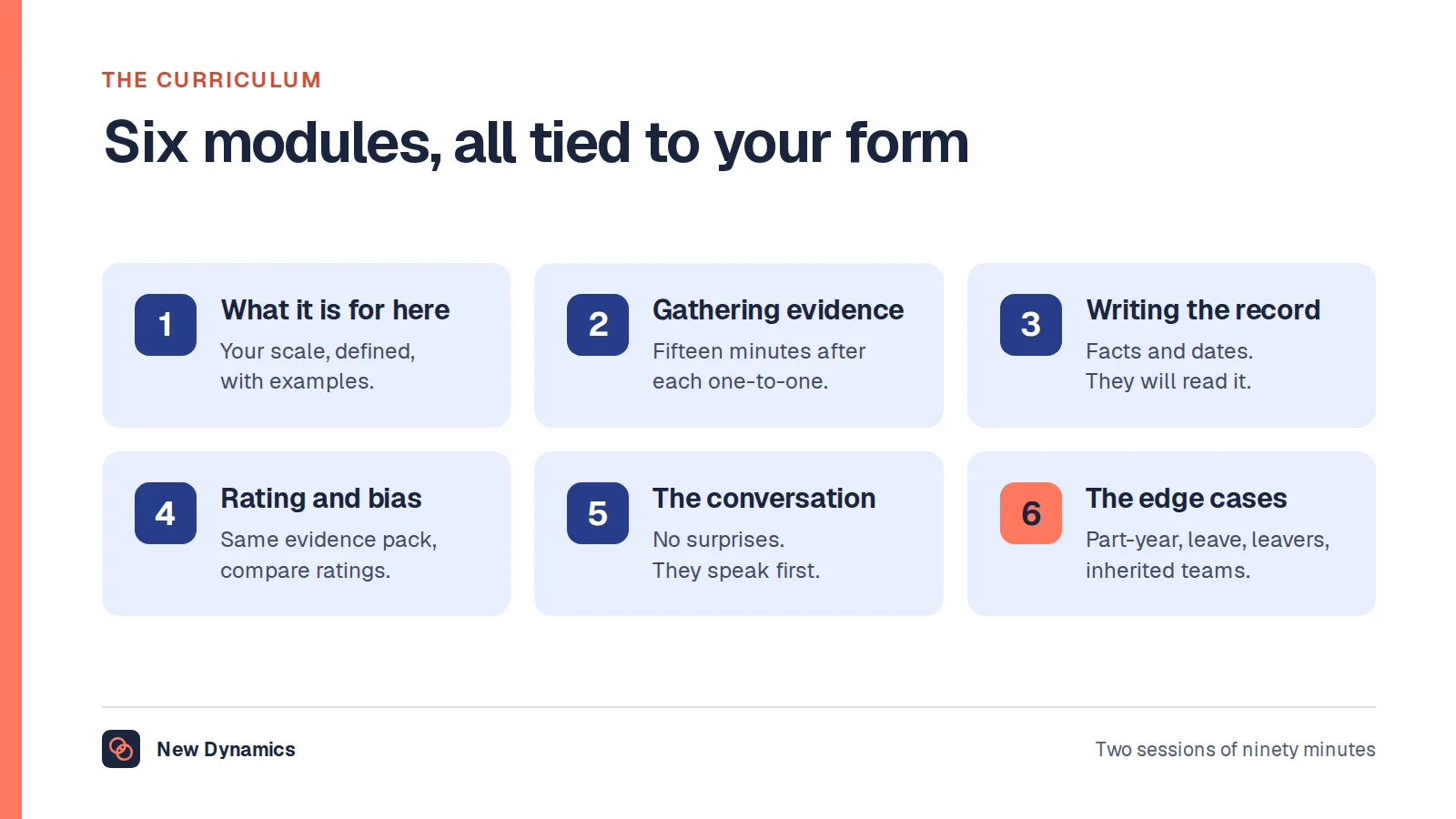
Finally, nothing is communicated until calibration finishes. Telling someone their rating and then withdrawing it costs more than waiting a week, and our post on performance review training for managers covers how to prepare a first-time manager for the room.
Frequently asked questions
How do you rate an employee fairly?
Apply the same written standard to everybody, rate each objective before deciding an overall level, and make sure each rating has specific evidence behind it. Then have the ratings looked at by more than one person before they are final, allow time for that conversation, and record the reasons for any changes.
Why does everyone get a middle rating?
Usually because the scale was never defined, because the rating decides pay and the middle avoids an argument, because a higher rating invites a promotion conversation nobody can fund, because managers expect to be moderated down, or because there is no evidence to support anything else. Each has a different fix.
What is rating inflation and why does it matter?
Rating inflation is the gradual drift of most people into the upper bands. It makes the top band meaningless, spreads the pay budget thinly, weakens written recognition and leaves a record that contradicts any later concern about performance. It feels generous in the moment and costs the strongest performers most.
Does unconscious bias affect performance appraisals?
It can. Acas says unconscious bias includes thinking better of someone because you believe you are alike, or less of someone because they are different, and that everyone is affected at some point. In ratings it shows up as recency, halo, visibility and similarity. The countermeasures are the same ones Acas recommends: more than one decision maker, time, and a written record of why.
Should you use a forced distribution or bell curve?
No. A required percentage in each band marks people down for arithmetic rather than performance, and in a small team it is close to random. Defined levels, evidence behind each rating and a calibration conversation produce a genuine spread without inventing one.
What should you check before finalising ratings?
Six things: the spread by manager, the spread by working pattern and location, the amount of evidence at each level, how many ratings moved from last year, whether any below-middle rating is a surprise to the person, and, in aggregate and with HR, whether any pattern tracks a protected characteristic.
Your next step: look at the shape before the names
- Export last cycle's ratings and chart them by manager. Do not look at names yet.
- Add working pattern, location and any period of leave, and look again.
- Pull five reviews at each level and count the specific examples in each.
- Book a calibration conversation with a rule that every rating is defended in three sentences.
For running that conversation properly, read and download our performance calibration guide. The guide is free to read, and the PDF uses our short download form.
Want ratings with the evidence attached and more than one pair of eyes on them? Book a New Dynamics demo and bring last cycle's distribution. You can also email contact@new-dynamics.com.