TL;DR
- Patient service representative is an American job title. In the United Kingdom the same work is done by a medical receptionist, a patient services adviser in a GP practice, or a ward clerk and an outpatient booking clerk in a hospital. One job description can serve both, as long as it says which country's rules govern the money and the records.
- Two sections make this role different from a general receptionist, and most adverts leave both out. Health data is special category data under the UK GDPR, so access is limited to people who reasonably need it and a non-clinical member of staff must not release health information on their own judgement. And in Great Britain the employer has a legal duty to assess the risk of violence at work and control it so far as is reasonably practicable.
- No official United Kingdom source publishes a pay figure under this title. The National Careers Service publishes £21,000 starter to £25,000 experienced for a receptionist and £23,000 to £30,000 for a medical secretary, the nearest published British profiles. Anything quoted under the American title here is a private estimate, not an official statistic.
A patient waiting for a biopsy result does not meet a clinician first. They meet whoever is at the desk. That person checks them in, notices they are shaking, declines to answer a question they are not allowed to answer, takes a payment, calms the man who has waited fifty minutes, and routes a message to a clinician who will not read it for an hour.
This patient service representative job description covers the role across a day, the four settings it splits into, the two sections almost every advert leaves out (confidentiality and abuse at the desk), the skills that matter, a template, and where the job leads.
The first fortnight carries the risk, because this person handles health data and money from their first shift. See how New Dynamics onboarding turns an induction into a dated path of tasks, early goals and check-ins, so confidentiality training and scoped access are recorded steps.
For the general version of the desk, see our receptionist job description.
What the title means, and what the job is called in Britain
The title is American. In the United States it sits inside the occupation the Occupational Information Network, the American labour market database, codes as 29-2099.08 Patient Representatives and lists as updated in 2026. Its summary is short: patient representatives "Assist patients in obtaining services, understanding policies and making health care decisions." Reported job titles for the same occupation include Patient Service Representative (Patient Service Rep), Patient Access Specialist, Patient Advocate and Patient Navigator. So "patient service rep", "PSR" and "patient rep" are one job, in American usage.
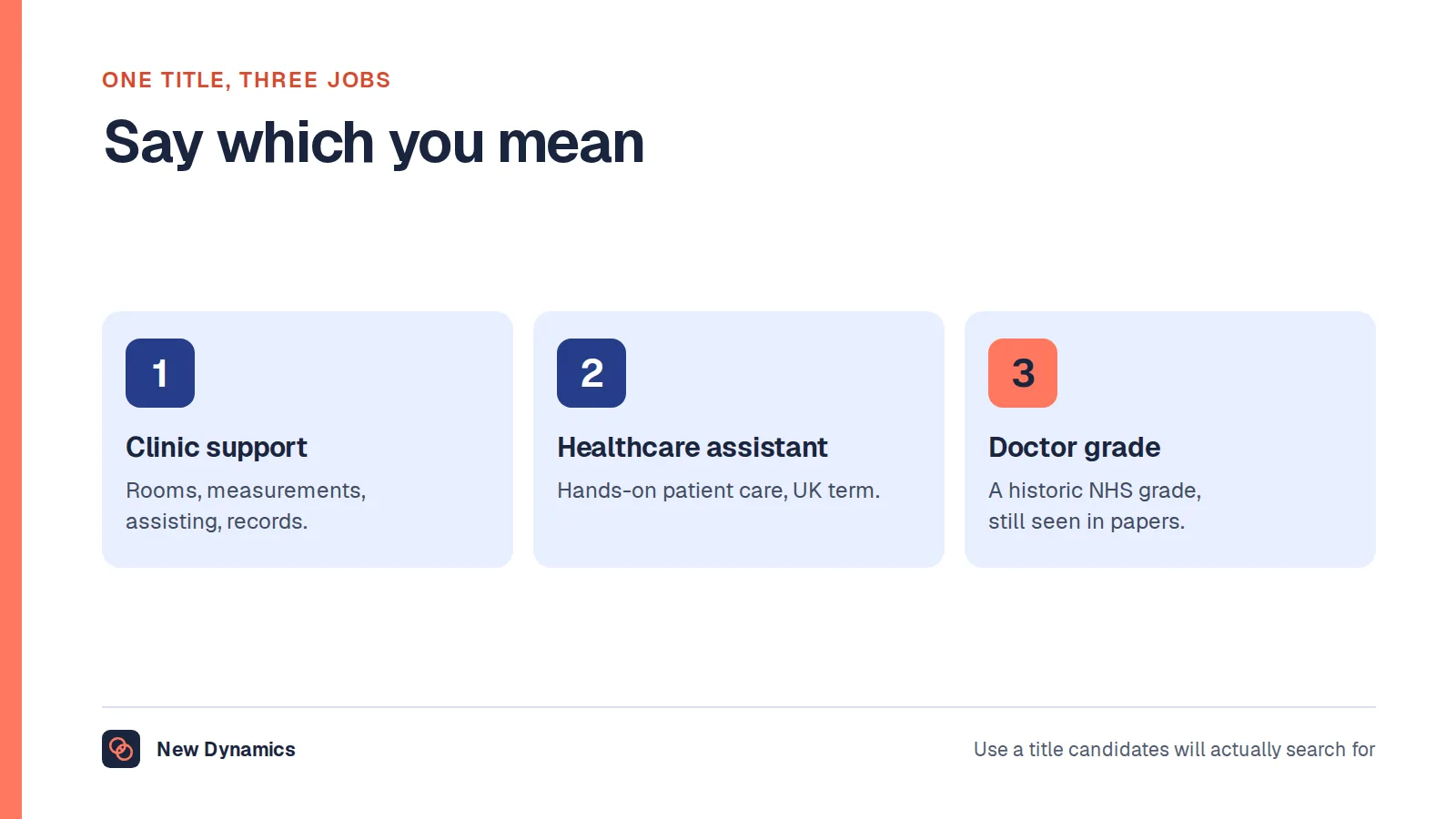
Nobody in the United Kingdom advertises that title. The same work carries four British titles:
- Medical receptionist. The general British name, across GP practices, dental practices and private clinics.
- Patient services adviser, or administrator. Common in GP practices, especially where the desk directs patients rather than only booking them.
- Ward clerk. Attached to a hospital ward: admissions and discharges, case notes, the bed board, relatives at the door.
- Outpatient booking clerk. Attached to clinics: clinic lists, waiting lists, letters, rebooking and missed appointments.
Hiring in Britain, use the British title. The duties transfer almost completely; what changes is who pays, which record system is in front of you and which law governs the confidentiality.
The job across a day at the desk
Most job descriptions for this role list eight bullets and miss the shape of the day.
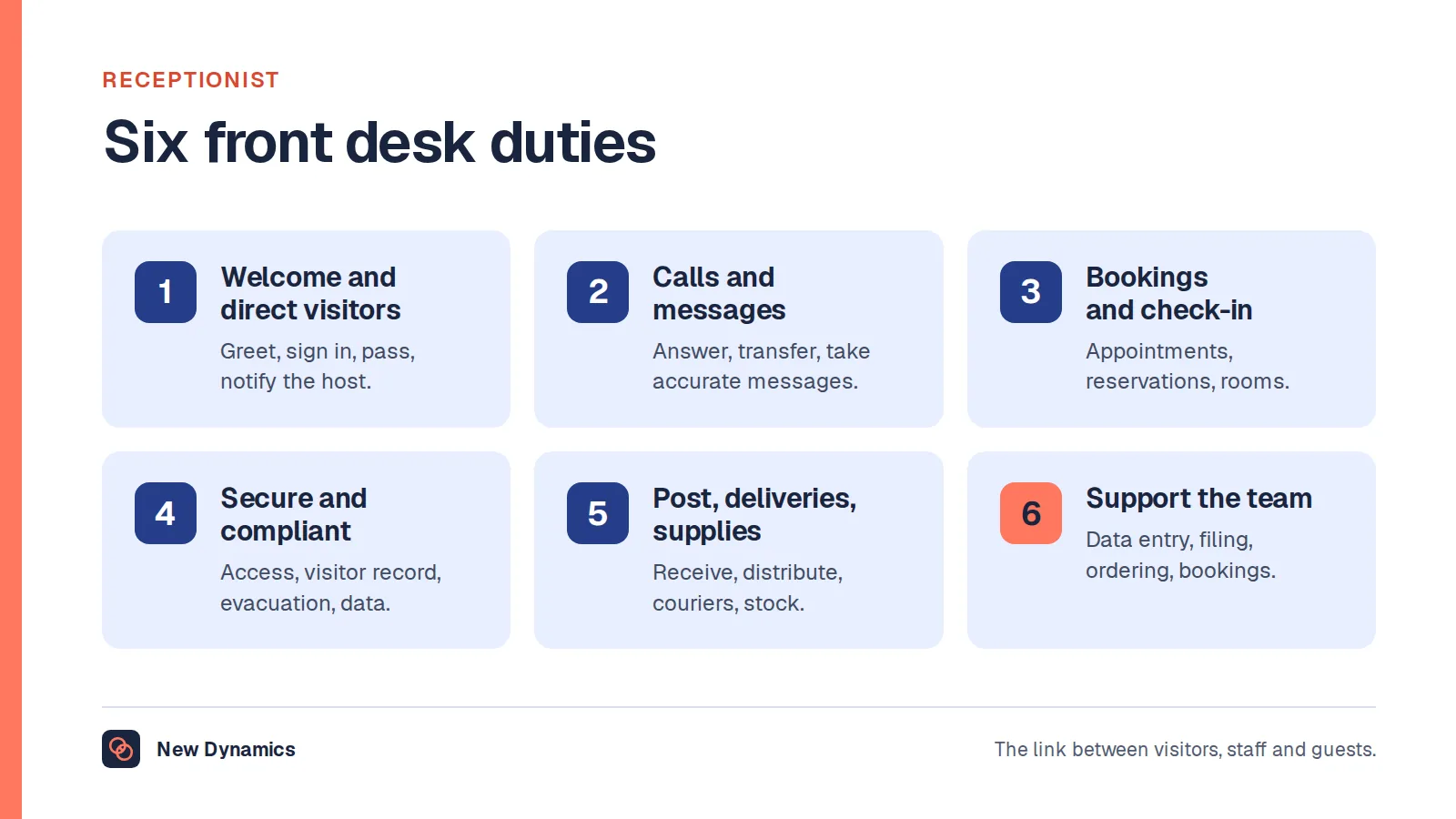
Before the doors open, and after they close. Clinic lists checked against what the clinicians intend to run, overnight voicemail picked up, late cancellations offered to the waiting list. At the close: takings reconciled, results chased, handover written for tomorrow.
Registration and arrivals. Registering new patients, verifying identity and address, checking eligibility, and getting the details right first time, because a transposed digit follows that person through every system that touches them. Then checking people in, and flagging anyone who looks worse than their appointment suggests.
Appointments, and the triage boundary. Booking, rebooking, cancelling and chasing the people who did not attend. In a GP practice this is where the job stops being clerical, because the practice's rules decide which problem goes to which slot, which to a pharmacist or nurse, and which to the duty clinician now. The desk applies a protocol rather than exercising clinical judgement, and the protocol must exist in writing before anyone can be held to it.
Money, exemptions and insurance. Here the two countries differ. The American task list for this occupation includes "Analyze patients' abilities to pay to determine charges on a sliding scale", which has no British equivalent in general practice. In Britain the money is narrower: exemption and declaration checks, dental charges and the treatment band, non-NHS fees, insurer authorisation and self-pay invoices in a private clinic. Say which the post holder handles, and whether they handle cash, because cash changes the security arrangements and the training.
Messages to clinicians. A routing function with consequences. "Patient called about results" is useless. Who called, when, on which number, what they said and what they now expect is the difference between a safe handover and a complaint. Put that standard in the job description.
The waiting room when the clinic runs late. The part the advert never mentions and the post holder spends the most effort on. When a clinic is an hour behind, the clinician is with a patient and the desk is in the room with twenty people who have each decided somebody should tell them something. The people who last tell the room before they are asked.
The specialisms by setting: four different desks

The commonest fault in these adverts is not naming the setting. These are four different jobs.
| Setting | What is distinctive |
|---|---|
| GP practice | Registration, the practice's own triage or navigation rules, repeat prescriptions, exemption checks, home visit requests, high call volume |
| Hospital outpatients | Clinic lists and waiting lists, booking rules, letters, missed appointments, case notes, interpreters, transport |
| Dental practice | Recalls, courses of treatment, charge bands, consent and medical history forms, short-notice cancellations |
| Private clinic | Insurer authorisation, self-pay quotes and invoices, consultant diaries, discretion about who is in the building |
A hospital desk is high volume and procedural. A GP desk is lower volume, more varied, and carries more judgement about urgency. A dental desk is commercial, because the recall list is the income.
Confidentiality and data protection: health data is special category data
Jurisdiction: United Kingdom. General information about the rules, not legal advice.
This is what separates a medical receptionist from a receptionist, and most adverts reduce it to the word "discretion".
What makes it special
The Information Commissioner's Office, the United Kingdom's data protection regulator, lists "data concerning health" among the special categories of personal data the UK GDPR singles out "as likely to be more sensitive". The definition it quotes from the legislation is wide: "'data concerning health' means personal data related to the physical or mental health of a natural person, including the provision of health care services, which reveal information about his or her health status."
Wide enough to cover routine reception work. It reaches "appointment details", "reminders" and "invoices", because "the key point is that the information needs to reveal something about a person's health status". So the appointment book, the reminder and the invoice are all health data, and the job description should say so.
The condition the employer relies on, and why it reaches the desk
Special category data needs a condition from Article 9 of the UK GDPR as well as a lawful basis. The relevant one is Article 9(2)(h), set out in the regulator's guidance on the conditions for processing special category data. It permits processing necessary for "the provision of health or social care or treatment or the management of health or social care systems and services on the basis of domestic law ... and subject to the conditions and safeguards referred to in paragraph 3."
Paragraph 3 is what matters for a reception post. The regulator calls it "an additional safeguard": to rely on this condition, "you must ensure the personal data is being processed by (or under the responsibility of) a professional who is subject to an obligation of professional secrecy." In the United Kingdom that means "a health professional or a social work professional" or "another person who in the circumstances owes a duty of confidentiality under an enactment or rule of law."
A receptionist is not a health professional. They are the second category: the regulator says an organisation can rely on this condition where its non-clinical staff have "a duty of confidence", demonstrable from "any employment contracts with staff" or "the common law duty of confidence". The confidentiality clause in the contract helps make the processing lawful.
Access on a need to know basis
The health service says "need to know"; the regulator says it as a security outcome. Under identity and access control in its security outcomes guidance: "Access rights granted to specific users must be understood, limited to those users who reasonably need such access to perform their function and removed when no longer needed." It adds that "you record user access to personal data."
Three things follow, and they belong in the job description.
- Access is scoped to the function. A booking clerk needs the appointment system and the demographic record, not the consultation notes of every patient.
- Access is logged, and looking is an act. Opening a record out of curiosity, or because the patient is a neighbour, is a disciplinary matter. Say that at induction, and say the logs are reviewed.
- Access is removed when no longer needed. Leavers, movers and anyone who changes role.
When a relative asks about a patient

This is the hardest minute in the job. A woman at the desk says she is the daughter, her mother came in this morning, and she only wants to know whether she is all right. It is not the receptionist's decision, for two reasons.
First, someone acting for a patient has to be entitled to. On third party requests, the guidance on the right of access to health information says: "A third party can make a SAR on behalf of a person, as long as they are entitled to act on the person's behalf ... The third party is responsible for providing you with evidence of this." Being a relative is not, by itself, that evidence.
Second, a non-clinical member of staff is restricted by name. The same guidance states: "If you are not a health professional, you must not disclose health information in response to a SAR unless: you are satisfied that the person it is about has already seen, or knows about, the health information; or within the last six months you have obtained an opinion from the appropriate health professional that the serious harm test for health information is not met."
That is written about formal subject access requests rather than a conversation at a desk, so do not overstate it: it is not a rule saying never speak to a relative. It establishes the principle the desk works to, that a non-clinical member of staff does not decide health information can be released. Give the post holder a script and an escalation route, not a judgement call.
- Do not confirm or deny that the person is a patient. Confirming attendance is itself health data in many contexts.
- Take the caller's name, relationship and number, and say someone will come back to them.
- Check whether the patient has recorded authority for this person, or can simply be asked, then pass it to a clinician or the service manager.
Then back the post holder when the relative is angry. Someone overruled in front of the queue will not follow this next time.
Records retention
The rule, as the regulator quotes Article 5(1)(e) of the UK GDPR in its guidance on the storage limitation principle, is that personal data shall be "kept in a form which permits identification of data subjects for no longer than is necessary for the purposes for which the personal data are processed".
The law sets no fixed period: "The UK GDPR does not set specific time limits for different types of data. This is up to you, and will depend on how long you need the data for your specified purposes." So anyone who says data protection law requires health records to be kept for a set number of years is describing a sector retention schedule. The regulator points at those while warning that industry guidelines "do not guarantee compliance. You must still be able to explain why those periods are justified, and keep them under review." Health and care organisations in England work to a published records management code; look up the current version rather than taking a figure from an article.
What the desk needs is simpler: a schedule that exists, confidential waste bins, a rule about what may be printed, and a named person to ask. Our employee data protection guide covers the staff side.
Abuse and aggression at the desk, and what the employer owes
Jurisdiction: Great Britain, where the Health and Safety Executive regulates workplace health and safety. Northern Ireland has its own regulator. General information, not legal advice.

Reception staff absorb a great deal of abuse. The usual response in a job advert is to ask the candidate to be resilient. That is the wrong way round.
What counts, and it is not only violence
The Health and Safety Executive defines work-related violence, in its guidance for employers on violence and aggression at work, as "Any incident in which a person is abused, threatened or assaulted in circumstances relating to their work." It says this "can include" both "verbal abuse or threats, including face to face, online and via telephone" and "physical attacks", and "might include violence from members of the public, customers, clients, patients, service users and students towards a person at work."
So the man shouting because the clinic is late is in scope, and so is the abusive phone call. The regulator adds that "serious or persistent verbal abuse or threats can also have a serious effect on a worker's mental health".
The duty to assess the risk
The duty is not vague. On what the law says, the regulator is direct about the Health and Safety at Work Act: it "places a legal duty on employers to ensure, so far as reasonably practicable, the health, safety, and welfare of workers. This includes protecting them from work-related violence." The Management of Health and Safety at Work Regulations then "require employers to assess the health and safety risks to workers, including the risk of work-related violence", and add duties to set up emergency procedures and provide training. Certain violent incidents are also reportable.
On assessing the risks it is a must: "As an employer, you must carry out a risk assessment to identify significant risks to your workers and implement effective control measures. This includes how to prevent and manage violence." Employers are told to ask their own workers about their experiences and to "look back at your incident records on work-related violence". Lone workers "may be at greater risk due to the lack of nearby support", and "new starters, trainees and other vulnerable workers are also often at greater risk", which is exactly the person you have just put on the desk. Then the sentence to read twice: "A risk assessment alone will not reduce the occurrence of work-related violence, but the actions you take following on from it should."
What reasonable steps look like
The guidance on control measures says "often no single control measure will be completely effective on its own and it is best to use a variety of approaches". For the room it gives "places where tension could grow, for example implementing a suitable queuing system", good visibility and lighting, and "carefully worded signage and visual displays as these can remind people to respect each other and not abuse workers." For the work it gives managing expectations "with clear information about delays or problems" and, bluntly, "ensure you have adequate staffing levels to manage violence and respond to incidents."
Training "should be available to everyone working for you who may be at risk", including temporary and agency workers, and covers "identifying underlying and immediate causes", "understanding that it should not be accepted as part of the job", "recognising warning signs, such as body language", and "incident reporting procedures". Then: "Keep records of incidents and examine them regularly to understand if your control measures are working."
Say it plainly
Put two sentences side by side. The regulator tells employers to train staff to understand that abuse "should not be accepted as part of the job". Most adverts for this role ask the candidate to be resilient and to deal with difficult patients.
Tolerating abuse of reception staff is a choice the employer is making. The queue layout, the staffing level at four o'clock, whether a clinician comes out to explain the delay, whether the incident form takes forty seconds or nine minutes, whether anything visibly happens after it is filed, whether a patient who threatens the desk is ever told not to return: somebody decides all of those, and the person at the desk decided none of them.
The skills that matter, and how to test them
The National Careers Service, the government's careers service for England, lists for a receptionist the need for "customer service skills", "to be thorough and pay attention to detail", "patience and the ability to remain calm in stressful situations" and "the ability to accept criticism and work well under pressure". Accurate, but untestable as written. Here is the same list as things you can check in an hour.
- Accuracy under interruption. Have the candidate complete a registration form from a recorded voicemail, and interrupt them twice. You are testing whether the date of birth survives.
- Message discipline. Play a ninety second voicemail and ask for the message they would pass to the clinician. Score it for who, when, what was said and what the patient now expects.
- The confidentiality boundary. "A woman says she is the daughter of a patient who came in this morning and asks if her mother is all right. What do you say, and what do you do next?" Listen for someone who does not confirm attendance and who escalates rather than improvising.
- De-escalation. Ask for a real example of someone who shouted at them, and then what they would want their employer to do about it. The second question tells you whether they have worked somewhere that did anything.
Qualifications are usually not required. The National Careers Service lists college courses in business administration and customer service, and the level 2 customer service practitioner and administration assistant apprenticeships, with "some GCSEs, usually including English and maths, or equivalent" for an intermediate apprenticeship. Insist on, and train, the confidentiality induction and the systems. See also our clinical assistant.
The emotional load, which almost no advert mentions
Write this down, because the people doing the job already know it and they will trust the advert that says it.
They hear bad news second hand: the patient just told something serious walks back past the desk, often to book the next appointment, often crying, and the receptionist books it kindly and calls the next name. They say no all day without being allowed to explain why. They absorb anger meant for the system. And they have no door: the desk is in public all shift, visible, interruptible and performing warmth on demand.
None of that is fixed by a wellbeing poster. What helps is cheap and specific: cover for breaks that actually happens, a back office to step into after a bad interaction, a clinician who explains the delay in person, a debrief after an incident rather than a form, and a manager who asks about the hard calls in a one to one. Our employee onboarding guide makes those supports scheduled rather than accidental.
A patient service representative job description template
Adapt the setting, systems, hours and money. Square brackets mark the choices. In Britain, change the title to medical receptionist, patient services adviser, ward clerk or outpatient booking clerk.
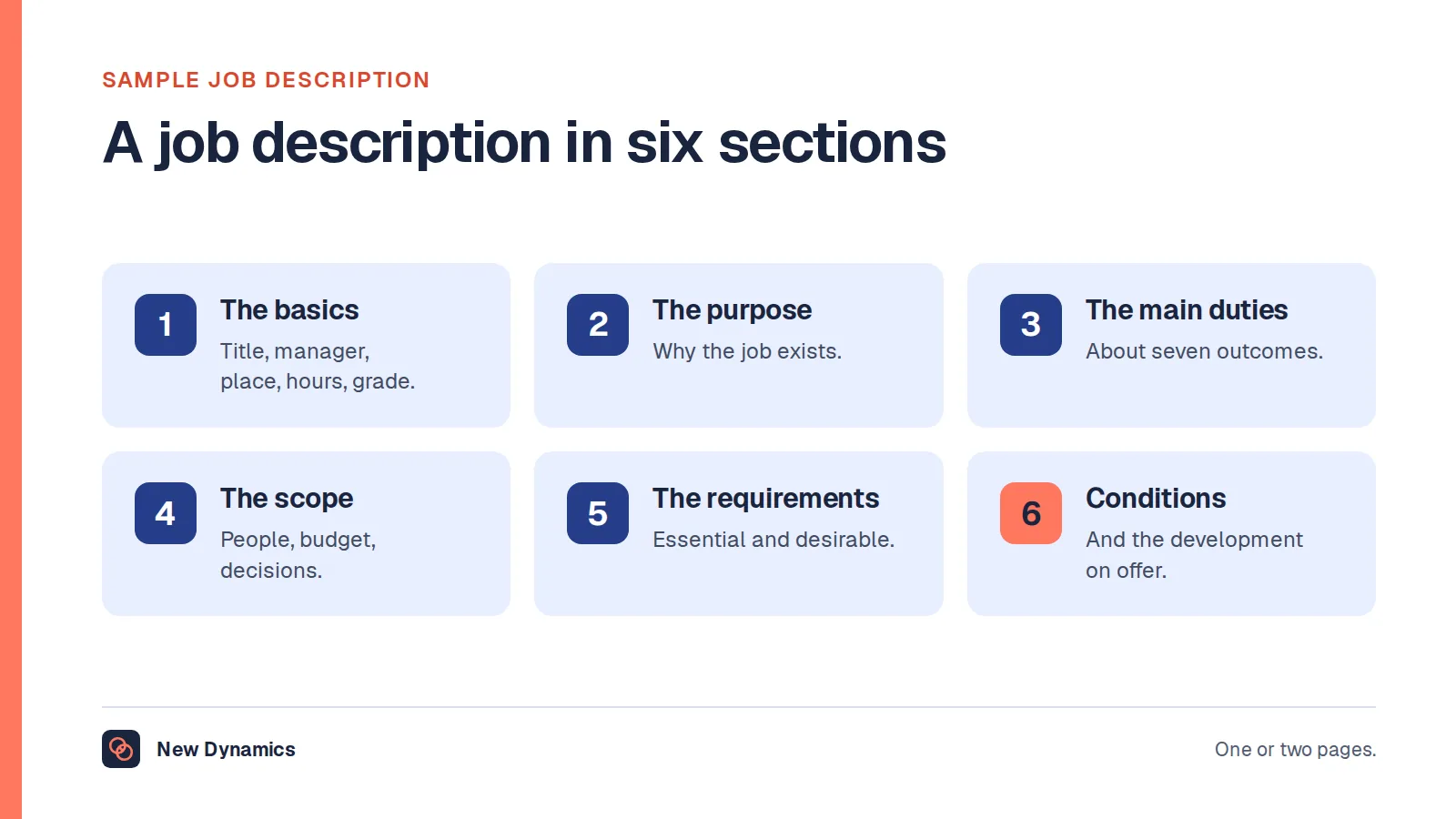
Job title: Patient service representative [United States] / Medical receptionist or patient services adviser [United Kingdom]
Setting: [GP practice / hospital outpatients / dental practice / private clinic]. Reports to: [practice manager / patient services team leader / outpatients manager].
Hours: [Full time, 37.5 hours, rota covering 8am to 6.30pm] [Early and late shifts] [Some Saturdays]
Purpose of the role: To be the first point of contact for patients in person, on the telephone and online: registering and checking in patients accurately, managing appointments under our booking protocols, handling charges and exemptions where they apply, passing messages to clinicians to a defined standard, and keeping the waiting area informed and calm.
Main duties:
- Register new patients, verify identity and details, and keep the record accurate
- Check patients in and out, and tell people what is happening and how long it will be
- Book, rebook, cancel and follow up appointments using our written protocols, escalating anything you are unsure about
- Handle [exemption checks / dental charges / insurer authorisation / self-pay invoices] and reconcile takings daily
- Pass messages to clinicians to our standard: who, when, number, what was said, what was promised, what the patient expects
- Route incoming post, results and letters, and keep patients informed when a clinic runs late
- Handle patient information in line with our confidentiality policy, escalate every third party request, and report every incident of abuse, threat or aggression
Skills and experience:
- Accurate with data under interruption
- Calm, clear and kind with people who are unwell, worried or angry
- Able to follow a written protocol and to say when it does not fit
- Discreet, and clear that confidentiality here is a legal duty rather than a preference
- Comfortable with [name the system], or quick to learn one
What we provide:
- A paid induction covering the systems, the booking protocol and confidentiality, with access scoped to your role
- Training in managing aggression and de-escalation, with refreshers
- A risk assessment covering violence at this desk, an alarm, and a route to report every incident
- A named person who responds to reports, and a stated position that abuse of our staff is not part of the job
- Cover for breaks, and a progression route to [senior receptionist, team leader, medical secretary or practice management]
For the structure of the whole document, use our job description template, and for the general version of the same skills our customer service representative job description.
Progression from the desk
The desk is a good first job in healthcare administration and a poor place to stay for ten years without a conversation about where it goes. The National Careers Service puts the first steps plainly: with training and experience a receptionist "could become a senior receptionist, front of house supervisor or personal assistant", and "in a GP surgery or health centre, you could train to become a medical secretary". From there it lists managing a team of secretaries and, with further training, "an administration manager, office manager or GP practice manager".
The routes in practice:
- Senior receptionist or patient services team leader. Rotas, training new starters, the complaints the desk cannot handle.
- Medical secretary or clinical administrator. Attached to a clinician or specialty: typing, referrals, waiting list work.
- Patient pathway or waiting list coordinator. Hospital work, tracking patients against the booking rules.
- Practice or outpatients management. The operational job, with the budget and the staff.
- Sideways into information governance, medical records or complaints. A reception background is real experience there.
The mechanism is the same whichever route: a named next role, the two or three things that would make the person ready, and a review date. Our career progression framework covers building that for a whole team.
Pay: what is published, and what is not
No official United Kingdom source publishes a pay figure for a patient service representative, because the title is not used here. Treat any figure quoted under it in a British context as a private estimate, not an official statistic. The nearest published British profiles come from the National Careers Service: £21,000 starter to £25,000 experienced a year for a receptionist, and £23,000 to £30,000 for a medical secretary. Those are England-facing figures for those two profiles, not for this title.
The Occupational Information Network reports median wages for Patient Representatives of $24.18 hourly and $50,290 annual for 2025, while stating that the wage data covers the broader group "Health Technologists and Technicians, All Other" rather than the title alone. American occupation, American figures. Our HR statistics hub collects the figures we have checked, with sources and reference periods.
Frequently asked questions
What is a patient service representative?
A patient service representative is the person at a healthcare reception desk who registers patients, manages appointments, checks people in, handles charges or insurance where they apply, passes messages to clinicians and keeps the waiting area informed. The title is American; in Britain the work is done by a medical receptionist, a patient services adviser, a ward clerk or an outpatient booking clerk.
What are the duties of a patient service representative?
Registration and identity checks, booking and cancelling appointments under the employer's written protocol, checking patients in and out, handling exemption checks, charges or insurer authorisation where they apply, passing accurate messages to clinicians, routing post and results, and keeping the waiting room informed.
What is a patient service representative called in the UK?
Medical receptionist is the general British title. A GP practice may advertise a patient services adviser or administrator. A hospital splits the work between a ward clerk and an outpatient booking clerk.
Do patient service representatives see medical records?
They see enough of the record to do the job and no more. Health data is special category data under the UK GDPR, and the Information Commissioner's Office expects access rights to be "limited to those users who reasonably need such access to perform their function and removed when no longer needed", with access logged. A receptionist is not a health professional, so they escalate rather than release health information. General information about the United Kingdom rules, not legal advice.
What skills does a patient service representative need?
Accuracy under interruption, calm with people who are unwell or angry, clear verbal communication, the discipline to follow a written protocol and escalate when it does not fit, discretion with special category data, and confidence with a patient administration system. Test each with a task at interview.
Your next step: write the two sections everybody else leaves out
- Name the setting, the hours, the systems and whether the post holder handles money.
- Write the booking protocol down before asking anyone to follow it.
- Add a confidentiality section naming special category data, scoped access and the escalation route for third party requests, and record the induction that covers it.
- Add an abuse section naming the risk assessment, the training, the alarm, the reporting route and what happens after a report.
- Give the post a named next role and a review date.
The first fortnight is where all of this either happens or quietly does not. Read and download our employee onboarding guide for a first weeks plan you can adapt to a reception rota. The guide is free to read, and the PDF uses our short download form.
Want the induction tasks, the confidentiality training record, the early goals and the first check-ins in one place? Book a New Dynamics demo and bring your current induction checklist. You can also email contact@new-dynamics.com.