TL;DR
- A career progression framework has three parts and no more: a small number of named levels, a written description of what is expected at each, and a stated route for moving between them. Remove any one part and the document becomes a hierarchy, a competency list or a wish.
- Write expectations as observable behaviour and scope of work rather than years of service, use fewer levels than people expect, and run a technical track alongside a management track so the only way up is not into management.
- A framework and a pay structure are related but separate. Mapping levels to pay bands is its own exercise with equal pay implications, and a framework that promises promotion the organisation cannot supply does more harm than no framework at all.
Ask ten people in the same organisation what it takes to reach the next level and you will often get ten answers. Time served. A vacancy. Being liked. Asking loudest. None of those is a framework, and all of them are what people fall back on when no framework exists.
This article defines a career progression framework in plain terms, separates it from the three documents it is constantly confused with, and shows how to build one. It covers how many levels to use, how to word the expectations, and how to run technical and management tracks side by side. It also covers the part most articles skip: what happens to the person who has sat at the top of a level for years, and how to stop a framework becoming a promise of promotion the organisation cannot keep.
A framework only becomes real where the work is discussed. See how New Dynamics Goals & OKRs keeps level expectations beside the goals someone is actually working on.
Two companion articles sit either side of this one. For the map of roles and moves that surrounds a framework, read career pathing. For the individual document that sits underneath it, read the employee development plan.
What is a career progression framework?
A career progression framework is a written structure that sets out the levels within a job family, what is expected of a person at each level, and how somebody moves from one level to the next.
Three parts. Nothing more.
- The levels. A small number of named steps, from entry to the most senior role in that family.
- The expectations. What a person at that level does, decides, owns and influences.
- The movement. What evidence a promotion needs, who decides, and when the decision is made.
Take away any one part and you have something else. Levels with no expectations are a hierarchy. Expectations with no route between them are a competency list. Both of those without a stated decision process are a wish, and people work out quickly that it is a wish.
"Career development framework" and "career framework" are used for the same document. Where the terms differ in practice, a career framework is the wider structure (job families, levels, professional standards) and a progression framework is the part of it that describes movement up through the levels.
Career path, career pathway and career trajectory
These three phrases get used interchangeably and mean slightly different things.
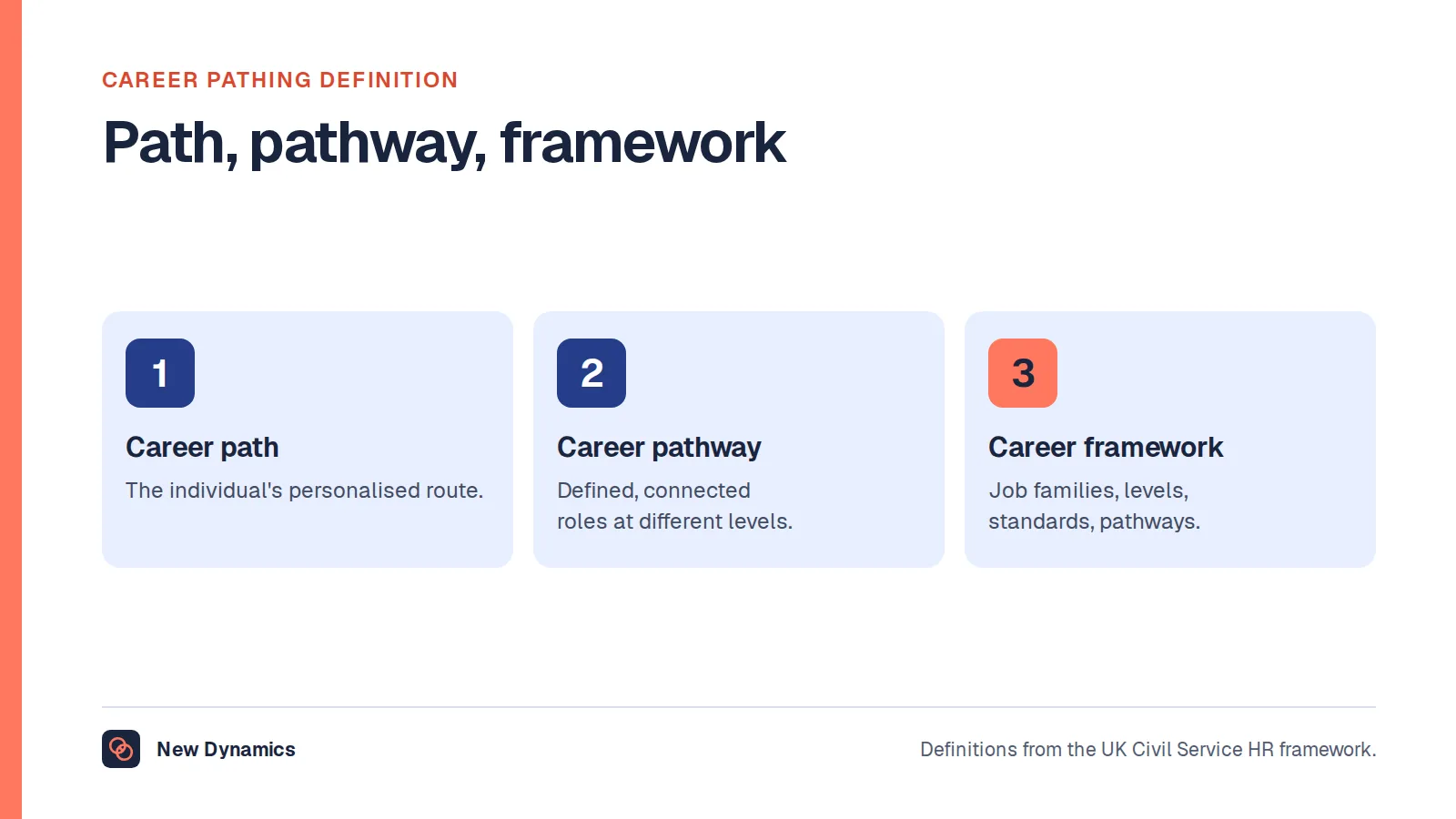
- A career path is one person's route through roles. It belongs to the individual, and it is often not a straight line.
- A career pathway is the organisation's published map: the connected roles and levels that routes can be built from.
- A career trajectory is the direction and pace of that route looked at over years rather than months. To define career trajectory honestly you need several years of history, so it is a description after the fact rather than a plan.
The framework supplies the pathway. The person supplies the path. The trajectory is what you can see later.
A framework is not a job description, a pay band or a development plan
These four documents are written by the same people, often in the same month, and they answer different questions. Confusing them is the single most common reason a framework fails.
| Document | The question it answers | Scope |
|---|---|---|
| Job description | What is this role accountable for? | One role, as it exists today |
| Pay band | What range does this level pay? | Money, and the rules around it |
| Development plan | What will this person work on next? | One person, a few months |
| Career progression framework | What does each level require, and how do you move? | A whole job family, for years |
A job description tells a new starter what the job is. It does not say what the level above looks like. A pay band tells you the range. It does not say what earns a place in it. A development plan tells one person what to practise next. It has no authority over anybody else. The framework is the only document of the four that describes the gap between two levels, which is the thing employees are actually asking about.

How many levels should a framework have?
Fewer than people expect. Four or five levels inside a job family is usually enough, and plenty of organisations run well on three.
The pressure always runs the other way. Levels feel cheap to add and they solve an awkward conversation today, so frameworks grow. The costs arrive later.
- Every extra level is another promotion the organisation has to be able to fund and justify.
- Narrow levels are hard to tell apart, so promotion decisions become arguments about wording.
- A long ladder trains people to expect a step every couple of years, which no organisation can sustain.
- The more levels there are, the more of them nobody can describe without reading the document.
A useful test: can an experienced manager, with the document closed, say what separates each level from the one below it? If not, there are too many levels, or the expectations are too vague, or both.
Name the levels in language people already use. If everybody says "senior" and "lead", do not invent "practitioner III".
Write expectations as observable behaviour and scope of work
The failure mode here is writing a level description that cannot be evidenced. "Has a deep understanding of the domain" is unfalsifiable. Two reasonable managers will disagree about it forever, and the person being assessed cannot act on it.
Write instead about what the person does, how far their work reaches, and how much judgement they exercise unsupervised. Three dimensions carry most of the weight.
- Scope. Own task, own area, own team, several teams, the whole function.
- Autonomy. Work is checked, work is reviewed, work is trusted, work sets the standard others are checked against.
- Impact. Who notices if this person is away for a month?
Then rewrite each expectation until it names something somebody could point at. Not "communicates effectively", but "writes the summary that a decision gets made from, and chases the decision". Not "shows leadership", but "picks up the work nobody owns and either does it or finds it an owner".
Keep years of service out of it entirely. Time is not a competence, and once a framework mentions years, every conversation becomes about the calendar instead of the work. Experience shows up anyway, in the scope and autonomy wording, because those things take time to earn.
A worked example: the route to HR manager
The common question "what is the career path to HR manager" is really a question about levels. In a mid-sized HR function the family usually runs through four, and the wording below is a starting point to argue with rather than a standard to copy.
- HR administrator. Owns their own queue of transactions and queries. Work is checked. Escalates anything with legal or policy judgement in it.
- HR adviser. Advises managers directly on routine cases, start to finish, without a second opinion. Spots when a pattern of cases is really a policy problem and says so.
- Senior HR adviser or HR business partner. Holds a business area. Brings the people view into decisions before they are made rather than after. Handles the complex and contested cases.
- HR manager. Accountable for the service, the policies and the people delivering it. Decides where the function spends its effort. Answers for the function's quality to the business.
Nothing in that list is a job title shuffle. Each step changes who the person answers to for what, which is the only thing that makes a level real.

Two tracks, so the only way up is not into management
If the framework has one ladder and management sits at the top of it, you have told every skilled specialist that growth means stopping the work they are good at. Some take the step and regret it. Some leave. Both outcomes cost more than writing a second track.
Run a technical or specialist track alongside the management track, from the point where they diverge. Both tracks need three things to be credible.
- Genuinely equal levels. Senior specialist and team manager sit at the same level, in the same pay band, with the same seniority in the room.
- Different expectations, same weight. The specialist track grows by depth, difficulty and influence over how work is done. The management track grows by scope of people, service and budget.
- Permission to move sideways. A manager who wants to return to deep work should be able to, at the same level, without it reading as a demotion.
The usual objection is that a senior specialist "has no direct reports, so cannot be at that level". That objection is about headcount, not contribution, and a framework that accepts it will always funnel people into management.

A published example: the UK Civil Service grade structure
The clearest place to look at a real progression structure is one that is published. The UK Civil Service sets out its grades openly, and the Cabinet Office publishes the distribution of staff across them each year.
Civil Service Statistics: 2026 reports the position as at 31 March 2026, when "employment stands at 557,825 headcount and 523,795 on a full-time equivalent basis (FTE)". The grade structure it reports against runs from Administrative Assistant and Administrative Officer (AA/AO), through Executive Officer (EO), Higher and Senior Executive Officer (HEO/SEO), Grades 6 and 7, up to the Senior Civil Service.
Two figures from that release are worth any framework owner's attention.
- "75.5% of civil servants work at Executive Office (EO) grade and above. This is a slight increase from 75.0% in 2025 and up from 62.1% in 2016."
- "The percentage of civil servants working in grades 6 and 7 has increased to 16.7%, up from 16.2% in 2025 and 9.7% in 2016."
Just over three quarters of the workforce now sits at EO grade or above, and the share at Grades 6 and 7 has gone from under a tenth to roughly a sixth in a decade. That is what a published structure lets you see: not just the shape of the ladder, but how the shape moves when a decade of individual promotion decisions accumulates. Most organisations never look. If you want the wider picture on workforce measures, our HR statistics hub collects published figures in one place.
The lesson is not that seniority drift is wrong. It is that nobody decides it deliberately. Count your own distribution by level once a year and you will know whether your framework is doing what you intended.
The people at the top of a level for a long time
Here is the situation frameworks are usually silent about. Somebody meets every expectation at their level. They have met them for three years. There is no vacancy above them, or the level above needs a scope the organisation does not have to give. What does the framework say to them?
If the answer is nothing, the framework has quietly become a promise, and the person is waiting on a promise you cannot keep. That is worse than having no framework, because now the disappointment is documented.
Four honest answers, in rough order of preference.
- Say it plainly. "You are performing at the top of this level. The next level needs a scope that does not exist in this team right now." That sentence is unpleasant to say and far better than silence.
- Separate the level from the recognition. Pay progression within a band, the hardest work, the trusted projects and the final word on a technical area are all available without a new level. Use them, and say that is what you are doing.
- Look sideways before up. A move into another team or job family at the same level adds scope that a vertical move cannot, and often unblocks the vertical move later.
- Decide whether the level above should exist. Sometimes repeated pressure at one level is real evidence that the structure is wrong. Change the structure deliberately, for everybody, rather than creating a level for one person.
Write this into the framework itself. One short section saying the framework describes what each level requires and does not guarantee a promotion by any date will do more for trust than any amount of careful level wording.
Pay: related to the framework, but a separate exercise
A career progression framework and a pay structure are connected and are not the same thing. The framework says what a level requires. The pay structure says what a level pays. Writing them as one document means every conversation about expectations turns into a conversation about money, and the expectations lose.
Map levels to pay bands as its own exercise, after the levels are stable. It carries legal implications, and in the UK those are specific.
Acas, the public body that advises on employment matters, states that "By law, men and women must get equal pay for doing 'equal work'". Its guidance on equal pay and the law sets out three ways work counts as equal: "like work", where "the job and skills are the same or similar"; "work rated as equivalent", which is "work that's found to be equivalent, usually using a job evaluation process"; and "work of equal value", which is "work that is not similar but is of equal value". Pay here is broader than salary, covering basic pay, pension, overtime pay, holiday pay, sick pay, performance-related pay and benefits.
That matters for a framework for one practical reason. If two levels in two different tracks are declared equal, the pay attached to them has to be defensible on the same basis. A job evaluation exercise is the usual way to show that, and the framework is an input to it rather than a replacement for it.
Separately, larger employers have a reporting duty. The gov.uk guidance on gender pay gap reporting states that "Any employer with 250 or more employees on a specific date each year (the 'snapshot date') must report their gender pay gap data", and that "You must report and publish your gender pay gap information within a year of your snapshot date". A gender pay gap is a different measure from an equal pay breach, and a framework that pushes one group into lower levels will show up in both.
Jurisdiction and status: the equal pay provisions of the Equality Act 2010 apply in England, Scotland and Wales, and Northern Ireland has its own separate legislation. This article is general information, not legal advice. Take advice on your own circumstances before you attach pay to levels.
How the framework shows up in a review conversation
A framework that lives on an intranet page is not a framework. It becomes real at exactly one moment: when a manager and an employee sit down and talk about the employee's work against it. Everything else is preparation for that conversation.
Three questions make the framework usable in a review, and they work in that order.
- Where are you against this level? Go through the expectations for the current level. Name the ones that are clearly met, with the evidence. Name the ones that are not yet, with the evidence. Avoid scoring. The point is a shared picture, not a number.
- Which expectations at the next level do you already show? Almost everybody shows some. Saying which ones, specifically, turns an abstract ladder into a short list.
- What would change the answer? Usually one or two things: a piece of work with more scope, a decision the person makes rather than recommends, something handed over so there is room. That is the development plan, written from the framework rather than from a list of courses.
Two rules keep the conversation honest. The expectations discussed must be the published ones, not a manager's private version. And if a promotion is not available, say so at the start of the conversation, not at the end of it, so the rest of the discussion is about capability rather than a decision already made elsewhere.
Promotion readiness covers how that judgement is made and what a "not yet" has to come with, and career conversations gives a structure for the wider discussion.
What goes wrong
Four failures account for most of the frameworks that quietly stop being used.
Levels written as a wish list
Somebody writes down the ideal senior engineer, the ideal senior adviser, the ideal lead. Nobody currently in those roles matches the description. The framework instantly labels every existing postholder as under-performing, so managers stop referring to it. Write levels from the people who are genuinely doing the job well today, then raise the bar deliberately if it is too low.
Criteria nobody can evidence
If an expectation cannot be supported by something a person actually did, it is decoration. Test every line by asking what you would point at in a review. If the answer is a feeling, rewrite the line or delete it.
Published once and never used
A framework launches with a presentation and a page. Six months later, nothing references it: not the review form, not the job adverts, not the promotion paperwork. It is now historical. The fix is structural rather than motivational. Put the level expectations in the review conversation, in the recruitment brief and in the promotion case, so the framework is unavoidable rather than optional.
Promotion decided outside it
The worst failure, because it is the one people notice. Someone is promoted without the evidence the framework asks for, or a promotion case that clearly meets it is refused for an unstated reason. Both tell everybody that the real criteria are elsewhere, and the framework never recovers that credibility cheaply. If a decision has to be made outside the framework, name that, name why, and fix the framework if it was wrong.
Frequently asked questions
What is a career progression framework?
It is a written structure with three parts: the levels in a job family, what is expected at each level, and the route for moving between them. It tells an employee what their current level requires and what the next one would require, and it tells the organisation what a promotion has to be justified by.
What is the difference between a career framework and a career path?
A career framework belongs to the organisation and is published. It sets out levels, expectations and routes for everybody in a job family. A career path belongs to one person and is a route they take through those roles over time. The framework is the map; the path is the journey somebody makes across it.
How many levels should a career progression framework have?
Usually four or five within a job family, sometimes three. Fewer than people expect. Each extra level is another promotion the organisation must fund and justify, and narrow levels are hard to tell apart, so decisions turn into arguments about wording rather than about work.
Does a career progression framework have to be linked to pay?
They need to be consistent, but they are separate documents produced by separate exercises. Decide the levels and expectations first, then map them to pay bands. In the UK that mapping carries equal pay implications under the Equality Act 2010, so take proper advice before you do it.
What is the career path to HR manager?
Commonly four levels: HR administrator, HR adviser, senior HR adviser or HR business partner, then HR manager. What changes at each step is scope and autonomy, from owning your own queue of work to advising managers unsupervised, then holding a business area, then being accountable for the function itself.
What should we do when someone is at the top of their level and there is no vacancy?
Say so directly, early. Then use what is actually available: pay progression inside the band, the hardest and most visible work, ownership of a technical area, or a sideways move into another team at the same level. Treating the framework as a promise of promotion by a certain point is the mistake to avoid.
Next steps
Build the framework in the order that keeps it honest. Pick the job family. Choose three to five levels and name them in words people already use. Write each level as scope, autonomy and impact, with no mention of years served. Add the second track where management and specialist work diverge. Write the paragraph that says what the framework does not promise. Only then map levels to pay bands, as a separate exercise and with advice. Then put the expectations into the review conversation, because that is the only place an employee ever meets the framework.
For the wider picture on growing careers inside an organisation, read and download our career development guide. The guide is free to read, and the PDF uses our short download form.
If you want to see level expectations, goals and review conversations held in one place rather than three spreadsheets, book a demo and we will walk through it with your own levels.