TL;DR
- A receptionist works at the front desk of an office, hotel, surgery or other building, welcoming and helping visitors, answering the phone, managing bookings and appointments and keeping the entrance secure and orderly. In hotels the same role is called a front desk agent.
- The job has six duties: welcome and direct visitors, answer and route calls and messages, manage bookings, appointments and check-in, keep the desk secure and compliant, handle post, deliveries and supplies, and support the wider team with administration.
- Employers look for warmth, calm under pressure, clear communication, accuracy with systems and discretion with personal data. No qualifications are usually required, and in England the level 2 hospitality and customer service apprenticeships cover the ground.
Whoever sits at the front desk is the organisation, for the thirty seconds it takes a visitor to decide what they think of it. The receptionist is also the person who knows where everyone is, which delivery has not arrived and who is waiting in the lobby getting annoyed.
This receptionist job description gives a job specification for the role: what a receptionist does, six front desk duties, how office, hotel and medical reception differ, the skills employers ask for, a template that you can adapt, and interview tips for candidates.
A receptionist's first week is the induction to everything the organisation does. See how New Dynamics onboarding brings tasks, early goals and manager conversations into a clear path for a new starter.
What is a receptionist?
The Cambridge Dictionary defines a receptionist as “a person who works in a place such as a hotel, office, or hospital, who welcomes and helps visitors and answers the phone”, and the front desk as “a desk near the entrance to a hotel, office building, etc. where people go when they arrive and where they can get information”.
Those two definitions contain the job. A receptionist is the person at the front desk who welcomes, helps, informs and connects. In hotels the title is usually front desk agent or front of house; in medical practices, medical receptionist; in corporate offices, receptionist or front of house coordinator. The settings differ, and the next section separates them, but the six duties are shared.
Receptionist duties: six responsibilities
- Welcome and direct visitors. Greet everyone who arrives, find out who they are here to see, sign them in, issue passes, offer a seat and a drink where that is the custom, and let the host know.
- Answer and route calls and messages. Answer the switchboard or main line and the shared inbox, transfer calls, take accurate messages and pass them on promptly.
- Manage bookings, appointments and check-in. Take and confirm appointments or reservations, manage the diary or the room bookings, and run check-in and check-out where the setting has them.
- Keep the desk secure and compliant. Control access to the building, keep the visitor record, follow the fire and evacuation procedures for visitors, and handle personal data in line with the organisation's rules.
- Handle post, deliveries and supplies. Receive and distribute post and parcels, sign for deliveries, arrange couriers and keep the reception area and its supplies in order.
- Support the team with administration. Data entry, scanning, filing, ordering, travel bookings and whatever the office or the front office needs when the desk is quiet.

Office, hotel and medical reception
| Setting | What is distinctive |
|---|---|
| Office reception | Visitor passes, meeting rooms, couriers, the switchboard and support for the office team |
| Hotel front desk | Check-in and check-out, reservations, payments, guest requests and complaints, and shifts around the clock |
| Medical reception | Appointments, patient records and confidentiality, prioritising the unwell and the anxious, and the practice's clinical systems |
For the hotel version, Skills England's hospitality team member apprenticeship standard, a level 2 standard which Skills England now lists as retired, describes the reception specialism: know the business procedures for delivering reception operations and the requirements for processing personal and sensitive data, know the products, facilities and services of the whole business, “Welcome customers and provide a broad range of relevant information relating to the business”, “Support an efficient check in / check out service for customers, answer enquiries and take reservations and bookings face to face, on the telephone or on-line”, and “Be the link between visitors, staff and guests”. That last phrase is the job in seven words, in any setting.
A front desk agent's duties and responsibilities in a hotel add payments, room allocation, guest requests and complaints, night shifts and the handover between shifts. A medical receptionist adds confidentiality, appointment triage under the practice's rules and calm with people who are unwell.

Skills employers ask for
- Warmth. A genuine welcome, to the hundredth visitor as much as the first.
- Calm under pressure. Three phones, a delivery and an angry visitor at once, handled in order and without visible panic.
- Clear communication. On the phone, at the desk and in messages, in plain language.
- Accuracy with systems. The visitor log, the diary, the booking or clinical system, the switchboard.
- Discretion. The receptionist sees who visits, who calls and, in a surgery, why. Confidentiality is part of the job.
- Organisation. Post, couriers, rooms, supplies, all in order without being asked.
- Presentation and punctuality. The desk must be staffed and ready when the doors open.
Qualifications
No qualifications are usually required. Employers train on their systems and procedures. In England the level 2 customer service practitioner apprenticeship and, for hotels, the hospitality standards offer work-based routes, and our customer service representative job description covers the wider customer service field. Experience in customer-facing work of any kind helps.
Receptionist job specification template
Adapt the setting, the systems and the hours.
Job title: Receptionist (front desk)
Reports to: Office manager, front office manager or practice manager
Hours: [Full time, Monday to Friday 8.30am to 5.30pm] / [shifts including evenings, weekends and nights]
Purpose of the role: To be the first point of contact for visitors, callers and staff, giving a welcoming, efficient and secure front desk service and supporting the [office, hotel or practice] with administration.
Main duties:
- Welcome visitors, sign them in, issue passes and notify hosts
- Answer and transfer calls, take accurate messages and manage the shared inbox
- Manage [appointments, reservations, meeting rooms] and run [check-in and check-out]
- Control access, keep the visitor record, follow fire and evacuation procedures and handle personal data correctly
- Receive and distribute post and deliveries, arrange couriers and keep the reception area and supplies in order
- Support the team with data entry, scanning, filing, ordering and bookings
Skills and experience:
- Warm, calm and clear with visitors and callers, in person and on the phone
- Accurate with [visitor, booking or clinical] systems and standard office software
- Discreet with confidential information
- Organised, punctual and well presented
- Experience in a customer-facing or front desk role [desirable]
We provide: Training on our systems, security and data protection procedures, and a route to senior receptionist, front office supervisor, office manager or administrative roles.
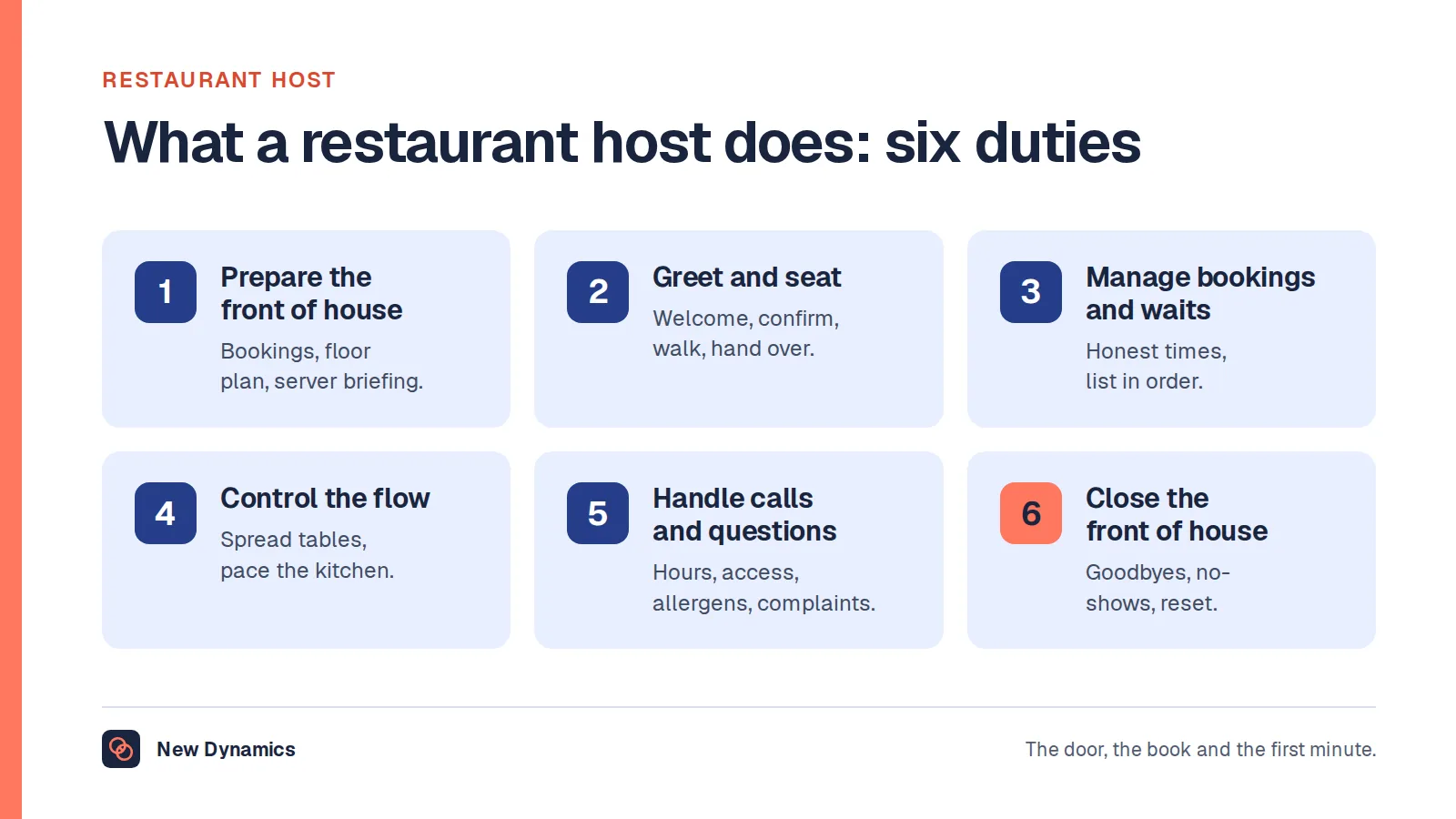
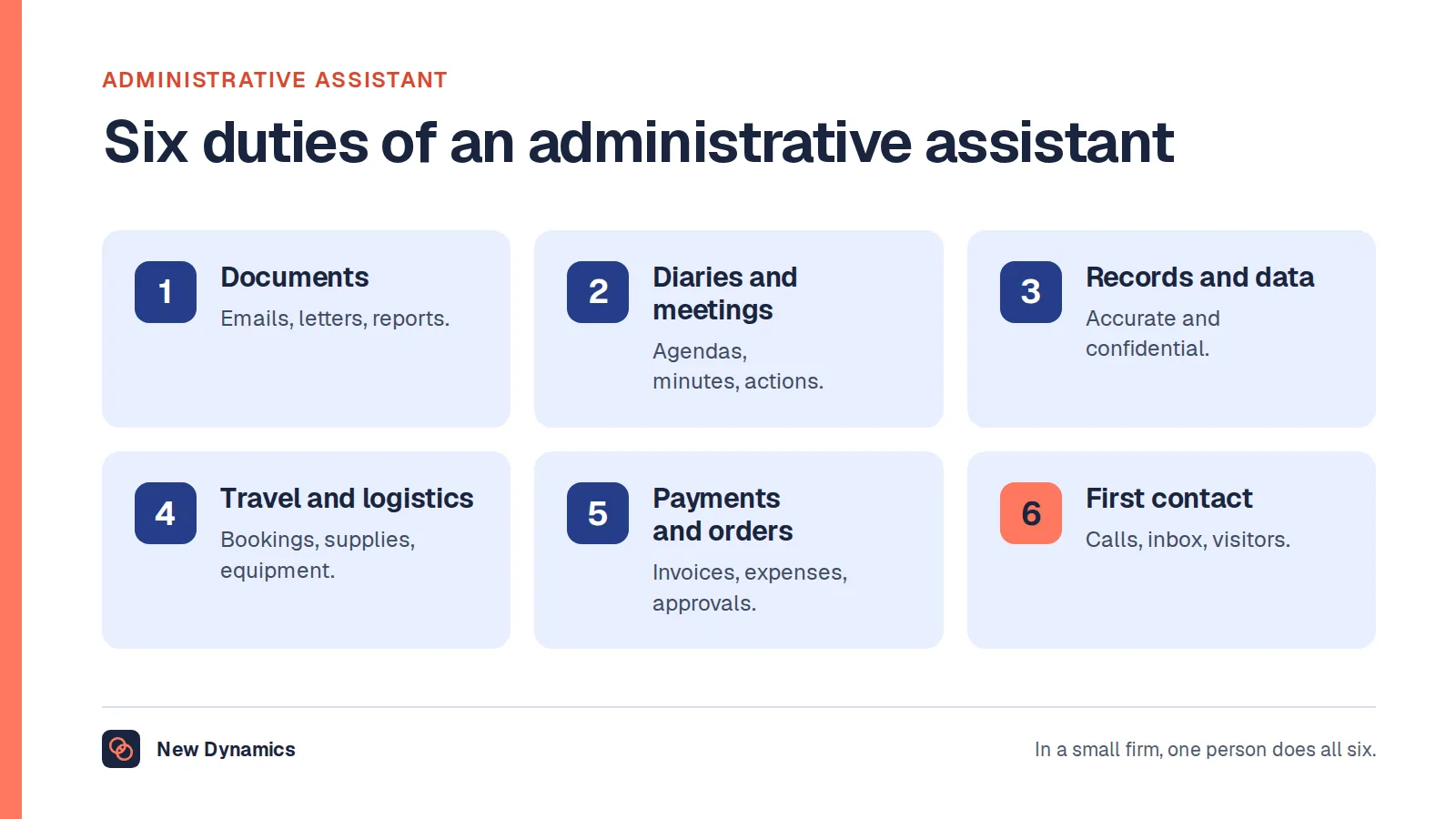
For the layout of the whole document, use our job description template. For the administrative role the receptionist often grows into, see our administrative assistant job description, and for the restaurant equivalent, our restaurant host job description.
Interview tips for a receptionist
For candidates, the interview starts in the car park. Employers hiring for the front desk watch how you arrive, greet and wait, because that is the job.
- Arrive early and greet everyone. The person who lets you in may be the person you would replace, and they will be asked what they thought.
- Prepare three stories. A difficult visitor or caller you calmed, a day when everything arrived at once and how you ordered it, and a mistake you caught before it mattered.
- Know the organisation. What it does, who its visitors are and what they will need from the desk.
- Show the systems. Name the switchboard, booking, visitor or clinical systems you have used, and say how quickly you learn new ones.
- Talk about confidentiality. Say how you would handle a caller asking for information you should not give.
- Ask about the desk. Cover for breaks, the busiest times, what goes wrong most often. It shows you understand the job and helps you judge the employer.
How to describe reception work on a CV
Employers want the setting, the volume, the systems and the standard. The lines below are invented examples, to show the form.
- Show the setting and volume. “Front desk for a 120-person law firm, around 60 visitors and 150 calls a day.”
- Show the systems. “Managed visitor passes, 14 meeting rooms and the switchboard.”
- Show the standard. “Kept the visitor log audit-ready and ran the evacuation roll call at every drill.”
- Show the people side. “Handled guest complaints at check-in for a 200-room hotel, escalating fewer than one a week.”
- Show the extra. “Took over travel bookings and stationery ordering for the office.”
Common mistakes in receptionist adverts
No setting. Office, hotel and surgery are different jobs to the people who do them. Say which.
Hidden hours. Early starts, shifts, weekends and nights belong in the first paragraph.
Silence on security and data. Passes, visitor records and confidentiality are duties. Name them and the training you give.
Personality only. “Bubbly” is not a skill. Ask for calm, accuracy and discretion.

Frequently asked questions
What is a job specification for a receptionist?
A receptionist job specification sets out the purpose of the front desk role, six main duties covering visitors, calls, bookings, security, post and administration, the skills required such as warmth, calm, accuracy and discretion, the hours and the systems used, and the route to senior reception or administrative roles.
What are front desk duties?
Front desk duties are welcoming and directing visitors, answering and routing calls and messages, managing bookings, appointments and check-in, keeping the desk secure and compliant, handling post, deliveries and supplies, and supporting the team with administration.
What are a front desk agent's duties and responsibilities in a hotel?
A hotel front desk agent runs check-in and check-out, takes and manages reservations, handles payments and room allocation, deals with guest requests and complaints, answers calls and enquiries, keeps the visitor and guest records secure, and hands over between shifts, often around the clock.
What skills does a receptionist need?
Warmth, calm under pressure, clear communication in person and on the phone, accuracy with systems, discretion with personal information, organisation, punctuality and good presentation.
What qualifications do you need to be a receptionist?
Usually none. Employers train on their systems and procedures. In England the level 2 customer service practitioner apprenticeship and the hospitality standards offer work-based routes, and customer-facing experience of any kind helps.
What are good interview tips for a receptionist?
Arrive early and greet everyone, prepare stories about a difficult visitor, a busy day and a mistake you caught, know the organisation and its visitors, name the systems you have used, be ready to talk about confidentiality, and ask about the desk's busiest times and cover.
Your next step: describe the desk, not just the person
- Say the setting, the hours and the systems.
- List the six duties and name security and data protection among them.
- Ask for calm, accuracy and discretion, with examples at interview.
- Show the route onward.
A receptionist's first week should cover the systems, the security procedures and who everyone is. Read and download our employee onboarding guide. The guide is free to read, and the PDF uses our short download form.
Want every new starter's first weeks planned, with tasks, goals and check-ins in one place? Book a New Dynamics demo and bring your current induction. You can also email contact@new-dynamics.com.