TL;DR
- A requisition is a formal request for something that is needed. A job requisition is a manager's formal request to fill a position, which must be approved before recruitment begins.
- It is an internal document. The job description records the role, and the job posting advertises it. The requisition asks permission to fill it, and says why, at what cost and by when.
- The process has six steps: identify the need, complete the request, get approval, open the requisition with a number, recruit against it and close it. The requisition number ties candidates, costs and reports together.
A candidate's email says: “I am applying for requisition 24-0187.” A manager is told: “You cannot interview until the req is approved.” A finance report lists “open requisitions” by department. The word sounds bureaucratic, and what it names is simple: permission to hire, written down.
This article gives the meaning of requisition, explains what a job requisition is, how it differs from a job description and a job posting, what it contains, how the approval process works and what a requisition number is for. It includes a template.
A requisition starts with a gap in the structure. See how New Dynamics org charts show roles, reporting lines and the relationships between them.
What does requisition mean?
The Cambridge Dictionary defines a requisition as “a formal or official request for something needed”. Its example is from an office: “The staff made a requisition for new desks.” As a verb, it means “to officially request or take something”.
Organisations use requisitions for anything that costs money and needs approval. Cambridge's business entry points to the purchase requisition, which is a request to buy goods or services. A job requisition, also called a position requisition, a hiring requisition or simply a “req”, is the same idea applied to people: a formal request to fill a job.
Large employers often work this way. The United States federal government, for example, has a standard form for requesting personnel actions. The Office of Personnel Management's Guide to Processing Personnel Actions explains how to prepare and process Standard Form 52, and devotes a chapter to “Requesting and Documenting Personnel Actions”.
Requisition, job description and job posting
Three documents are easily confused.
- Job requisition. An internal request for permission to fill a position. Its readers are the people who approve headcount and budget.
- Job description. A record of the role: its purpose, duties and requirements. Its readers are the post holder, the manager and applicants.
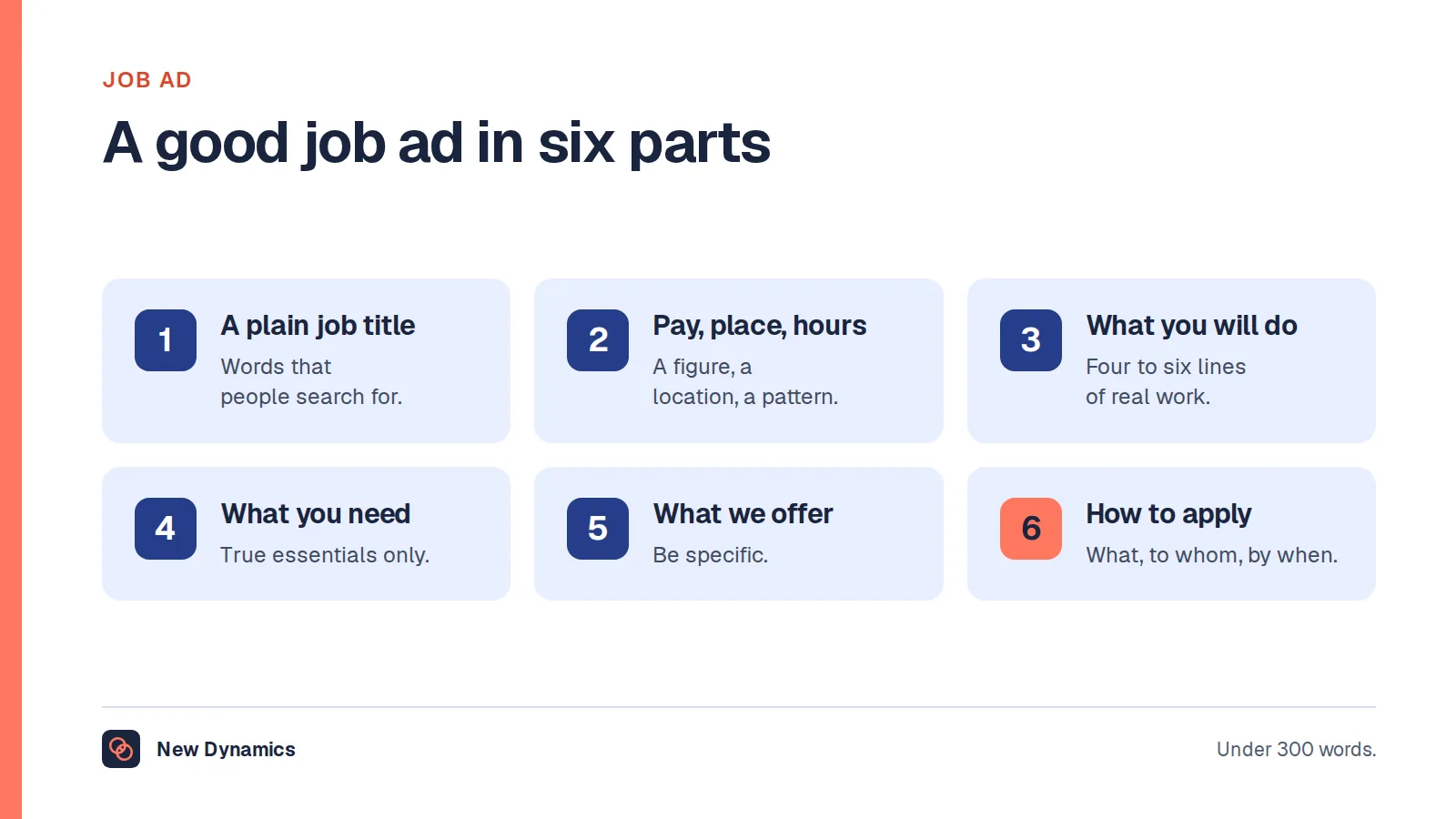
- Job posting. The public advert. Its reader is a stranger who might apply. Our guide to the job ad shows how to write one.
The order matters. The requisition comes first, because there is no point in advertising a job that has not been approved. The job description is usually attached to it. The posting follows approval.

What a job requisition contains
A requisition answers five questions.
- Why? Is this a replacement or a new position? What happens if it is not filled? Could the work be done another way?
- What? The job title, department, location, grade, reporting line, and whether the post is permanent, fixed term, full time or part time.
- What will it cost? The salary range, the budget code, and whether the cost is already in the budget.
- When? The target start date, and any deadline that drives it.
- Who approves? The hiring manager who asks, and the people who must agree: usually a department head, finance and HR.
It should also carry the job description, and name the hiring manager and the recruiter.
The first question is the one that gets skipped. A vacancy is a chance to ask whether the role should be refilled as it was, redesigned, moved or left empty. Our guide to the meaning of staffing sets out five ways to fill a gap, of which a permanent hire is only one.

The job requisition process in six steps
- Identify the need. Someone resigns, the workload grows or the plan calls for a new skill. The hiring manager defines the gap.
- Complete the requisition. The manager fills in the form or the screen in the HR system, with the job description attached.
- Get approval. The request passes along the approval chain. Each approver checks something different: the department head checks the need, finance checks the budget, and HR checks the grade, the pay range and the fit with the workforce plan.
- Open the requisition. Once approved, the requisition is given a number and a status of open. Recruitment can start.
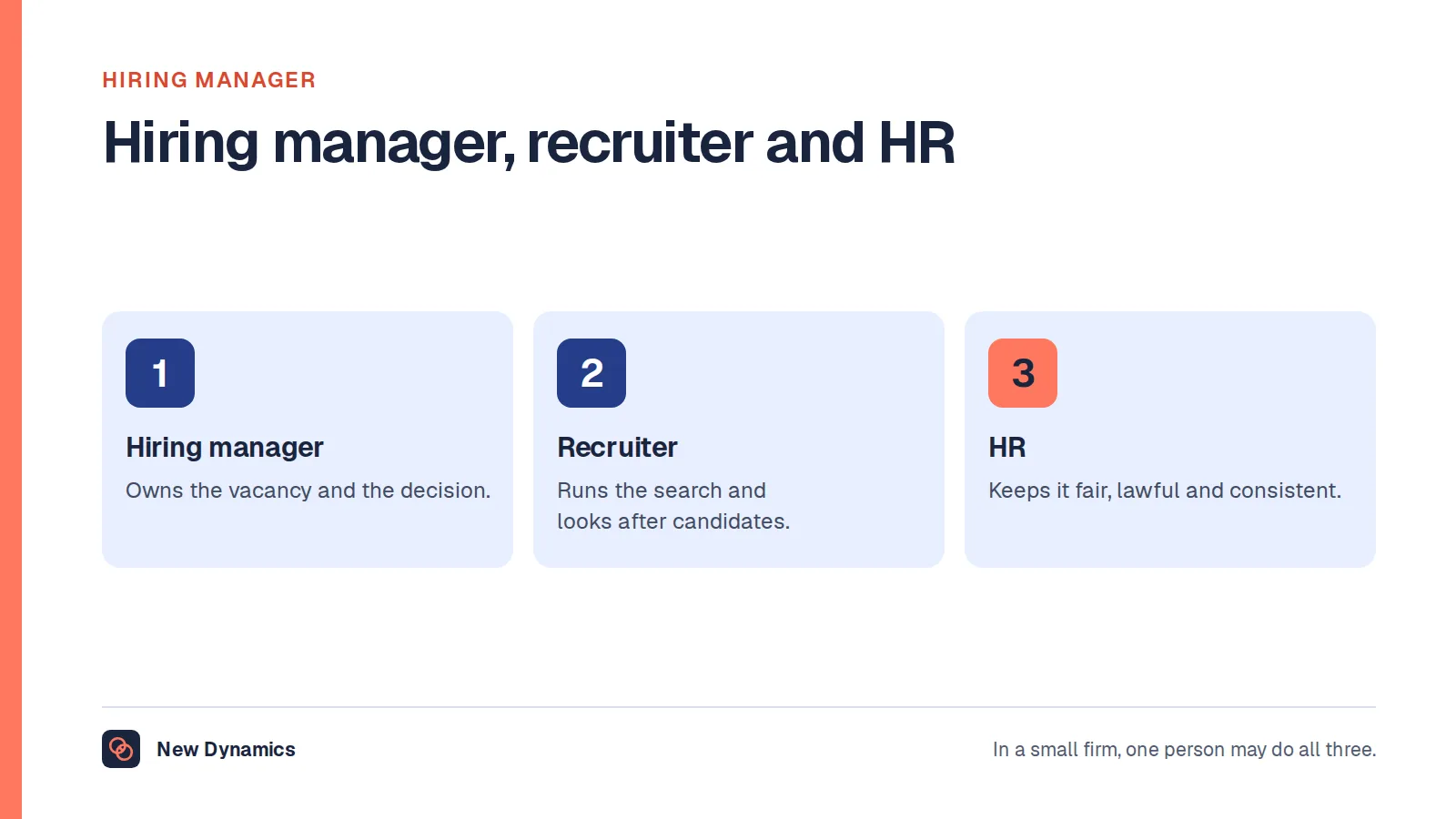
- Recruit against it. The posting, the applicants, the interviews and the offer are all recorded against the requisition. Our article on the hiring manager explains who does what.
- Close it. When the offer is accepted and the person starts, the requisition is closed as filled. If plans change, it is closed as cancelled, or put on hold.
Speed matters here. The Office of Personnel Management opens its hiring process analysis tool with the problem: “One of the greatest challenges for a hiring manager is getting the right person on board in the least amount of time.” If the process moves too slowly, it warns, “the best candidate may lose interest in the position or may accept a different job”. Approval that takes three weeks is three weeks in which nobody is being recruited.

What is a requisition number?
A requisition number, or req ID, is the unique reference that is given to an approved requisition. Formats vary. Some employers use the year and a running number, such as 24-0187. Others add a code for the department or the location.
The number does three jobs.
- It identifies the vacancy. Two openings with the same job title in different teams have different numbers. Candidates may see the number on the posting, and can quote it when they apply or ask a question.
- It links the records. Applications, interview notes, the offer and recruitment costs are all filed under it.
- It makes reporting possible. Open requisitions, time to fill and cost per hire are all counted by requisition.
One requisition usually covers one position. When a team is hiring several people into identical roles, some employers open one requisition with several openings, and others open one each. Either works, as long as the practice is consistent.
A job requisition template
Adapt this to your organisation. Text in square brackets is for you to complete.
Requisition number: [Assigned on approval]
Date requested: [Date] Requested by: [Hiring manager]
Position
- Job title: [Title]
- Department and cost centre: [Department, code]
- Location and working pattern: [Site. On site, hybrid or remote. Hours.]
- Reports to: [Manager's job title]
- Grade or level: [Grade]
- Contract: [Permanent or fixed term. Full time or part time.]
- Number of openings: [Number]
Reason
- Type: [Replacement for a leaver, a new position, or a temporary need]
- Justification: [Why the role is needed. What happens if it is not filled. Alternatives that were considered.]
Cost and timing
- Salary range: [Range]
- Budgeted: [Yes or no. If no, the source of funding.]
- Other costs: [Agency fees, advertising, equipment]
- Target start date: [Date]
Attachments: [Job description. Person specification.]
Approvals: [Department head, date. Finance, date. HR, date.]
Status: [Draft, submitted, approved, open, on hold, filled or cancelled]
Keep it to one page. If managers need an afternoon to complete the form, they will find ways around it.
Common mistakes
Recruiting before approval. An offer is made, and then finance says that there is no budget. Few things damage a manager's credibility, or a candidate's trust, more quickly.
Rubber-stamp replacements. Refilling every vacancy as it was, without asking the first question.
Too many approvers. Each signature adds days. Three is usually enough.
A requisition with no job description. Approvers cannot judge a role that they cannot see.
Requisitions that never close. Old open requisitions distort every report. Review them monthly.
Salary ranges that change after approval. If the market forces a higher offer, go back for approval. Do not hope that nobody notices.
Frequently asked questions
What does requisition mean?
A requisition is a formal or official request for something that is needed. Organisations use purchase requisitions to request goods and services, and job requisitions to request permission to fill a position.
What is a job requisition?
A job requisition is a hiring manager's formal, internal request to fill a position. It states why the role is needed, what the role is, what it will cost and when it is needed, and it must be approved before recruitment begins.
What is the difference between a job requisition and a job description?
The requisition asks for permission to hire, and is read by the people who approve headcount and budget. The job description records the purpose, duties and requirements of the role. The job description is usually attached to the requisition.
What is a requisition number?
A requisition number, or req ID, is the unique reference given to an approved requisition. It identifies the vacancy, links applications, interviews, offers and costs to it, and allows reports such as open requisitions and time to fill.
Who approves a job requisition?
Typically the head of the department, finance and HR. The department head confirms the need, finance confirms the budget, and HR checks the grade, the pay range and the fit with the workforce plan. Smaller employers may need only one approver.
What does “requisition closed” mean?
It means that the requisition is no longer open for recruitment. It may have been filled, because a candidate accepted an offer, or cancelled, because plans changed. A candidate who sees this status can ask the employer which it was.
Your next step: time one requisition
- Take your last three hires, and count the days between the request and the approval.
- List everyone who had to approve. Ask whether each one added a check that nobody else made.
- Add the “why” question to your form, if it is missing.
- Close or cancel every requisition that has been open for more than six months.
For a full, fair hiring process, read and download our recruitment and selection guide. The guide is free to read, and the PDF uses our short download form.
Want to see where each new role sits before you ask for it? Book a New Dynamics demo and bring your current structure. You can also email contact@new-dynamics.com.