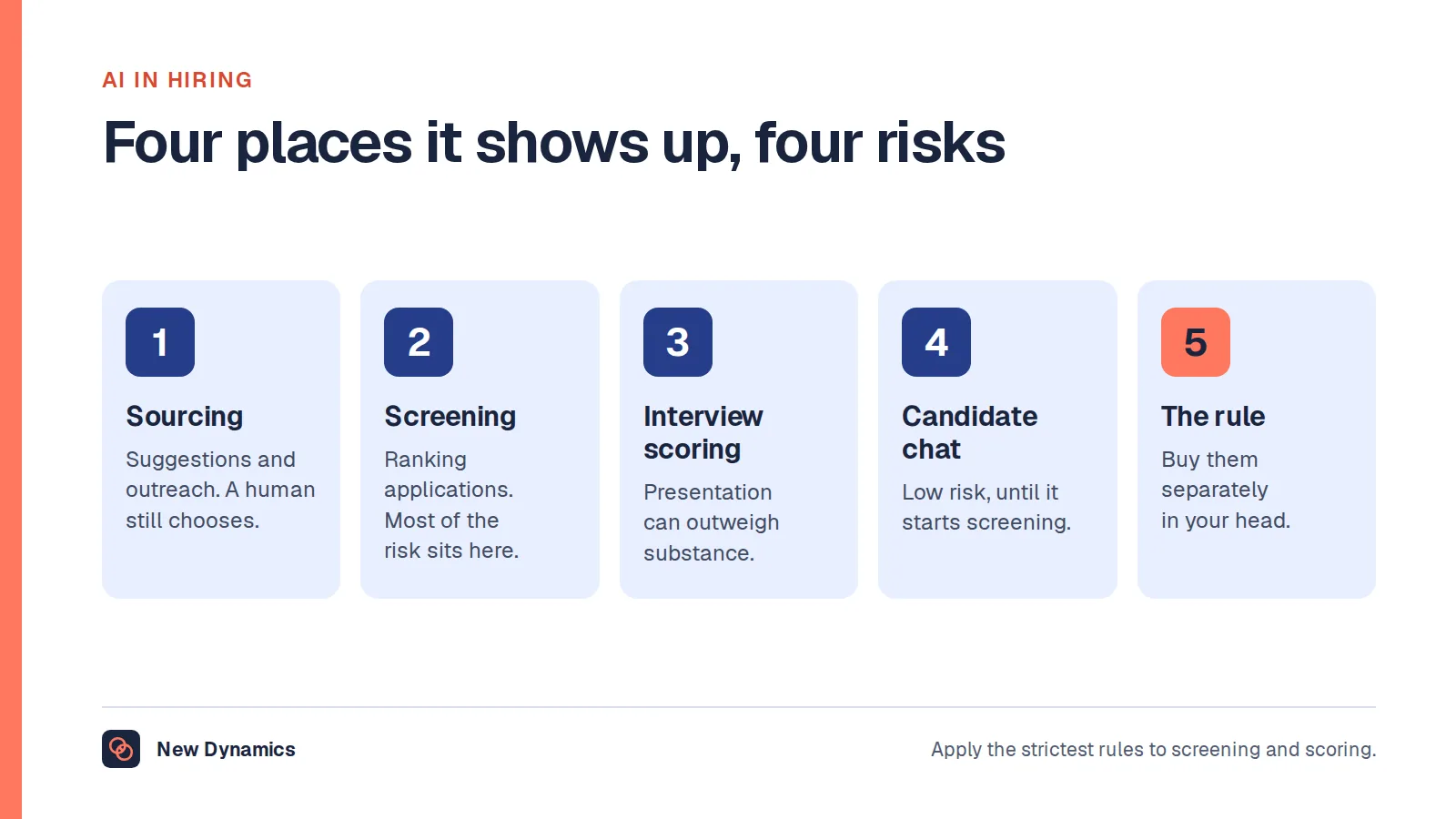
TL;DR
- The dividing line is whether a step decides anything. Acknowledgements, interview slots, reminders and data entry move work around and carry no judgement. Sifting, scoring and rejecting are decisions about a person, and the ICO's draft recruitment guidance says data protection law restricts solely automated decisions including "a decision about whether to shortlist a candidate, recommend them for interview, reject them or promote them".
- The rule changed. Section 80 of the Data (Use and Access) Act 2025 came into force on 5 February 2026 by S.I. 2026/82 and replaced UK GDPR Article 22 with Articles 22A to 22D. Article 22A says "a decision is based solely on automated processing if there is no meaningful human involvement in the taking of the decision", and requires you to weigh "the extent to which the decision is reached by means of profiling".
- Training a sift on past hiring imports past hiring. The GOV.UK Responsible AI in Recruitment guide warns that screening tools "are often trained using historical data" and may "use proxy indicators for success that are not relevant to a position", which is where sections 19 and 15 of the Equality Act 2010 bite. This is general information about the United Kingdom, not legal advice.
A recruiter opens the inbox on Monday and finds nine hundred applications for one vacancy. Something has to give. Two of the steps in front of them are safe to hand to software, and two of them are decisions the law expects a named person to make.
That is the whole of recruitment automation. The useful question is never how much of hiring you can automate, but which steps carry a judgement about a person, because those steps bring duties and the rest do not.
This article separates the two: the steps that genuinely absorb automation, why automated sifting is the part that goes wrong, the data protection rules that changed on 5 February 2026, what counts as human involvement, what you tell candidates, where the discrimination risk sits, how long to keep the records, and what to ask a supplier. It names no products, describes the position in the United Kingdom, and is general information rather than legal advice.
Automation is mostly routing, and routing is only safe when somebody owns the next step. See how New Dynamics workflows send a task to a named owner with a due date, so a handover is recorded rather than assumed.
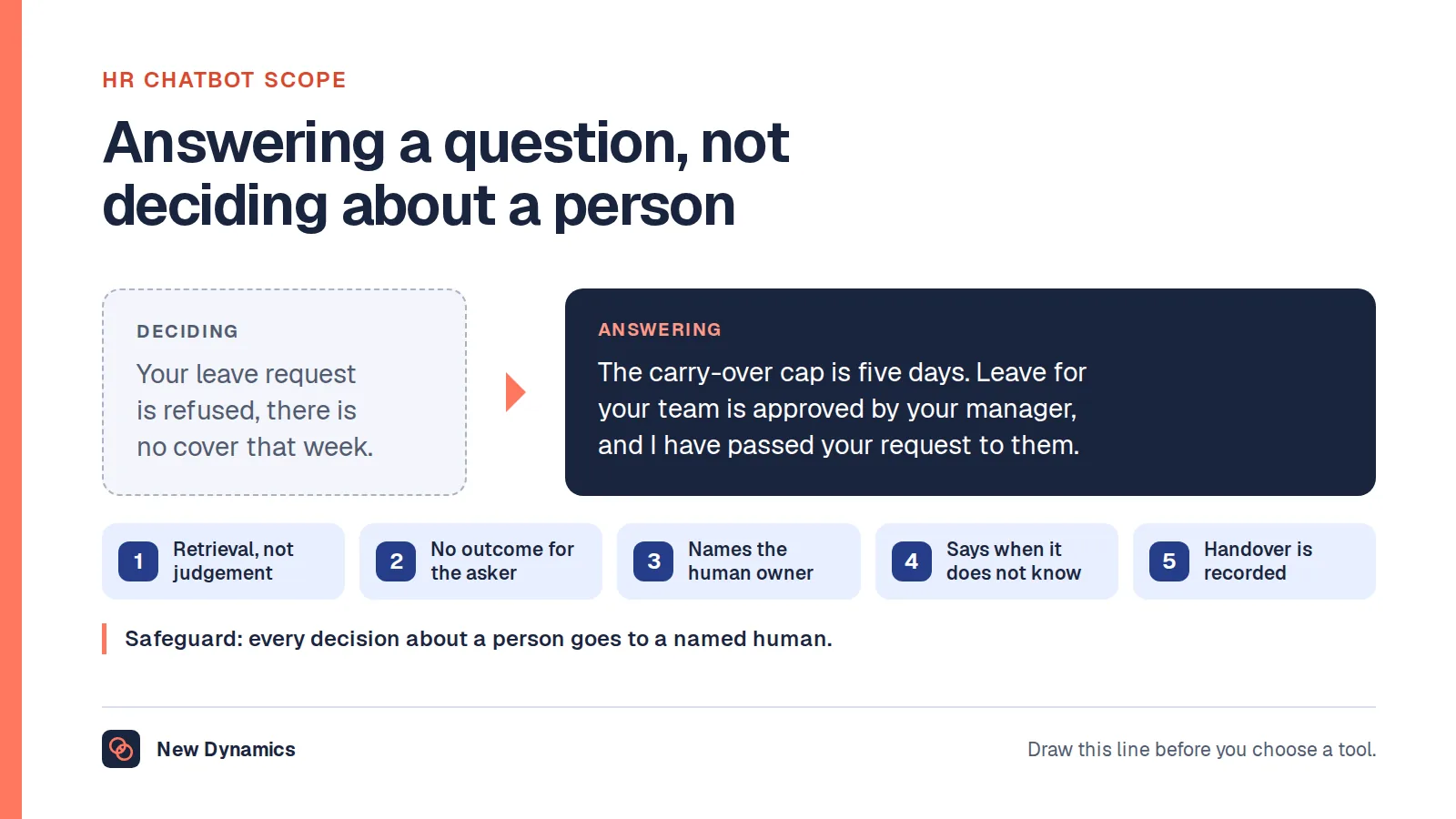
If you are assessing the tools rather than the process, our guide to AI recruiting tools covers the evidence to demand before signing. Our post on HR chatbots draws the same answering-against-deciding line for employee queries and traces the commencement history of the new articles in more detail than we repeat here.
Moving work is not the same as deciding about a person
Write your hiring process out as a list of steps, then mark each one with a single question: does this step change a candidate's position in the process?
Sending an acknowledgement does not. Offering five interview slots does not. Reminding a hiring manager that a scorecard is outstanding does not. Copying a parsed CV into a record does not. These steps move work and information around, and the duties that survive automating them are the ordinary ones: accuracy, security, a privacy notice and a retention period.
Ranking nine hundred applications does change a candidate's position. So does setting a score threshold, so does sending a rejection, and so does never showing an advert to a group of people. The Information Commissioner's Office says so directly. Its draft chapter on automated decision-making and profiling for recruitment and selection states that "Data protection law restricts the use of solely automated decision-making and profiling that has legal or similarly significant effects on people. This includes a decision about whether to shortlist a candidate, recommend them for interview, reject them or promote them."

The volume pressure behind all of this is real. The Office for National Statistics reported in its Labour market overview, UK: October 2026 that "Early estimates for July to September 2026 suggest a decrease of 21,000 (2.9%) to 691,000, compared with April to June 2026". How many of those vacancies are sifted by machine is not something any official UK source publishes, so treat any prevalence percentage you are shown as a vendor estimate. Our HR statistics hub collects the figures that are published.
What recruitment automation genuinely absorbs
Four categories take automation well, because none of them reaches a conclusion about anybody.
- Acknowledgement and status. A confirmation on submission, a status change when a stage closes. The content is factual.
- Scheduling. Slot offers, calendar holds, reschedules, joining details, reminders to both sides. This is the single largest time saving in most hiring processes.
- Reminders and chasing. Outstanding scorecards, unreturned references, an offer awaiting signature. Automate the nudge, keep the decision with the person being nudged.
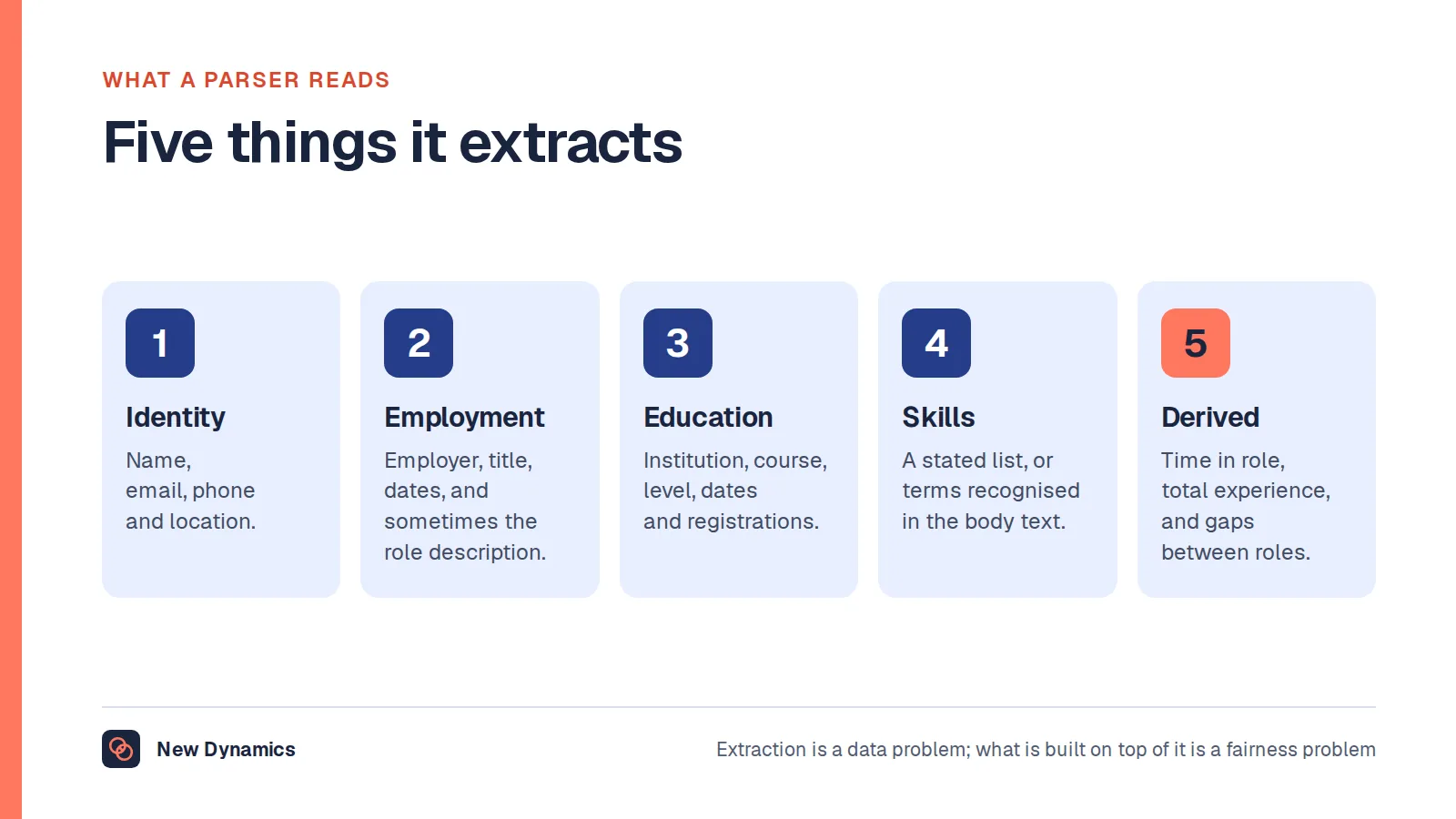
- Data entry. Parsing an application into structured fields so a record can be searched. Extraction is not judgement, though it fails on unusual formatting and the fields it produces are then trusted. Our post on resume parsing covers what breaks a parser.
One trap hides in this safe category. If your application form screens on the answers, it is deciding rather than collecting. And if one of those questions touches health, section 60 of the Equality Act 2010 is in play: a person to whom an application for work is made "must not ask about the health of the applicant" before offering work or before "including B in a pool of applicants" from which they intend to select. Subsection (6) has narrow exceptions, including establishing whether a candidate can "carry out a function that is intrinsic to the work concerned" and "monitoring diversity in the range of persons applying". An automated knockout question about sickness absence sits outside all of them.
Automated sifting is the risky part
Sifting is where the saving is, and where the exposure is. The ICO's draft guidance gives a worked pair of examples worth reading before you buy anything. A company marks a multiple-choice aptitude test automatically and ranks candidates by score. Taking those scores into account alongside a group exercise and an interview, with the overall decision made by a human, is labelled good practice. Using the scores "to eliminate half of the candidates, without a human having considered their overall performance" is labelled bad practice, and the guidance says of it: "This is unlawful."
The failure modes it lists are mundane. Software that "excludes candidates who live a certain distance away from the place of work, even if they intend to move to the area". Software that "incorrectly eliminates candidates who meet the job criteria". Software that "incorrectly decides that a person has no legal right to work in the UK". And software that "eliminates candidates with gaps in their CV even though this was because the candidate had a serious illness".
The ICO treats all of this as high risk: "You must do a DPIA if you plan to use solely or partly automated decision-making and profiling for recruitment purposes as both activities are high risk." Partly automated counts, so a tool that only assists a sift still needs a data protection impact assessment before you switch it on.
The rules changed on 5 February 2026
Do not plan against Article 22 of the UK GDPR. It has been replaced.
Section 80 of the Data (Use and Access) Act 2025 substitutes a new Section 4A for Article 22, and the commencement note on that page records "S. 80 in force at 5.2.2026 in so far as not already in force by S.I. 2026/82, reg. 2(j) (with reg. 5)". Four articles now govern.
Article 22A sets the two tests. It provides that "a decision is based solely on automated processing if there is no meaningful human involvement in the taking of the decision", and that a decision is significant if "it produces a legal effect for the data subject" or "it has a similarly significant effect for the data subject". It adds a sentence that matters in hiring: "When considering whether there is meaningful human involvement in the taking of a decision, a person must consider, among other things, the extent to which the decision is reached by means of profiling." A sift built on inferences about a candidate is profiling, so the bar for real human involvement rises with it.
Article 22B restricts rather than permits. A significant decision resting entirely or partly on special category data "may not be taken based solely on automated processing" unless there is explicit consent, or the decision is necessary for a contract or required or authorised by law and an Article 9(2)(g) condition applies. It also bars a solely automated significant decision where the processing is carried out "entirely or partly in reliance on Article 6(1)(ea)", the recognised legitimate interests basis. Health, disability, ethnicity and religion all appear in recruitment data, often unasked for.
Article 22C requires safeguards, including measures that "enable the data subject to obtain human intervention on the part of the controller" and "enable the data subject to contest such decisions". Article 22D lets the Secretary of State define meaningful human involvement by regulations.
Two things follow. First, the practical route for most employers is to stay outside the solely automated category by keeping a real human decision in the sift, rather than to rely on an exception. Second, the regulator's recruitment guidance has not caught up. Both the ICO chapters cited here carry the banner "Due to changes made by the Data (Use and Access) Act, this guidance is under review and may be subject to change", and both add "Our consultation on this draft guidance is now closed. The final version will be published in due course." The recruitment chapter still refers to "where the processing falls within Article 22" and still lists the old three exceptions without the Article 6(1)(ea) bar. Where draft guidance and the statute diverge, the statute governs.
What counts as a human in the loop

The ICO's draft recruitment guidance sets out what a reviewer must be able to do. Decisions about progressing a candidate are made by a human. Where several candidates have similar qualifications and experience, "the decision about who to interview is made by a human, although you can consider the recommendations made by the software". Staff must not "attach disproportionate weight to the AI recommendations" and must be trained so that "they are able to reach their own conclusions".
It also tells you to keep the evidence: "You should keep a record of each time a human reviewer overrides an automated recruitment decision. This will help you evaluate both the system you use and the effectiveness of the human involvement." That override log is the cheapest audit you will ever run. If it is empty after a hiring round, your human step is decoration.
Note what the guidance does not say. It does not promise that an accurate tool is a safe one: "software which demonstrates sufficient statistical accuracy may not be appropriate to use for recruitment purposes in the absence of safeguards."
What you tell candidates, and where
Transparency is not a line in a notice nobody opens. Where decisions are solely automated, the ICO says you must provide "meaningful details about the logic involved and the significance and likely consequences for the candidate", and lists what to explain, including "how the system uses their information, including how it makes decisions about them (eg the criteria it uses to select or reject them)", "the level of any human involvement in the decision-making" and their right not to be subject to solely automated decision-making. Commercial sensitivity is not a way out: "you must provide people with an explanation about how your automated system uses their information", though "You are not required to disclose your source code or any algorithmic trade secrets."
The GOV.UK Responsible AI in Recruitment guide, published on 29 January 2025 by the Department for Science, Innovation and Technology, explains why this comes first: "it is not possible for an applicant to contest decisions, recommendations, or predictions that have been made or enabled by an AI system, without knowing that this system is being deployed." It adds the consequence most employers miss. "Without signposting whether an AI model is used and/or the specific limitations of the system, applicants who could be disadvantaged may not report a need for reasonable adjustments."
Put the disclosure next to the thing being automated, in the advert and on the form, not three clicks away.
The discrimination risk is in the training data
A sift trained on your past hiring learns your past hiring. The GOV.UK guide names the mechanism: "Data-driven tools 'learn' how to make hiring decisions based on training data. If there are historical biases in this data, then the tool is likely to perpetuate these biases at scale." On screening tools it warns that they "are often trained using historical data", creating "a risk that the system might inherit bias from past recruitment practices or use proxy indicators for success that are not relevant to a position", and gives the example that keeps recurring: "A sifting tool may also consider gaps in employment in a way that disproportionately affects parents, people with care-giving responsibilities, people with disabilities or long-term health conditions and neurodivergent candidates."
Two provisions of the Equality Act 2010 turn that into liability.
Section 19, indirect discrimination. A person discriminates by applying "a provision, criterion or practice which is discriminatory in relation to a relevant protected characteristic". It is discriminatory where it "puts, or would put, persons with whom B shares the characteristic at a particular disadvantage when compared with persons with whom B does not share it", it puts B at that disadvantage, and the employer "cannot show it to be a proportionate means of achieving a legitimate aim". A scoring rule applied to every applicant is exactly a provision, criterion or practice. Read section 19, then read your sift criteria again.
Section 15, discrimination arising from disability. A person discriminates against a disabled person by treating them "unfavourably because of something arising in consequence of" the disability where they "cannot show that the treatment is a proportionate means of achieving a legitimate aim". A career gap caused by illness is a textbook something arising in consequence. Section 15 offers one defence, in subsection (2), where the employer "did not know, and could not reasonably have been expected to know" about the disability. A tool that filters on gaps and never asks why removes your chance to know.
Reasonable adjustments do not pause because a machine is running the stage. The GOV.UK guide treats this as a legal obligation "pursuant to section 20 of the Equality Act 2010" and is blunt about where it can lead: "sometimes the substantial disadvantage a person with protected characteristics experiences can only be avoided if the AI system/technology is removed from the recruitment process." Plan the manual alternative before go-live, not when the first request arrives.
Record keeping and retention
Keep too little and you cannot show the process was fair. Keep too much and you are holding personal data without a reason.
There is no published number to copy. The ICO's draft chapter on keeping recruitment records says data protection law "does not specify timescales for keeping recruitment records. You should carefully consider how long you need to keep this information for and set clear retention periods." Its steer is that "In general, you should not keep information beyond the statutory period in which a legal claim can potentially be brought", and it points to the Limitation Act 1980, the Limitation (Northern Ireland) Order 1989 and the Prescription and Limitation (Scotland) Act 1973 rather than giving a figure. It also warns against the opposite error: "if you destroy records about any of the candidates too quickly, it may be more difficult for you to prove that your end-to-end process is transparent, fair and accountable."
For an automated stage, keep five things for whatever period you set: the criteria the tool applied, the outputs it produced, every human override, every candidate challenge and its resolution, and the version of the model or ruleset in use. The ICO also asks you to "record and monitor the number of challenges made by candidates on the grounds of fairness". All of it is disclosable through a subject access request. Our post on recruitment process evaluation covers the review these records feed.
What to ask a supplier

The GOV.UK guide is built around questions to put to a supplier. These are the ones that separate an answer from a demo.
- What data trained the model? The guide asks for "data type, breakdown of protected characteristics of data subjects and where the data was sourced from".
- How does it perform across groups? It asks for "the demonstrated accuracy and performance of the model across different groups/protected characteristics with specific reference to understanding the UK context, including UK equality law and demographic makeup".
- What are the known limitations? Ask for the bias audit, the risk assessment and the supplier's own DPIA, which "should be shared during any procurement exercise".
- Can a reviewer overturn an output, and is the override logged? If not, you are buying a solely automated decision whatever the sales deck says.
- What happens when the model drifts? The guide notes AI systems "are also subject to model drift" and asks whether "your supplier set up a regular testing schedule to measure AI system performance over time".
One more is yours rather than the supplier's: who in your organisation is named as the decision-maker for this stage, and do they know it? Automation does not transfer accountability. As the ICO puts it, "As controller, you are responsible for the software you use to process personal information, even if you did not build the software or create the algorithm."
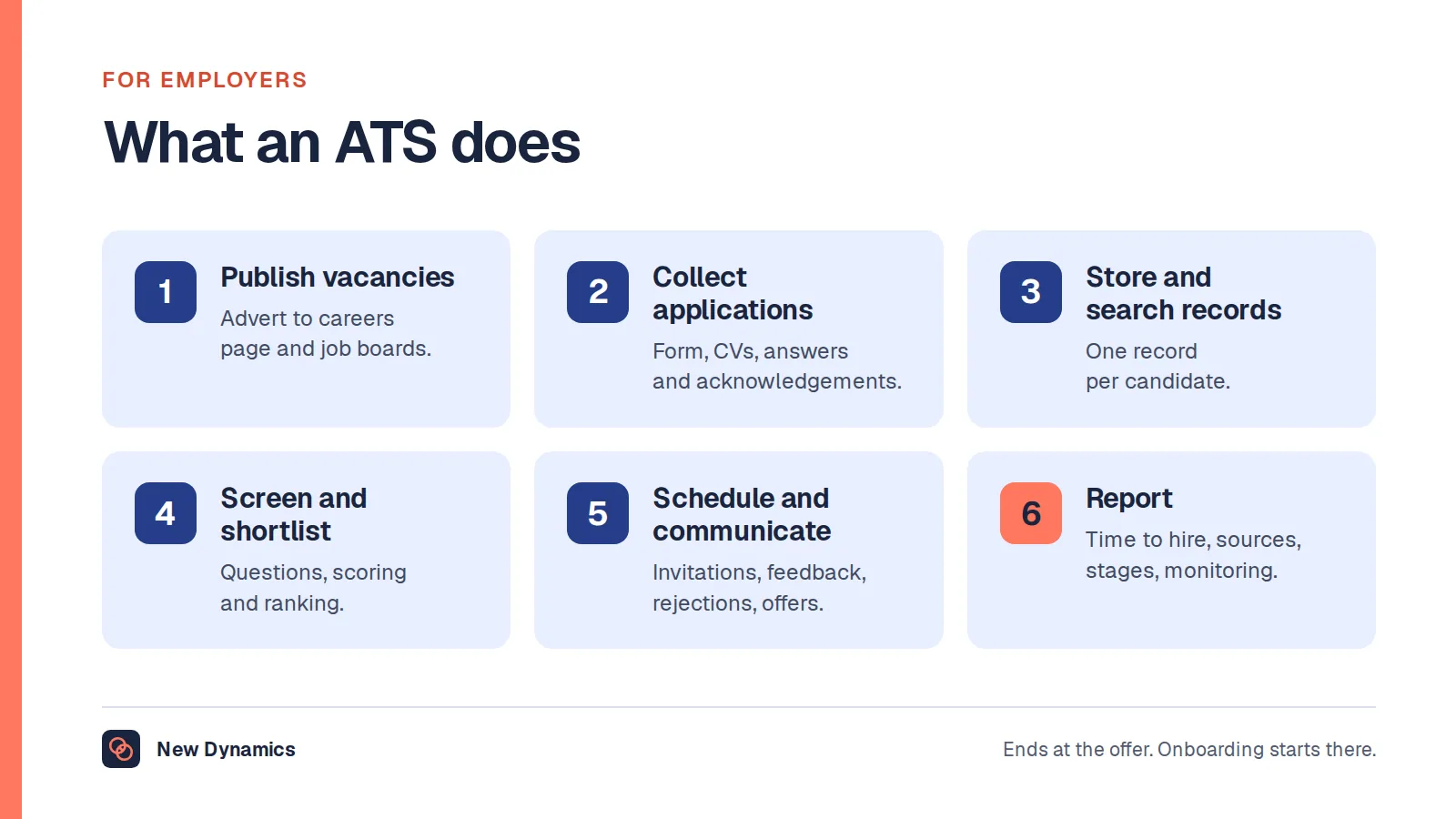
If you are still choosing the underlying system, our explainer on what an ATS is sets out what the software does before automation is layered on top.
Frequently asked questions
What is recruitment automation?
Recruitment automation is using software to carry out hiring steps without a person performing them each time. It splits into two groups: administrative steps such as acknowledgements, interview scheduling, reminders and data entry, which carry no judgement about a candidate, and decision steps such as sifting, scoring and rejecting, which do and which bring legal duties with them.
Is automated CV sifting legal in the United Kingdom?
Partly automated sifting, where software ranks or scores and a human makes the progression decision, is lawful if done properly. Solely automated sifting of a significant decision is restricted. The ICO's draft guidance says you "must not shortlist candidates using solely automated decision-making and profiling unless you're able to rely on an exception and you have safeguards in place", and labels eliminating half a candidate pool on test scores alone unlawful.
Does Article 22 of the UK GDPR still apply?
No. Section 80 of the Data (Use and Access) Act 2025 substituted a new Section 4A for Article 22, in force on 5 February 2026 by S.I. 2026/82. Articles 22A to 22D now govern solely automated significant decisions, on different conditions from the old Article 22. Some ICO pages still refer to Article 22 while their guidance is under review.
Which hiring tasks are safe to automate?
Confirmations and status updates, interview scheduling and reminders, chasing outstanding scorecards and references, and parsing applications into structured records. None of these decides anything about a candidate. The duties that remain are accuracy, security, telling candidates what you collect and why, and deleting it when you no longer need it.
Do we have to tell candidates that automation is used?
Yes, and the explanation has to be useful. Where decisions are solely automated the ICO requires "meaningful details about the logic involved and the significance and likely consequences for the candidate", including the criteria used to select or reject and the level of human involvement. GOV.UK guidance adds that candidates who are not told cannot contest a decision or ask for a reasonable adjustment.
How long can we keep automated sifting records?
No official source publishes a figure. The ICO states that data protection law "does not specify timescales for keeping recruitment records", and advises documented retention periods that do not run beyond the statutory period for bringing a claim arising from the recruitment process. Keep the criteria, the outputs, the overrides and the challenges for whatever period you set, and write down your reason.
Who is responsible if an automated sift rejects someone unfairly?
The employer. The ICO is direct: "As controller, you are responsible for the software you use to process personal information, even if you did not build the software or create the algorithm." A supplier contract allocates commercial risk. It does not move the data protection or Equality Act duty off the employer.
Your next step: find the decision you have already automated
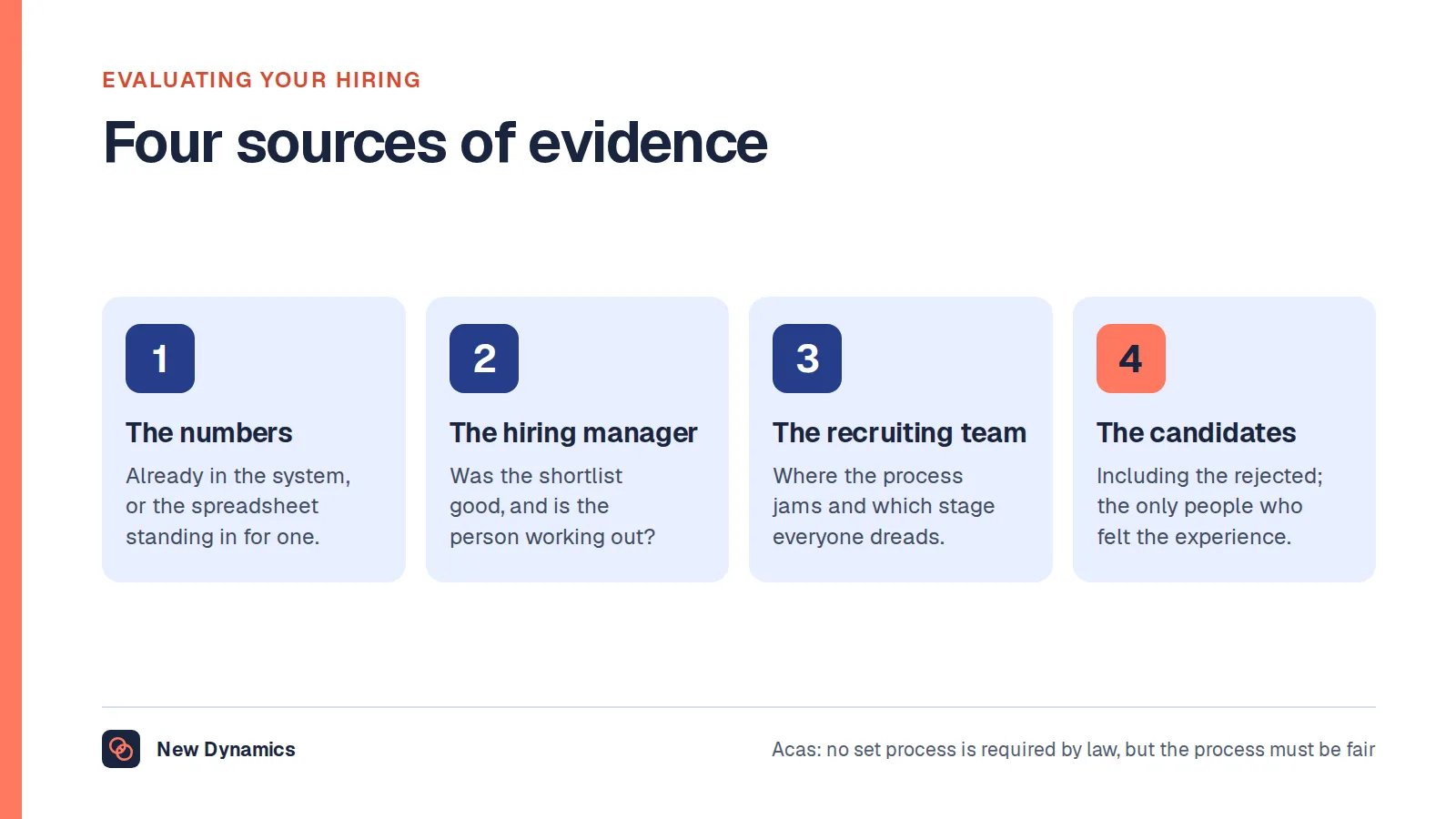
Take your last hiring round and list the stages in order. Against each one, write the name of the person who decided and what they could have changed. Any stage where that box is empty is already a solely automated decision, whether you meant it to be or not.
Then do three things. Write the human review step in with a named owner and a service level, start the override log, and publish the sift criteria in the advert so a candidate who meets them can say so.
For the wider process, our recruitment and selection guide covers structuring a hiring round so the evidence behind each decision exists before it is needed.
Want the handovers in your hiring process to have an owner and a date rather than a hope? Book a New Dynamics demo and bring your current stage list. You can also email contact@new-dynamics.com.