TL;DR
- AI appears in four places in hiring: finding candidates, screening and ranking applications, scoring interviews, and answering candidates. They carry very different levels of risk, and buying them as one bundle hides that.
- In the United Kingdom, a decision made by automated means without meaningful human involvement is a special category of processing. The ICO's test for meaningful is whether a human 'has the power to disagree with the AI recommendations or predictions, and can overturn them', and candidates can challenge a solely automated decision that significantly affects them.
- Government guidance expects monitoring to continue after go-live, not stop at procurement. Ask for bias testing evidence, write the human review step into the process, tell candidates how the system uses their information, and sample what the tool rejects. This is general information, not legal advice.
A provider demonstrates a tool that reads nine hundred applications and hands back a ranked top twenty. It is genuinely impressive, and the awkward question arrives about a minute later: if a rejected candidate asks why, who answers, and with what?
That question, not the feature list, is what buying AI recruiting tools is actually about.
This article sets out where AI appears in hiring and what each use really produces, the United Kingdom rules on automated decisions, the evidence to demand before signing, how to write the human step into your process, what to tell candidates, and what monitoring looks like once the tool is live. It names no products. The position described is the United Kingdom one, and this is general information rather than legal advice.
Hiring ends at the offer, and the first ninety days decide whether it worked. See how New Dynamics onboarding turns an accepted offer into tasks, early goals and manager conversations.
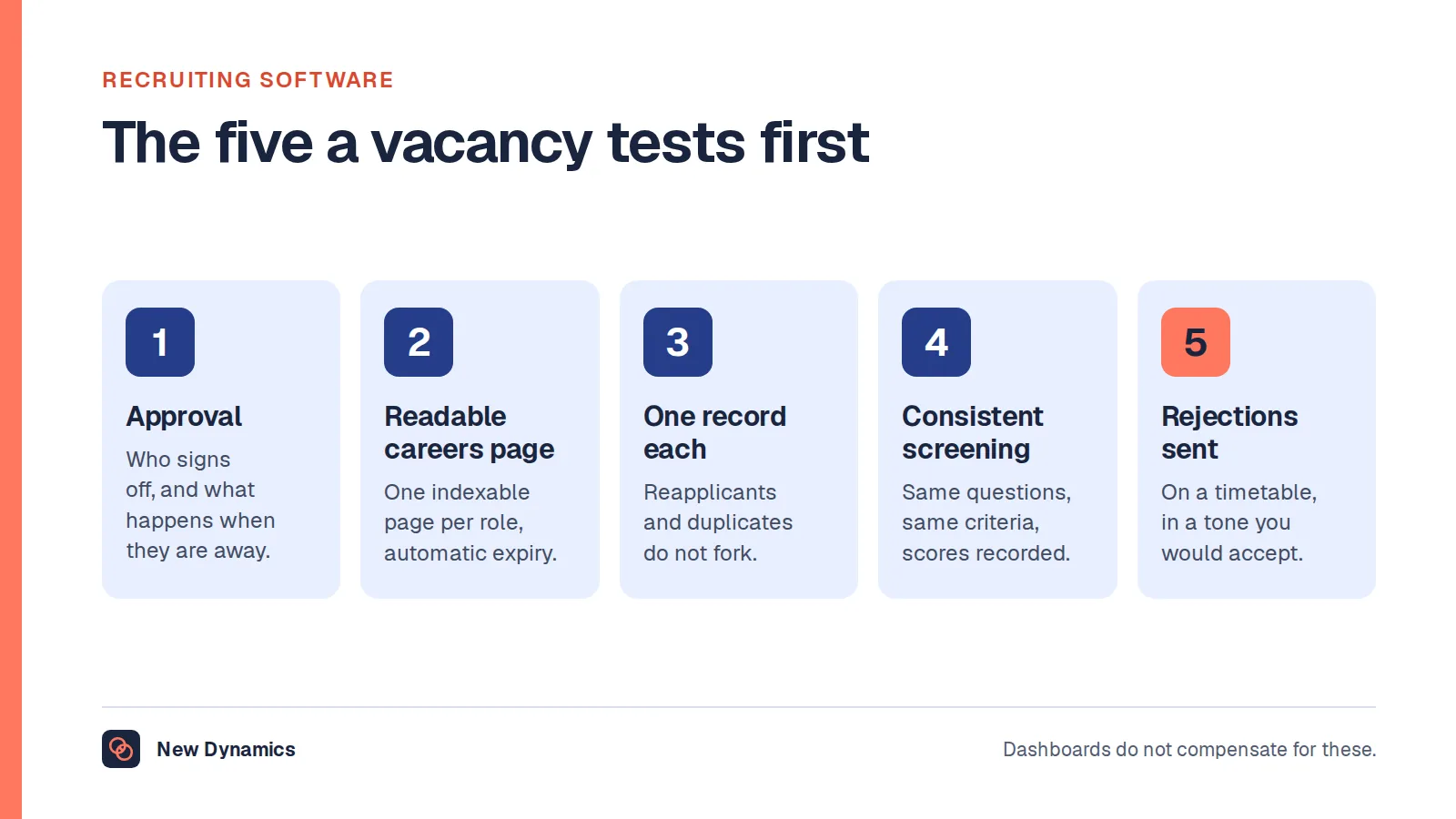
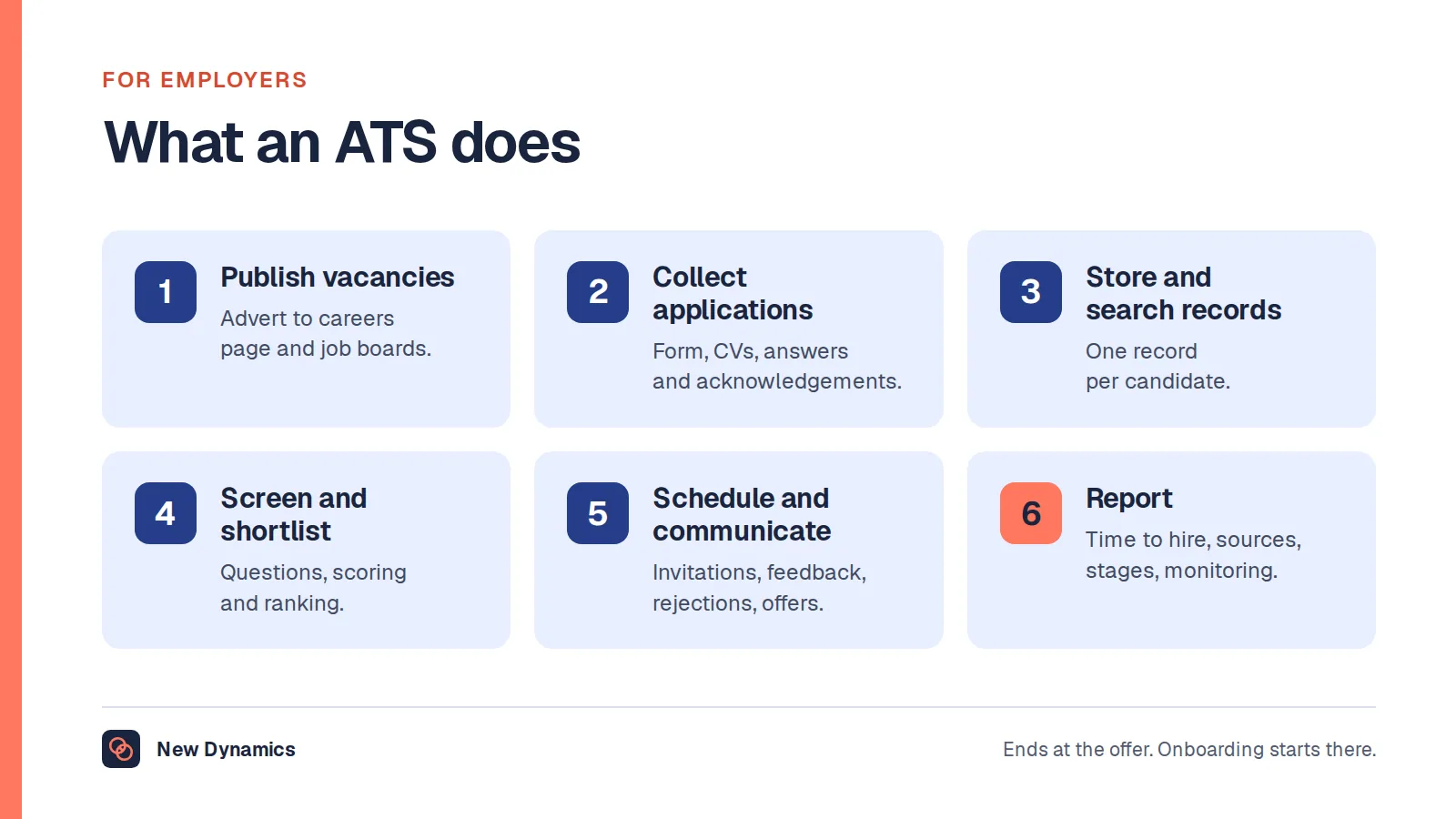
If you are choosing the underlying system rather than the AI features, our guide to recruiting software covers the requirements a real vacancy breaks on.
Four places AI shows up, with four different risks

Sourcing. Finding and suggesting candidates, writing outreach, generating adverts. Lowest risk, because a human still decides who to approach, though biased suggestions narrow the pool quietly.
Screening and ranking. Reading applications and ordering them. This is where most of the risk sits, because the output looks like a judgement and is treated as one.
Interview scoring. Transcribing, summarising or scoring interviews, including video analysis. High risk, because candidates with atypical speech, accents or disabilities can be scored on how they present rather than on what they say.
Candidate-facing chat. Answering questions, booking slots, collecting information. Low risk until it starts screening, at which point it has quietly become the second category.
Buy them separately in your head, even if they arrive in one product, and apply the strictest rules to screening and interview scoring.
The rule that decides your process design
The United Kingdom has specific rules for decisions taken without a human. The ICO describes these as "decisions fully made by automated means, without meaningful human involvement", and sets a practical test for what meaningful means: "a human has the power to disagree with the AI recommendations or predictions, and can overturn them".
Two consequences follow, and they are design decisions rather than paperwork.
- A rubber stamp is not human involvement. If the reviewer has no time, no information and no authority to disagree, the decision is automated whatever the process diagram says.
- Candidates can push back. The ICO notes that "People have the right to challenge any solely automated recruitment decision which significantly affects them and request human intervention", so you need a route for that before the first rejection goes out, not after the first complaint.
You also have to be open about it. The guidance expects you to explain "how the system uses their information, including how it makes decisions about them".
What to demand from a provider

Ask for documents, not reassurance.
- What the model produces, in one sentence a recruiter can repeat: a ranking, a score, a summary, a match percentage. Then ask what it is derived from.
- Bias testing evidence: what was tested, against which groups, on what data, how often it is repeated, and what the results were. Government guidance on responsible AI in recruitment expects "Iterative performance testing" and bias audits once a model is in live operation.
- Your data protection impact assessment, started at procurement rather than after launch.
- Controller and processor responsibilities, written into the contract.
- What the audit trail records for every decision: inputs, output, who reviewed it and when.
- An accessibility position, especially for interview tools: what happens for a candidate who requests an adjustment, and whether a human-assessed route exists.
- What happens to your candidate data, including whether it is used to train anything.
If a provider cannot produce bias testing evidence, that is the answer to the question.
Writing the human step into the process
The part most organisations skip is deciding what the reviewer actually does. Three rules make the review real.
- Give them the inputs, not just the output. A reviewer who sees only a score cannot disagree with it.
- Give them time and authority. Twenty ranked candidates reviewed in ten minutes is not review. Say explicitly that the reviewer may overturn the ranking, and record when they do.
- Require a reason that does not cite the score. If the only justification for a shortlist is the ordering, nothing human happened.
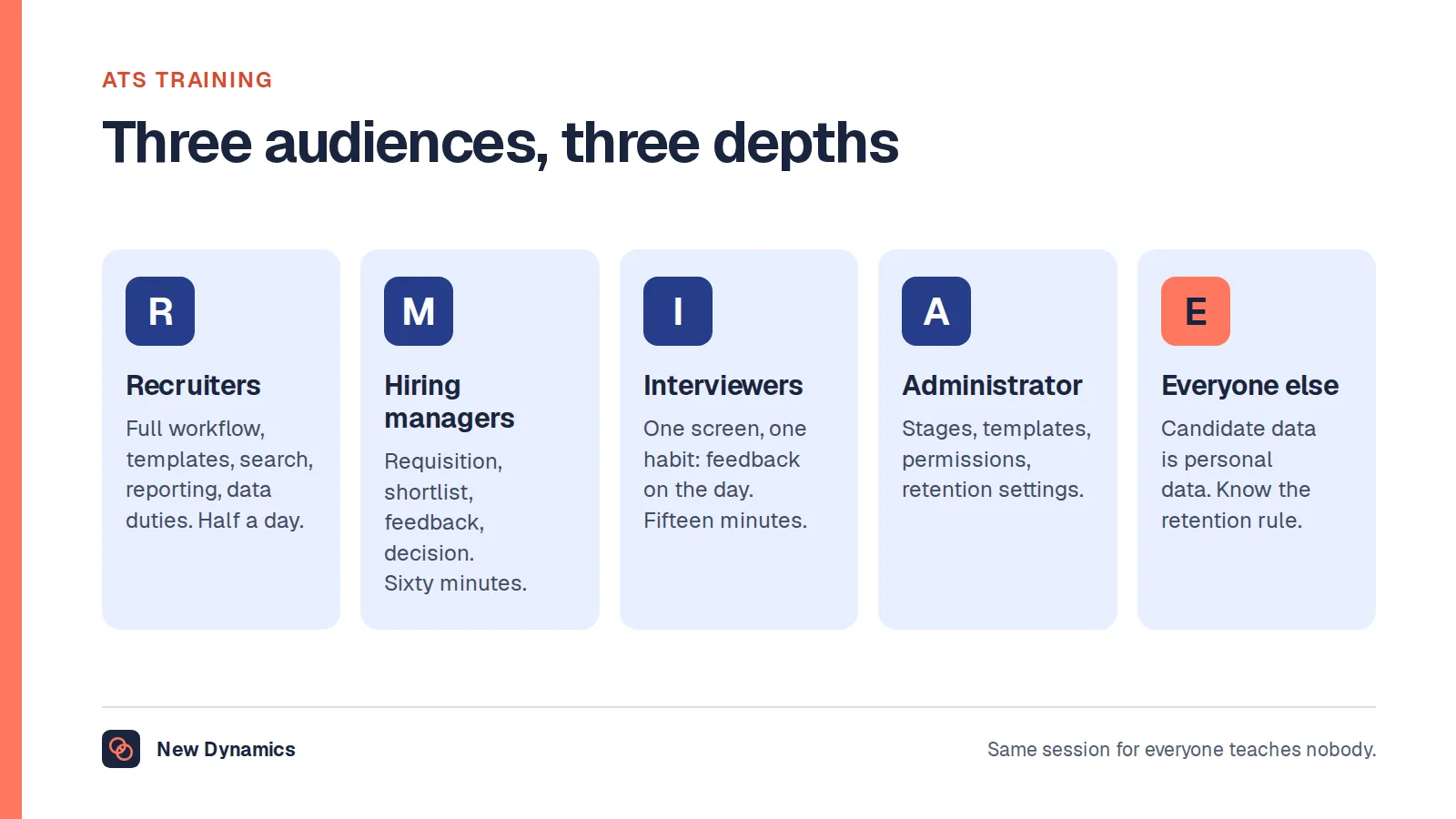
Then sample the other direction: read a handful of applications the tool ranked low on every vacancy. It is the cheapest check available, and it keeps recruiters able to read an application. Our post on ATS training covers how to build that habit into the team.
What to tell candidates
Plain words, in the application itself rather than buried in a policy:
- That AI is used, and at which stage.
- What it does: ranks, summarises, transcribes, schedules.
- That a person makes the decision, if that is true, and what to do if they want it reviewed.
- How to ask for an adjustment.
Honesty here is also self-protective. An employer who has described the process accurately has a far easier conversation when someone challenges it.
Monitoring after go-live

Procurement is not the end of the duty. The government's guidance states that "An AI system in live operation requires continuous monitoring to ensure that it performs as intended."
Four things to watch, quarterly at least:
- Pass rates by group at each automated stage, compared with the stages a human runs.
- Override rate. How often reviewers disagree with the tool. Zero is a warning sign, not a success.
- Complaints and challenges, including requests for human intervention.
- Drift. Whether the model, the job mix or the applicant pool has changed since the last test.
Write down who owns each number and what triggers switching the feature off. A kill switch nobody owns is decoration.
Frequently asked questions
What are AI recruiting tools?
Software that uses machine learning in hiring: finding and suggesting candidates, reading and ranking applications, transcribing or scoring interviews, and answering candidate questions. They are often bundled into an applicant tracking system rather than bought separately, which can hide how different their risks are.
Is it legal to use AI to screen job applicants in the UK?
Using AI to assist screening is lawful, but decisions made without meaningful human involvement are a special case with extra duties, and candidates can ask for human intervention. Meaningful means the reviewer can actually disagree and overturn the output, with the time, information and authority to do so.
What is meaningful human involvement?
The ICO's test is whether a human has the power to disagree with the recommendation and can overturn it. A reviewer who sees only a score, has no time and is not permitted to depart from the ranking is a rubber stamp, and the decision is treated as automated.
What evidence should an AI recruitment provider give you?
Bias testing evidence covering what was tested and how often, documentation of controller and processor responsibilities, an audit trail for each decision, an accessibility position, and clarity on whether your candidate data trains anything. Reassurance in a slide is not evidence.
Do you have to tell candidates that AI is used?
Yes, and plainly. Explain how the system uses their information and how it makes decisions about them, say at which stage it is used, and give a route to ask for human review or an adjustment. Put it in the application, not only in a privacy policy.
How do you monitor an AI hiring tool after launch?
Track pass rates by group at the automated stages, the rate at which reviewers override the tool, complaints and requests for human intervention, and whether anything has drifted since the last test. Government guidance expects continuous monitoring, and an override rate of zero usually means the review is not real.
Your next step: find the rubber stamp
- Draw your current hiring process and mark every point where a machine orders, scores or filters people.
- At each point, write down who reviews it, what they see, how long they have, and whether they are allowed to disagree.
- Ask your provider for bias testing evidence and the audit trail, in writing.
- Add the sample of low-ranked applications to every vacancy, and record what it found.
For the full set of procurement questions and a governance checklist, read and download our AI recruitment guide. The guide is free to read, and the PDF uses our short download form.
Want the post-offer experience to be as carefully designed as the screening? Book a New Dynamics demo and bring your onboarding checklist. You can also email contact@new-dynamics.com.