TL;DR
- A rating quietly does four jobs: it tells someone where they stand, feeds pay, feeds promotion decisions, and anchors consistency between managers. Removing the label leaves all four jobs in place, so they move somewhere else.
- The usual failure is the shadow rating. Pay and promotion still get decided, now from a private ranking in a manager's head, which is less transparent than the number it replaced and harder to defend if anyone asks why.
- A cycle without ratings is more work, not less: written standards per level, a stated basis for pay, a moderation conversation about words, frequent check-ins, a written record every time, and a way to identify who needs support.
Somebody brings a proposal: remove the ratings. People fixate on the number, the argument goes, so they stop hearing the feedback. The conversations will get better and the anxiety will go.
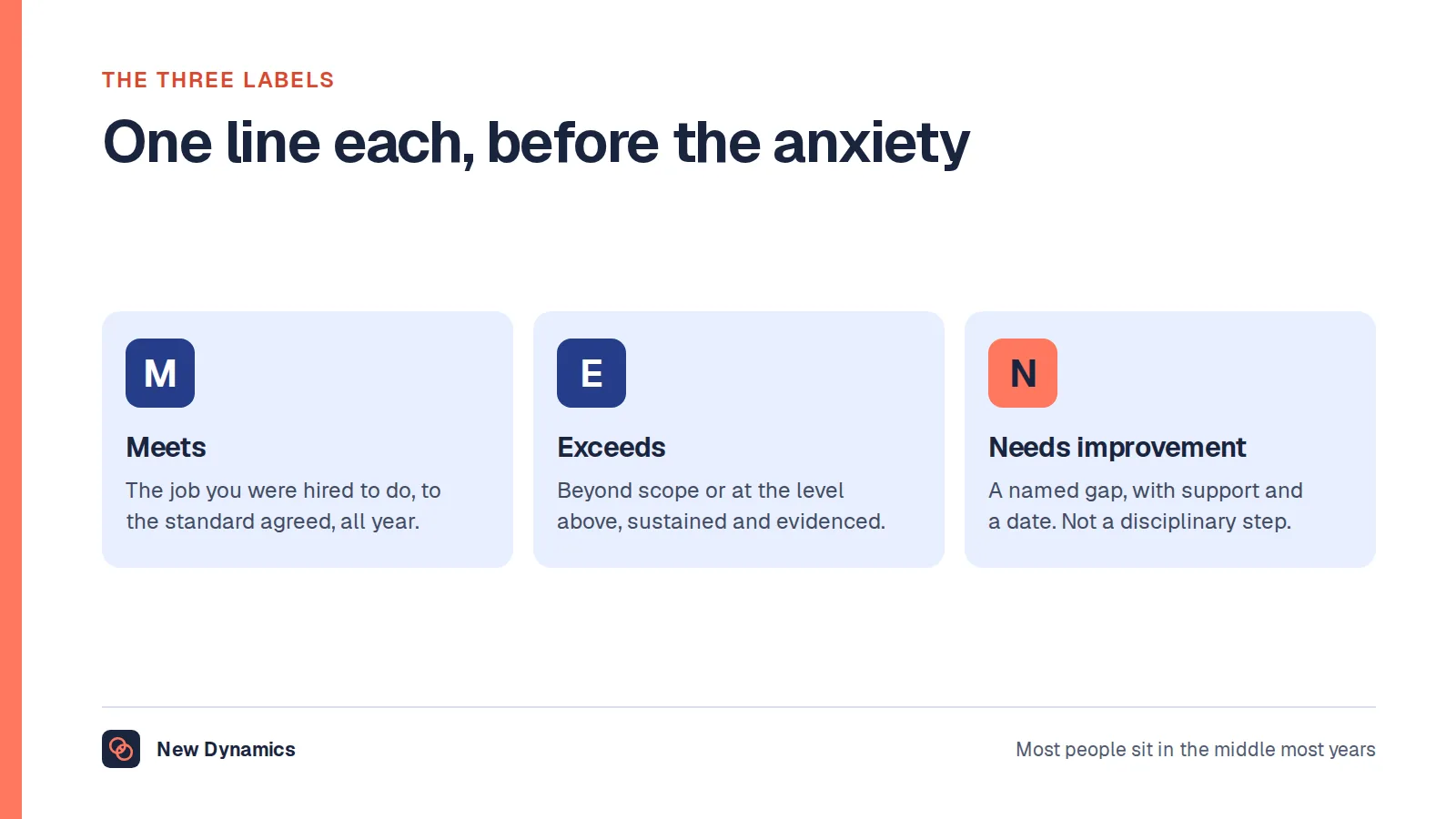
Half of that is true. The part that is missing is that a rating does several jobs at once, and removing the label does not remove the jobs. This article covers what those jobs are, what usually breaks, what a cycle without ratings needs instead, and the questions to settle before deciding. It describes the position in Great Britain and is general information, not legal advice.
Whatever you decide, the conversations have to carry more weight. See how New Dynamics continuous feedback keeps evidence and check-ins through the year rather than in one meeting.
The four jobs a rating does

It tells someone where they stand. Crudely, but unmistakably. Most people would rather have a blunt answer than a warm paragraph they have to decode.
It feeds pay. Where increases or bonuses follow performance, the rating is the mechanism that connects the two.
It feeds promotion and talent decisions. Succession lists, development investment and who gets the stretch work are all downstream of it.
It anchors consistency between managers. A shared label is what makes calibration possible: without a common unit, comparing two managers' assessments is comparing two essays.
Acas describes a review as covering what someone is doing well, areas for improvement, support or training needed and career objectives, based on things like whether they are "meeting or has met any agreed objectives". None of that requires a number. The four jobs above do not require one either, but they do require something.
What usually breaks

The shadow rating appears. Pay still gets decided, so managers rank their people privately to do it. The ranking is now invisible, unmoderated and undocumented, which is worse on every count than the label it replaced.
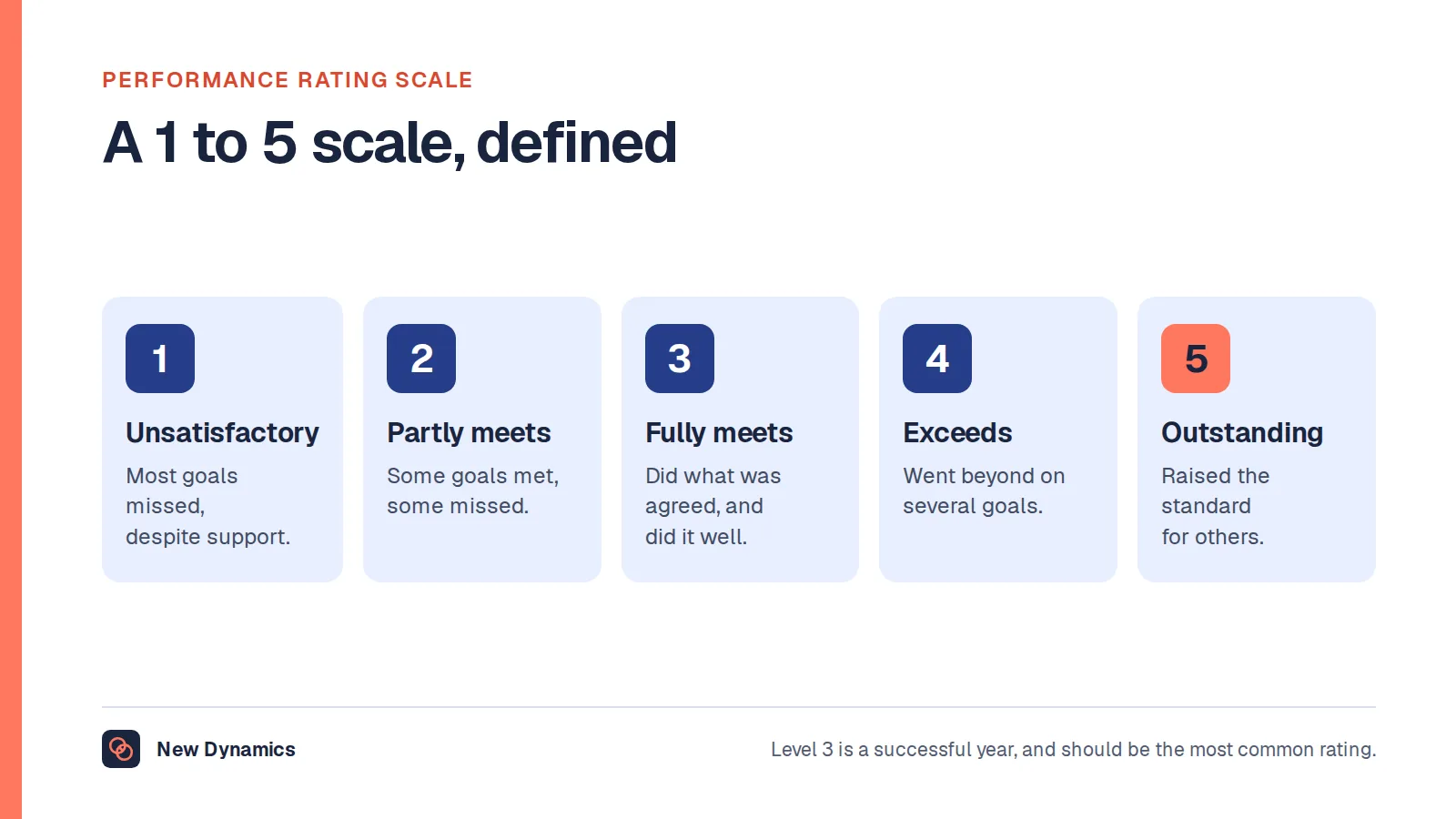
Consistency drops. Without a common unit, two managers describing the same quality of work in different words cannot be compared, and the moderation conversation becomes a debate about prose.
People stop knowing where they stand. In the absence of a signal, employees read the silence, and in most cases they read it as a problem. Strong performers are hit hardest, because they had the most to gain from being told.
Documentation thins. When nothing has to be defended, less gets written down. That matters later: Acas says employers should try to help someone improve before any formal procedure, and that "it's important for employers to keep a record of any conversations they have with employees about performance". A thin record makes a fair process harder to run and harder to show.
There is a fairness dimension too. Acas notes that less favourable treatment "might include: excluding someone from opportunities or benefits" and that it can be discrimination "even if the less favourable treatment was not intended". A visible, moderated basis for who gets opportunities is easier to check for patterns than an invisible one.
What a cycle without ratings needs instead

- Written standards for each level. What good looks like in this role at this level, in observable terms. Without a label, this is the only remaining shared reference.
- A stated basis for pay. If not the rating, then what: market position, level, a manager recommendation with a moderation step, a fixed increase for everyone. Publish it.
- A moderation conversation about words. Managers still compare, now using evidence and written standards. It takes longer than comparing numbers, and it is the part most organisations underestimate.
- Frequent check-ins. Acas lists "sharing regular feedback", "coaching" and "regular check-ins, sometimes known as one-to-ones" alongside the formal cycle. Without an annual label, these carry the signal.
- A written record every time. Acas asks for a record of what was discussed, shared with the employee. In a ratingless system this record is the whole assessment, so it has to be better than before, not thinner.
- A clear route for someone who needs support. Acas expects steps to help someone improve before any formal procedure, with an improvement plan setting out "specific objectives", "a reasonable timeline" and "any further support or training they need". Removing ratings must not remove the trigger that starts that conversation.
Read that list and the real trade-off becomes clear: a cycle without ratings is not less work, it is different work, and most of it lands on managers.
Eight questions before you decide
- How will pay decisions be made, and who will see the basis?
- How will two managers' assessments be compared?
- How will a strong performer know they are strong?
- How will someone be told they are not meeting the standard, and what triggers it?
- What does the written record look like, and who checks that it exists?
- What happens to promotion and succession decisions that currently use the label?
- How much manager time does the new version need, and where is it coming from?
- How will you tell in a year whether this worked?
If your answer to several of these is "the manager will handle it", the ratings have not been removed. They have been privatised.
Middle paths that tend to work
- Rate the parts, not the person. Separate judgements on objectives and behaviours, with no single overall label. You keep comparability and lose the one-number fixation.
- Replace the scale with statements. "Ready for the next level", "fully effective in role", "needs support in a named area". These read as decisions rather than scores and are easier to explain, as our post on what meets expectations means covers.
- Keep the label, change its visibility. Use it for moderation and pay, discuss the evidence rather than the score in the meeting, and be honest that it exists.
- Keep the label and fix the scale instead. If the complaint is that everyone lands in the middle, that is a definitions and calibration problem, which our post on rating an employee fairly deals with directly.
How to tell whether it worked
Decide the measures before you switch, and take a baseline. Useful ones: whether employees can state where they stand when asked, the spread of pay outcomes and whether it tracks anything defensible, how many people learn of a concern for the first time at a review, the amount of written evidence in a sample of records, and manager time spent on the cycle.
Unhelpful ones: how popular the change is in the month it launches, and how many other organisations have done it.
Frequently asked questions
Should we remove ratings from performance reviews?
Only if you are prepared to replace what the rating does: tell people where they stand, feed pay, feed promotion decisions and keep managers consistent. If pay will still be differentiated, you need a stated basis for it and a moderation conversation, otherwise the rating survives privately in each manager's head.
What is a performance review without ratings like?
More demanding, for managers especially. It needs written standards per level, frequent check-ins, a full written record of each discussion, a comparison conversation based on evidence rather than numbers, and a clear trigger for supporting someone who is not meeting the standard.
How do you decide pay without performance ratings?
Pick a basis and publish it: level and market position with a fixed increase, a manager recommendation moderated across a group, or a separate performance input that is not shown as a score. What matters is that someone outside the decision can see the reasoning, which is also easier to check for unfair patterns.
Do employees prefer reviews without ratings?
Some do and some find them worse, because a label at least answers the question. Strong performers often lose most, since the recognition becomes harder to see. Ask your own people before and after rather than assuming either way.
Does removing ratings make reviews fairer?
Not by itself. It removes one visible instrument and leaves the decisions in place, and an invisible basis is harder to examine. Fairness comes from written standards, evidence, more than one person looking, and a record of why, whether or not a label exists.
What is the main risk of going ratingless?
The shadow rating: managers ranking their teams privately to make pay work, with nothing written down and no moderation. It is less transparent than the system it replaced, and nobody notices for a year or two, by which point the records are thin as well.
Your next step: test the proposal against the four jobs
- Write down how each of the four jobs will be done without the label, in one sentence each.
- Find out how pay will actually be decided next cycle, and whether anyone outside the decision could follow it.
- Check the strength of your written standards per level. If they do not exist, fix that first, with or without ratings.
- Decide the measures and take a baseline before you change anything.
For an operating model built around regular conversations rather than an annual score, read and download our continuous performance management guide. The guide is free to read, and the PDF uses our short download form.
Want to see what the cycle looks like when the evidence does the work? Book a New Dynamics demo and bring your current form. You can also email contact@new-dynamics.com.