TL;DR
- A store team has four layers: the shop floor, the supervisors, the store manager, and the specialists behind the floor such as merchandisers, stock and delivery staff and loss prevention. O*NET's tasks for retail salespersons describe the first layer plainly: greet customers and ascertain what each wants, recommend and locate merchandise, compute prices and process payment, ticket, arrange and display stock, inventory and requisition it, handle exchanges and returns, watch for security risks, and open and close the till.
- The supervisory layer adds direction rather than more selling. O*NET's first-line supervisors of retail sales workers direct and supervise staff engaged in sales, inventory-taking and reconciling cash receipts, examine merchandise to ensure it is correctly priced and displayed, instruct staff on difficult sales, assign duties, plan work schedules and keep time records, review inventory and sales records to prepare reports, and set departmental policies and goals, with purchasing, budgeting, accounting and personnel work often attached.
- What separates a good retail advert from a bad one is rarely the duty list, which candidates can predict. It is the six things adverts leave out: the shift pattern and how far ahead the rota is published, weekend and peak-trading expectations, the physical demands, any age-restricted sales training, the uniform and discount, and what December looks like. Say those, and name the route from shop floor to supervisor, because that is the retention argument most retailers never make.
A shop advertises for "retail staff". Three people apply: one wants twelve hours on Saturdays, one wants full-time with no evenings, one is happy with anything until December. All three will find out what the job actually involves at the interview, and two will withdraw. Retail job descriptions fail less on the duties, which everyone can guess, than on the things nobody writes down: the rota, the peak, the standing and the Sunday.
This article maps a store team into four layers, gives the duties at each using the US O*NET occupational database and the UK National Careers Service, provides two templates, lists the six things a retail advert must state, and links to the detailed posts we have already written for each role.
Shop-floor teams are spread across sites and shifts, and priorities have to travel with them. See how New Dynamics Goals & OKRs keep targets and progress visible wherever people are working.
The four layers of a store team
- The shop floor. Sales associates and assistants, cashiers, stock and replenishment staff. They meet the customers and move the goods. Our posts on the sales associate, the cashier and the stocking associate cover these in detail.
- Supervisors and team leaders. Section, department or shift leads who run the floor hour to hour, hold keys, open and close and handle what the floor escalates.
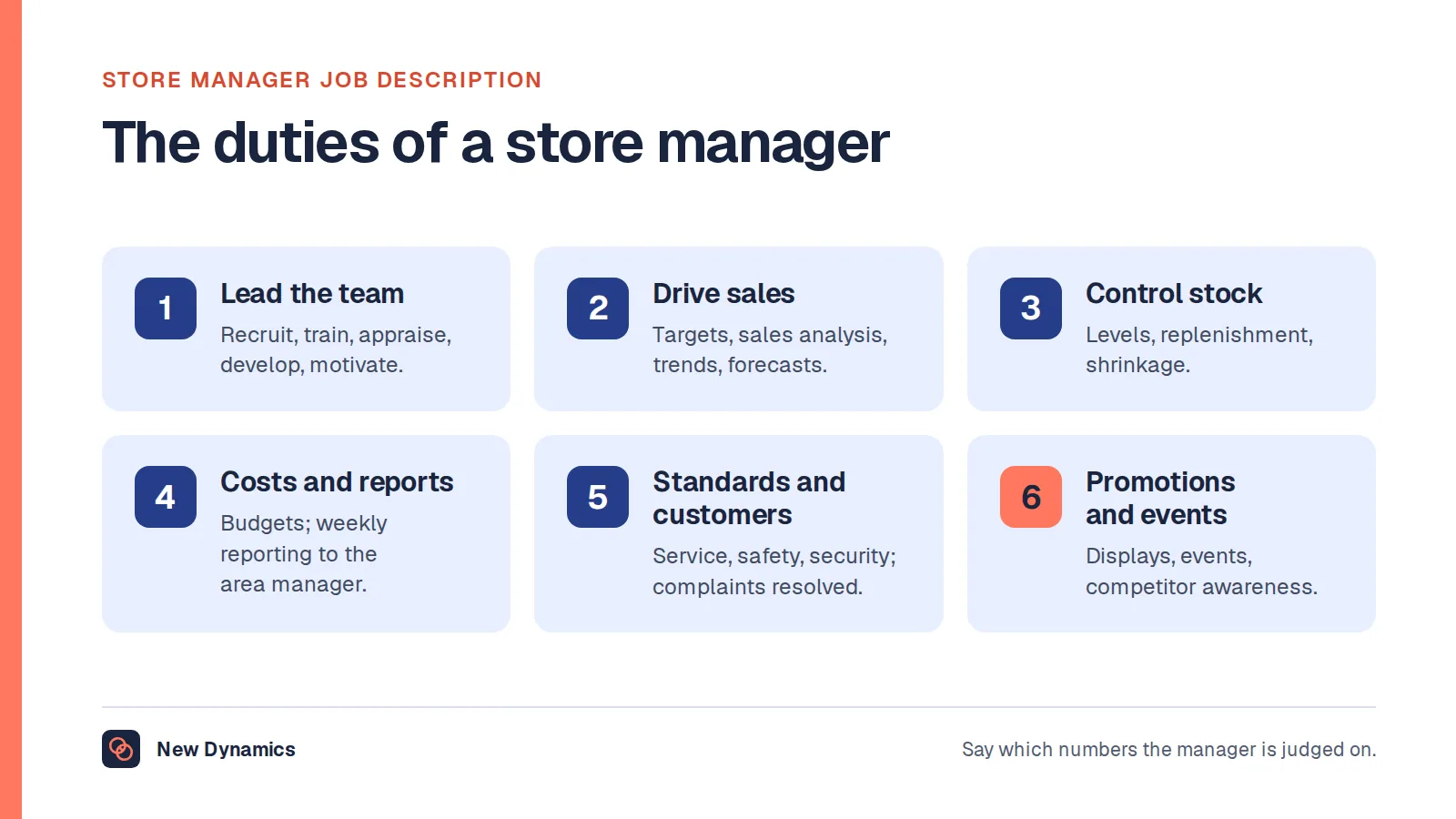
- The store manager. Accountable for the store's sales, costs, people and standards; our store manager job description covers the role, and larger stores add assistant and deputy managers.
- Behind the floor. Visual merchandisers, stockroom and delivery staff, loss prevention, click-and-collect and online fulfilment, and in head office the buyers, planners and category managers.
Say which layer an advert is for, and who the post reports to on a shift.

Layer one: the shop floor
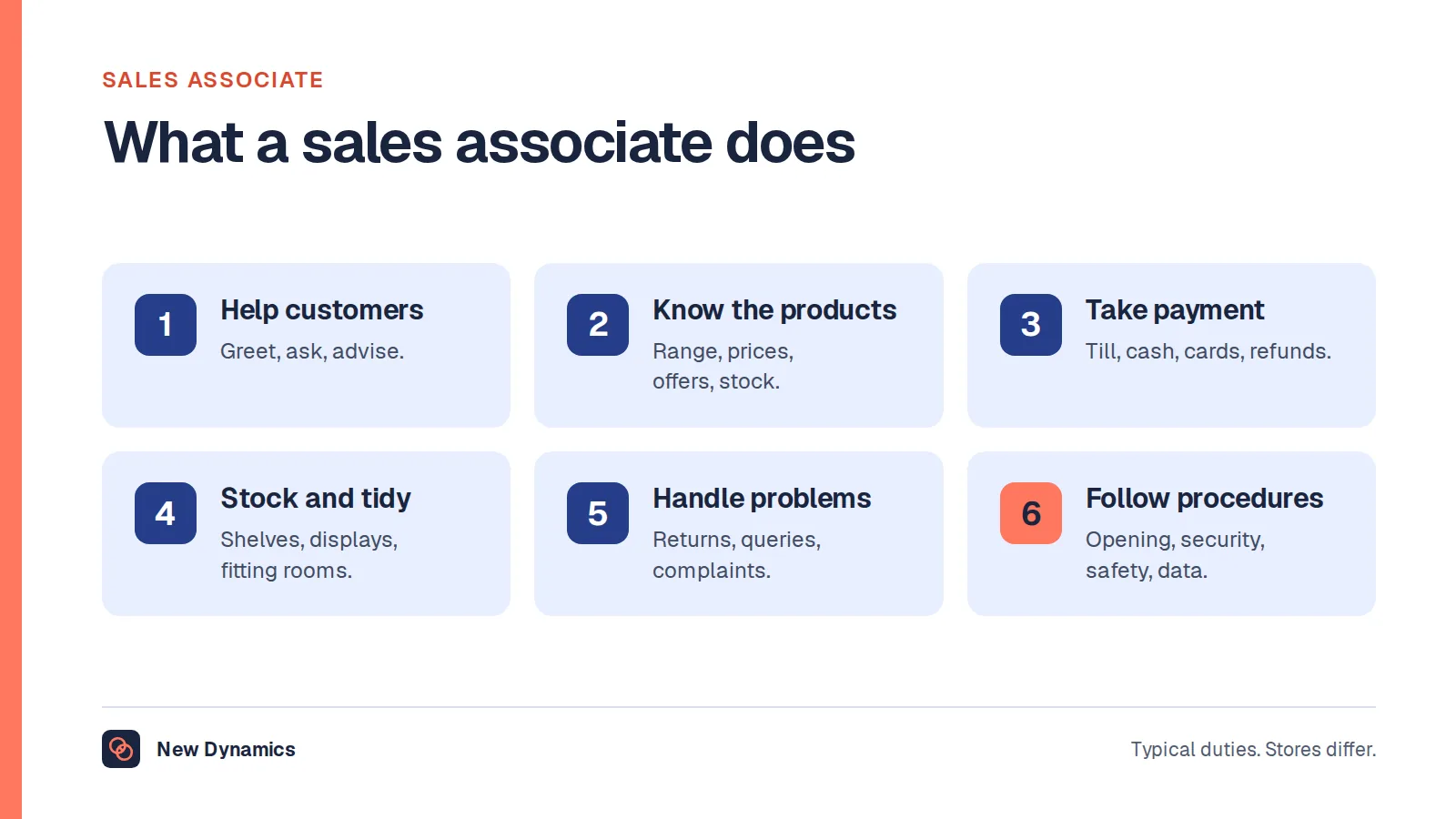
O*NET describes retail salespersons as selling merchandise to consumers, and its tasks give the duty list almost ready to paste into an advert: “greet customers and ascertain what each customer wants or needs”; “recommend, select, and help locate or obtain merchandise based on customer needs and desires”; “compute sales prices, total purchases, and receive and process cash or credit payment”; “answer questions regarding the store and its merchandise”; “maintain knowledge of current sales and promotions, policies regarding payment and exchanges, and security practices”; “demonstrate use or operation of merchandise”; “ticket, arrange, and display merchandise to promote sales”; “inventory stock and requisition new stock”; “exchange merchandise for customers and accept returns”; “watch for and recognize security risks and thefts and know how to prevent or handle these situations”; “clean shelves, counters, and tables”; and “open and close cash registers, performing tasks such as counting money, separating charge slips, coupons, and vouchers”.
The National Careers Service gives the British version: answer customer questions about products; serve customers at tills and handle returned goods and refunds; unpack deliveries, stock shelves and arrange displays; price up and rotate stock; take part in promotional events in store; and keep the store clean and tidy. It notes the environment may be physically demanding and a uniform may be required.
Grouped for an advert, that is five duties: serve customers, know the products, take payment, keep the floor stocked and presentable, and protect the stock.

Layer two and three: supervisors and managers
O*NET's first-line supervisors of retail sales workers “directly supervise and coordinate activities of retail sales workers”, with duties that “may include management functions, such as purchasing, budgeting, accounting, and personnel work, in addition to supervisory duties”. Its tasks include directing and supervising employees engaged in sales, inventory-taking and reconciling cash receipts; examining merchandise to ensure it is correctly priced and displayed and functions as advertised; monitoring sales activities to ensure customers receive satisfactory service; instructing staff on how to handle difficult and complicated sales; assigning employees to specific duties; keeping records of purchases, sales and requisitions; planning and preparing work schedules and keeping time records; reviewing inventory and sales records to prepare reports; and establishing policies, goals, objectives and procedures for the department.
The National Careers Service retail manager profile describes the layer above: manage and motivate a retail team to increase sales; track stock and negotiate prices with wholesalers; organise sales promotions and in-store events; deal with queries, complaints and feedback; analyse sales figures and forecast future trends; control budgets and report to company executives; recruit, train and supervise staff; and put security measures in place to protect against fraud and theft.
The practical line between the two: a supervisor runs the shift, a manager runs the store. If the advert mentions budgets, forecasts and recruitment, it is a manager's job and should be paid and titled as one.
What a retail advert must state
These are the six things candidates ask about and adverts omit.
- The hours and the rota. Contracted hours, the shift pattern, earliest start and latest finish, and how far ahead the rota is published. This is the single biggest cause of early leaving in retail.
- Weekends, evenings and peak trading. Say plainly what is expected, including the restrictions on leave in the busiest weeks.
- The physical side. Standing for a shift, lifting, ladders, cold stores, working a stockroom.
- Age-restricted sales and training. Where the store sells alcohol, knives, solvents or similar, say that refusal training is required and that the role carries that responsibility.
- Uniform and discount. What is provided, what the worker buys, and what the staff discount actually is.
- December, or the sector's equivalent peak. The retail year is not flat, and pretending it is loses people in week three.

Two templates
Shop floor
Job title: Sales Assistant (or Retail Assistant, Sales Associate; add the department)
Reports to: Supervisor or Store Manager
Purpose: Serve customers well, keep the floor stocked, priced and presentable, take payment accurately and help the store trade.
Responsibilities: greet and help customers and find what they need; know the products, promotions, payment and exchange policies; operate the till, take payment, handle refunds and exchanges; replenish, rotate, price and display stock; keep the floor and stockroom clean and safe; follow security and loss-prevention procedures; take part in promotions and stocktakes.
About you: friendly and helpful with customers; accurate with money; reliable on the shifts the store needs; comfortable on your feet and lifting stock; no experience required and training provided.
Hours: [contracted hours, shift pattern, earliest start, latest finish, weekend expectation, rota notice].
Progression: the National Careers Service route runs to retail supervisor, departmental manager or store manager, or specialisms in after-sales customer service, visual merchandising or buying. Say which the business supports.
Supervisor
Job title: Retail Supervisor (or Team Leader, Duty Manager)
Reports to: Store Manager
Purpose: Run the shop floor shift by shift so that customers are served, standards are kept and the team knows what to do.
Responsibilities: direct and support the team on shift and assign duties; open and close the store and hold keys; handle escalated customer questions and complaints; coach staff on difficult sales and on standards; check pricing, displays and stock levels; reconcile cash and complete shift records; prepare rotas or contribute to them; support recruitment, induction and training.
About you: experience on a shop floor; calm with customers and confident with a team; accurate with cash and records; available for the shift pattern.
Keeping retail staff
Retailers lose people to rotas, to being left alone on a bad shift and to never hearing that progression exists. Four things help more than a pay rise the business cannot afford:
- Publish the rota further ahead and protect agreed days off.
- Never leave a new starter alone on the floor in their first week; name the person they can ask.
- Tell every shop-floor starter the route to supervisor and what it takes, at induction rather than at exit.
- Ask the leavers what happened and fix the pattern rather than the individual case.
Frequently asked questions
What are the main duties in a retail job description?
On the shop floor: greeting and helping customers, knowing the products and promotions, computing prices and processing payment, ticketing, arranging and displaying merchandise, inventorying and requisitioning stock, handling exchanges and returns, watching for security risks, keeping the area clean, and opening and closing the till. The US occupational database lists all of these among the tasks of retail salespersons.
What is the difference between a retail assistant, a supervisor and a store manager?
The assistant serves customers and keeps the floor working; the supervisor runs the shift, assigns duties, handles escalations and reconciles cash; the store manager is accountable for sales, budgets, stock, recruitment, training and security across the store. The US occupational database notes that supervisory duties often include purchasing, budgeting, accounting and personnel work.
What should a retail job advert include?
Beyond the duties: contracted hours and the shift pattern, how far ahead the rota is published, weekend, evening and peak-trading expectations, the physical demands, any age-restricted sales responsibility and training, uniform and staff discount, and the route to supervisor or manager.
What qualifications do you need for a retail job?
Usually none for shop-floor work. The National Careers Service lists college courses in retail skills, apprenticeships including the Retailer level 2, volunteering and direct application as the routes in, with training given on the job. Supervisory and management roles are usually filled on experience.
How do retailers keep shop-floor staff?
Mostly by fixing the rota: publishing it further ahead and protecting agreed days off. Then by making the first week supported rather than solitary, telling every starter that a route to supervisor exists, and acting on what leavers say.
Your next step: write the rota into the advert
- Say which of the four layers the job is, and who it reports to on a shift.
- Use the duty list for that layer rather than a generic one.
- State hours, rota notice, weekends and peak-trading expectations.
- Name the progression route and who to talk to about it.
For a plan to keep the people you train, read and download our employee retention guide. The guide is free to read, and the PDF uses our short download form.
Want objectives, check-ins and development visible across stores and shifts, without pulling people off the floor? Book a New Dynamics demo and bring your current store rota. You can also email contact@new-dynamics.com.