TL;DR
- There is no test that tells you the right career. There is a method: identify your skills, interests, values and the life you want; explore careers against them; decide on a top option and backups; and set goals to test it. Prospects, the UK graduate careers service, sets out those four steps and says the model works for school leavers, graduates and career changers alike.
- Tools help with the first step. The National Careers Service skills assessment, forty questions in five to ten minutes, shows what motivates you and suggests careers to compare; it says there are no right or wrong answers and it is a way to understand yourself better.
- The test that matters is real work: shadowing, volunteering, a placement, a project in your current job. If you are already in a career that feels wrong, the same method applies, starting from what you have learned about yourself so far.
Nobody is handed the right career. Some people find it early by luck, some by trial and error, and a few never stop asking. The question how to know what career is right for you has an answer, but it is a method rather than a revelation: learn what you are like, look hard at what exists, decide, and then test the decision in real work before you bet years on it.
This article sets out that method as the UK's careers services describe it, the questions to ask yourself, the tools that help, how to try a career before committing, and what to do if you are already in one that does not fit. It is written for the person choosing, and for the managers and HR teams who help them.
Careers are decided in conversations as much as in tests. See how New Dynamics performance reviews bring goals, feedback and development into one fair discussion.
Four steps, not one answer
Prospects, the UK graduate careers service, describes a career plan as “an evolving strategy to guide your learning and progression throughout your working life” in its guide to how to choose a career. It sets out four stages: identify your skills and interests, explore career ideas, make a decision, and set achievable goals, and says the model “can be used by anyone - from school leavers to students, graduates and career changers”.
The point of a method is that it protects you from the two commonest mistakes: choosing on a whim, and never choosing at all. Prospects says career planning helps you “avoid impulsive decisions and recognise the right time to look for new career opportunities or develop new skills”.

Step 1: know what you are like
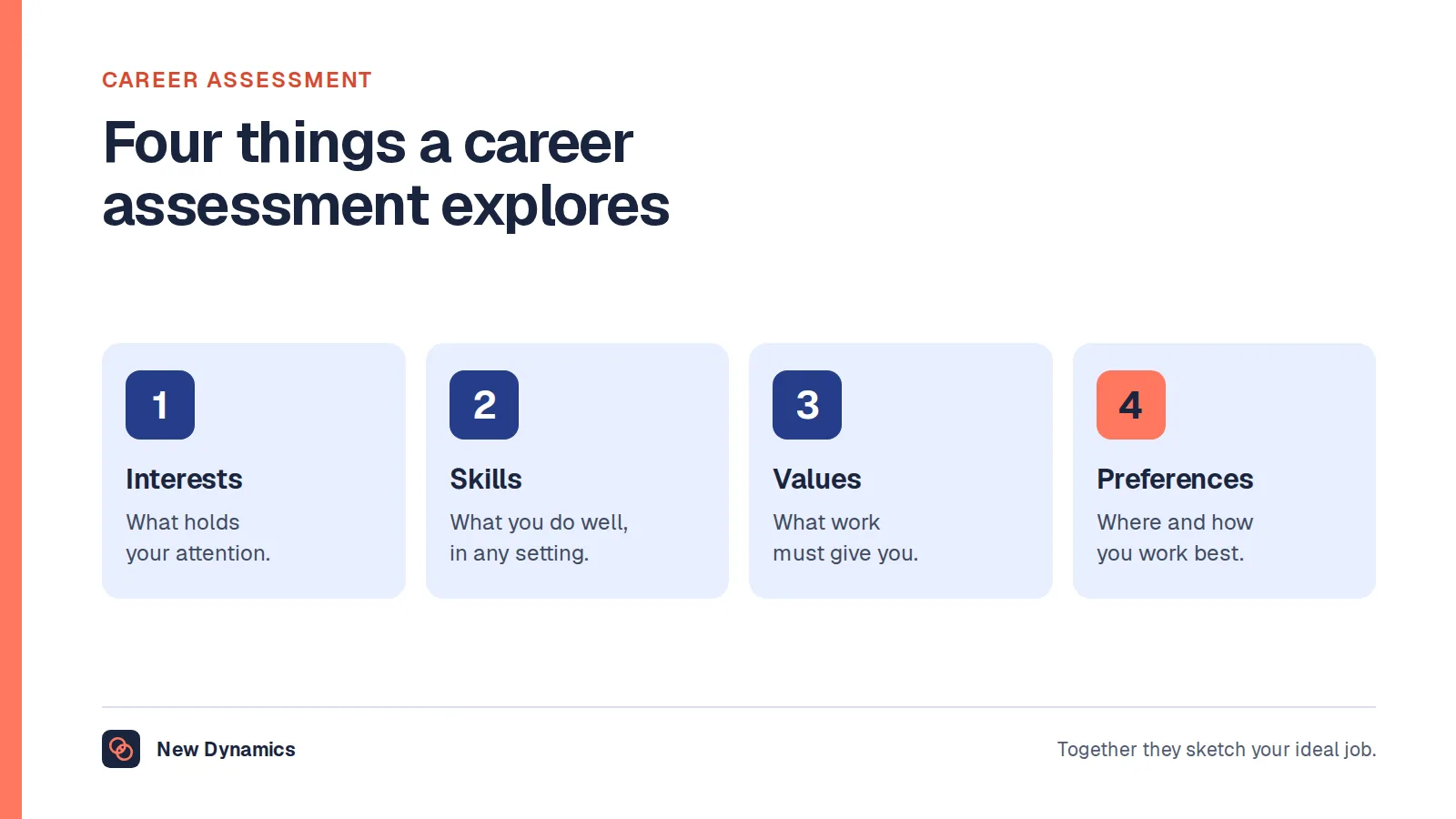
Prospects says the career choice “plays a major role in your long-term happiness and success”, and that to enjoy the job, stay motivated and fulfil your potential “you need to choose wisely”. Its advice is to list your key skills with real-life examples, and to reflect on six questions:
- What am I good at?
- What are my interests, motivations and values?
- What kind of work environment do I thrive in?
- What kind of lifestyle do I want?
- What do I want from my career?
- What is important to me?
Two of those are underrated. Environment and lifestyle, the questions about where and how you work, sink more careers than lack of talent: the person who loves the subject but hates the open-plan office, the shift pattern or the travel. Answer them honestly, with examples from things you have actually done: school, work, volunteering, hobbies. The evidence of what you enjoyed and did well is more reliable than what you think you should like.
Tools that help with step 1
The National Careers Service skills assessment asks 40 multiple-choice questions in five to ten minutes about things you like to do or are good at, shows what motivates you and gives career suggestions to compare. The service says: “There are no right or wrong answers when doing a skills assessment. It's a way to understand yourself better and help you think about your next step.” It suggests using one to find out what motivates you, to work out careers that do not interest you, and to see what you can do with the skills you have.
Prospects likewise suggests practice psychometric tests or its job match quiz for people who struggle to identify their strengths. Our guide to the career assessment test explains what these tools measure and how to choose one. Treat every result as a prompt for the next question, not a verdict.
Step 2: explore what exists
Most people choose from the dozen careers they happen to know about. Prospects' second step is to research the job market and narrow down paths that match your interests. It suggests browsing job profiles, which “may introduce you to some less obvious career paths where your skills and qualifications could be useful”, listening to podcasts, reading real job postings and watching day-in-the-life videos, and it describes three overarching sectors: private, public and not-for-profit.
Then shortlist. Prospects advises compiling around five to ten jobs and weighing each on career development, employment outlook, entry requirements, the job description, related jobs, salary and conditions, and training. Add your own criteria from step 1: environment, hours, location, the people you would work with. The National Careers Service job profiles, which this site draws on for its job descriptions, give the tasks, skills, routes and hours for hundreds of careers; our job description guides show what the work looks like from the employer's side.
Step 3: decide, with backups
Prospects' third step is to combine what you have learned about yourself with what you have found about the options, and choose a top option and a couple of strong backups. Its decision questions include: Will I enjoy doing the job every day? Does it meet most of my preferences? Do I have the right skills? Does the company fit with my values? Are there clear paths for advancement? Are there location, financial or skills limitations to take into account?
Notice the word most. No career meets every preference. The right one meets the ones that matter most to you, which is why step 1 comes first.

Step 4: test it in real work
A decision on paper is a hypothesis. Prospects' fourth step is to set achievable goals, and its second step already points to the way to test them: work experience and internships, work shadowing and volunteering, which “help you to gain an insight into the areas you're interested in before committing yourself to a certain career path”.
The cheapest tests come first.
- Talk to three people who do the job. Ask what a bad week looks like, not just a good one.
- Shadow for a day if the employer allows it.
- Do a slice of the work: a volunteer role, a short course with a practical project, a freelance job, a stretch task in your current role.
- Take a placement, internship or entry-level job with a clear exit if it is wrong.
- Review after three months against the criteria from step 1.
If the test fails, you have not failed; the method has worked. Go back to the shortlist.
If you are already in the wrong career
The same four steps apply, with one advantage: you have data. Write down what you have liked and disliked about the jobs you have had, separating the work itself from the manager, the employer and the commute, which are often the real problem. Many people who think they need a new career need a new employer, or a different role in the same field. Our guide to career pathing shows how to map moves inside an organisation, and our career development guide covers planning the change.
For a change of field, the skills you have already are the starting point. Prospects notes that awareness of your skills highlights the gaps to fill; list the transferable ones with examples, identify the two or three you would need to add, and test the new field with a slice of real work before resigning from anything.
For managers and HR teams
People ask this question inside organisations as often as outside them, and the manager who helps answer it keeps more good people than the one who does not.
- Ask the step 1 questions in development conversations, not only at review time.
- Offer slices of work: secondments, project roles, shadowing across teams.
- Keep an honest map of the roles that exist, and how people have moved between them.
- Accept that some answers lead out of the door, and that a good leaver returns, refers and recommends.

Frequently asked questions
How do you know what career is right for you?
By method rather than by test: identify your skills, interests, values and the environment and lifestyle you want; explore careers against them and shortlist five to ten; decide on a top option and backups; then test the choice in real work through conversations, shadowing, volunteering or a placement, and review after a few months.
Is there a test that tells you which career is right for you?
No single test can. Tools such as the National Careers Service skills assessment show what motivates you and suggest careers to compare, and the service says there are no right or wrong answers. Use results as prompts for research and conversation, not as a verdict.
What questions should I ask myself when choosing a career?
Prospects suggests: What am I good at? What are my interests, motivations and values? What kind of work environment do I thrive in? What kind of lifestyle do I want? What do I want from my career? What is important to me? Answer with examples from things you have actually done.
How do I choose between two careers?
Score both against the criteria that matter most to you from step 1, then test the front-runner in real work: talk to people who do it, shadow, volunteer or take on a project. Keep the other as a backup. Prospects advises choosing a top option and a couple of strong backups rather than a single bet.
How do I know if I am in the wrong career?
Separate the work from the circumstances. If the tasks themselves, on a good day with a good manager, still leave you flat, the career may be wrong. If the problem is the manager, the employer, the commute or the pay, the fix is usually a move within the field rather than out of it.
Can I change career later in life?
Yes. Prospects says its four-step model applies to career changers as well as school leavers and graduates. Start from the skills and self-knowledge you already have, identify the gaps, and test the new field with a slice of real work before committing.
Your next step: one honest hour
- Answer the six step 1 questions in writing, with examples.
- Take the National Careers Service skills assessment or a similar tool, and compare its suggestions with your answers.
- Shortlist five to ten careers and read a job profile for each.
- Arrange one conversation with someone who does the front-runner.
For planning the development that follows, read and download our career development guide. The guide is free to read, and the PDF uses our short download form.
Want development conversations that help people find the right role inside your organisation? Book a New Dynamics demo and bring your current approach. You can also email contact@new-dynamics.com.