TL;DR
- A security guard, or security officer, protects people, premises and property. The Cambridge Dictionary describes the job as preventing people going into places without permission, transporting money or protecting goods from being stolen.
- The six main duties are access control, patrols, monitoring, incident response, reporting and helping people. Most of the job is prevention and observation. Very little of it is confrontation.
- In the UK, contracted security staff usually need a Security Industry Authority (SIA) licence, and the type depends on the activity. In-house guards usually do not, with exceptions such as door supervision.
Most people picture a security guard at the moment of drama: the chase through the shopping centre, the hand on the shoulder. Guards themselves will tell you that a good shift is one in which nothing happens, because they noticed the propped-open fire door, the unfamiliar van and the visitor without a badge before any of them became a problem.
This article gives a security guard job description, which also serves for a security officer: what the job is, the six main duties, the skills that matter, when a licence is needed in the UK, a template, wording for a CV or resume and a set of interview questions.
A new officer has a site, its procedures and its people to learn. See how New Dynamics onboarding brings tasks, early goals and manager conversations into a clear path for a new starter.
What does a security guard or security officer do?
The Cambridge Dictionary defines a security guard as “someone whose job involves preventing people going into places without permission, transporting large amounts of money, or protecting goods from being stolen”.
Security officer is another title for the same job. England's occupational standard for the role is called the professional security operative. Skills England sums up its purpose in one line: “To be an organisation's first line of defence.” The job roles that it lists show how wide the field is. They include security guard, security officer, door supervisor, CCTV operator, control room operative, mobile officer, loss prevention officer, event security officer and security receptionist.
The core of the work is the same everywhere: observe, deter, report and help. A guard is rarely there to fight crime. The job is to make trouble less likely, to notice it early and to bring in the right people when it happens.
Security guard duties and responsibilities: six
- Control access. Check identification and passes, sign visitors and contractors in and out, manage gates, barriers and deliveries, and challenge politely when something does not fit.
- Patrol. Walk or drive set and varied routes, check doors, windows, fences, lighting and alarms, and look for hazards as well as intruders.
- Monitor. Watch CCTV, alarm panels and access systems, within the limits of your licence and the site's data protection rules.
- Respond to incidents. Alarms, theft, trespass, disorder, fire, medical emergencies and accidents. Follow the site's procedures, call the emergency services when needed, and use the minimum intervention that the law and your training allow.
- Report and record. Keep the daily occurrence log, write clear incident reports, preserve evidence and hand over properly to the next shift.
- Help people. Give directions, assist visitors and staff, support evacuations and first aid, and be the calm, visible presence that makes people feel safe.
Some posts add specialist duties: searching bags or vehicles, key holding and alarm response, cash handling, lone working at night or running a control room.

Five skills of a good security officer
- Observation. Noticing what is out of place, and remembering details accurately.
- Communication. Clear speech on the radio and in person, and plain, factual report writing.
- Calm under pressure. Conflict management and de-escalation. The best officers talk situations down.
- Integrity and reliability. The post holder is trusted with keys, codes and empty buildings. Punctuality matters, because a late relief leaves a site uncovered.
- Customer service. On many sites, the security officer is the first person whom every visitor meets.
Physical fitness matters in proportion to the post. Patrols, stairs and long periods standing are common, so describe the real demands and consider reasonable adjustments for disabled applicants.
Licensing in the UK: when an SIA licence is needed
In the UK, the private security industry is regulated by the Security Industry Authority (SIA). Its guidance on finding out if you need an SIA licence opens with a warning: “If you work in the private security industry without an SIA licence you may be breaking the law.”
The rule turns on two things: the contract and the activity. The SIA explains: “You will need an SIA licence if the work you will be doing is part of a 'contract for services' and involves a 'licensable activity'.” Its example is an employer that is “a private security company that places you as a guard in a shop and then charges that shop a fee for your services”.
In-house staff are treated differently. The SIA says: “You do not usually need an SIA licence if you will be working 'in-house'.” That means being employed directly by the company that uses your services, such as a supermarket's own guard. There are two exceptions where a licence is needed either way: door supervision at licensed premises, and vehicle immobilising, which applies only in Northern Ireland.
The SIA describes five manned guarding licences.
- Security guarding. The SIA's definition: “You need a security guard licence to guard premises or property against damage, theft, unauthorised access or disorderly behaviour.”
- Door supervision. The same activities at licensed premises, meaning venues licensed to sell alcohol for consumption on the premises or to provide regulated entertainment. This licence also covers security guarding.
- Public space surveillance (CCTV). Using CCTV to identify people or monitor their activities, to guard against disorder or to protect people from assault.
- Cash and valuables in transit. Guarding property against damage or theft while transporting it in a vehicle designed for secure transportation.
- Close protection. Guarding people against physical assault or injury.
There is also a key holding licence, for work that involves keeping or controlling access to keys. Managers, supervisors and directors of businesses that supply security operatives under contract may need a licence too.
An employer should state the licence required in the job description, and check it before the first shift. This is a summary of SIA guidance. It is general information, not legal advice. Other countries, and American states, have their own licensing rules.

Security guard job description template
Adapt the wording to your site. Replace the text in square brackets.
Job title: Security officer
Reports to: [Security supervisor, facilities manager or site manager]
Location and hours: [Site]. [Hours per week] on a rota of [days, nights, weekends and public holidays]. [Lone working applies on some shifts.]
Purpose of the job: To protect the people, premises and property of [site], by preventing incidents where possible and responding calmly and correctly when they occur.
Main duties
- Control access to the site: check passes, sign in visitors and contractors, and manage gates, barriers and deliveries.
- Carry out internal and external patrols, and check doors, alarms, lighting and fire routes.
- Monitor CCTV, alarm and access control systems, in line with the site's data protection procedures.
- Respond to alarms and incidents following the assignment instructions, and call the emergency services when needed.
- Keep an accurate daily log, write incident reports and hand over to the next shift.
- Assist staff, visitors and the emergency services, including during evacuations.
- Report hazards and defects, and follow health and safety rules.
- [Specialist duties: searches, key holding, control room, first aid.]
Essential requirements
- [A current SIA licence of the type required, where the law requires one.]
- Clear spoken and written English, including report writing.
- A calm, polite and firm manner.
- A reliable record of attendance and timekeeping.
- The right to work, and the ability to pass the vetting that the site requires.
Desirable
- Experience on a similar site: [retail, corporate, construction, healthcare, events].
- First aid, fire marshal or conflict management training.
- A driving licence, for mobile patrols.
Conditions: [Hourly rate], [uniform and equipment provided], [holiday], [training and licence renewal support].
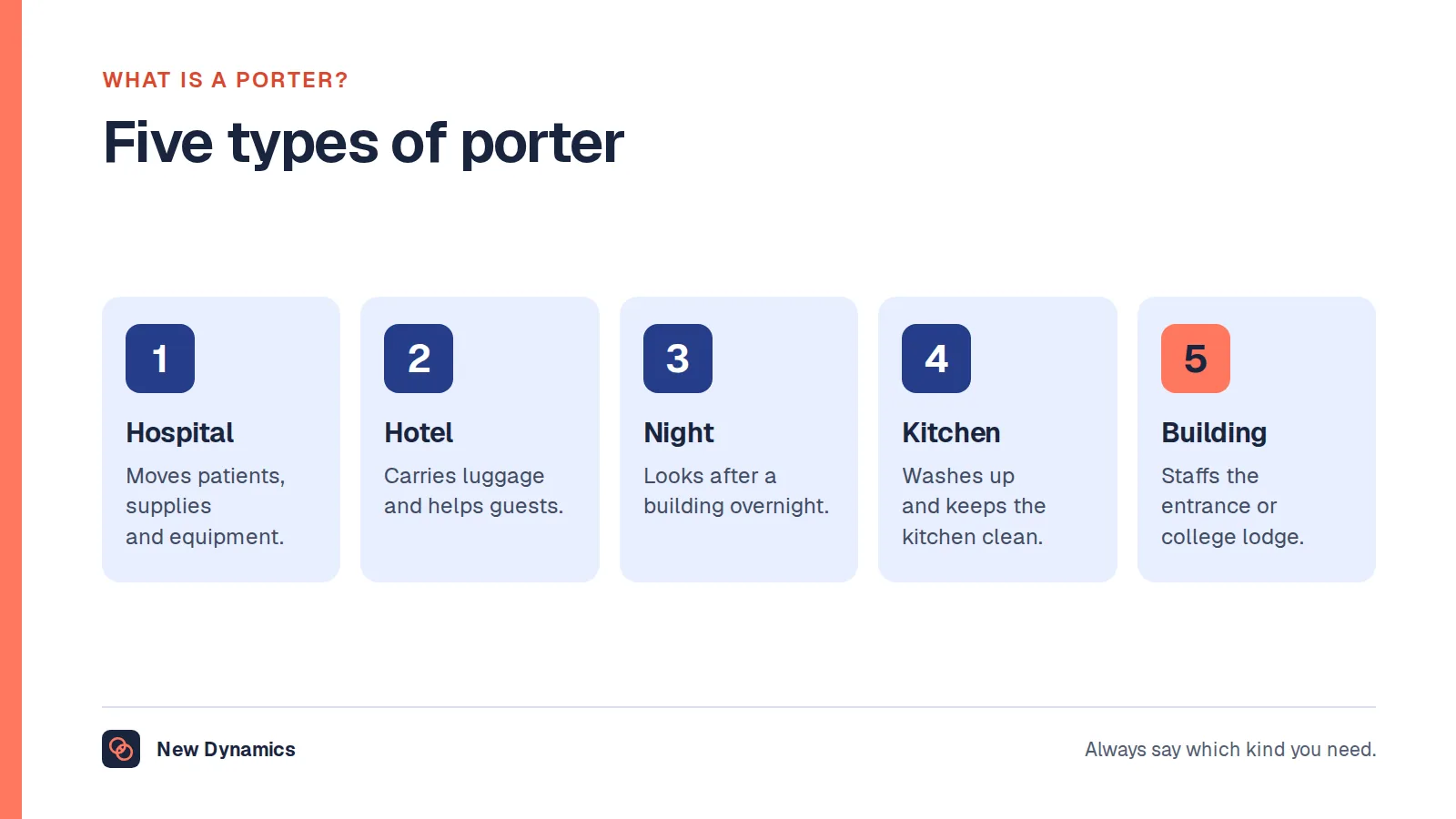
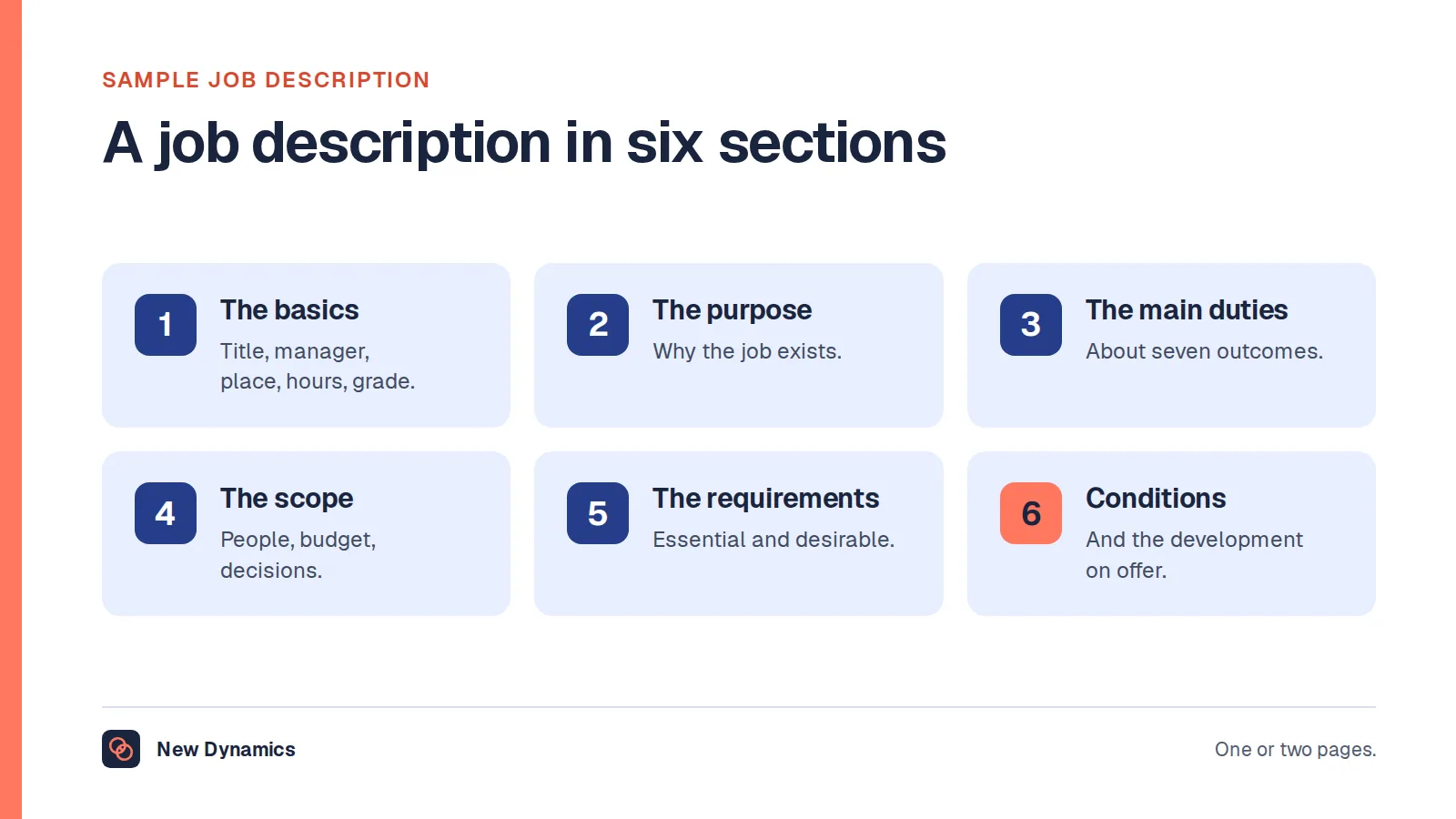
For the general format, see our sample job description. For another front-of-house support role, see our porter job description.
Security officer job description for a CV or resume
“Responsible for site security” is what every other applicant has written. Five details make yours stand out.
- The site. The kind and size of place: a distribution centre, a hospital, a city-centre office, an events venue.
- The scale. Shifts covered, team size, visitor numbers, the area patrolled.
- The systems. CCTV, access control, alarm and radio systems by name, and any control room experience.
- The incidents. One or two real examples, told factually: what happened, what you did and the result.
- Licences and training. Your SIA licence type, first aid, fire marshal and conflict management training.
For example: “Night security officer at a 40,000 square metre distribution centre. Controlled vehicle access for about 120 lorries a shift, monitored CCTV and wrote all incident reports.” Use your own real figures.

Eight interview questions for a security officer
For employers and for candidates who want to prepare. Ask every candidate the same questions, and score the answers against the duties.
- Walk me through how you would start a shift on a site that is new to you.
- A person without a pass insists that they have a meeting inside. What do you do?
- Tell me about a time when you calmed down an angry or aggressive person.
- You find a fire door propped open for the third night running. What do you do?
- Describe an incident report that you have written. What did you include, and why?
- You see a colleague breaking a site rule. How do you handle it?
- How do you stay alert on a long, quiet night shift?
- What are the limits of what a security officer may do when someone is suspected of theft?
Good answers show procedure, judgement and restraint. Be wary of the candidate who is keen on confrontation. Our list of interview questions to ask candidates explains how to score answers fairly.
Common mistakes
A title without a site. A night guard on a building site and a concierge officer in a bank need different people.
Leaving out the licence. State the type, and whether you will fund renewal.
Hiding nights and lone working. Candidates find out in the first week, and leave in the second.
Describing an enforcer. Words such as “tough” attract the wrong applicants. Describe observation, service and calm.
No mention of reporting. Writing is half the job. Test it at interview.
Forgetting welfare. Lone workers need check-in procedures, breaks and somewhere warm. Say what you provide.
Frequently asked questions
What is the job description of a security guard?
A security guard protects people, premises and property. The job covers controlling access, patrolling, monitoring CCTV and alarms, responding to incidents, keeping logs and writing reports, and helping staff and visitors, in line with the site's procedures and the law.
What are the duties and responsibilities of a security guard?
The six main duties are to control access, patrol the site, monitor security systems, respond to incidents and emergencies, report and record accurately, and help people. Some posts add searches, key holding, control room work or first aid.
What does a security officer do?
A security officer does the same job as a security guard. Employers often use the title where customer service and reception duties sit beside protection.
Do security guards need a licence in the UK?
Usually, if they are supplied under a contract for services. The Security Industry Authority says that a licence is needed when the work is part of a contract for services and involves a licensable activity. In-house guards usually do not need one, except for door supervision at licensed premises.
How do I describe security guard duties on a resume?
Name the kind and size of site, the scale of the work, the security systems that you used, one or two real incidents and how you handled them, and your licences and training. Keep it factual and use real numbers.
What questions are asked in a security officer interview?
Expect questions about access control, dealing with aggressive people, incident reports, staying alert on night shifts, handling a colleague who breaks rules, and the legal limits of a security officer's powers. Employers look for procedure, judgement and restraint.
Your next step
If you are hiring, copy the template, state the licence and the shift pattern, and add the two specialist duties that make your site different. If you are applying, rewrite your experience with the five details above and prepare an answer to each of the eight questions.
For the whole hiring process, from the job description to the offer, read and download our recruitment and selection guide. The guide is free to read, and the PDF uses our short download form.
Want every new starter to have clear tasks and goals from the first shift? Book a New Dynamics demo and bring your current approach. You can also email contact@new-dynamics.com.