TL;DR
- A SMART nursing goal names the part of your practice that will change, the evidence that will show it, the support you need, why it matters and a date.
- Measure what you control. Avoid targets that discourage incident reporting, and keep patient-identifiable details out of your evidence.
- Use the 30 examples as starting points. Agree the baseline, protected time and first check-in with your manager, preceptor or practice assessor.
A nursing goal such as “improve my clinical skills” is easy to agree and hard to review. These 30 SMART goal examples for nurses turn good intentions into clear agreements: what will change in your practice, what evidence will show it, what support you need and when you will check progress.
The examples cover nursing students and newly registered nurses, clinical skills and patient safety, communication, documentation, leadership and professional development. Pick one close to your role, then adapt the numbers, dates and support with your manager, preceptor or practice assessor. If your organisation needs one place to connect objectives, check-ins and appraisals, explore New Dynamics Goals & OKRs.
Before you copy a goal: every figure below is illustrative. It is not a clinical benchmark, a staffing standard or a customer result, and nothing here is clinical guidance. Follow your employer's policies, your scope of practice and your regulator's standards. The examples use dates in late 2026 and early 2027, so reset them if you are reading later.
What makes a nursing goal SMART?
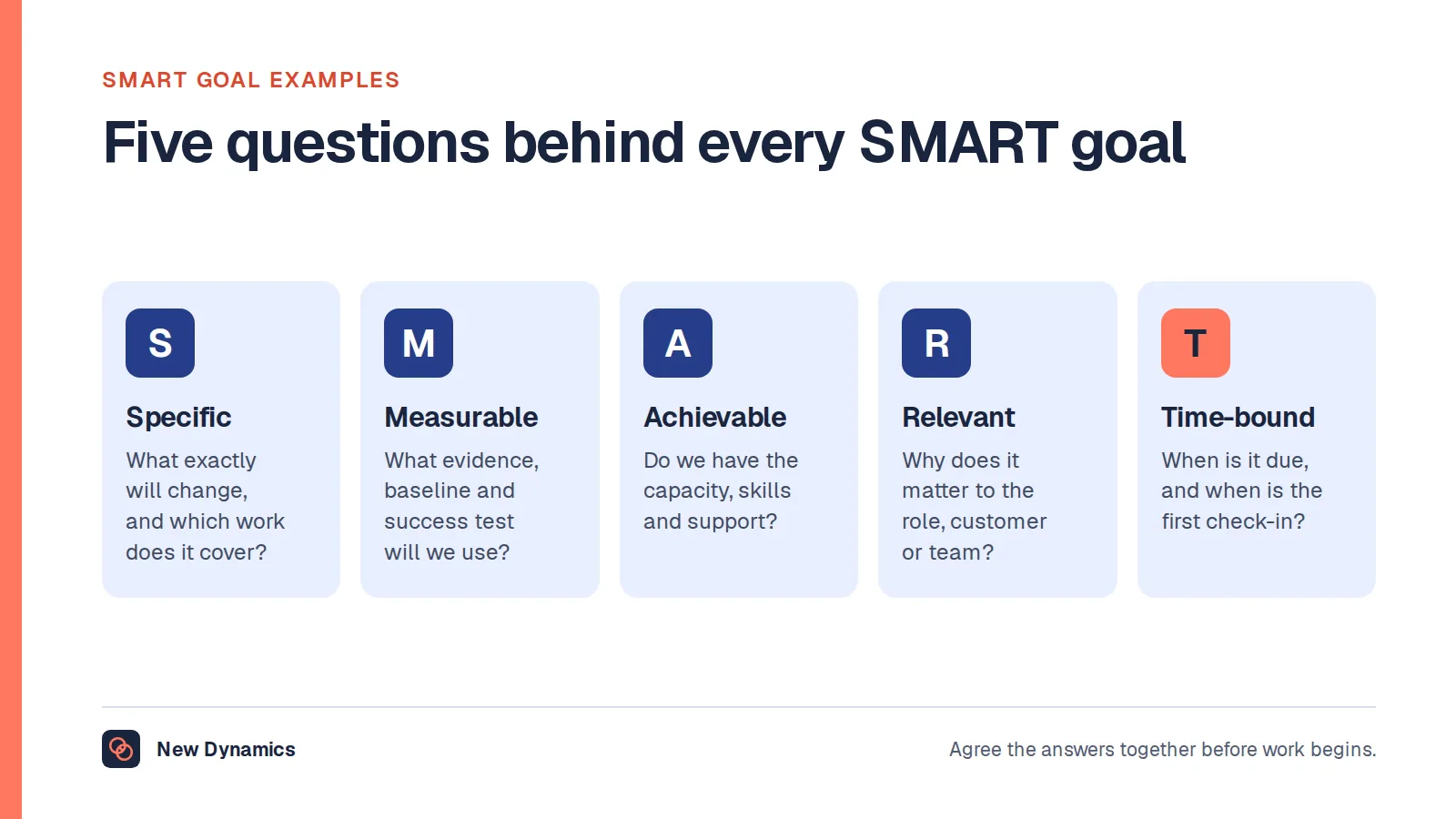
SMART means specific, measurable, achievable, relevant and time-bound. The CIPD performance management factsheet describes SMART objectives as one part of a wider process that includes regular feedback and development. That matters in nursing, where a well-worded goal still depends on the rota, supervision and the team around you.
- Specific: name the part of your practice that will change, such as handover, risk assessments or a clinical skill.
- Measurable: agree the evidence. It could be an audit result, an observed practice, a sign-off or feedback.
- Achievable: check staffing, protected time, training places and supervision before you agree the target.
- Relevant: link the goal to safe care, your role and your development plan.
- Time-bound: set a completion date and an earlier check-in.
Not every nursing goal needs a percentage. A competency signed off by an approved assessor, or six observed handovers, can be stronger evidence than a number nobody can verify.

Three safety checks before you set a nursing SMART goal
Nursing goals deserve more care than a typical workplace target, because a badly chosen measure can work against safe practice. Run these three checks first.
Measure what you control
Falls, pressure ulcers and infection rates depend on staffing, patient acuity, equipment and the whole team. One nurse cannot own those results alone. A fair individual goal names your own practice: assessments completed on time, checks carried out, teaching delivered. Shared outcomes belong in team goals with shared ownership.
Never reward silence
A goal to “reduce reported medication errors” can quietly discourage reporting. A safer goal strengthens the checking routine and keeps reporting open. Treat a rise in reports and near misses as useful information, and never use the number of reports as a personal performance target.
Keep patients out of your evidence
Use counts, anonymised audit samples and observation notes. The NMC's guidance on written reflective accounts tells nurses not to record information that might identify another person. Apply the same rule to goal records, check-in notes and anything you type into a performance system.
How to adapt these SMART goal examples for nurses
Start with the change in practice you want, rather than an activity that is easy to count. “Attend a study day” records attendance. “Use the new skill in practice and have it signed off” describes a change in capability.
Use this working sentence:
By [date], I will [specific change in my practice], moving from [checked baseline] to [agreed evidence of success], with [support: supervision, training or protected time], while maintaining [safety safeguard]. We will review progress [how often] using [evidence that identifies no one].
A few practical points will save trouble later:
- Check the baseline. Use the last audit, a first spot check or an initial observation. Do not guess.
- Agree who observes. If the evidence is observed practice, name the observer and book the time.
- Treat “achievable” as a rota question. If protected time is cancelled, the plan changed, and the goal should be reviewed openly.
- Name the safeguard. Faster documentation should never mean thinner records. Say so in the goal.
For each example below, the review line suggests what to discuss at a check-in.
SMART goal examples for nursing students and newly registered nurses
1. Complete your preceptorship competencies
By 26 February 2027, complete all the competencies in my preceptorship programme that apply to my ward, each signed off by my preceptor after observed practice. We will meet every two weeks for 30 minutes of protected time to plan the next sign-offs.
Review: count signed competencies at each meeting. If protected time is cancelled twice in a row, raise it with the ward manager rather than letting the date slip quietly.
2. Build confidence with observations and escalation
By 30 November 2026, record and score observations for my allocated patients in line with local policy, and escalate every score that meets the local trigger. My preceptor will review a sample of ten of my anonymised charts with me each fortnight.
Review: discuss scoring accuracy, timing and escalation decisions in the sample. Note one thing to keep doing and one thing to change.
3. Manage a full patient allocation
By 29 January 2027, move from caring for four patients with close support to the ward's usual allocation for my role with routine support. My preceptor and I will agree each step up in advance.
Review: after each stage, discuss what felt safe and what did not. Pause the increase when acuity or staffing makes it unsafe. A pause is a sound decision, not a failed goal.
4. Achieve your placement proficiencies
By the end of my placement on 18 December 2026, achieve the proficiencies agreed with my practice assessor at the initial interview. I will ask my practice supervisor for feedback at least once a week and record it in my practice assessment document.
Review: use the midpoint interview to check progress. If a proficiency is at risk, agree an action plan straight away instead of waiting for the final week.
5. Learn the medicines used most on your ward
By 11 December 2026, learn the purpose, usual cautions and monitoring needs of the 20 medicines used most often on my ward. I will explain five of them to my preceptor or supervisor each week, and continue to administer medicines only under the supervision and policy that apply to my role.
Review: keep a simple list of medicines covered. The evidence is a supervised discussion. It is not a claim of independent competence.
SMART goal examples for clinical skills and patient safety
6. Gain a new clinical skill competency
By 29 January 2027, complete the employer-approved training for intravenous cannulation, carry out the number of supervised practices required by local policy and be signed off by an approved assessor.
Review: track the training date, supervised practices and sign-off. Avoid a personal “first-attempt success rate” target, which can put pressure on you not to ask for help.
7. Strengthen your medicines checking routine
By 30 November 2026, follow every step of the local medicines administration procedure on every round, confirmed by three rounds observed by a senior colleague. I will report every error or near miss I notice through the incident system.
Review: talk through the observation notes. Treat reports as learning. The number of reports is not the measure of success.
8. Complete risk assessments on time
By 18 December 2026, complete falls and pressure ulcer risk assessments for the patients I admit within the timeframe in local policy, rising from 80% to 95% in the ward's monthly documentation audit. I will tell the nurse in charge when workload makes that impossible.
Review: look at the audit results for my admissions and the reasons for late assessments. A pattern linked to staffing is a team issue to escalate, not a personal failing.
9. Lead hand hygiene checks for your area
By 18 December 2026, complete the link nurse training for infection prevention, carry out the ward's monthly hand hygiene audit for three months and share each result in a two-minute update at the team huddle.
Review: confirm the audits and updates happened, and that the team agreed one improvement action each month.
10. Practise responding to a deteriorating patient
By 26 February 2027, take part in two simulation or skills sessions on recognising and responding to a deteriorating patient, using a structured communication tool in each scenario. I will ask the facilitator for written feedback.
Review: discuss the feedback and one change made in practice. Record the sessions as participatory learning if they meet your regulator's definition.
SMART goal examples for communication and patient experience
11. Give a structured handover every time
By 27 November 2026, use the ward's structured handover format for every patient I hand over. A senior colleague will observe six of my handovers and confirm that each covered the patient's current condition, risks and outstanding tasks.
Review: go through the six observation notes together. Agree one habit to keep and one to change.
12. Check understanding before discharge
By 18 December 2026, use the teach-back method when I explain discharge medicines or self-care, and record that understanding was checked in at least nine of every ten discharge records sampled in the ward audit.
Review: sample ten anonymised discharge records a month. Discuss what made teach-back difficult, such as time pressure or language needs, and what support would help.
13. Escalate concerns clearly
By 30 November 2026, use the SBAR structure (situation, background, assessment, recommendation) for every escalation call I make. I will ask two senior colleagues for brief feedback on how clear my calls were.
Review: discuss the feedback and one real call that went well or badly, without identifying the patient.
14. Act on patient feedback
By 29 January 2027, review the ward's patient feedback with the team each month, choose one communication theme and test one small change. My own change is to introduce myself by name and role to every patient at the start of each shift.
Review: check whether the change is happening and what later comments say. With small numbers of comments, look for themes rather than proof.
15. Prepare for difficult conversations
By 26 February 2027, complete an approved communication skills session on difficult conversations and apply it in practice. I will reflect on two conversations with my clinical supervisor, without recording details that could identify anyone.
Review: use supervision to discuss what changed. Consider turning one reflection into a written reflective account.
The graphic below rebuilds example 11 from a vague intention into a SMART goal.

SMART goal examples for documentation and time management
16. Write records at the time of care
By 30 November 2026, complete care records during or straight after care instead of at the end of the shift. A fortnightly spot check of ten entries with a senior colleague will show at least nine made within the timeframe in local policy, measured against the first spot check.
Review: compare each spot check with the first one. Discuss what gets in the way, such as device access or interruptions.
17. Finish on time without cutting corners
By 18 December 2026, reduce the shifts where I stay more than 30 minutes late to finish documentation from about three a week to one or fewer. I will plan priorities at the start of the shift and review them with the nurse in charge mid-shift. Documentation audit results must not fall.
Review: keep a simple log with reasons. If the cause is workload rather than organisation, that is a staffing conversation for the manager to own.
18. Use the electronic record properly
By 30 November 2026, complete the electronic patient record refresher and set up the approved templates for my ward's common assessments. The digital nurse lead will check that I use them correctly and that I never copy forward an old assessment without reassessing the patient.
Review: demonstrate two common tasks. Note anything in the system that slows safe recording and pass it on.
19. Put the patient's own goal in every care plan
By 29 January 2027, make sure every care plan I write or update names the patient's own goal or preference where they can express one. A monthly peer review of five anonymised plans will confirm it.
Review: discuss examples where this was hard, such as patients who lack capacity, and how the team involves families and advocates.
20. Plan your shift priorities
From 5 October to 27 November 2026, begin every shift with a short written priority plan for my patients and revisit it mid-shift. The nurse in charge will review one plan with me each week for six weeks.
Review: look at how priorities changed during the shift and why. The aim is sound judgement under pressure, rather than a perfect plan.
SMART goal examples for charge nurses and ward managers
21. Hold useful appraisals on time
By 31 March 2027, complete appraisal conversations with all 18 nurses in my team. Each will end with at least one agreed development goal and a check-in date within three months. I will book protected time into the rota at least four weeks ahead.
Review: track completed and booked conversations. Ask three team members whether the conversation was useful and what would improve it.
22. Run a short daily safety huddle
By 30 November 2026, run a ten-minute safety huddle at the start of at least nine in ten day shifts, covering staffing, patients at risk and one learning point.
Review: check the huddle log monthly and ask the team whether it helps. Change the format if it has become a routine nobody listens to.
23. Grow preceptor capacity
By 29 January 2027, increase the number of trained preceptors on the ward from four to seven. I will release three nurses for preceptor training and pair each with an experienced preceptor for their first new starter.
Review: confirm training dates, release from the rota and pairings. Ask new preceptors what support they still need.
24. Share learning from incidents
By 26 February 2027, share learning from incidents at each monthly team meeting in a blame-free summary. Every action will have an owner and a date, and at least 80% of actions will be closed by their agreed date.
Review: review open actions monthly. Keep incident numbers out of individual performance targets so that reporting stays open.
25. Take charge with support
By 18 December 2026, take charge of the ward for six shifts with a senior nurse available for support. After each shift I will complete a short debrief covering staffing decisions, escalation and delegation.
Review: discuss the debrief notes with my manager. Agree which decisions I am now confident to make alone and which still need backup.
SMART goal examples for professional development and wellbeing
26. Plan your CPD towards revalidation
By 31 March 2027, complete and record 12 hours of CPD relevant to my scope of practice, at least 8 of them participatory. For each activity I will record the date, topic, hours, the most relevant part of the Code and my evidence.
Review: check the log every three months. The hours here are an illustrative pace towards the NMC's three-year requirement. Nurses outside the UK should use their own regulator's rules.
27. Write your reflective accounts early
By 29 January 2027, write two reflective accounts on the NMC form: one about a CPD activity and one about feedback I received. Each will explain what I learned, what I changed and how it relates to the Code, without identifying anyone.
Review: discuss both accounts with a registered colleague. Spreading accounts across the three years is easier than writing five in the final month.
28. Apply for a specialist course
By 26 February 2027, apply for a specialist module in my field starting in autumn 2027. I will shortlist courses by 30 November 2026 and agree study leave and funding with my manager by 29 January 2027.
Review: check each milestone on its date. If funding is refused, agree an alternative development route rather than dropping the goal.
29. Make supervision a habit
By 18 December 2026, attend three clinical or restorative supervision sessions, roughly one every six weeks, and bring one practice question to each.
Review: note attendance and whether the time was protected. Cancelled sessions are a rota issue to raise, not a reason to give up supervision.
30. Protect your breaks
From 5 October to 18 December 2026, take my full break away from the clinical area on at least eight of every ten shifts, handing over my patients before I go. I will log missed breaks with the reason and raise any pattern with the nurse in charge.
Review: look at the log together. Missed breaks are usually a staffing signal. They are rarely a personal failing.
Link nursing goals to appraisal, revalidation and everyday feedback
A goal written in September and read again at next year's appraisal has done very little. Short, regular check-ins keep it useful. Our one-to-one meeting guide offers a simple agenda that a preceptor or ward manager can adapt.
In the UK, goals can also do double duty. The NMC's CPD requirement is 35 hours of CPD relevant to your scope of practice in the three years since you last renewed or joined the register, including at least 20 hours of participatory learning. The NMC also asks for five written reflective accounts in the same period. Planning that learning as SMART goals spreads the work and gives your reflective discussion something concrete to draw on.
Choose development that fits your practice. The RCN's CPD guidance notes that mandatory training unrelated to your practice, such as fire safety, cannot count towards those hours. Every goal should also sit comfortably with the Code.
Nurses often receive feedback from more than one person: a line manager, a preceptor, a clinical supervisor and a practice educator. Agree who contributes evidence to each goal. If your organisation manages this across many wards, see how New Dynamics supports multi-manager reviews, continuous feedback and performance reviews that bring the year's evidence into one conversation.

Common mistakes with SMART goals in nursing
Turning a team outcome into one nurse's target. A ward's falls rate reflects staffing, environment and patient mix. Give individuals goals about their own practice and hold outcomes as a team.
Counting courses instead of changed practice. A certificate shows attendance. A sign-off, an observation or an audit shows that practice changed.
Ignoring the rota. A goal that needs protected time is only achievable if the time is booked. Review the goal when the plan changes.
Setting targets that punish reporting. If fewer reports looks like success, people stop reporting. Measure the process and the learning instead.
Changing the target silently. Record why a date or measure moved. A clear history makes the appraisal conversation fairer for everyone.
Frequently asked questions
What is an example of a SMART goal for a nurse?
A useful example is: “By 27 November 2026, use the ward's structured handover format for every patient I hand over, confirmed by six handovers observed by a senior colleague.” It names the practice, the evidence, the support and the date. The details are illustrative, so agree your own with your manager or preceptor.
What are good SMART goals for nursing students?
Good student goals link to the proficiencies agreed with your practice assessor. For example, achieve the agreed proficiencies by the end of the placement, ask your practice supervisor for feedback at least once a week and record it in your practice assessment document. Keep every goal within the supervision rules for your programme.
How many SMART goals should a nurse have?
There is no set number. Two or three meaningful goals for a review period are usually easier to sustain alongside clinical work than a long list. Routine duties remain part of the role and do not each need a separate goal.
Can nursing SMART goals support NMC revalidation?
Yes. A goal can plan CPD that is relevant to your scope of practice, and the evidence and reflection you gather can inform your written reflective accounts and reflective discussion. The goal itself is not a revalidation requirement. Always check the current NMC guidance.
How do you measure a nursing goal without using patient data?
Use counts, anonymised audit samples, observed practice, competency sign-offs and feedback. Record how many, how often and to what standard. Leave out names, dates of birth, bed numbers and any detail that could identify a patient, relative or colleague.
Should nursing goals include patient outcomes such as falls?
Treat outcomes such as falls or pressure ulcers as team measures, because they depend on staffing, acuity and the environment. An individual goal should focus on practice the nurse controls, such as completing risk assessments on time and escalating concerns.
Your next step: agree one nursing goal and a first check-in
- Choose one example that matches a real need in your practice.
- Check the baseline using an audit, an observation or a first spot check.
- Agree the evidence, the support and the safety safeguard with your manager, preceptor or practice assessor.
- Book the first check-in before you finish the conversation.
For a worksheet to use in that conversation, read and download our SMART goals guide. The guide is free to read, and the PDF uses our short download form. For roles outside clinical practice, see our 50 SMART goal examples for 2026.
Leading appraisals across wards or services? Book a New Dynamics demo and bring a real goal-setting challenge. You can also email contact@new-dynamics.com.