TL;DR
- Baby boomers are people born in the surge of births that followed the Second World War. The US Census Bureau and Pew Research Center use the years 1946 to 1964, which makes boomers 62 to 80 years old in 2026.
- Pew warns that generational categories are not scientifically defined, and that labels can lead to stereotypes. “Boomer” is also used as a dismissive word for any older person.
- At work, age is protected by law in both the UK and the US. Offer later-career employees the same development, flexibility and honest conversation as anyone else, and plan early to keep what they know.
“OK, boomer.” Two words, and an entire generation is waved away as out of touch. The same generation is described elsewhere as loyal, hard-working and impossible to replace. Both pictures are drawn from a birth certificate, and neither tells you anything about the colleague who is sitting opposite you.
This article gives the definition of boomers, the birth years that official and research bodies use, the limits of the label, and what managers should and should not do with it. It draws on the Cambridge Dictionary, the US Census Bureau, Pew Research Center, GOV.UK and the US Equal Employment Opportunity Commission.
Every employee, at any age, deserves a conversation about what comes next. See how New Dynamics continuous feedback supports check-ins between managers and their teams.
What is a boomer?
Boomer is short for baby boomer. The Cambridge Dictionary defines a baby boomer as “a person who was born during the baby boom (= a large increase in the number of children being born) that happened in the UK and the US following the Second World War”.
Its entry for boomer adds a usage note that matters at work. It marks the word “sometimes disapproving”, and says that it is “also used to refer to an older person in general”. In other words, boomer has two meanings: a member of a particular generation, and a put-down aimed at anyone older than the speaker.
Which years are the baby boomers?
The most widely used definition is 1946 to 1964.
The US Census Bureau uses those years. Its article By 2030, all baby boomers will be age 65 or older says that boomers were born after World War II, from 1946 to 1964, and puts the size of the generation in the United States at an estimated 73 million.
Pew Research Center uses the same span. In Defining generations: where Millennials end and Generation Z begins, its president Michael Dimock calls the baby boomers “the only generation officially designated by the U.S. Census Bureau, based on the famous surge in post-WWII births in 1946 and a significant decline in birthrates after 1964”.
Dictionaries are looser. Cambridge's entries give “between approximately 1945 and 1965”, and one American entry gives 1947 to 1961. The timing of the boom was not the same in every country, so the American dates fit other places only roughly.
On the 1946 to 1964 definition, boomers turn between 62 and 80 during 2026. Some retired years ago. Many are still at work, as employees, owners, board members, consultants and volunteers.
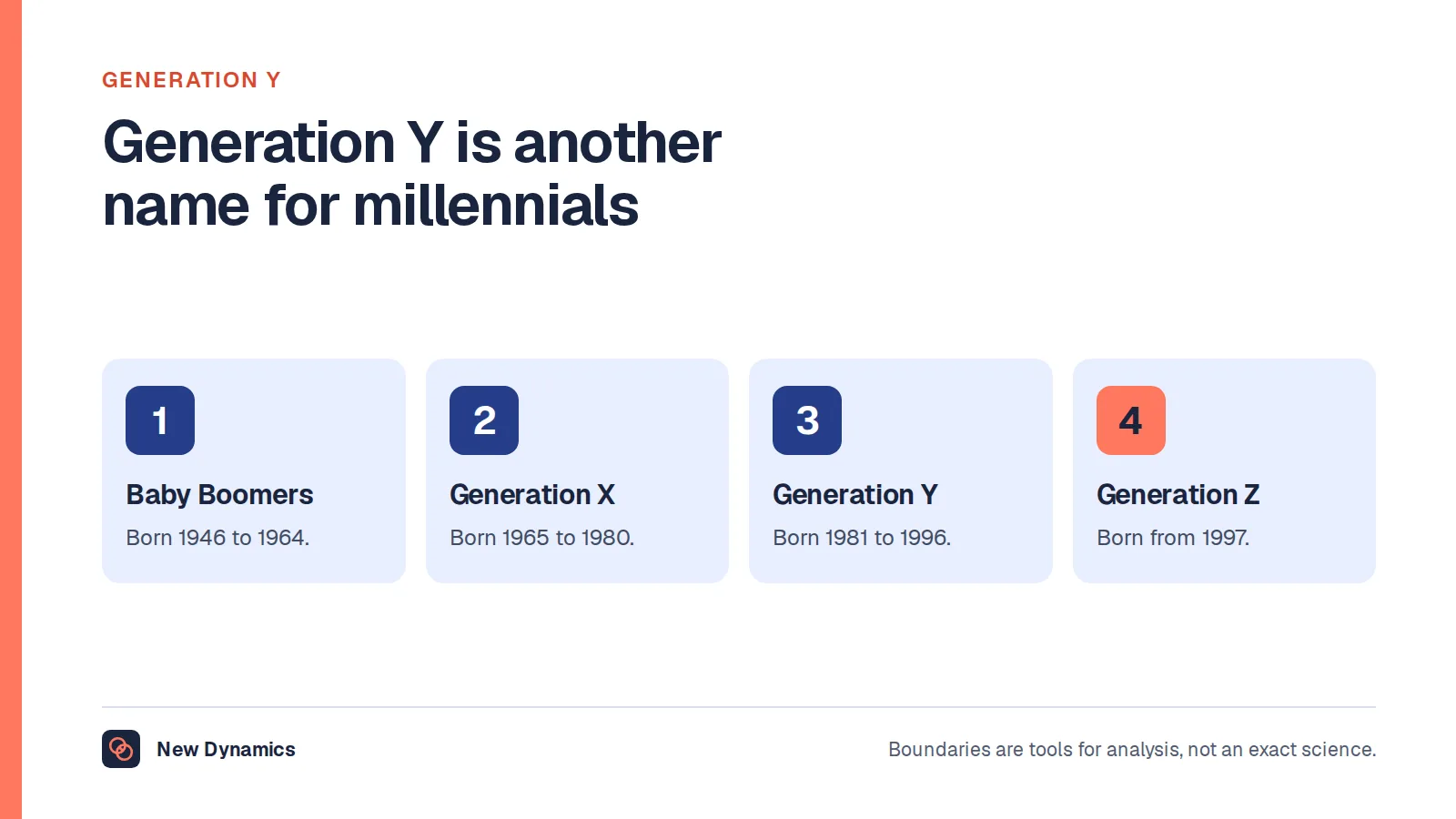
Four generations, using Pew's years
| Generation | Birth years used by Pew | Age reached in 2026 |
|---|---|---|
| Baby boomers | 1946 to 1964 | 62 to 80 |
| Generation X | 1965 to 1980 | 46 to 61 |
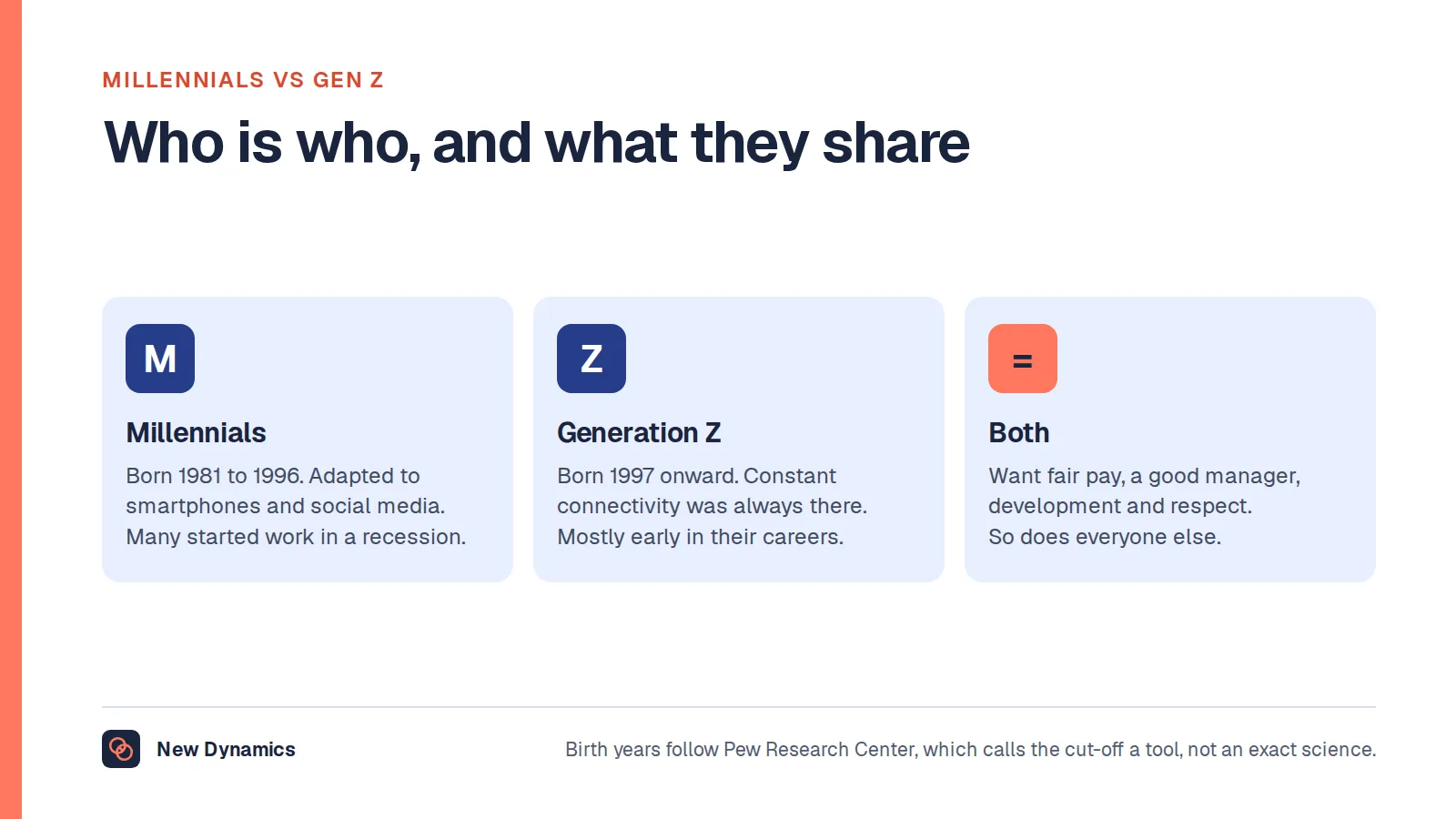
| Millennials (Generation Y) | 1981 to 1996 | 30 to 45 |
| Generation Z | 1997 onwards | Up to 29 |
For the next generation but one, see our guide to Generation Y.

Why the label is only a rough guide
Pew itself has become cautious about generational labels. Its article 5 things to keep in mind when you hear about Gen Z, Millennials, Boomers and other generations makes three points that every manager should know.
- “Generational categories are not scientifically defined.” The boundaries are not precise, definitive or universally agreed.
- “Generational labels can lead to stereotypes and oversimplification.” Pew adds that all millennials or baby boomers are not the same.
- “People change over time.” What looks like a generational trait may simply be a stage of life.
A span of nineteen years covers people with very different lives. Someone born in 1946 started work in the early 1960s. Someone born in 1964 left school in the 1980s. They did not share a childhood, an economy or a first job market. Add differences of country, class, sex, education and health, and the phrase “what boomers want” stops meaning very much.
So treat lists of “boomer characteristics” with suspicion, including flattering ones. Pew does note one shared experience: baby boomers grew up as television expanded dramatically. That is a fact about their childhood. It is not a fact about how any one of them uses a laptop today.
Age and the law
Decisions that are based on someone's generation are decisions that are based on their age, and age is protected.
In the United States, the EEOC's page on age discrimination explains that the Age Discrimination in Employment Act “forbids age discrimination against people who are age 40 or older”. The law prohibits discrimination in any aspect of employment, including hiring, firing, pay, job assignments, promotions, layoff, training and benefits.
In the UK, GOV.UK's guide to working after State Pension age says: “You can usually work for as long as you want to. ‘Default retirement age’ (a forced retirement age of 65) no longer exists.” An employer can set a compulsory retirement age only if it can give a good reason, for example where the job requires certain physical abilities, or where the law sets an age limit.
The practical consequences are plain. Do not assume that someone is about to retire. Do not leave older employees out of training or promotion. Do not use “boomer” as a joke in the office. Our plain guide to the definition of discrimination at work explains the terms. This is general information, not legal advice.
Five things that later-career employees need from a manager
These are the same five things that everyone needs. They are listed here because older employees can be the ones who are left without them.
- Development. Keep offering training, stretch work and feedback. A person of 60 may have another ten years of work ahead.
- Flexibility. Part-time hours, phased retirement and adjusted duties keep people who would otherwise leave. GOV.UK notes that employees can ask to work more flexibly or part time.
- Knowledge sharing. Ask experienced people to teach, mentor and document. Many are glad to be asked.
- Health support. Make adjustments readily, and without fuss. Needs change at every age.
- Choice about the future. Ask everyone, of every age, about their plans in the same way. “Where would you like to be in two years?” is a fair question for a person of 28 and a person of 62. “When are you retiring?” is not.

Keeping what people know: five steps
When a long-serving employee leaves, years of knowledge about customers, systems and past mistakes can leave too. That is a risk with any experienced person, whatever their age. Plan for it early.
- Identify the critical knowledge. Which roles depend on what one person knows? What would stop if they were away for three months?
- Ask about plans, and do not assume. Use the same open question for everyone in your regular conversations.
- Pair people up. Shadowing, joint projects and mentoring move knowledge better than documents do. Mentoring can run in both directions.
- Write down the essentials. Key contacts, how-to notes, the reasons behind decisions.
- Phase the handover. Reduced hours, a consulting period or a planned overlap with the successor.
Our article on talent development explains how succession fits into development more widely.

Common mistakes
Managing the label. Assuming that a person dislikes technology, resists change or is coasting to retirement because of a birth year.
Reverse stereotypes. “Boomers are loyal and hard-working” is still a stereotype, and it sets up younger colleagues as the opposite.
Training stops at 55. It is both unfair and wasteful.
The retirement question. Pressing someone about when they will go can amount to age discrimination. Ask everyone about their plans in the same way.
Letting “OK, boomer” pass as banter. Remarks about age can be harassment, whichever direction they travel in.
Waiting for the leaving date. Knowledge transfer takes months. Start before anyone has resigned.
Frequently asked questions
What is the definition of a boomer?
A boomer, or baby boomer, is a person born during the surge of births that followed the Second World War. The US Census Bureau and Pew Research Center use the birth years 1946 to 1964. The word is also used, often dismissively, for any older person.
What years are baby boomers?
The most widely used definition is 1946 to 1964, which is the span used by the US Census Bureau and Pew Research Center. Some dictionaries give approximately 1945 to 1965. The timing of the baby boom differed between countries.
How old are baby boomers in 2026?
On the 1946 to 1964 definition, baby boomers turn between 62 and 80 during 2026. The US Census Bureau has noted that by 2030 all boomers will be at least 65.
Why are they called baby boomers?
Because they were born during a baby boom: a large increase in the number of children being born. Pew describes a famous surge in births after the Second World War, beginning in 1946, and a significant decline in birth rates after 1964.
Is “boomer” an offensive word?
It can be. The Cambridge Dictionary marks boomer as sometimes disapproving, and notes that it is also used for an older person in general. At work, remarks that mock someone's age can amount to harassment, so it is best avoided.
Can an employer make a baby boomer retire?
In the UK, GOV.UK says that the default retirement age no longer exists, and that an employer who sets a compulsory retirement age must give a good reason. In the US, the law forbids age discrimination against people aged 40 or older. This is general information, not legal advice.
Your next step: check three things
- Look at who received training and stretch work last year, by age band. Is anyone being left out?
- Ask every member of your team, in the same words, where they would like to be in two years.
- Name the three people whose knowledge your team could least afford to lose, and start one handover activity for each.
For a method for that last step, read and download our succession planning guide. The guide is free to read, and the PDF uses our short download form.
Want regular, fair conversations with every employee, at every stage of their career? Book a New Dynamics demo and bring your current approach. You can also email contact@new-dynamics.com.