TL;DR
- Rank AI uses in HR by what happens if the output is wrong. Drafting and summarising are low risk because a person edits them. Answering policy questions is medium risk. Screening, scoring and anything touching pay or discipline is high risk and needs real human decision-making.
- Settle governance before the pilot, not after: what data the tool sees, where it goes, whether it trains on your people's information, who checks the output, and what employees are told.
- The honest measure is time saved on work that still had to be checked, not enthusiasm in the pilot. This article describes the United Kingdom position and is general information, not legal advice.
An HR team of four is offered a tool that will "transform HR with AI". The demonstration writes a job advert in nine seconds, summarises a policy and drafts a difficult email. All of that is genuinely useful. None of it is the part that will cause a problem.
This article sorts AI tools for HR by risk, sets out the governance to settle before any pilot, covers what to tell employees, and gives the questions that separate a serious vendor from a wrapper. It names no products and is general information rather than legal advice.
AI is most useful where the human work is already clear. See how New Dynamics continuous feedback keeps the evidence that any summary would have to be built from.
Where AI touches hiring specifically, our post on AI recruiting tools covers the oversight that cannot be delegated.
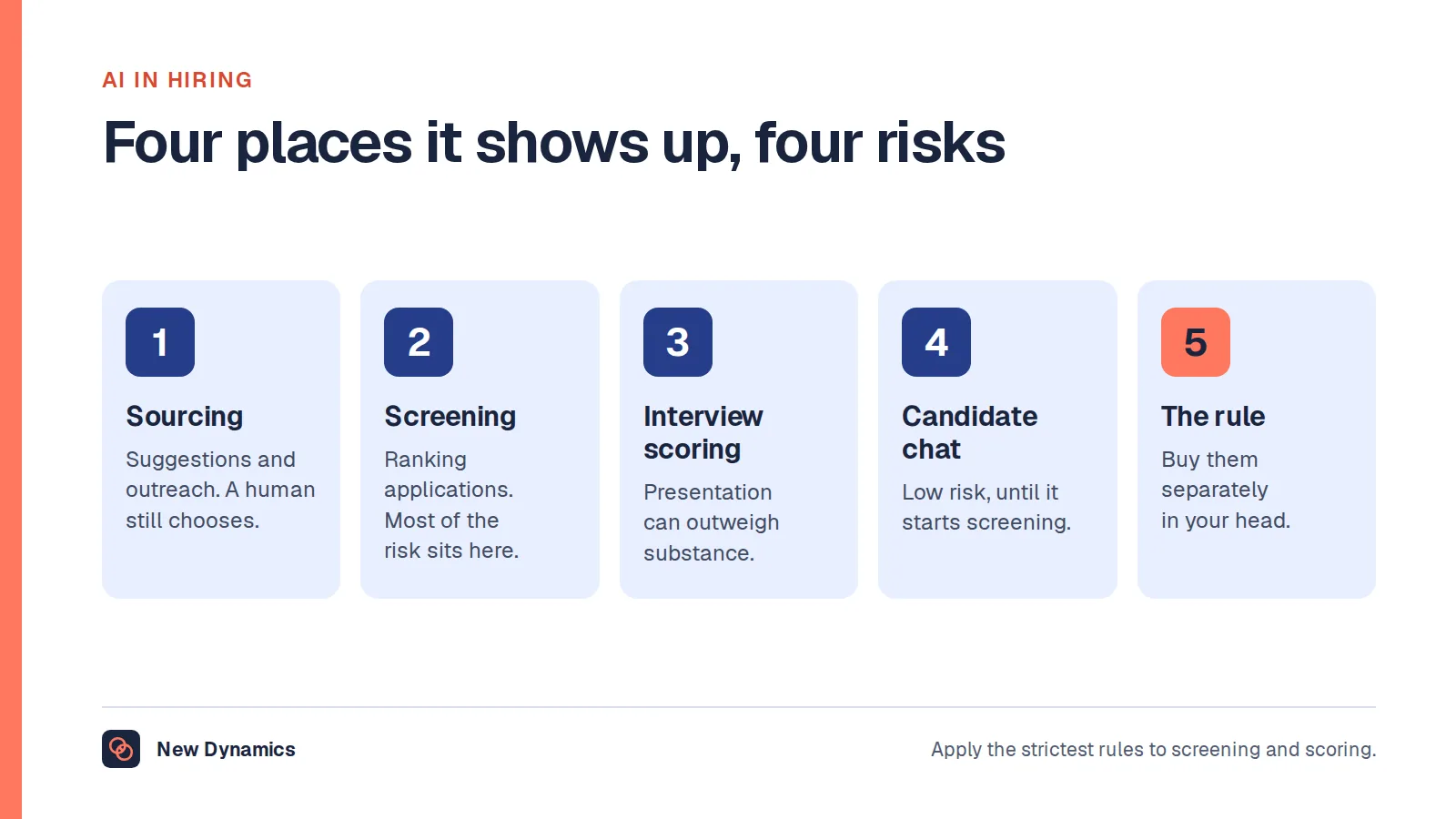
Rank uses by what happens if it is wrong

Drafting and summarising. Job adverts, policy first drafts, meeting summaries, rewriting something in plainer language. A person reads and edits every output, so the risk is low and the time saving is real.
Answering questions. A bot answering "how much holiday do I have left" or "what is the sickness policy". Medium risk: a confident wrong answer about pay or leave is a problem, so it needs good source content and a visible route to a human. Our post on knowledge base software covers getting that content right first.
Analysing patterns. Summarising survey comments, clustering themes, spotting attrition patterns. Medium to high risk, because the output looks objective and people act on it. Check the method, not just the chart.
Deciding about individuals. Screening, ranking, scoring, flagging performance or conduct. High risk, and the one to approach last and slowest.
That band has its own rules. The ICO describes decisions "fully made by automated means, without meaningful human involvement" as a distinct case, and treats human involvement as meaningful only where "a human has the power to disagree with the AI recommendations or predictions, and can overturn them".
A simple test: if the output goes straight to a person who is affected by it, without a human who can disagree in between, you are in the top band whatever the vendor calls it.
Governance to settle before the pilot

Six decisions, written down:
- What data the tool sees. Policies and anonymised documents are one thing; employee records, case files and health information are another.
- Where that data goes, who processes it, in which country, and whether it is used to train anything.
- Who checks the output, with the time and authority to disagree.
- What employees are told, in plain words, before the tool is in use rather than after.
- Retention and deletion, including prompts and outputs, which are records too.
- How you will stop, and who decides.
The ICO's guidance on AI and data protection frames this as applying the data protection principles across the whole lifecycle, with fairness considered "from problem formulation through decommissioning", and expects an impact assessment where the processing is likely to be high risk.
Where the time actually goes
The pilot result that matters is not "the team liked it". It is the time saved on work that still had to be checked.
Three measures worth taking before and after:
- Minutes per output, including review and correction. A draft that takes nine seconds and eleven minutes of fixing has saved nothing.
- Error rate on checked outputs, sampled honestly, including the plausible-but-wrong ones.
- What the team stopped doing with the time, which is the only way a saving becomes a benefit.
If nobody can name what the saved hours were spent on, the business case is a feeling.
What to ask a vendor

- What model is behind this, hosted where, and what happens to our data?
- Does any of our content train your models, by default or by setting?
- Show me a wrong answer. How does the product behave when it does not know?
- What does the audit trail record for an output that influenced a decision?
- What is the accuracy evidence, on data like ours rather than a benchmark?
- What happens at the end of the contract to prompts, outputs and any fine-tuned material?
- Which of our use cases do you recommend we do not use this for? A vendor with no answer has not thought about risk.
What usually goes wrong
- Starting with the high-risk use because it has the biggest headline saving.
- Feeding sensitive case files into a general tool with nobody checking the terms.
- No human in a position to disagree, which turns assistance into decision-making.
- Telling employees afterwards, which converts a reasonable tool into a trust problem.
- Measuring enthusiasm, not checked-output time.
- Pilots with no end date, which quietly become production without a decision.
Frequently asked questions
Where do AI tools genuinely help HR teams?
In drafting and summarising, where a person edits every output: job adverts, policy drafts, meeting notes, plain-language rewrites. The saving is real and the risk is low because nothing reaches an employee without human review.
What are the risky uses of AI in HR?
Anything that decides or scores people: screening applications, ranking candidates, scoring performance, flagging conduct, or answering questions about pay and leave without a human route. These need an impact assessment, a reviewer who can overturn the output, and clear communication to employees.
What should you settle before piloting an AI tool in HR?
What data it sees, where that data goes and whether it trains anything, who checks the output and with what authority, what employees are told, how prompts and outputs are retained, and the conditions for stopping. Write them down before the pilot rather than during it.
Do you have to tell employees that HR uses AI?
Be open about it. Explain where it is used and what it does, particularly where it touches decisions about people, and give a route to a human. Telling people after they discover it turns a defensible tool into a trust problem.
How do you measure whether an AI tool is worth it?
Measure minutes per output including review and correction, the error rate on sampled outputs, and what the team did with the time saved. Enthusiasm during a pilot is not evidence, and a draft that needs heavy correction can cost more than it saves.
Can AI write performance reviews?
It can draft wording from evidence you supply, which is useful for a manager who struggles to start. It cannot supply the evidence or the judgement, and a review assembled from generic phrasing is obvious to the person reading it. Keep the examples specific and the decisions human.
Your next step: sort your list by risk
- Write down every AI use someone has proposed, and put each in one of the four bands above.
- Start with the lowest band and measure minutes per checked output.
- Settle the six governance questions in writing before any pilot involving employee data.
- Decide now what you will tell employees, and when.
For a fuller governance structure across HR processes, read and download our AI in HR processes guide. The guide is free to read, and the PDF uses our short download form.
Want the evidence that any AI summary would have to be built from, in one place? Book a New Dynamics demo and bring your proposed use list. You can also email contact@new-dynamics.com.